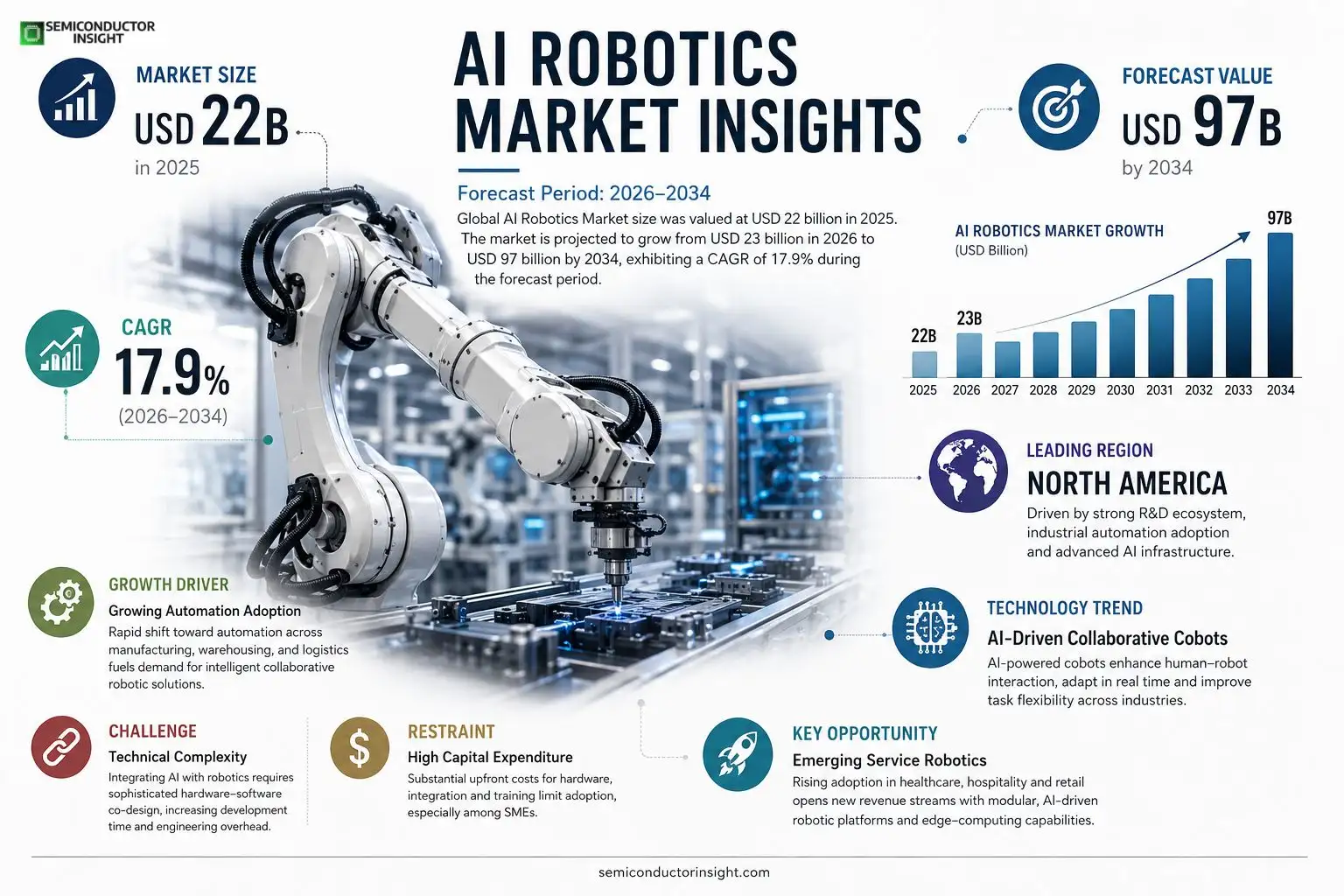
AI Robotics Market Insights
Global AI Robotics Market size was valued at USD 22 billion in 2025.The market is projected to grow from USD 23 billion in 2026 to USD 97 billion by 2034, exhibiting a CAGR of 17.9% during the forecast period.AI robotics combine artificial‑intelligence algorithms with physical robotic platforms such as manipulators, mobile units and collaborative cobots.
These systems integrate sensors, actuators and edge‑computing hardware to perceive environments, make autonomous decisions and execute tasks ranging from precision assembly to patient‑care assistance.The convergence of machine‑learning models with advanced actuation enables robots to adapt their behavior in real time.
The rapid expansion is driven by escalating automation investments across manufacturing, logistics and healthcare sectors.
Furthermore, breakthroughs in deep‑learning perception and cloud‑based robot‑as‑a‑service models lower entry barriers for midsize enterprises.Key playersincluding Boston Dynamics, iRobot Holdings, ABB Ltd., FANUC Corp., and NVIDIA Corp.are accelerating development through strategic partnerships and acquisitions; for example, NVIDIA’s collaboration with Toyota announced in March 2024 aims to embed generative‑AI capabilities into next‑generation autonomous robots.
MARKET DRIVERS
Growing Automation Adoption
AI Robotics Market is being propelled by a rapid shift toward automation across manufacturing, warehousing, and logistics. Companies are seeking to improve throughput while reducing labor costs, leading to increased deployment of collaborative robots equipped with advanced perception capabilities.
Advancements in AI Algorithms
Breakthroughs in machine‑learning models, especially in reinforcement learning and computer vision, enable robots to adapt to dynamic environments in real time. This technical progress expands use‑case applicability from structured assembly lines to unstructured service settings.
➤ “Intelligent robots are now able to make decisions on the shop floor that previously required human expertise.”
Combined with falling sensor costs, these drivers create a compelling value proposition, encouraging enterprises to invest in next‑generation robotic solutions.
MARKET CHALLENGES
Technical Complexity
Integrating AI capabilities into robotic platforms demands sophisticated hardware‑software co‑design, which can lengthen development cycles and increase engineering overhead. Smaller firms often lack the in‑house expertise to manage such complexity.
Other Challenges
Regulatory Uncertainty
Legislative frameworks for autonomous systems vary widely across regions, creating compliance risk and deterring investment in markets where rules are still evolving.
MARKET RESTRAINTS
High Capital Expenditure
Deploying AI‑enabled robots typically requires substantial upfront spending on hardware, integration services, and workforce training. This financial barrier can limit adoption, particularly among capital‑constrained small and medium enterprises.
MARKET OPPORTUNITIES
Emerging Service Robotics
Service sectors such as healthcare, hospitality, and retail are beginning to adopt intelligent robotic assistants for tasks ranging from patient monitoring to inventory management. These applications open new revenue streams for vendors.Within AI Robotics Market, demand for modular platforms that can be rapidly reconfigured for different tasks is rising, offering manufacturers a chance to differentiate through flexibility.Furthermore, the convergence of edge computing with AI allows robots to process data locally, reducing latency and enhancing privacyan attractive proposition for industries handling sensitive information.
AI Robotics Market Trends
Accelerating Adoption in Manufacturing
AI Robotics Market is witnessing a rapid shift as manufacturers integrate intelligent robotic platforms into production lines. Advanced perception sensors combined with machine‑learning algorithms enable robots to perform high‑precision assembly tasks while adapting to variations in real time. This shift reduces downtime, improves yield, and allows midsize factories to compete with larger players by leveraging cost‑effective automation solutions. Strategic collaborations, such as the partnership between NVIDIA and Toyota announced in early 2024, are embedding generative‑AI capabilities directly into autonomous robots, further shortening the time to deploy sophisticated automation across plant floors.
Other Trends
Robotics‑as‑a‑Service (RaaS) Expansion
RaaS models are gaining traction by offering subscription‑based access to AI‑enabled robotic fleets. Cloud‑based robot‑as‑a‑service platforms lower the capital barrier for companies in logistics and healthcare, allowing them to scale operations without large upfront investments. Providers integrate edge‑computing hardware with centralized AI models, delivering continuous software updates that enhance robot performance and security. This service orientation accelerates market penetration and creates new revenue streams for equipment manufacturers.
AI‑Driven Collaborative Cobots
Collaborative cobots equipped with AI are redefining human‑robot interaction in both industrial and service environments. By processing real‑time sensor data, these cobots can anticipate human motions, adjust force output, and safely share workspaces. Companies such as Boston Dynamics and ABB are launching next‑generation cobots that combine high‑dexterity manipulators with adaptive learning modules. The result is a measurable increase in task flexibility, enabling workers to focus on complex decision‑making while routine motions are delegated to intelligent machines.
COMPETITIVE LANDSCAPEKey Industry Players
AI Robotics Market Competitive Overview
AI Robotics Market is dominated by a cluster of technologically advanced firms that integrate deep‑learning algorithms with high‑precision actuation. Boston Dynamics leads the sector with its agility‑focused mobile platforms, while NVIDIA supplies the essential GPU‑accelerated AI engines that power perception and decision‑making across robotic applications. Traditional industrial automation powerhouses such as ABB Ltd. and FANUC Corp. have leveraged their extensive control‑system expertise to embed AI into collaborative cobots and high‑speed production lines, reshaping market structure toward integrated hardware‑software ecosystems. Strategic alliancesexemplified by NVIDIA’s partnership with Toyota to embed generative‑AI capabilitiesaccelerate consolidation, driving a competitive landscape where scale, data access, and algorithmic sophistication are paramount.Beyond the marquee players, a diverse set of niche innovators enriches the AI robotics ecosystem. iRobot Holdings continues to pioneer consumer‑grade autonomous navigation, whereas KUKA and Universal Robots focus on modular, easy‑to‑program collaborative solutions for mid‑size manufacturers. SoftBank Robotics, Hyundai Robotics, and Yaskawa deliver sector‑specific platforms ranging from service robots to advanced motion control. Cloud and service‑oriented entrants such as Microsoft Azure Robotics and Amazon AWS RoboRunner expand the market through robot‑as‑a‑service models, lowering entry barriers for midsize enterprises. These companies collectively broaden the value chain, fostering competitive differentiation through specialized applications in healthcare, logistics, and precision assembly.
List of Key AI Robotics Companies Profiled
- Boston Dynamics
- NVIDIA Corp.
- ABB Ltd.
- FANUC Corp.
- iRobot Holdings
- KUKA AG
- Universal Robots
- SoftBank Robotics
- Hyundai Robotics
- Yaskawa Electric Corp.
- Siemens AG
- Microsoft Azure Robotics
- Amazon AWS RoboRunner
- DJI Innovations
Segment Analysis:
| Segment Category | Sub-Segments | Key Insights |
| By Type |
|
Industrial Robots continue to dominate the AI robotics landscape because they integrate sophisticated AI perception with high‑payload actuation, enabling complex assembly tasks. • They are prized for reliability in harsh manufacturing environments. • Continuous AI model upgrades improve adaptive decision‑making, reducing downtime. • Partnerships between hardware manufacturers and AI specialists accelerate feature rollout, fostering ecosystem growth. |
| By Application |
|
Manufacturing remains the primary application driver as AI‑enabled robots perform precision assembly, quality inspection, and predictive maintenance. • Integration of vision‑based AI allows real‑time defect detection. • Adaptive learning models enable robots to switch tasks without extensive reprogramming. • Collaborative cobots augment human workers, fostering flexible production lines and faster product cycles. |
| By End User |
|
Large Enterprises drive adoption through scale, capital investment, and integration of AI robotics across multiple production sites. • They leverage extensive data ecosystems to refine robot learning loops. • Strategic alliances with AI cloud providers enable seamless model deployment. • Organizational focus on workforce reskilling supports harmonious human‑robot collaboration. |
| By Technology |
|
Machine Vision is a core enabler, allowing robots to perceive and interpret complex visual environments. • High‑resolution sensors paired with deep‑learning models deliver robust object recognition. • Continuous model refinement through edge‑computing reduces latency. • Vision‑centric AI accelerates adoption in quality control and autonomous navigation scenarios. |
| By Deployment Model |
|
Cloud‑Based (Robot‑as‑a‑Service) is reshaping market dynamics by lowering entry barriers and offering scalable AI capabilities. • Subscription models provide continuous access to the latest algorithms. • Centralized data aggregation improves collective learning across fleets. • Flexibility to switch between on‑premise and cloud resources supports diverse operational requirements. |
Regional Analysis: North America
United States
The manufacturing industry in North America is witnessing a significant transformation with the adoption of AI-powered robotics. Automation is enhancing efficiency, improving quality control, and reducing operational costs. Collaborative robots (cobots) are gaining traction, working alongside human workers to optimize production processes and address labor shortages.
AI robotics is revolutionizing healthcare through applications like surgical assistance, rehabilitation, and drug delivery. The increasing demand for minimally invasive procedures and personalized patient care is driving the adoption of sophisticated robotic systems. Expect to see more robots assisting surgeons with precision tasks and improving patient outcomes.
The logistics sector is leveraging AI robotics to streamline warehousing, transportation, and last-mile delivery. Autonomous vehicles, warehouse robots, and drone delivery systems are optimizing efficiency and reducing costs. The focus is on developing robust and reliable robotic solutions capable of navigating complex and dynamic environments.
AI robotics is playing an increasingly important role in defense and security, enabling tasks like surveillance, reconnaissance, and bomb disposal. Autonomous drones and robots are enhancing situational awareness and reducing risks to human personnel. The development of AI-powered defense systems is a key area of investment in North America.
Europe
Europe is witnessing steady growth in AI Robotics Market, driven by strong industrial foundations and government initiatives promoting technological innovation. Germany, France, and the UK are leading the way in adopting robotic solutions across various industries. The focus in Europe is heavily on industrial automation, particularly in sectors like automotive, aerospace, and electronics. There’s a significant emphasis on developing sustainable and energy-efficient robotic systems. While adoption rates are generally lower than in the US, the European market presents a considerable long-term opportunity. There is a strong emphasis on human-robot collaboration and addressing workforce concerns related to automation.
Asia-Pacific
The Asia-Pacific region, particularly China and Japan, is emerging as a major player in AI Robotics Market. China’s massive manufacturing base and government support for technological development are fueling rapid growth. Japan’s expertise in robotics and automation further contributes to the region’s prominence. Key applications in Asia-Pacific include manufacturing, logistics, and elder care. The market is characterized by strong domestic demand and increasing investment in research and development. The focus in this region is on developing cost-effective robotic solutions and addressing the needs of an aging population.
South America
South America represents a growing market for AI robotics, with increasing adoption in industries like agriculture, mining, and logistics. Brazil and Argentina are the leading markets in the region. The demand for robotic solutions is driven by the need to improve efficiency and address labor shortages in these sectors. While the market is relatively nascent compared to North America and Asia-Pacific, it offers significant potential for future growth. Challenges include infrastructure limitations and the availability of skilled workforce.
Middle East & Africa
The Middle East & Africa region is witnessing increasing interest in AI robotics, driven by investments in infrastructure development and a growing focus on automation. Countries like Saudi Arabia and the UAE are leading the way in adopting robotic solutions in sectors like construction, logistics, and healthcare. The market is expected to grow significantly in the coming years, driven by government initiatives to diversify economies and promote technological advancement. Challenges include high initial costs and a limited supply of skilled labor.
Report Scope
This market research report provides a comprehensive analysis of the AI Robotics Market , covering the forecast period 2026–2034. It offers detailed insights into market dynamics, technological advancements, competitive landscape, and key trends shaping the industry.
Key focus areas of the report include:
- Market Overview: The report begins with an overview outlining its current market scenario, key growth indicators, and industry transformation drivers. It discusses macroeconomic factors, demand–supply balance, regulatory landscape, and the strategic role of semiconductors in powering advancements across industries such as automotive, telecommunications, consumer electronics, and industrial automation.
- Market Size & Forecast: Historical data and future projections for revenue, unit shipments, and market value across major regions and segments.
- Segmentation Analysis: Detailed breakdown by product type, technology, application, and end-user industry to identify high-growth segments and investment opportunities.
- Regional Insights: Insights into market performance across North America, Europe, Asia-Pacific, Latin America, and the Middle East & Africa, including country-level analysis where relevant.
- Competitive Landscape: Profiles of leading market participants, including their product offerings, R&D focus, manufacturing capacity, pricing strategies, and recent developments such as mergers, acquisitions, and partnerships.
- Technology Trends & Innovation: Assessment of emerging technologies, integration of AI/IoT, semiconductor design trends, fabrication techniques, and evolving industry standards.
- Market Drivers & Restraints: Evaluation of factors driving market growth along with challenges, supply chain constraints, regulatory issues, and market-entry barriers.
- Stakeholder Insights: Insights for component suppliers, OEMs, system integrators, investors, and policymakers regarding the evolving ecosystem and strategic opportunities.
Primary and secondary research methods are employed, including interviews with industry experts, data from verified sources, and real-time market intelligence to ensure the accuracy and reliability of the insights presented.
FREQUENTLY ASKED QUESTIONS:
What is the current market size of AI Robotics Market?
-> AI Robotics Market was valued at USD 22 billion in 2025 and is expected to reach USD 97 billion by 2034.
Which key companies operate in AI Robotics Market?
-> Key players include Boston Dynamics, iRobot Holdings, ABB Ltd., FANUC Corp., and NVIDIA Corp.
What are the key growth drivers?
-> Key growth drivers include escalating automation investments in manufacturing, logistics and healthcare, breakthroughs in deep‑learning perception, and the emergence of cloud‑based robot‑as‑a‑service models.
Which region dominates the market?
-> The reference does not specify a dominant region for AI Robotics Market.
What are the emerging trends?
-> Emerging trends include integration of generative‑AI capabilities, collaborative cobot deployments, and advanced edge‑computing hardware that enables real‑time adaptive robot behavior.

Get Sample Report PDF for Exclusive Insights
Report Sample Includes
- Table of Contents
- List of Tables & Figures
- Charts, Research Methodology, and more...
 Download Sample Report PDF