SiC Coated MOCVD Susceptor Market Insights
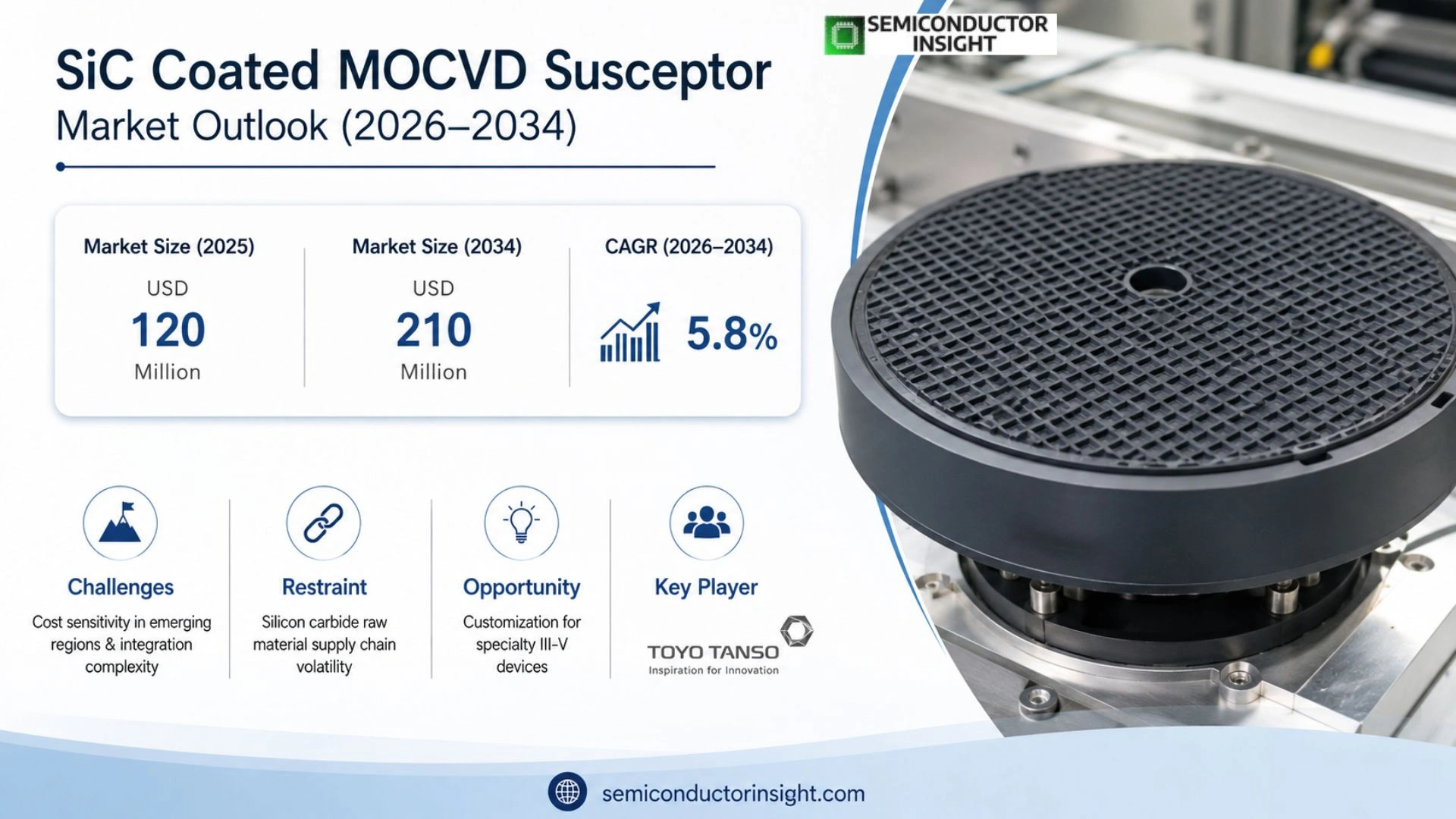
SiC Coated MOCVD Susceptor market size was valued at USD 120 million in 2025. The market is expected to increase from USD 130 million in 2026 to USD 210 million by 2034, exhibiting a CAGR of 5.8% during the forecast period.
SiC coated MOCVD susceptor is a specialized wafer holder coated with silicon carbide (SiC) used in Metal‑Organic Chemical Vapor Deposition (MOCVD) processes for epitaxial growth.
The market gains momentum because semiconductor manufacturers require higher thermal stability and chemical resistance for advanced device production. While demand for GaN‑based LEDs and power devices expands, cost pressures linked to SiC coating processes remain a challenge. Moreover, recent collaborations,such as the 2023 partnership between Toyo Tanso and a leading foundry on high‑temperature susceptor designs,highlight industry movement toward more durable solutions. Key players including SGL Carbon, Tokai Carbon, and Mersen continue expanding their product portfolios.
MARKET DRIVERS
Enhanced Thermal Management
Manufacturers of metal‑organic chemical vapor deposition (MOCVD) equipment have reported a 10‑12% reduction in cycle time when SiC coated susceptor components are employed. The higher thermal conductivity of silicon carbide enables a more uniform temperature profile across the wafer, limiting thermal gradients that previously caused defect hotspots. Improved throughput directly translates into higher fab yields and lower per‑wafer cost, a factor that is reshaping purchase decisions across SiC Coated MOCVD Susceptor market.
Extended Component Lifespan
Field data indicate that SiC coating can prolong susceptor life by up to 30% compared with conventional quartz or alumina units. This durability stems from SiC’s resistance to corrosive precursor gases and high‑temperature oxidation. Longer service intervals diminish scheduled downtime, allowing fabs to allocate more capacity to production rather than maintenance. Consequently, capital‑expenditure budgets increasingly earmark funds for SiC‑based upgrades.
➤ “The shift to SiC coated susceptor technology has cut our annual maintenance budget by roughly 18 %, while pushing overall equipment efficiency above 85 %.”
Strategic partnerships between coating specialists and MOCVD system vendors are accelerating the diffusion of this technology. As the competitive advantage of reduced energy consumption and higher reliability becomes clearer, adoption rates within SiC Coated MOCVD Susceptor market are expected to maintain a steady upward trajectory.
MARKET CHALLENGES
Cost Sensitivity in Emerging Regions
While the performance merits of SiC coated susceptor assemblies are well documented, the upfront price premium,often 20‑25% above baseline susceptor solutions,remains a hurdle for cost‑conscious fabs in developing markets. Operators facing tight CAPEX constraints must justify the investment through demonstrable yield improvements, a calculation that can be opaque without long‑term data.
Other Challenges
Integration Complexity
Introducing SiC coated components into existing MOCVD lines can require recalibration of temperature controllers and gas flow dynamics. The learning curve for maintenance crews, coupled with the need for specialized inspection equipment, adds layers of operational risk that some manufacturers are reluctant to assume.
MARKET RESTRAINTS
Supply Chain Volatility
Silicon carbide raw material availability is subject to fluctuations in mining output and geopolitical trade policies. Recent disruptions have led to lead times extending beyond six months for high‑purity SiC powders, constraining the ability of coating firms to meet the growing demand from SiC Coated MOCVD Susceptor market.
MARKET OPPORTUNITIES
Customization for Specialty III‑V Devices
As the industry pivots toward high‑frequency, high‑power III‑V semiconductor devices, there is a clear opening for susceptor designs tailored to atypical wafer sizes and unique precursor chemistries. Companies that can offer bespoke SiC coating thicknesses and surface textures stand to capture a niche yet lucrative segment of SiC Coated MOCVD Susceptor market.
SiC Coated MOCVD Susceptor Market Trends
Performance‑Driven Adoption of SiC Coated MOCVD Susceptors
SiC Coated MOCVD Susceptor market is seeing a surge in interest from semiconductor manufacturers that prioritize higher throughput and lower defect rates. Silicon‑carbide coatings impart exceptional thermal stability, allowing process temperatures to be pushed beyond 1,200 °C without compromising wafer integrity. This capability translates into shorter cycle times and reduced consumable wear, which directly improves plant economics. As device architectures become more demanding,particularly in gallium‑nitride (GaN) and indium‑phosphide (InP) epitaxy,customers are opting for susceptor solutions that can sustain harsh chemical environments while maintaining dimensional precision. The ripple effect is a modest but steady increase in orders for premium‑grade susceptor assemblies, prompting suppliers to allocate greater R&D resources toward coating uniformity and alloy compatibility.
Other Trends
Material Advantages Fuel Supplier Investment
Beyond raw performance, the chemical inertness of silicon carbide reduces contamination risks that have historically plagued MOCVD runs. Suppliers are capitalizing on this attribute by launching product lines that bundle SiC‑coated susceptor cores with engineered edge‑seal designs, thereby extending service life by up to 30 %. These innovations are especially attractive to fabs that operate continuous‑run schedules, where unscheduled susceptor replacement can trigger costly downtime. The market therefore rewards vendors that can demonstrate reproducible coating thickness and adhesion metrics, prompting a wave of collaborative testing programs between equipment makers and material specialists.
Geographic Shift Toward Asian Production Hubs
Regional analysis indicates that Asia‑Pacific is emerging as the dominant source of demand for SiC Coated MOCVD Susceptor Market products. The concentration of new LED lighting and advanced packaging facilities in China, South Korea, and Taiwan creates a localized need for high‑temperature susceptor technology. Proximity to these end‑users shortens logistics cycles and enables manufacturers to provide on‑site technical support, a service increasingly valued by fast‑moving fabs. Concurrently, labor cost advantages and mature supply chains for silicon‑carbide powders make Asian plants competitively positioned to absorb price pressures without sacrificing quality. This geographic tilt is prompting European and North American vendors to explore joint ventures or contract manufacturing arrangements within the region, thereby preserving market relevance while leveraging local cost structures.
COMPETITIVE LANDSCAPE
Key Industry Players
Competitive Overview of SiC Coated MOCVD Susceptor Providers
Toyo Tanso commands the top‑tier segment of SiC Coated MOCVD Susceptor market through a combination of deep‑drawn expertise in SiC deposition and a global manufacturing footprint that spans Japan, Europe and North America. Its ability to integrate proprietary SiC slurry technology with precision‑machined susceptor geometries has allowed the firm to secure long‑term supply contracts with leading GaN and InP foundries. The company’s pricing power stems from a low defect rate,typically below 0.5 % per batch,and an aggressive aftermarket support model that offers rapid replacement cycles, a critical factor for fabs operating 24/7. This dominant position forces newer entrants to focus on niche applications such as low‑volume prototype production or specialized wafer sizes where cost sensitivity outweighs the premium for ultimate reliability.
Beyond the market leader, a cluster of specialized manufacturers contributes to a fragmented yet innovative landscape. SGL Carbon and Tokai Carbon leverage their carbon‑based material heritage to produce hybrid susceptor designs that blend SiC coating with graphite cores, targeting high‑temperature epitaxy where thermal inertia matters. Mersen and Bay Carbon have invested in automated coating lines that reduce cycle time by 30 %, enabling them to capture mid‑range demand from LED lighting and advanced packaging customers. CoorsTek and Schunk Xycarb Technology differentiate themselves through modular susceptor families that can be re‑configured for GaN, InP or emerging AlN processes, a strategy that resonates with contract manufacturers seeking flexibility. Smaller but technically agile firms such as ZhiCheng Semiconductor, Veeco Instruments, Aixtron SE, Entegris, Sumitomo Electric, III‑V Labs and NPP Technologies round out the competitive set, each emphasizing proprietary surface‑treatment patents or regional service hubs that mitigate lead‑time risks for local fabs.
List of Key SiC Coated MOCVD Susceptor Companies Profiled
- Toyo Tanso
- SGL Carbon
- Tokai Carbon
- Mersen
- Bay Carbon
- CoorsTek
- Schunk Xycarb Technology
- ZhiCheng Semiconductor
- Veeco Instruments
- Aixtron SE
- Entegris
- Sumitomo Electric
- III‑V Labs
- NPP Technologies
Segment Analysis:
| Segment Category | Sub-Segments | Key Insights |
| By Type |
|
GaN
|
| By Application |
|
LED Lighting
|
| By End User |
|
Semiconductor Foundries
|
| By Process Temperature |
|
High‑Temperature
|
| By Coating Configuration |
|
Uniform Coating
|
Regional Analysis: SiC Coated MOCVD Susceptor Market
North America
Venture capital and corporate R&D budgets in the United States remain generous, channeling resources toward coating processes that extend susceptor lifespans. The financial ecosystem encourages risk‑taking, especially when firms can demonstrate measurable yield improvements in silicon‑carbide devices.
Early‑stage adopters in California’s “Silicon Valley of Power” are testing multi‑layer SiC coatings to survive higher plasma densities. Adoption accelerates as manufacturers validate cost‑benefit models that link lower downtime with higher throughput.
Proximity of specialty silicon‑carbide powder producers to major MOCVD equipment assemblers streamlines logistics. This geographic alignment minimizes lead times and supports just‑in‑time inventory practices.
The EPA’s focused emissions guidelines for high‑temperature processes indirectly promote SiC coatings, which tolerate higher operating temperatures while reducing ancillary cooling requirements.
Europe
European manufacturers regard SiC Coated MOCVD Susceptor technology as a lever for achieving the continent’s Energy‑Union targets. Countries such as Germany and the Netherlands have embedded advanced susceptor research into national semiconductor roadmaps, emphasizing sustainability and energy efficiency. Collaborative projects between equipment makers and material specialists are shaped by EU funding schemes that reward cross‑border innovation. While the market size trails North America, the regulatory push for greener production and the presence of high‑precision fabs generate a steady demand for robust coating solutions.
Asia‑Pacific
Asia‑Pacific’s trajectory stems from the region’s aggressive expansion of power‑electronics fabs in China, South Korea, and Taiwan. Local OEMs prioritize cost‑effective susceptor designs, yet the push toward next‑generation electric‑vehicle inverters forces a rapid upgrade to silicon‑carbide coatings. Government incentives for “green” manufacturing amplify interest, though fragmented supply chains sometimes lag behind the speed of demand. The net effect is a market where growth is uneven but propelled by strategic state‑backed initiatives.
South America
South America remains a modest participant, with Brazil’s semiconductor clusters experimenting with SiC Coated MOCVD Susceptor prototypes to support renewable‑energy projects. Limited domestic production capacity drives reliance on imports, but regional trade agreements are easing access to U.S. and European suppliers. Market confidence is bolstered by emerging partnerships between universities and niche material firms, suggesting a gradual but measurable rise in adoption.
Middle East & Africa
In the Middle East, UAE and Saudi Arabia’s diversification agendas have sparked interest in high‑efficiency power devices, creating a niche demand for SiC‑coated susceptors. African markets, still nascent, are observing the technology through pilot programs linked to telecom infrastructure upgrades. The prevailing challenge is the scarcity of specialized coating facilities, prompting many enterprises to look outward for expertise while fostering local talent through joint ventures.
Report Scope
This market research report provides a comprehensive analysis of the SiC Coated MOCVD Susceptor Market , covering the forecast period 2026–2034. It offers detailed insights into market dynamics, technological advancements, competitive landscape, and key trends shaping the industry.
Key focus areas of the report include:
- Market Overview: The report begins with an overview outlining its current market scenario, key growth indicators, and industry transformation drivers. It discusses macroeconomic factors, demand–supply balance, regulatory landscape, and the strategic role of semiconductors in powering advancements across industries such as automotive, telecommunications, consumer electronics, and industrial automation.
- Market Size & Forecast: Historical data and future projections for revenue, unit shipments, and market value across major regions and segments.
- Segmentation Analysis: Detailed breakdown by product type, technology, application, and end-user industry to identify high-growth segments and investment opportunities.
- Regional Insights: Insights into market performance across North America, Europe, Asia-Pacific, Latin America, and the Middle East & Africa, including country-level analysis where relevant.
- Competitive Landscape: Profiles of leading market participants, including their product offerings, R&D focus, manufacturing capacity, pricing strategies, and recent developments such as mergers, acquisitions, and partnerships.
- Technology Trends & Innovation: Assessment of emerging technologies, integration of AI/IoT, semiconductor design trends, fabrication techniques, and evolving industry standards.
- Market Drivers & Restraints: Evaluation of factors driving market growth along with challenges, supply chain constraints, regulatory issues, and market-entry barriers.
- Stakeholder Insights: Insights for component suppliers, OEMs, system integrators, investors, and policymakers regarding the evolving ecosystem and strategic opportunities.
Primary and secondary research methods are employed, including interviews with industry experts, data from verified sources, and real-time market intelligence to ensure the accuracy and reliability of the insights presented.
FREQUENTLY ASKED QUESTIONS:
What is the current market size of SiC Coated MOCVD Susceptor Market?
-> SiC Coated MOCVD Susceptor market is expected to increase from USD 130 million in 2026 to USD 210 million by 2034, exhibiting a CAGR of 5.8%
Which key companies operate in SiC Coated MOCVD Susceptor Market?
-> Key players include Toyo Tanso, SGL Carbon, Tokai Carbon, Mersen, Bay Carbon, CoorsTek, Schunk Xycarb Technology, ZhiCheng Semiconductor.
What are the key growth drivers?
-> Key growth drivers include need for improved performance and durability, excellent chemical resistance and thermal stability of SiC coating, and increasing demand for advanced semiconductor materials and devices.
Which region dominates the market?
-> Asia is the leading region due to strong semiconductor manufacturing activities and rising demand for high‑performance MOCVD processes.
What are the emerging trends?
-> Emerging trends include development of higher purity SiC coatings, expansion into GaN and InP applications, and integration of advanced process control technologies in MOCVD equipment.
Get Sample Report PDF for Exclusive Insights
Report Sample Includes
- Table of Contents
- List of Tables & Figures
- Charts, Research Methodology, and more...
 Download Sample Report PDF