Microprocessing Unit Market Insights
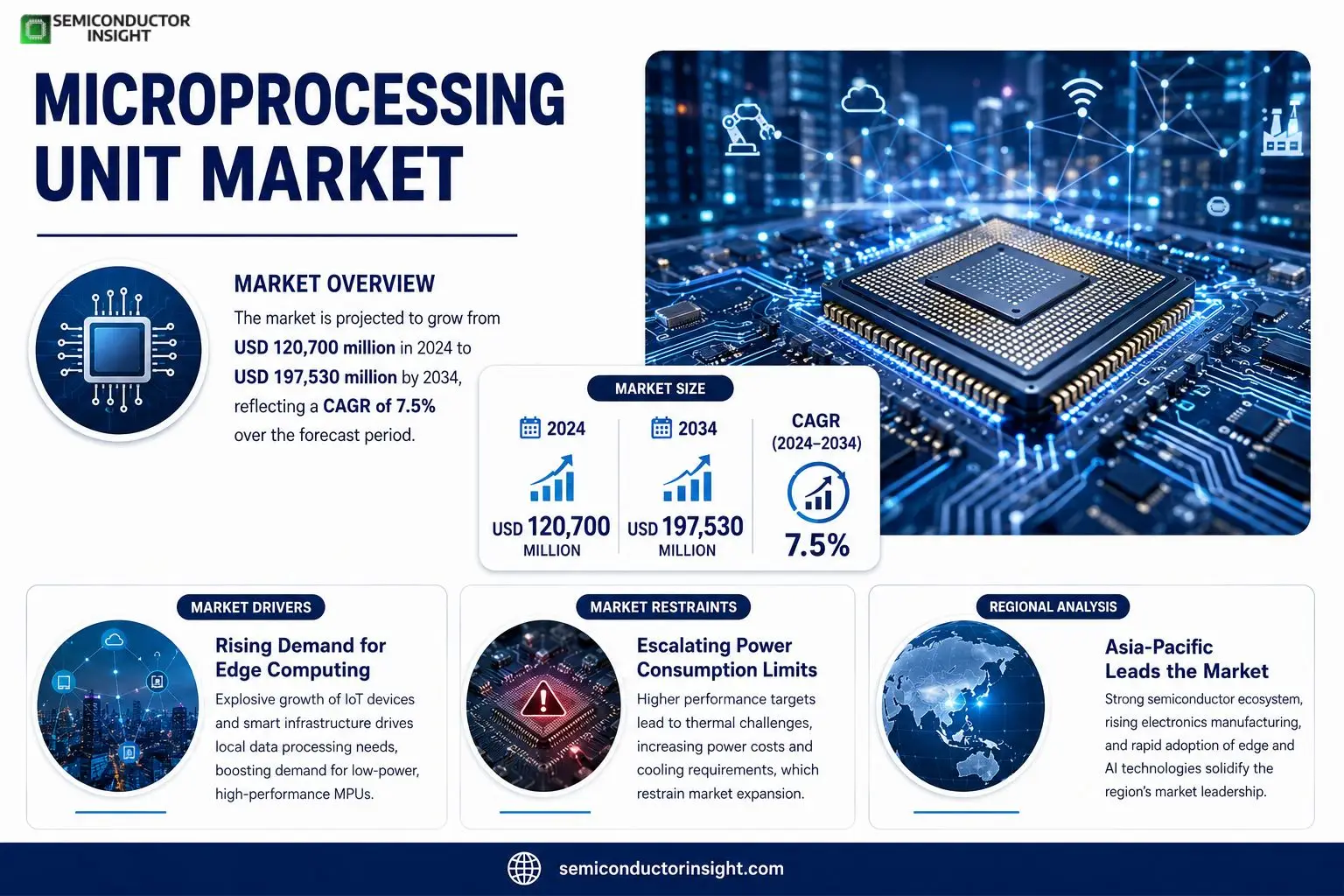
Microprocessing Unit market size was valued at USD 120,700 million in 2024 and is expected to reach USD 197,530 million by 2034, reflecting a CAGR of 7.5 % over the forecast horizon.
Microprocessing Units are integrated circuits that execute programmed instructions; they comprise ARM‑Based MPUs, x86‑Based MPUs and other architectures, enabling functions across consumer electronics, communications equipment, automotive systems and industrial control.The upward trend stems from expanding edge‑computing workloads, increasing AI inference requirements and the proliferation of IoT devices; for example, Intel’s recent collaboration with Microsoft on cloud‑based FPGA services illustrates how leading vendors are broadening their offerings. Prominent manufacturers such as Intel, Qualcomm, AMD, Nvidia, Texas Instruments and IBM continue to invest heavily in new silicon designs.
MARKET DRIVERS
Rising Demand for Edge Computing
The proliferation of Internet‑of‑Things (IoT) gateways and smart‑city sensors forces data to be processed locally, reducing latency and bandwidth costs. This shift elevates the relevance of Microprocessing Unit Market, as manufacturers tailor chips for low‑power, high‑throughput edge workloads. Designs that balance performance with minimal energy draw are now a competitive prerequisite for vendors targeting the expanding edge ecosystem.
Integration of AI and Machine Learning
Artificial‑intelligence inference on devicesfrom smartphones to industrial robotsrequires on‑chip acceleration that traditional general‑purpose processors cannot deliver efficiently. This reality compels chipmakers to embed tensor cores, neural‑network engines, and other AI‑focused blocks within their microprocessing units. The resulting performance‑per‑watt improvements are directly translating into higher adoption rates across enterprise and consumer segments.
➤ “Every product that processes data at the edge is now a candidate for a purpose‑built microprocessor, and that reality is reshaping the investment landscape.”
Consequently, the convergence of edge requirements and AI workloads creates a feedback loop: stronger demand fuels R&D investment, which in turn yields more capable silicon, further accelerating market uptake. Stakeholders that anticipate this cycle can align product roadmaps with the emerging value chain.
MARKET CHALLENGES
Supply Chain Volatility
Geopolitical tensions, coupled with periodic disruptions at semiconductor foundries, have rendered the sourcing of advanced lithography equipment unpredictable. When fab capacity tightens, lead times for critical microprocessing units extend, pressuring OEMs to hold larger inventoriesa cost that erodes margins across the value chain.
Other Challenges
Design Complexity
The push toward heterogeneous integrationcombining CPUs, GPUs, and AI accelerators on a single diedemands sophisticated verification workflows and cross‑disciplinary expertise. Companies lacking deep‑bench engineering teams often face prolonged time‑to‑market, which can cede ground to more agile competitors.In parallel, regulatory scrutiny over export controls for high‑performance computing chips adds a compliance layer that can stall cross‑border collaborations, especially for firms operating in multiple jurisdictions.
MARKET RESTRAINTS
Escalating Power Consumption Limits
As performance targets climb, the thermal envelope of many microprocessing units approaches the thresholds of current cooling technologies. Enterprises deploying dense compute racks in data‑center environments report rising electricity bills and cooling infrastructure upgrades, factors that temper aggressive expansion plans.
Thermal Management Issues
Thermal throttling, once a rare event, now surfaces in edge devices where enclosure space is limited. Engineers are forced to balance silicon performance against reliability, often opting for conservative clock speeds that sacrifice potential market share gains.
Cost Sensitivity in Consumer Segments
Price‑conscious consumers continue to prioritize total cost of ownership over marginal performance improvements. This price pressure forces manufacturers to thin margins on flagship microprocessing units, slowing investment in next‑generation process nodes.
MARKET OPPORTUNITIES
Emerging 3nm and Beyond Fabrication Nodes
The transition to sub‑3nm processes unlocks transistor densities that can double compute capability without proportionally increasing power draw. Early adopters of these nodes within Microprocessing Unit Market stand to differentiate their product portfolios with unprecedented efficiency metrics.
Growth of Customized ASIC Solutions
Industries such as fintech, autonomous logistics, and health‑tech are commissioning application‑specific integrated circuits that embed microprocessing units tailored to niche workloads. This trend opens a revenue stream for foundries that can offer rapid prototyping and low‑volume production services.
Potential in Automotive Autonomous Systems
Self‑driving platforms demand deterministic processing under rugged conditions. Microprocessing units engineered for automotive safety standards present a high‑margin opportunity, especially as OEMs seek to consolidate multiple control functions onto a single silicon platform.
Microprocessing Unit Market Trends
Shift Toward ARM‑Based Architectures
The design preference of OEMs is moving decisively away from legacy x86 cores toward ARM‑centric solutions. This shift reflects the desire for lower power envelopes and greater integration density, which are critical for battery‑operated devices and for embedding intelligence directly into sensors. Chipmakers such as Qualcomm and Nvidia have accelerated ARM‑based system‑on‑chip roll‑outs, prompting Intel to broaden its own ARM portfolio. For system integrators, the transition translates into shorter time‑to‑market cycles because a single ARM IP block can serve multiple product families, reducing engineering overhead and inventory complexity.
Other Trends
Rise of Edge Computing in Industrial Automation
Manufacturers of production equipment are embedding microprocessing units at the network edge to process data locally, thereby limiting latency and preserving bandwidth for critical control loops. The proliferation of 5G connectivity in factories amplifies this tendency, as real‑time analytics become feasible without reliance on central data centers. Suppliers that couple robust security features with deterministic performance are gaining traction among European and Asian automation firms, which view on‑premise processing as a hedge against cyber‑risk and supply‑chain disruptions.
Consolidation Among Leading Suppliers
Strategic alliances and acquisitions are reshaping the competitive landscape. Recent transactions have seen larger players absorb niche design houses, creating portfolios that span everything from high‑performance graphics cores to ultra‑low‑power controllers. This consolidation grants incumbents greater bargaining power with foundries, enabling cost efficiencies that can be passed to downstream customers. At the same time, the reduced number of independent innovators raises the bar for differentiation, compelling remaining independents to double‑down on specialized IP blocks or custom silicon services to stay relevant.
COMPETITIVE LANDSCAPE
Key Industry Players
Microprocessing Unit Market: Competitive Overview
Intel continues to dominate the high‑performance segment, leveraging its long‑standing relationships with OEMs and its aggressive roadmap for both x86 and hybrid architectures. The company’s ability to monetize process‑technology licensing while expanding foundry services has reinforced its market share, especially in data‑center and PC categories where performance per watt remains a decisive factor. AMD, riding on its Zen microarchitecture gains, has narrowed the gap, capturing price‑sensitive customers by delivering comparable compute density at lower cost. Qualcomm’s System‑on‑Chip (SoC) strategy, anchored by its Snapdragon line, has translated into a substantial foothold in mobile and emerging automotive infotainment spaces, where integration and power efficiency drive procurement decisions. Nvidia, traditionally strong in graphics, has leveraged its CUDA ecosystem to infiltrate AI acceleration workloads, prompting a shift of revenue streams from pure graphics to heterogeneous computing solutions. Collectively, these four firms shape a tiered competitive hierarchy, where scale, IP portfolios, and ecosystem lock‑in dictate pricing power and R&D investment cycles.Beyond the headline makers, a cluster of niche players exerts outsized influence within specific sub‑segments. Texas Instruments (TI) remains indispensable for analog‑rich embedded MPUs, catering to industrial control and automotive safety modules that demand deterministic latency. IBM’s focus on Power architecture persists in high‑throughput enterprise servers, while Baikal Electronics targets the Russian defence and telecommunications markets with domestically sourced designs. AppliedMicro, now part of MACOM, supplies customizable ARM‑based cores for networking equipment, capitalising on its low‑power, high‑throughput IP. Toshiba’s legacy in low‑power microcontrollers sustains its relevance in consumer IoT devices, and Broadcom’s approach of integrating networking ASICs with MPUs secures its place in data‑center fabric solutions. Companies such as MediaTek, STMicroelectronics, Renesas, and Samsung round out the landscape, each carving out vertical nichesranging from affordable smartphones to automotive‑grade processorswhere specialised feature sets outweigh sheer performance metrics. This stratified ecosystem creates a competitive pressure that forces the leading giants to diversify into these specialty markets, while the smaller firms leverage agility to address emerging application requirements.
List of Key Microprocessing Unit Companies Profiled
- Intel
- AMD
- Qualcomm
- Nvidia
- Texas Instruments
- IBM Corporation
- Baikal Electronics
- AppliedMicro
- Toshiba Corporation
- Broadcom
- MediaTek
- STMicroelectronics
- Renesas Electronics
- Samsung Electronics
Segment Analysis:
| Segment Category | Sub-Segments | Key Insights |
| By Type |
|
ARM‑Based MPUs dominate design conversations due to their energy‑efficiency and extensive ecosystem support.
|
| By Application |
|
Automotive emerges as a pivotal application segment, driven by increasing electronic content in vehicles.
|
| By End User |
|
Device Manufacturers lead the adoption curve, especially in consumer wearables and smart home products.
|
| By Architecture |
|
RISC‑V Open‑Source Architecture is gaining traction as a strategic differentiator.
|
| By Integration Level |
|
System‑on‑Chip (SoC) Solutions are the preferred integration method for emerging smart devices.
|
Regional Analysis: Microprocessing Unit Market
Asia‑Pacific
Companies in the region are embracing chiplet architectures that allow modular integration of specialized cores, thereby addressing diverse application demands without the cost of full custom silicon. This modularity also supports rapid iteration, enabling firms to react to shifting consumer preferences in real time.
Recent disruptions have motivated manufacturers to diversify sourcing across multiple countries, reducing reliance on any single node. Strategic stockpiling of critical substrates and the development of local testing facilities are becoming standard risk‑mitigation practices.
The rise of 5G infrastructure and autonomous vehicle prototypes is amplifying demand for high‑throughput, low‑latency processors. Vendors are tailoring microprocessing units to handle intensive AI inference workloads directly at the edge, a trend that reshapes product roadmaps.
Governments across the region are rolling out tax incentives and R&D grants aimed at bolstering domestic design capabilities. These programmes lower entry barriers for startups, fostering a more competitive innovation environment.
North America
In North America, Microprocessing Unit Market is anchored by a mature ecosystem of design firms and a strong venture‑capital presence. The United States continues to lead in advanced node research, while Canada leverages its AI expertise to spin out specialized processing solutions. Companies are increasingly prioritizing secure‑by‑design architectures in response to heightened cybersecurity concerns, prompting collaborations between hardware producers and software developers to embed encryption at the silicon level.
Europe
European stakeholders emphasize sustainability and regulatory compliance, driving a shift toward energy‑efficient microprocessing units. The EU’s Green Deal incentivizes low‑power designs, encouraging manufacturers to adopt advanced power‑management techniques. Additionally, the region’s strong automotive sector fuels demand for processors that can handle real‑time sensor fusion, positioning Europe as a hub for safety‑critical chip development.
South America
South America’s market remains nascent but is gaining traction as local manufacturers seek to reduce dependence on imported chips. Brazil’s investment in semiconductor fabrication clusters aims to create a regional supply base, while Argentina’s tech startups explore custom processing solutions for agricultural IoT devices. The focus is on cost‑effective designs that can operate in challenging environmental conditions.
Middle East & Africa
In the Middle East & Africa, Microprocessing Unit Market is characterized by strategic diversification initiatives. Nations such as the United Arab Emirates are establishing semiconductor research hubs to attract foreign expertise. African countries, meanwhile, are leveraging mobile broadband expansion to drive demand for affordable, low‑power processors that power education and health platforms, laying groundwork for future ecosystem development.
Report Scope
This market research report provides a comprehensive analysis of the Microprocessing Unit Market , covering the forecast period 2026–2034. It offers detailed insights into market dynamics, technological advancements, competitive landscape, and key trends shaping the industry.
Key focus areas of the report include:
- Market Overview: The report begins with an overview outlining its current market scenario, key growth indicators, and industry transformation drivers. It discusses macroeconomic factors, demand–supply balance, regulatory landscape, and the strategic role of semiconductors in powering advancements across industries such as automotive, telecommunications, consumer electronics, and industrial automation.
- Market Size & Forecast: Historical data and future projections for revenue, unit shipments, and market value across major regions and segments.
- Segmentation Analysis: Detailed breakdown by product type, technology, application, and end-user industry to identify high-growth segments and investment opportunities.
- Regional Insights: Insights into market performance across North America, Europe, Asia-Pacific, Latin America, and the Middle East & Africa, including country-level analysis where relevant.
- Competitive Landscape: Profiles of leading market participants, including their product offerings, R&D focus, manufacturing capacity, pricing strategies, and recent developments such as mergers, acquisitions, and partnerships.
- Technology Trends & Innovation: Assessment of emerging technologies, integration of AI/IoT, semiconductor design trends, fabrication techniques, and evolving industry standards.
- Market Drivers & Restraints: Evaluation of factors driving market growth along with challenges, supply chain constraints, regulatory issues, and market-entry barriers.
- Stakeholder Insights: Insights for component suppliers, OEMs, system integrators, investors, and policymakers regarding the evolving ecosystem and strategic opportunities.
Primary and secondary research methods are employed, including interviews with industry experts, data from verified sources, and real-time market intelligence to ensure the accuracy and reliability of the insights presented.
FREQUENTLY ASKED QUESTIONS:
What is the current market size of Microprocessing Unit Market?
-> Microprocessing Unit Market was valued at USD 120,700 million in 2024 and is projected to reach USD 197,530 million by 2034, representing a CAGR of 7.5% over the forecast period.
Which key companies operate in Microprocessing Unit Market?
-> Key players include Intel, Qualcomm, AMD, Freescale, Nvidia, TI, IBM Corporation, Baikal Electronics, AppliedMicro, Toshiba Corporation, Broadcom.
What are the key growth drivers?
-> Key growth drivers include rising demand for consumer electronics, automotive electronics, communication infrastructure, industrial control systems, and the shift toward AI‑enabled and IoT‑connected devices.
Which region dominates the market?
-> Asia holds the largest share, driven primarily by strong demand in China, Japan, and South Korea across multiple application segments.
What are the emerging trends?
-> Emerging trends include increased adoption of ARM‑Based MPUs, integration of AI/ML capabilities at the edge, and the development of low‑power, high‑performance processors for IoT and automotive applications.
Get Sample Report PDF for Exclusive Insights
Report Sample Includes
- Table of Contents
- List of Tables & Figures
- Charts, Research Methodology, and more...
 Download Sample Report PDF