MARKET INSIGHTS
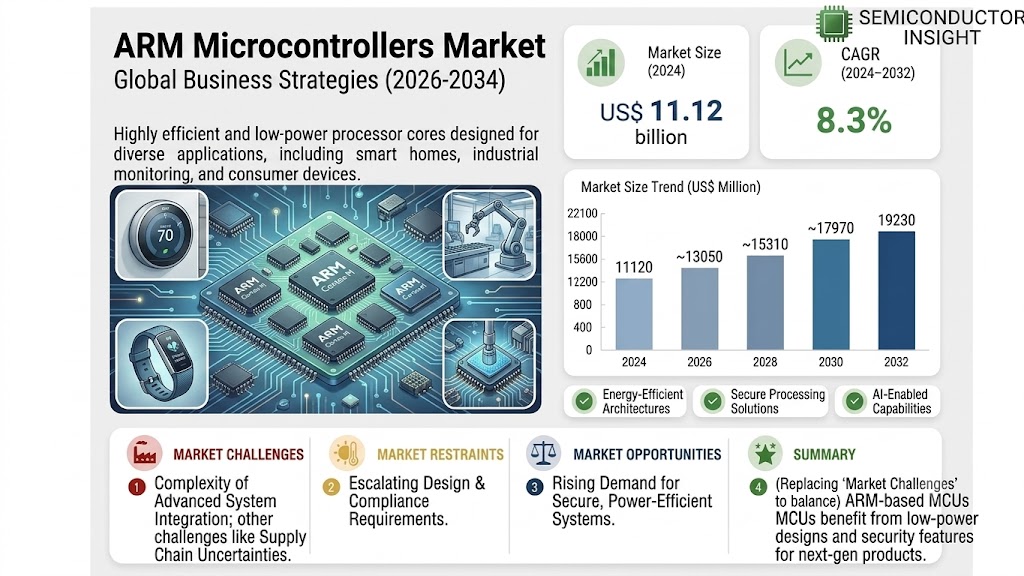
The global ARM Microcontrollers market size was valued at USD 11,120 million in 2024. The market is projected to grow from USD 12,050 million in 2025 to USD 19,230 million by 2032, exhibiting a CAGR of 8.3% during the forecast period.
ARM Microcontrollers are 32-bit RISC-based processors designed for embedded applications, offering a balance of high performance and low power consumption. These microcontrollers are intellectual property cores licensed by ARM Holdings to semiconductor manufacturers who integrate them into their System-on-Chip (SoC) designs. The architecture features a load-store design, fixed-length 32-bit instruction set, and large register file, making it particularly suitable for applications ranging from industrial automation to consumer electronics where energy efficiency is critical.
Market growth is primarily driven by the expanding Internet of Things (IoT) ecosystem, increasing automation across industries, and the growing adoption of smart devices. The automotive sector represents a significant growth area, with modern vehicles incorporating numerous ARM-based MCUs for advanced driver assistance systems (ADAS), infotainment, and vehicle control units. Furthermore, the standardization on ARM architecture has created a robust software ecosystem, reducing development time and costs for manufacturers. Leading players including NXP Semiconductors, STMicroelectronics, and Microchip Technology continue to innovate with more powerful and energy-efficient variants, further accelerating market penetration across diverse applications.
 MARKET DRIVERS
Growing Adoption of Embedded Intelligence
The ARM Microcontrollers Market is being propelled by the rising integration of embedded intelligence across consumer electronics, industrial automation, and connected devices. Manufacturers are increasingly adopting **ARM‑based MCUs** due to their efficiency, performance scalability, and strong ecosystem support. This trend is particularly visible in applications requiring low-power computation and real-time responsiveness.
Expansion of IoT and Edge Computing
The continuous expansion of IoT and edge systems is elevating demand for microcontrollers optimized for power efficiency and robust processing. ARM architectures offer a balanced mix of compute capability, security extensions, and software compatibility, making them the preferred choice for OEMs building scalable device networks.
➤ ARM-based MCUs remain central to smart device ecosystems due to flexibility, reduced development time, and broad toolchain support.
In addition, ongoing advancements in sensor fusion, connectivity stacks, and embedded security modules are supporting the sustained adoption of ARM microcontrollers across both emerging and traditional market segments.
MARKET CHALLENGES
Complexity of Advanced System Integration
The ARM Microcontrollers Market faces challenges stemming from increasing system complexity. Integrating advanced peripherals, security features, and real-time processing within compact architectures requires significant engineering expertise. This complexity can extend development timelines and raise overall project costs for manufacturers.
Other Challenges
Supply Chain Uncertainties
Fluctuations in semiconductor manufacturing capacity, logistics pressures, and node transition constraints can influence lead times and availability. These disruptions affect product planning cycles for companies relying on ARM-based MCUs.
MARKET RESTRAINTS
Escalating Design and Compliance Requirements
The ARM Microcontrollers Market is moderated by increasingly stringent design, safety, and compliance requirements in sectors such as automotive, industrial controls, and medical electronics. Meeting these standards demands additional validation processes, specialized software stacks, and secure hardware features, which can limit rapid deployment.
MARKET OPPORTUNITIES
Rising Demand for Secure, Power-Efficient Systems
Emerging opportunities within the ARM Microcontrollers Market are driven by increasing demand for secure, power-efficient processing solutions across smart homes, industrial monitoring, consumer wearables, and mobility applications. Advancements in low‑power architectures, integrated security modules, and AI‑enabled microcontrollers position ARM-based MCUs favorably for next‑generation product development.
ARM Microcontrollers Market () Trends
Rising Integration of ARM-Based MCUs in Connected and Automated Systems
The ARM Microcontrollers Market continues to experience steady advancement as industries deepen their reliance on embedded processing for intelligent device functionality. ARM-based microcontrollers, built on efficient 32-bit RISC architecture, remain central to applications requiring low power consumption and consistent performance. A major trend shaping the market is the rapid adoption of connected devices, driven by expanding IoT deployments across industrial, consumer, and commercial sectors. Manufacturers increasingly leverage the broad software ecosystem supporting ARM architecture, which simplifies development cycles and accelerates migration toward more integrated embedded solutions. This ecosystem advantage, combined with improvements in energy efficiency and processing capability, has solidified the role of ARM microcontrollers in next‑generation smart devices.
Another trend influencing market behavior is the shift toward more complex automation systems. Industries are deploying intelligent monitoring, control, and predictive maintenance technologies that rely heavily on embedded computing. ARM-based microcontrollers enable manufacturers to design highly optimized, low-latency systems with long operational lifespans. Their fixed-length instruction sets and load‑store architecture enhance computational predictability, which is especially valuable in industrial automation settings. As automation expands into mid-tier manufacturing regions, demand for efficient microcontroller platforms is expected to intensify, reinforcing ARM’s position across multiple verticals.
Other Trends
Growing Use of ARM-Based MCUs in Automotive Electronics
The automotive sector remains one of the most influential drivers of adoption, with modern vehicles incorporating numerous microcontrollers for crucial subsystems such as driver assistance, infotainment, and body electronics. ARM-based solutions are favored due to their balance of power efficiency and computational capability, supporting features that require stable real-time performance. Increasing integration of electronic control units and standardization on ARM architecture allow automakers to streamline development, reduce software fragmentation, and improve system reliability. As vehicles transition toward higher automation levels, demand for powerful yet efficient microcontroller designs continues to grow.
Advancements in Energy-Efficient Embedded Processing
Continuous innovation from leading semiconductor manufacturers has resulted in microcontrollers that deliver improved efficiency and enhanced performance profiles. These advancements support applications such as battery-powered smart sensors, wearables, and portable industrial devices. By refining architectures and optimizing power states, manufacturers enable broader deployment of intelligent systems in constrained environments. This trend supports the ongoing expansion of embedded intelligence in both consumer and industrial domains.
Standardization and Ecosystem Expansion as Market Accelerators
Standardization on ARM architecture across semiconductor vendors has created a robust global ecosystem that significantly lowers development complexity. This shared foundation enables faster prototyping, consistent toolchains, and reusable software assets, making it easier for manufacturers to scale product lines. As ecosystem support expands, companies across industries benefit from streamlined integration, reduced engineering effort, and accelerated time-to-market. This dynamic reinforces the widespread adoption of ARM-based solutions and continues to shape market direction as embedded intelligence becomes foundational to modern electronic design.
COMPETITIVE LANDSCAPE
Key Industry Players
ARM Microcontrollers Market Competitive Dynamics
The ARM Microcontrollers market is shaped by a concentrated set of globally established semiconductor manufacturers that license ARM CPU architectures and differentiate their offerings through power efficiency, peripheral integration, software ecosystem support, and manufacturing scale. Leaders such as NXP Semiconductors, STMicroelectronics, and Microchip Technology sustain strong competitive advantage through extensive ARM Cortex-M portfolios, deep automotive and industrial partnerships, and continuous investment in next‑generation low‑power process technologies. These companies maintain broad developer ecosystems and long product lifecycle support, making them preferred suppliers in high‑reliability applications spanning automotive electronics, industrial automation, and connected devices.
Beyond the frontline leaders, several specialized and regionally strong companies contribute significantly to market depth. Renesas Electronics, Infineon Technologies, Texas Instruments, and Silicon Labs continue to strengthen their ARM‑based MCU lines with enhanced connectivity, security accelerators, and real‑time control features. Additionally, players such as Nordic Semiconductor, Samsung Electronics, and Broadcom leverage domain expertise in wireless connectivity and consumer SoCs to expand ARM MCU penetration across IoT devices and smart consumer systems. Collectively, these companies compete through differentiated microarchitectures, ecosystem collaboration, and aggressive product innovation tailored to emerging IoT, automotive, and industrial use cases.
List of Key ARM Microcontrollers Market Companies Profiled
- NXP Semiconductors
- STMicroelectronics
- Microchip Technology
- Renesas Electronics
- Infineon Technologies
- Texas Instruments
- Silicon Labs
- Nordic Semiconductor
- Qualcomm
- Samsung Electronics
- Broadcom Inc.
- Analog Devices
- Arm Holdings (IP licensor)
- Hilscher Gesellschaft
- GigaDevice Semiconductor
Segment Analysis:
| Segment Category | Sub-Segments | Key Insights |
| By Type |
|
Leading Segment Cortex-M Series dominates due to its balance of performance and ultra-low power usage, making it ideal for IoT nodes and battery-powered devices.
|
| By Application |
|
Leading Segment Automotive Electronics leads due to rapid adoption of advanced control systems, ADAS features, and connected vehicle technologies.
|
| By End User |
|
Leading Segment Electronics Manufacturers remain the primary end users as ARM MCUs enable innovation across a wide range of connected and smart devices.
|
| By [Segment Category 3]] |
|
Leading Segment Low-Power Microcontrollers are prominent, driven by growing IoT deployments and wearable electronics.
|
| By [Segment Category 4]] |
|
Leading Segment Embedded Systems represent the largest functional category as ARM architectures are foundational to compact, reliable system designs.
|
Regional Analysis: ARM Microcontrollers Market
Asia-Pacific hosts the world’s most concentrated electronics manufacturing base, providing unmatched scale advantages for ARM microcontroller production. The region’s deeply integrated supply chains — from silicon wafer fabrication to final product assembly — allow manufacturers to achieve competitive cost structures while maintaining high output volumes, making it the preferred sourcing destination for global OEMs across multiple end-use verticals.
The rapid expansion of Internet of Things infrastructure across Asia-Pacific is a principal catalyst for ARM microcontroller demand. Smart home systems, wearable devices, and connected industrial equipment all rely on energy-efficient ARM-based processors. Government-backed smart city initiatives across China, India, and Southeast Asian nations are accelerating deployment, creating sustained long-term demand trajectories for embedded ARM microcontroller solutions in both consumer and industrial segments.
Asia-Pacific’s automotive sector, led by China’s booming electric vehicle industry and Japan’s established automotive giants, is increasingly integrating ARM microcontrollers for vehicle control units, battery management systems, and advanced driver-assistance technologies. Simultaneously, industrial automation across the region is embracing ARM-based embedded solutions to enable smarter, more responsive production environments, reinforcing sustained market growth throughout the forecast period.
National semiconductor self-sufficiency strategies in China, India, and South Korea are channeling substantial investment into ARM microcontroller research, design, and fabrication capabilities. These policy-driven efforts are cultivating homegrown chip design talent and fostering partnerships between government institutions and private semiconductor firms, steadily elevating the region’s innovation capacity and reducing dependence on external suppliers within the ARM microcontroller ecosystem.
North America
North America represents a technologically advanced and high-value segment of the global ARM Microcontrollers Market, characterized by strong demand from the automotive, aerospace, defense, healthcare, and industrial automation sectors. The United States serves as the regional anchor, home to leading semiconductor design firms, a well-established ecosystem of embedded systems developers, and world-class research institutions that continuously push the boundaries of ARM microcontroller applications. The region’s emphasis on edge computing, cybersecurity, and artificial intelligence integration within embedded systems is creating new demand pathways for sophisticated ARM-based architectures. Canada contributes through its expanding IoT and smart infrastructure programs, while the overall regulatory environment encourages innovation in safety-critical applications. North America’s focus on high-performance, secure, and energy-efficient microcontroller solutions ensures its sustained relevance and competitiveness within the global ARM Microcontrollers Market landscape through 2032.
Europe
Europe holds a strategically important position in the ARM Microcontrollers Market, driven by its leadership in automotive engineering, industrial automation, medical technology, and energy management. Germany, France, the United Kingdom, and the Nordic countries are key contributors, with their advanced manufacturing industries serving as primary end-users of ARM microcontroller solutions. The European automotive sector’s accelerating transition toward electrification and connected mobility is generating robust demand for embedded ARM-based systems. Additionally, Europe’s stringent regulatory frameworks around energy efficiency and environmental compliance are encouraging the adoption of low-power ARM microcontrollers across consumer and industrial applications. The region’s commitment to semiconductor sovereignty, reflected in the European Chips Act, is fostering local design and production capabilities, which will progressively strengthen Europe’s self-reliance and influence within the broader ARM Microcontrollers Market ecosystem over the coming years.
South America
South America represents an emerging opportunity within the global ARM Microcontrollers Market, with growth primarily driven by increasing industrialization, expanding consumer electronics penetration, and rising investment in digital infrastructure. Brazil is the dominant market in the region, supported by a growing technology sector and government initiatives aimed at modernizing manufacturing and telecommunications. Argentina and Colombia are also witnessing gradual adoption of ARM microcontroller-based solutions across agricultural automation, smart metering, and consumer electronics segments. While the region faces challenges related to economic volatility and limited local semiconductor manufacturing capacity, the growing presence of international technology firms and the proliferation of affordable connected devices are steadily building a foundation for more sustained ARM microcontroller market development across South America in the years ahead.
Middle East & Africa
The Middle East and Africa region is progressively emerging as a nascent but increasingly relevant participant in the global ARM Microcontrollers Market. Gulf Cooperation Council nations, particularly the United Arab Emirates and Saudi Arabia, are at the forefront of regional adoption, driven by ambitious smart city projects, Vision 2030 economic diversification programs, and expanding digital infrastructure investments. ARM microcontrollers are finding growing application in building automation, smart energy management, and connected healthcare systems across these markets. Africa, while still in an early stage of market development, presents long-term potential through its expanding mobile technology ecosystem and increasing demand for affordable embedded solutions in agriculture and utilities. As digital transformation agendas gain momentum and infrastructure investment intensifies, the Middle East and Africa region is poised to become a more significant contributor to the global ARM Microcontrollers Market through 2032.
Report Scope
This market research report provides a comprehensive analysis of the ARM Microcontrollers Market , covering the forecast period 2026–2034. It offers detailed insights into market dynamics, technological advancements, competitive landscape, and key trends shaping the industry.
Key focus areas of the report include:
- Market Overview: The report begins with an overview outlining its current market scenario, key growth indicators, and industry transformation drivers. It discusses macroeconomic factors, demand–supply balance, regulatory landscape, and the strategic role of semiconductors in powering advancements across industries such as automotive, telecommunications, consumer electronics, and industrial automation.
- Market Size & Forecast: Historical data and future projections for revenue, unit shipments, and market value across major regions and segments.
- Segmentation Analysis: Detailed breakdown by product type, technology, application, and end-user industry to identify high-growth segments and investment opportunities.
- Regional Insights: Insights into market performance across North America, Europe, Asia-Pacific, Latin America, and the Middle East & Africa, including country-level analysis where relevant.
- Competitive Landscape: Profiles of leading market participants, including their product offerings, R&D focus, manufacturing capacity, pricing strategies, and recent developments such as mergers, acquisitions, and partnerships.
- Technology Trends & Innovation: Assessment of emerging technologies, integration of AI/IoT, semiconductor design trends, fabrication techniques, and evolving industry standards.
- Market Drivers & Restraints: Evaluation of factors driving market growth along with challenges, supply chain constraints, regulatory issues, and market-entry barriers.
- Stakeholder Insights: Insights for component suppliers, OEMs, system integrators, investors, and policymakers regarding the evolving ecosystem and strategic opportunities.
Primary and secondary research methods are employed, including interviews with industry experts, data from verified sources, and real-time market intelligence to ensure the accuracy and reliability of the insights presented.
FREQUENTLY ASKED QUESTIONS:
What is the current market size of ARM Microcontrollers Market?
-> Global ARM Microcontrollers Market was valued at USD 12,050 million in 2025 and is expected to reach USD 19,230 million by 2032, exhibiting a CAGR of 8.3% during the forecast period.
Which key companies operate in ARM Microcontrollers Market?
-> Key players include NXP Semiconductors, STMicroelectronics, and Microchip Technology, among others.
What are the key growth drivers?
-> Key growth drivers include the expanding Internet of Things (IoT) ecosystem, increasing automation across industries, growing adoption of smart devices, and rising demand from the automotive sector for advanced driver assistance systems (ADAS), infotainment, and vehicle control units.
Which region dominates the market?
-> Asia-Pacific is the fastest-growing region, driven by strong semiconductor manufacturing activity and rising demand for consumer electronics and industrial automation solutions.
What are the emerging trends?
-> Emerging trends include integration of ARM-based MCUs in IoT devices, adoption of energy-efficient 32-bit RISC architectures, standardization on ARM ecosystem to reduce development costs, and increasing deployment in automotive ADAS and smart industrial applications.
Get Sample Report PDF for Exclusive Insights
Report Sample Includes
- Table of Contents
- List of Tables & Figures
- Charts, Research Methodology, and more...