Key Statistics
Key Takeaways
- Universal/general-purpose 8-bit MCUs form the broadest product segment because low cost, mature tools and flexible peripherals keep the architecture attractive for appliances, sensors, motor control and simple embedded logic.
- Consumer electronics and home appliances remain major application areas, while automotive and industrial safety applications are adding value through functional-safety, touch and hardware-control peripherals.
- Asia Pacific is the leading regional market based on the regional market analysis, supported by electronics manufacturing scale in China, Japan and broader Asia.
- 8-bit architectures are still receiving new silicon investment. Microchip launched the AVR LA family in 2026 for low-voltage capacitive touch, battery-powered sensors, industrial HMI and automotive applications.
- Core-independent peripherals are extending the life of 8-bit MCUs. Modern PIC and AVR families offload timing, logic, analog and motor-control tasks from the CPU, allowing simple cores to handle increasingly capable embedded systems.
8-Bit Microcontrollers Market Overview
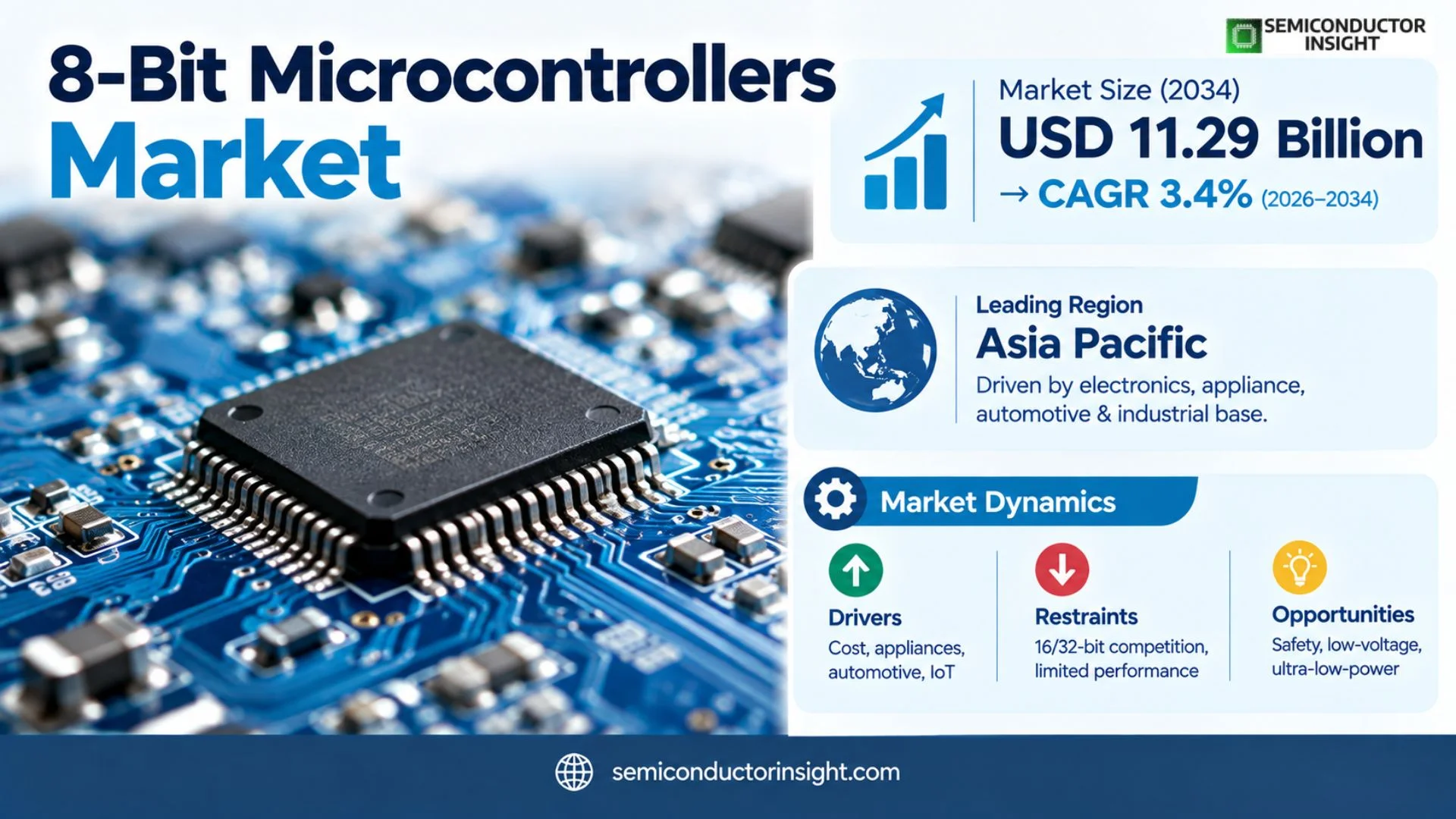
8-Bit Microcontrollers market is valued at USD 8.36 billion in 2025 and is projected to reach USD 11.29 billion by 2034, representing a 3.4% CAGR during 2026–2034. The 2026 estimated market size is USD 8.64 billion. Asia Pacific is the leading regional market, supported by its large electronics, appliance, automotive and industrial manufacturing base.
An 8-bit microcontroller integrates an 8-bit CPU core with Flash or other program memory, SRAM, timers, analog functions and communication peripherals on a single chip. The architecture is optimized for deterministic, low-cost embedded control rather than high-throughput computing. It remains common in products that need to sense inputs, manage a small state machine, drive motors or displays, and communicate over simple serial buses.
The market persists because system cost and development simplicity are often more important than raw CPU performance. A small 8-bit MCU can replace discrete logic, timers, analog comparators and interface components when the device includes configurable peripherals. Mature software tools, large developer communities and long product lifecycles also reduce engineering risk for appliances, industrial controls and automotive body electronics.
Modern 8-bit devices are not static legacy products. Microchip continues to add functional safety, USB, configurable logic, capacitive touch and low-voltage operation to PIC and AVR families. ST maintains STM8 for industrial, mass-market and automotive applications, while NXP’s S08 portfolio continues to cover cost-sensitive 5V control designs.
Segment Analysis: By Type
By type, the market is segmented into Universal Type and Exclusive Type. Universal devices serve a broad range of embedded-control applications, while exclusive or application-specific devices integrate peripherals tailored to automotive, touch, motor control, safety or other targeted functions.
| Type | Technical profile | Market position |
|---|---|---|
| Universal Type | General-purpose PIC, AVR, STM8 and S08-class devices combine digital I/O, timers, ADCs, serial interfaces and configurable peripherals across many package and memory options. | Broadest segment. Appliances, industrial controls, toys, low-cost sensors and simple consumer products benefit from low unit cost and reusable software. |
| Exclusive / Application-Specific Type | Devices add specialized functions such as LIN/CAN, capacitive touch, motor-control peripherals, safety mechanisms, USB or enhanced analog to target a narrower system role. | A higher-value segment where integrated peripherals reduce external components and simplify compliance or control design. |
Memory, package and functional segmentation
The market can also be segmented by Flash size, package count and embedded functionality. Small-memory devices serve simple control loops and disposable electronics, while 32–128 KB-class 8-bit MCUs support richer communication, touch and control features. Low-pin-count packages remain important because board space and BOM cost are central purchase criteria.
| Axis | Segments | Commercial implication |
|---|---|---|
| By Memory / Package | 2–8 KB · 16–32 KB · 64–128 KB+ · 8–20 pin · 24–48 pin and above | Small-memory devices maximize cost efficiency; larger Flash and pin counts enable communications, motor control, automotive I/O and richer HMI functions. |
| By Functional Feature | General Purpose · Touch / HMI · Motor Control · Functional Safety · USB / Connectivity · Low-Power Sensor Control | Peripheral integration lets 8-bit MCUs solve system tasks without moving to a larger CPU, protecting the architecture in cost-sensitive embedded applications. |
Segment Analysis: By Application
By application, the market spans Aerospace & Defense, Consumer Electronics, Home Appliances, Automotive, Healthcare, Data Processing and Other Embedded Systems. Consumer electronics and appliances create large unit volumes, while automotive and industrial applications provide longer product lives and higher qualification value.
| Application | Key market insight |
|---|---|
| Consumer Electronics | 8-bit MCUs control buttons, displays, charging, simple sensors, lighting and housekeeping functions. They are used where deterministic response and low BOM cost are more important than high compute performance. |
| Home Appliances | Washing machines, refrigerators, pumps, fans, small kitchen appliances and HVAC controls use MCUs for motor sequencing, touch panels, relays, sensors and safety logic. Noise-robust touch is an active product-development area. |
| Automotive | Body electronics, lighting, switches, HMI, small actuators and low-level monitoring use 8-bit MCUs where long lifecycle, 5V tolerance, LIN communication and functional safety are important. |
| Industrial | Industrial sensors, simple motor controllers, power supplies and control panels use 8-bit devices for deterministic housekeeping, watchdog and interface functions. |
| Healthcare / Other | Portable medical devices, small instruments, toys and battery-powered sensors use ultra-low-power MCUs where simple control and standby current dominate system economics. |
Regional Analysis
Asia Pacific is the leading 8-Bit Microcontrollers market based on the regional market structure, supported by large-scale electronics manufacturing in China and Japan and expanding embedded-device production across India and Southeast Asia. North America remains a major high-value market for automotive, industrial and consumer applications.
How do regional 8-bit MCU markets differ?
Asia Pacific combines the largest manufacturing footprint with high appliance, automotive and consumer-electronics volume. North America emphasizes industrial, automotive and IoT design. Europe has strong automotive and industrial demand. South America and the Middle East & Africa are smaller but benefit from appliance, mobility and automation growth.
| Region | Market position | Growth outlook | Core demand | Commercial priority |
|---|---|---|---|---|
| Asia Pacific | Leading | Moderate to high | Consumer, appliance & automotive | Cost, availability and local manufacturing |
| North America | Large high-value market | Moderate | Industrial, auto & IoT | Development ecosystem and long lifecycle |
| Europe | Automotive / industrial hub | Moderate | Auto, appliance & industrial | Safety, 5V operation and qualification |
| South America | Emerging | Selective | Appliance & automotive | Cost and distribution |
| Middle East & Africa | Emerging | Selective | Appliance, IoT & infrastructure | Availability and low-power design |
Competitive Landscape
Key participants include Microchip Technology, Renesas Electronics, NXP Semiconductors, STMicroelectronics, Cypress/Infineon, Silicon Laboratories, Holtek Semiconductor, Infineon Technologies, IXYS, Panasonic, Sony and Epson. Competition increasingly centers on peripheral integration, software tools, product longevity and cost rather than CPU core performance alone.
Microchip has the broadest visible active investment in 8-bit MCUs through PIC and AVR. Its portfolio spans general purpose, USB, touch, motor control and functional-safety families and is supported by MPLAB X, MCC and XC8. The 2026 AVR LA and PIC CLB-based families show continued silicon development rather than simple legacy support.
STMicroelectronics maintains the STM8 platform across mainstream STM8S, ultra-low-power STM8L and automotive STM8AF/STM8AL series. Its long-life product positioning and mature 5V-capable peripherals support industrial, appliance and vehicle designs that do not need 32-bit software complexity.
NXP’s S08 portfolio and Holtek’s cost-focused 8-bit products address high-volume control markets. Renesas, Infineon/Cypress and other suppliers participate through legacy and application-specific lines, but new design activity is increasingly concentrated among vendors that keep toolchains and peripherals current.
Competitive tier structure
| Competitive tier | Representative companies | Competitive strengths |
|---|---|---|
| Active global 8-bit leaders | Microchip; STMicroelectronics; NXP | Large product portfolios, long lifecycle, integrated tools and broad industrial / consumer coverage |
| Regional / cost-focused suppliers | Holtek; Panasonic; Epson and Asian MCU vendors | Appliance, touch, low-cost control and regional customer relationships |
| Legacy / application-specific suppliers | Infineon/Cypress; Renesas; Silicon Labs; IXYS | Installed bases, niche peripherals and migration support |
Key companies profiled
8-Bit MCU Manufacturing Capacity & Product Lifecycle Analysis
8-bit MCU capacity uses mature semiconductor nodes with embedded non-volatile memory, analog and mixed-signal capability. These processes are less capital intensive than leading-edge logic but compete for mature-node wafer capacity with automotive analog, power-management and sensor products. Product longevity and assembly/test capacity are therefore as important as nominal wafer starts.
Long-lived designs require stable masks, packages and test programs. Automotive and industrial customers may ship one MCU family for a decade or more, so suppliers maintain older process flows while introducing new families on compatible platforms.
Package diversity also affects capacity. Eight-pin and small QFN packages support compact designs, while 28–48 pin devices serve motor, touch and automotive systems with more I/O. Back-end assembly must support many low-cost package variants at high volume.
Market Dynamics
Growth is driven by low-cost embedded control, appliances, automotive body electronics, touch/HMI, motor control and IoT. Restraints include competition from 16/32-bit MCUs, limited compute performance and mature-market pricing pressure. Opportunities center on configurable peripherals, functional safety, low-voltage operation and ultra-low-power edge nodes.
MARKET DRIVERS
Simple control remains a massive market
Many products only need timers, ADCs, PWM, serial interfaces and deterministic logic. A small 8-bit MCU solves these tasks at low cost and power.
Peripheral integration reduces BOM
Configurable logic, touch, analog and motor-control blocks can replace external components and allow the CPU to sleep more often.
Automotive and industrial programs value long life
Mature MCUs with proven software and qualification are attractive when field reliability and redesign cost matter more than benchmark performance.
Low-voltage operation expands battery applications
Newer families operate down to 1.62V and use nanoamp standby modes, extending 8-bit relevance in sensors and portable devices.
Drivers Impact Analysis
| Driver | Impact | Primary markets | Time horizon |
|---|---|---|---|
| Appliance / embedded control | High | Asia Pacific, Europe, Americas | Persistent |
| Automotive body electronics | Medium to high | Asia, Europe, North America | Persistent |
| Touch / HMI integration | Medium to high | Consumer & industrial | Medium term |
| Low-cost IoT sensing | Medium | Global | Persistent |
MARKET RESTRAINTS
More complex systems need larger cores
Advanced connectivity, graphics, security and real-time operating systems are easier to implement on 32-bit architectures.
Memory ceilings limit software growth
Small Flash and SRAM constrain protocol stacks, security libraries and feature expansion.
High-volume applications are price sensitive
Unit price differences of only a few cents can influence large appliance and consumer contracts.
Legacy families can fragment development
Older compilers, debuggers and peripheral models increase maintenance effort, encouraging customers to standardize on newer MCU platforms.
Restraints Impact Analysis
| Restraint | Impact | Exposure | Time horizon |
|---|---|---|---|
| 16/32-bit MCU competition | High | New complex designs | Persistent |
| Limited compute / memory | High | AI, networking & advanced control | Persistent |
| Pricing pressure | Medium to high | High-volume consumer | Persistent |
| Legacy-tool fragmentation | Medium | Older installed base | Persistent |
MARKET OPPORTUNITIES
Add hardware logic and smart peripherals
Core-independent peripherals let 8-bit MCUs handle timing-critical functions without software overhead.
Expand functional-safety 8-bit families
Low-cost safety mechanisms support automotive switches, appliance control and industrial systems that need ASIL or SIL design paths.
Target low-voltage touch interfaces
Noise-robust capacitive touch in appliances and HMI creates a large market for specialized 8-bit devices.
Unify tools across 8-bit and 32-bit portfolios
Common IDEs, code configurators and package compatibility lower migration risk and help vendors retain customers as system complexity changes.
8-Bit Microcontroller Value Chain Analysis
MCU architecture & IP
Mature-node wafer fabrication
Assembly & test
Embedded-system integration
Peripheral architecture determines system value
An 8-bit core becomes much more capable when timers, analog and logic operate independently of the CPU.
Mature-node fabs support cost efficiency
Established processes provide proven reliability and lower wafer cost than advanced digital nodes.
Software tools influence design wins
Code generation, compilers and low-cost evaluation boards can reduce engineering time more than small differences in CPU speed.
Long product lifecycles create recurring demand
Once an MCU is qualified in an appliance or vehicle platform, it can ship for years with relatively little design change.
Recent Developments in the 8-Bit Microcontrollers Market
Microchip publishes AVR LA development guidance
Microchip released onboarding documentation for AVR LA 8-bit MCUs, including MPLAB X, VS Code, XC8 and Curiosity Nano development workflows.
Microchip makes MPLAB XC Pro compilers available at no cost
The change removes compiler-license fees and expands access to optimized development tools across Microchip MCU families, including PIC and AVR.
Microchip adds AVR LA 8-bit MCUs
The AVR LA family targets low-voltage touch, battery sensors, industrial HMI, automotive HMI and data-center housekeeping with 1.62V–5.5V operation.
Microchip expands PIC 8-bit MCU portfolio with configurable logic
PIC16F13276 and PIC18-Q35 combine programmable hardware logic with MCU control for timing-critical industrial and automotive functions.
ST continues active STM8 portfolio and tool support
STM8S, STM8L, STM8AF and STM8AL remain active families for mainstream, low-power and automotive 8-bit applications.
REPORT SCOPE & SEGMENTATION
| Attribute | Details |
|---|---|
| Study Period | 2019–2034 |
| Base Year | 2025 |
| Estimated Year | 2026 |
| Forecast Period | 2026–2034 |
| Historical Period | 2019–2025 |
| Market Size 2025 | USD 8.36 billion |
| Market Size 2034 | USD 11.29 billion |
| Growth Rate | 3.4% during 2026–2034 |
| Unit | Value (USD Million/Billion) and MCU unit shipments |
| By Type | Universal Type · Exclusive Type |
| By Application | Aerospace and Defense · Consumer Electronics · Home Appliances · Automotive · Healthcare · Data Processing · Other |
| By Memory / Package | 2–8 KB · 16–32 KB · 64–128 KB+ · Low Pin Count · Standard / High Pin Count |
| By Functional Feature | General Purpose · Touch / HMI · Motor Control · Functional Safety · USB / Connectivity · Low-Power Sensor Control |
| By Region | Each region analysed by MCU type, application, memory/package class, functional feature and country embedded-electronics ecosystem North AmericaUnited States, Canada, Mexico EuropeGermany, France, Italy, Central Europe and other European markets Asia PacificChina, Japan, India, South Korea, Southeast Asia and other Asian markets South AmericaBrazil, Argentina and other South American markets Middle East & AfricaUAE, Saudi Arabia, South Africa and other MEA markets |
| Key Companies Profiled | Microchip Technology · Renesas Electronics · NXP Semiconductors · STMicroelectronics · Cypress / Infineon · Silicon Laboratories · Holtek Semiconductor · Infineon Technologies · IXYS · Panasonic · Sony · Epson |
| Customization Scope | Free report customization equivalent to up to four analyst working days with purchase. Addition or alteration to country, regional and segment scope. |
Frequently Asked Questions
What is the 2025 size of the 8-Bit Microcontrollers market?
The market is valued at USD 8.36 billion in 2025 and is projected to reach USD 11.29 billion by 2034. The 2026 estimate is USD 8.64 billion and the 2026–2034 CAGR is 3.4%.
Why are 8-bit MCUs still used?
They deliver low cost, low power, deterministic control and mature software for tasks that do not require 32-bit processing, including appliances, buttons, relays, sensors and simple motor control.
Which applications drive demand?
Consumer electronics, home appliances, automotive, healthcare, industrial control and simple IoT systems are the main application groups.
Which region leads the market?
Asia Pacific is the leading regional market based on electronics manufacturing scale and the regional market structure, with strong demand from China, Japan, India and Southeast Asia.
What is the estimated market size in 2026?
The 2026 estimated market size is USD 8.64 billion, based on the endpoint-consistent growth path from the 2023 and 2030 global market values.
How are new 8-bit MCUs improving?
Suppliers are adding configurable logic, capacitive touch, low-voltage operation, functional safety, USB and smarter analog peripherals so more functions run without heavy CPU software.
What are the main market restraints?
Competition from 16-bit and 32-bit MCUs, limited compute and memory, pricing pressure and legacy tool fragmentation are the main constraints.
Which suppliers are important?
Microchip, STMicroelectronics, NXP, Holtek, Renesas and Infineon/Cypress are important suppliers across active, mature and application-specific 8-bit portfolios.
What is the role of automotive applications?
Body electronics, lighting, switches, HMI and small actuators need inexpensive, reliable controllers with long product life, 5V operation and functional-safety support.
What does the report cover?
The report covers universal and application-specific 8-bit MCUs, major applications, memory and package classes, functional features, five global regions, competitive landscape, manufacturing, dynamics, developments and value chain.
Research Sources & Evidence Base
View primary and authoritative evidence used in this overview
- Microchip Technology. 8-bit PIC and AVR MCUs – Official portfolio evidence for active PIC and AVR 8-bit microcontrollers.
- Microchip Technology. Q2 2026 New Products – AVR LA – Official 2026 product evidence for low-voltage AVR LA touch and sensor MCUs.
- Microchip Technology. PIC MCUs with Configurable Logic – April 2026 evidence on PIC16F13276 and PIC18-Q35 hardware-logic integration.
- STMicroelectronics. STM8 8-bit MCUs – Official portfolio evidence for mainstream, low-power and automotive STM8 families.
- NXP Semiconductors. 8-bit S08 MCUs – Official product evidence for S08 automotive, industrial and consumer 8-bit families.
- Microchip Technology. AVR LA Getting Started – August 2026 development-tool and device-family evidence.
Get Sample Report PDF for Exclusive Insights
Report Sample Includes
- Table of Contents
- List of Tables & Figures
- Charts, Research Methodology, and more...
 Download Sample Report PDF