Global 16-bit Automotive Microcontrollers (MCU) Market, Size, Trends, Business Strategies 2026-2033

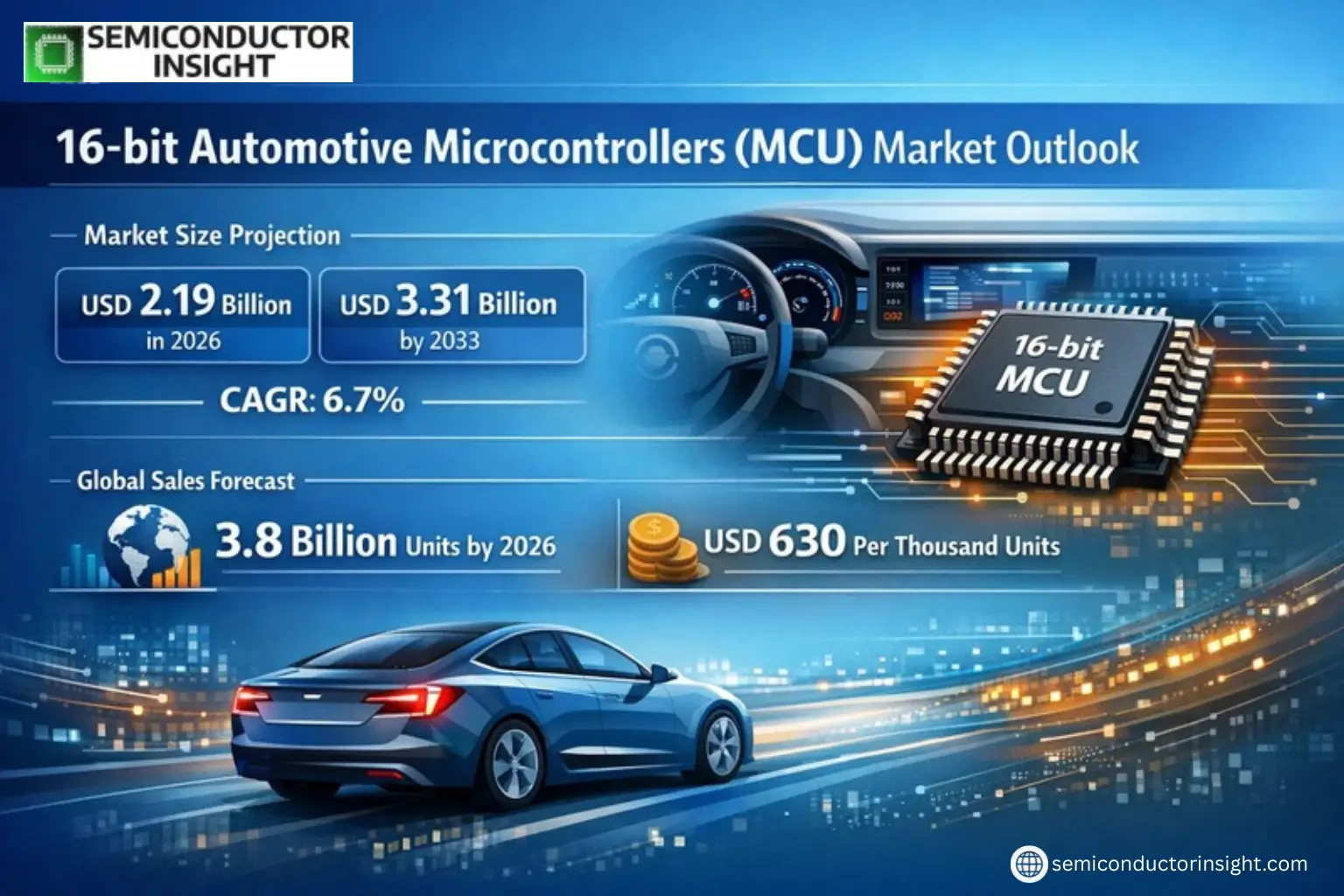
16-bit Automotive Microcontrollers (MCU) Market size was valued at USD 2.19 billion in 2026 and is projected to reach USD 3.31 billion by 2033, exhibiting a CAGR of 6.7% during the forecast period.

PDF Icon Download Sample Report PDF
  • Quick Dispatch

    All Orders

  • Secure Payment

    100% Secure Payment

Price range: $1,500.00 through $4,250.00

Clear

Market Insights

Global 16-bit Automotive Microcontrollers (MCU) Market size was valued at USD 2.19 billion in 2026 and is projected to reach USD 3.31 billion by 2033, exhibiting a CAGR of 6.7% during the forecast period.

Global sales of these MCUs are expected to reach 3.8 billion units by 2026, with an average selling price of approximately USD 630 per thousand units.

16-bit Automotive Microcontrollers (MCU) Market is a specialized computing chip designed for vehicle electronics, integrating a CPU, memory (ROM/RAM/Flash), I/O interfaces, and peripheral modules like ADC, PWM, and CAN bus interfaces. These components enable real-time control for moderately complex automotive applications such as powertrain systems (engine control, electric turbochargers), chassis control (electric power steering, braking systems), and body electronics (lighting and window controls). The industry maintains gross margins between 40%-55%, balancing performance with cost efficiency.

The market growth is driven by increasing vehicle electrification and trends. Electric vehicles require more MCUs for motor control and battery management systems (BMS), while advanced driver-assistance systems (ADAS) and smart cockpits further boost demand. For instance, intelligent vehicles now use up to 300 MCUs per unit, compared to just 70 in traditional gasoline cars. Additionally, stringent functional safety standards (AEC-Q100, ISO 26262) and localization initiatives are accelerating adoption. Key players like Infineon Technologies, NXP Semiconductors, and Renesas Electronics dominate the market with innovations in low-power designs and RISC-V architecture integration.
Xyz market size & forecast

MARKET DRIVERS

Growing Demand for Vehicle Electrification

16-bit Automotive Microcontrollers (MCU) Market is experiencing growth due to increasing adoption of electronic control units (ECUs) in modern vehicles. As automakers transition toward electrified powertrains, the need for efficient, cost-effective 16-bit MCUs has risen significantly. These components are essential for managing basic automotive functions while maintaining optimal power consumption.

Cost-Effectiveness for Mid-Range Applications

16-bit Automotive Microcontrollers (MCU) offer a balanced solution between performance and affordability, making them ideal for non-critical systems like dashboard controls, lighting, and basic sensor management. Unlike 32-bit alternatives, they provide sufficient computational power at a lower price point, driving adoption among cost-sensitive OEMs.

The longevity of 16-bit architectures in legacy automotive systems also contributes to their sustained demand, as manufacturers prefer backward-compatible solutions for gradual upgrades.

MARKET CHALLENGES

Competition from 32-bit and ARM-based MCUs

16-bit Automotive Microcontrollers (MCU) Market faces stiff competition from more advanced 32-bit solutions, which offer higher processing power for advanced driver-assistance systems (ADAS) and connected car features. While 16-bit MCUs remain relevant for basic functions, their market share is increasingly pressured by newer architectures.

Other Challenges

Design Complexity Limitations
16-bit Automotive Microcontrollers (MCU) struggle with more complex automotive applications that require real-time data processing or AI capabilities, limiting their use in premium vehicle segments.

MARKET RESTRAINTS

Slow Innovation Cycle in Legacy Architectures

The development pace for 16-bit Automotive Microcontrollers (MCU) has slowed compared to 32-bit alternatives, as semiconductor companies prioritize R&D investments in more advanced nodes. This technological gap may gradually reduce the competitiveness of 16-bit solutions in the automotive sector.

MARKET OPPORTUNITIES

Emerging Markets for Basic Automotive Electronics

Growing automotive production in developing regions presents significant opportunities for the 16-bit Automotive Microcontrollers (MCU) Market. These cost-sensitive markets often prioritize functionality over advanced features, making 16-bit MCUs an ideal solution for entry-level vehicles and two-wheeler applications.
16-bit Automotive Microcontrollers (MCU) Market Trends

Electrification and Intelligentization Driving Demand Growth

Global 16-bit Automotive Microcontrollers (MCU) Market is experiencing significant growth, valued at USD 2186 million in 2026 with projections reaching USD 3307 million by 2033 at a 6.7% CAGR. This surge is primarily driven by automotive electrification and intelligentization trends. Electric vehicle adoption is increasing demand for 16-bit MCUs in motor control and battery management systems (BMS), with each BMS requiring multiple MCU units. Intelligent vehicle architectures are pushing MCU usage from 70 units in traditional cars to 300 units in smart vehicles, creating sustained demand for cost-effective 16-bit solutions.

Other Trends

Functional Safety and Low-Power Design Innovations

16-bit MCUs are evolving to meet stringent automotive requirements, operating reliably in -40°C to 150°C environments for 15+ years. Manufacturers are enhancing anti-interference capabilities through optimized oscillation circuits and hardware CRC checks while implementing dynamic voltage regulation for power efficiency. The industry is also witnessing adoption of RISC-V architecture to reduce development costs while maintaining reliability standards.

Localization and Supply Chain Reshaping

Geopolitical factors and chip shortages are accelerating domestic production of 16-bit automotive MCUs, with governments supporting local certification processes through tax incentives. Chinese manufacturers like GigaDevice are gaining market share, though international players still dominate 90% of the market. The competitive landscape is shifting as regional suppliers increase production scale and move into higher-value applications.

The market shows strong segmentation by application, with powertrain systems accounting for 38% of 2026 demand, followed by chassis control (29%) and body electronics (22%). Asia-Pacific leads regional growth with 47% market share, driven by China’s automotive production expansion and regional supply chain development.

COMPETITIVE LANDSCAPE

Key Industry Players

Global Leaders Dominate 16-bit Automotive MCU Market with Expanding Regional Presence

16-bit Automotive Microcontrollers (MCU) Market is characterized by strong dominance from established semiconductor giants, with Infineon Technologies, NXP Semiconductors, and Renesas Electronics collectively holding over 60% market share. These leaders leverage their automotive-grade certification expertise, extensive product portfolios, and long-standing relationships with Tier 1 suppliers. Infineon’s AURIX TC2xx series and Renesas’ RL78 family are industry benchmarks for powertrain and body control applications, featuring ASIL-B/C compliance and industrial temperature range operation (-40°C to 125°C). The market exhibits moderate fragmentation with suppliers differentiating through application-specific optimizations – Microchip focuses on low-power designs for electric vehicles while STMicroelectronics leads in integrated motor control solutions.

Emerging players are gaining traction through technological specialization and regional strategies. Chinese manufacturers like GigaDevice and Chipsea Technologies are capturing 10-15% of the domestic market with cost-competitive alternatives meeting AEC-Q100 Grade 1 requirements. Texas Instruments maintains a strong position in analog-integrated MCUs for sensor hubs, while Silicon Laboratories specializes in wireless-connected automotive modules. The market sees increasing vertical integration with IDM players like Toshiba enhancing their 300mm wafer production for automotive MCUs to improve supply chain stability post-2022 shortages.

List of Key 16-bit Automotive MCU Companies Profiled

Segment Analysis:

Segment Category Sub-Segments Key Insights
By Type
  • Basic Control Type
  • Functional Safety Type
  • Power Domain MCU
  • Chassis Domain MCU
Functional Safety Type dominates due to stringent automotive reliability requirements:

  • Critical for safety-critical systems like braking and steering with ISO 26262 compliance
  • Incorporates hardware redundancy and error-correction mechanisms for fault tolerance
  • Growing adoption in ADAS applications requires higher safety integrity levels
By Application
  • Body Electronics
  • Chassis & Powertrain
  • Infotainment & Telematics
  • Safety & Security Systems
Chassis & Powertrain remains the largest application segment:

  • Essential for engine management, transmission control, and electric power steering systems
  • Increasing complexity of hybrid/electric powertrains drives MCU performance requirements
  • Demand rising for motor control units in EV battery management systems
By End User
  • OEMs
  • Tier 1 Suppliers
  • Aftermarket
Tier 1 Suppliers are key adopters:

  • Major system integrators driving innovations in automotive electronics
  • Increasing vertical integration with MCU manufacturers for customized solutions
  • Pushing for higher integration of sensors and actuators in modular designs
By Certification Level
  • AEC-Q100 Grade 1
  • AEC-Q100 Grade 2
  • ISO 26262 ASIL B
  • ISO 26262 ASIL C
AEC-Q100 Grade 1 remains most widely adopted:

  • Balances cost-effectiveness with sufficient temperature range (-40°C to +125°C)
  • Meets requirements for majority of body electronics and basic control applications
  • Lower certification costs make it accessible for mass-market vehicles
By Architecture
  • RISC-V Based
  • ARM Cortex Based
  • Proprietary Cores
ARM Cortex Based architectures lead:

  • Extensive ecosystem of development tools and software libraries available
  • Proven reliability in automotive environments with mature IP blocks
  • Wide adoption enables easier code portability and talent availability

Regional Analysis: Global 16-bit Automotive Microcontrollers (MCU) Market

Asia-Pacific

The Asia-Pacific region dominates the 16-bit Automotive Microcontrollers market, driven by robust automotive production in China, Japan, and South Korea. Local manufacturers increasingly integrate 16-bit MCUs in entry-level and mid-range vehicles to balance performance with cost efficiency. Government initiatives supporting electric vehicle adoption are creating new demand for reliable microcontroller solutions. The region benefits from strong semiconductor supply chains and growing domestic R&D capabilities. OEMs are partnering with local MCU suppliers to develop customized solutions for the Asia-Pacific automotive market, further strengthening the regional ecosystem. Labor cost advantages continue to attract foreign automakers, sustaining demand for cost-effective 16-bit microcontroller solutions in vehicle electronics.

Production Hub Advantage
China’s automotive electronics manufacturing clusters provide efficient supply chains for 16-bit MCU integration, reducing costs and lead times for regional automakers.
EV Market Growth
Expanding electric vehicle production across Asia-Pacific creates demand for reliable 16-bit MCUs in battery management and auxiliary systems.
Localized Solutions
Regional semiconductor firms are developing application-specific 16-bit MCUs tailored to Asian automotive OEM requirements.
Cost Optimization Focus
Automakers prioritize 16-bit architectures for basic control functions where 32-bit capabilities aren’t required, maintaining competitive pricing.

North America
The North American 16-bit Automotive MCU market benefits from established automotive electronics infrastructure and strong aftermarket demand. U.S. manufacturers utilize these microcontrollers in legacy vehicle systems and cost-sensitive new applications. The region’s focus on vehicle connectivity and ADAS features drives selective adoption of 16-bit MCUs for secondary control functions. Regulatory requirements for vehicle safety systems continue to sustain stable demand. Supply chain realignment efforts are improving regional availability of automotive-grade 16-bit microcontroller solutions.

Europe
European automotive OEMs maintain steady demand for 16-bit MCUs in conventional vehicle systems while transitioning to newer architectures for core functions. The region’s stringent emissions standards create opportunities for 16-bit microcontroller applications in engine management refinements. Premium automakers maintain legacy system support, while volume manufacturers optimize costs with balanced MCU solutions. Germany’s strong automotive electronics sector continues to drive technical innovations in 16-bit microcontroller applications.

Middle East & Africa
This emerging market shows growing acceptance of 16-bit automotive microcontrollers in commercial vehicles and entry-level passenger cars. Regional assembly plants increasingly incorporate these cost-effective solutions for basic vehicle functions. The aftermarket sector presents significant opportunities for replacement MCUs due to aging vehicle fleets. Infrastructure development projects are driving demand for commercial vehicles equipped with reliable 16-bit microcontroller-based systems.

South America
Brazil and Argentina lead South America’s adoption of 16-bit automotive MCUs, with focus on economic vehicle segments. Local automakers prioritize these solutions for cost-sensitive models while maintaining necessary performance standards. Government policies promoting domestic vehicle production indirectly support microcontroller demand. The region’s growing middle class continues to drive automotive sales, sustaining steady MCU market growth.

Report Scope

This market research report provides a comprehensive analysis of the 16-bit Automotive Microcontrollers (MCU) Market , covering the forecast period 2026–2033. It offers detailed insights into market dynamics, technological advancements, competitive landscape, and key trends shaping the industry.

Key focus areas of the report include:

  • Market Overview: The report begins with an overview outlining its current market scenario, key growth indicators, and industry transformation drivers. It discusses macroeconomic factors, demand–supply balance, regulatory landscape, and the strategic role of semiconductors in powering advancements across industries such as automotive, telecommunications, consumer electronics, and industrial automation.
  • Market Size & Forecast: Historical data and future projections for revenue, unit shipments, and market value across major regions and segments.
  • Segmentation Analysis: Detailed breakdown by product type, technology, application, and end-user industry to identify high-growth segments and investment opportunities.
  • Regional Insights: Insights into market performance across North America, Europe, Asia-Pacific, Latin America, and the Middle East & Africa, including country-level analysis where relevant.
  • Competitive Landscape: Profiles of leading market participants, including their product offerings, R&D focus, manufacturing capacity, pricing strategies, and recent developments such as mergers, acquisitions, and partnerships.
  • Technology Trends & Innovation: Assessment of emerging technologies, integration of AI/IoT, semiconductor design trends, fabrication techniques, and evolving industry standards.
  • Market Drivers & Restraints: Evaluation of factors driving market growth along with challenges, supply chain constraints, regulatory issues, and market-entry barriers.
  • Stakeholder Insights: Insights for component suppliers, OEMs, system integrators, investors, and policymakers regarding the evolving ecosystem and strategic opportunities.

Primary and secondary research methods are employed, including interviews with industry experts, data from verified sources, and real-time market intelligence to ensure the accuracy and reliability of the insights presented.

FREQUENTLY ASKED QUESTIONS:

What is the current market size of 16-bit Automotive Microcontrollers (MCU) Market?

16-bit Automotive Microcontrollers (MCU) Market size was valued at USD 2.19 billion in 2026 and is projected to reach USD 3.31 billion by 2033, exhibiting a CAGR of 6.7% during the forecast period.

Which key companies operate in 16-bit Automotive Microcontrollers (MCU) Market?

-> Key players include Infineon Technologies, NXP Semiconductors, Renesas Electronics, Microchip Technology, STMicroelectronics, Texas Instruments, Analog Devices, Silicon Laboratories, Toshiba, and Giga Device Semiconductor, among others.

What are the key growth drivers?

-> Key growth drivers include accelerated vehicle electrification and intelligentization, functional safety requirements, and domestic substitution policies driving localization efforts.

Which region dominates the market?

-> Asia is the fastest-growing region, with significant contributions from China, Japan, and South Korea.

What are the emerging trends?

-> Emerging trends include RISC-V architecture adoption for cost reduction, low-power designs for extended battery life, and increasing integration of MCUs in smart cockpits and autonomous driving systems.

Global 16-bit Automotive Microcontrollers (MCU) Market, Size, Trends, Business Strategies 2026-2033

Get Sample Report PDF for Exclusive Insights

Report Sample Includes

  • Table of Contents
  • List of Tables & Figures
  • Charts, Research Methodology, and more...

PDF Icon Download Sample Report PDF

Download Sample Report

Table of Content

Table of Contents
1 Research Methodology and Statistical Scope
1.1 Market Definition and Statistical Scope of 16-bit Automotive Microcontrollers (MCU)
1.2 Key Market Segments
1.2.1 16-bit Automotive Microcontrollers (MCU) Segment by Type
1.2.2 16-bit Automotive Microcontrollers (MCU) Segment by Application
1.3 Methodology & Sources of Information
1.3.1 Research Methodology
1.3.2 Research Process
1.3.3 Market Breakdown and Data Triangulation
1.3.4 Base Year
1.3.5 Report Assumptions & Caveats
2 16-bit Automotive Microcontrollers (MCU) Market Overview
2.1 Global Market Overview
2.1.1 Global 16-bit Automotive Microcontrollers (MCU) Market Size (M USD) Estimates and Forecasts (2019-2030)
2.1.2 Global 16-bit Automotive Microcontrollers (MCU) Sales Estimates and Forecasts (2019-2030)
2.2 Market Segment Executive Summary
2.3 Global Market Size by Region
3 16-bit Automotive Microcontrollers (MCU) Market Competitive Landscape
3.1 Global 16-bit Automotive Microcontrollers (MCU) Sales by Manufacturers (2019-2024)
3.2 Global 16-bit Automotive Microcontrollers (MCU) Revenue Market Share by Manufacturers (2019-2024)
3.3 16-bit Automotive Microcontrollers (MCU) Market Share by Company Type (Tier 1, Tier 2, and Tier 3)
3.4 Global 16-bit Automotive Microcontrollers (MCU) Average Price by Manufacturers (2019-2024)
3.5 Manufacturers 16-bit Automotive Microcontrollers (MCU) Sales Sites, Area Served, Product Type
3.6 16-bit Automotive Microcontrollers (MCU) Market Competitive Situation and Trends
3.6.1 16-bit Automotive Microcontrollers (MCU) Market Concentration Rate
3.6.2 Global 5 and 10 Largest 16-bit Automotive Microcontrollers (MCU) Players Market Share by Revenue
3.6.3 Mergers & Acquisitions, Expansion
4 16-bit Automotive Microcontrollers (MCU) Industry Chain Analysis
4.1 16-bit Automotive Microcontrollers (MCU) Industry Chain Analysis
4.2 Market Overview of Key Raw Materials
4.3 Midstream Market Analysis
4.4 Downstream Customer Analysis
5 The Development and Dynamics of 16-bit Automotive Microcontrollers (MCU) Market
5.1 Key Development Trends
5.2 Driving Factors
5.3 Market Challenges
5.4 Market Restraints
5.5 Industry News
5.5.1 New Product Developments
5.5.2 Mergers & Acquisitions
5.5.3 Expansions
5.5.4 Collaboration/Supply Contracts
5.6 Industry Policies
6 16-bit Automotive Microcontrollers (MCU) Market Segmentation by Type
6.1 Evaluation Matrix of Segment Market Development Potential (Type)
6.2 Global 16-bit Automotive Microcontrollers (MCU) Sales Market Share by Type (2019-2024)
6.3 Global 16-bit Automotive Microcontrollers (MCU) Market Size Market Share by Type (2019-2024)
6.4 Global 16-bit Automotive Microcontrollers (MCU) Price by Type (2019-2024)
7 16-bit Automotive Microcontrollers (MCU) Market Segmentation by Application
7.1 Evaluation Matrix of Segment Market Development Potential (Application)
7.2 Global 16-bit Automotive Microcontrollers (MCU) Market Sales by Application (2019-2024)
7.3 Global 16-bit Automotive Microcontrollers (MCU) Market Size (M USD) by Application (2019-2024)
7.4 Global 16-bit Automotive Microcontrollers (MCU) Sales Growth Rate by Application (2019-2024)
8 16-bit Automotive Microcontrollers (MCU) Market Segmentation by Region
8.1 Global 16-bit Automotive Microcontrollers (MCU) Sales by Region
8.1.1 Global 16-bit Automotive Microcontrollers (MCU) Sales by Region
8.1.2 Global 16-bit Automotive Microcontrollers (MCU) Sales Market Share by Region
8.2 North America
8.2.1 North America 16-bit Automotive Microcontrollers (MCU) Sales by Country
8.2.2 U.S.
8.2.3 Canada
8.2.4 Mexico
8.3 Europe
8.3.1 Europe 16-bit Automotive Microcontrollers (MCU) Sales by Country
8.3.2 Germany
8.3.3 France
8.3.4 U.K.
8.3.5 Italy
8.3.6 Russia
8.4 Asia Pacific
8.4.1 Asia Pacific 16-bit Automotive Microcontrollers (MCU) Sales by Region
8.4.2 China
8.4.3 Japan
8.4.4 South Korea
8.4.5 India
8.4.6 Southeast Asia
8.5 South America
8.5.1 South America 16-bit Automotive Microcontrollers (MCU) Sales by Country
8.5.2 Brazil
8.5.3 Argentina
8.5.4 Columbia
8.6 Middle East and Africa
8.6.1 Middle East and Africa 16-bit Automotive Microcontrollers (MCU) Sales by Region
8.6.2 Saudi Arabia
8.6.3 UAE
8.6.4 Egypt
8.6.5 Nigeria
8.6.6 South Africa
9 Key Companies Profile
9.1 STMicroelectronics NV
9.1.1 STMicroelectronics NV 16-bit Automotive Microcontrollers (MCU) Basic Information
9.1.2 STMicroelectronics NV 16-bit Automotive Microcontrollers (MCU) Product Overview
9.1.3 STMicroelectronics NV 16-bit Automotive Microcontrollers (MCU) Product Market Performance
9.1.4 STMicroelectronics NV Business Overview
9.1.5 STMicroelectronics NV 16-bit Automotive Microcontrollers (MCU) SWOT Analysis
9.1.6 STMicroelectronics NV Recent Developments
9.2 Infineon Technologies AG
9.2.1 Infineon Technologies AG 16-bit Automotive Microcontrollers (MCU) Basic Information
9.2.2 Infineon Technologies AG 16-bit Automotive Microcontrollers (MCU) Product Overview
9.2.3 Infineon Technologies AG 16-bit Automotive Microcontrollers (MCU) Product Market Performance
9.2.4 Infineon Technologies AG Business Overview
9.2.5 Infineon Technologies AG 16-bit Automotive Microcontrollers (MCU) SWOT Analysis
9.2.6 Infineon Technologies AG Recent Developments
9.3 Renesas Electronics Corporation
9.3.1 Renesas Electronics Corporation 16-bit Automotive Microcontrollers (MCU) Basic Information
9.3.2 Renesas Electronics Corporation 16-bit Automotive Microcontrollers (MCU) Product Overview
9.3.3 Renesas Electronics Corporation 16-bit Automotive Microcontrollers (MCU) Product Market Performance
9.3.4 Renesas Electronics Corporation 16-bit Automotive Microcontrollers (MCU) SWOT Analysis
9.3.5 Renesas Electronics Corporation Business Overview
9.3.6 Renesas Electronics Corporation Recent Developments
9.4 Microchip Technology Inc.
9.4.1 Microchip Technology Inc. 16-bit Automotive Microcontrollers (MCU) Basic Information
9.4.2 Microchip Technology Inc. 16-bit Automotive Microcontrollers (MCU) Product Overview
9.4.3 Microchip Technology Inc. 16-bit Automotive Microcontrollers (MCU) Product Market Performance
9.4.4 Microchip Technology Inc. Business Overview
9.4.5 Microchip Technology Inc. Recent Developments
9.5 NXP Semiconductors NV
9.5.1 NXP Semiconductors NV 16-bit Automotive Microcontrollers (MCU) Basic Information
9.5.2 NXP Semiconductors NV 16-bit Automotive Microcontrollers (MCU) Product Overview
9.5.3 NXP Semiconductors NV 16-bit Automotive Microcontrollers (MCU) Product Market Performance
9.5.4 NXP Semiconductors NV Business Overview
9.5.5 NXP Semiconductors NV Recent Developments
9.6 Texas Instruments Incorporated
9.6.1 Texas Instruments Incorporated 16-bit Automotive Microcontrollers (MCU) Basic Information
9.6.2 Texas Instruments Incorporated 16-bit Automotive Microcontrollers (MCU) Product Overview
9.6.3 Texas Instruments Incorporated 16-bit Automotive Microcontrollers (MCU) Product Market Performance
9.6.4 Texas Instruments Incorporated Business Overview
9.6.5 Texas Instruments Incorporated Recent Developments
9.7 Toshiba Corporation
9.7.1 Toshiba Corporation 16-bit Automotive Microcontrollers (MCU) Basic Information
9.7.2 Toshiba Corporation 16-bit Automotive Microcontrollers (MCU) Product Overview
9.7.3 Toshiba Corporation 16-bit Automotive Microcontrollers (MCU) Product Market Performance
9.7.4 Toshiba Corporation Business Overview
9.7.5 Toshiba Corporation Recent Developments
9.8 ROHM Semiconductor
9.8.1 ROHM Semiconductor 16-bit Automotive Microcontrollers (MCU) Basic Information
9.8.2 ROHM Semiconductor 16-bit Automotive Microcontrollers (MCU) Product Overview
9.8.3 ROHM Semiconductor 16-bit Automotive Microcontrollers (MCU) Product Market Performance
9.8.4 ROHM Semiconductor Business Overview
9.8.5 ROHM Semiconductor Recent Developments
9.9 Analog Devices Inc.
9.9.1 Analog Devices Inc. 16-bit Automotive Microcontrollers (MCU) Basic Information
9.9.2 Analog Devices Inc. 16-bit Automotive Microcontrollers (MCU) Product Overview
9.9.3 Analog Devices Inc. 16-bit Automotive Microcontrollers (MCU) Product Market Performance
9.9.4 Analog Devices Inc. Business Overview
9.9.5 Analog Devices Inc. Recent Developments
9.10 ON Semiconductor
9.10.1 ON Semiconductor 16-bit Automotive Microcontrollers (MCU) Basic Information
9.10.2 ON Semiconductor 16-bit Automotive Microcontrollers (MCU) Product Overview
9.10.3 ON Semiconductor 16-bit Automotive Microcontrollers (MCU) Product Market Performance
9.10.4 ON Semiconductor Business Overview
9.10.5 ON Semiconductor Recent Developments
9.11 Cypress Semiconductor Corp
9.11.1 Cypress Semiconductor Corp 16-bit Automotive Microcontrollers (MCU) Basic Information
9.11.2 Cypress Semiconductor Corp 16-bit Automotive Microcontrollers (MCU) Product Overview
9.11.3 Cypress Semiconductor Corp 16-bit Automotive Microcontrollers (MCU) Product Market Performance
9.11.4 Cypress Semiconductor Corp Business Overview
9.11.5 Cypress Semiconductor Corp Recent Developments
9.12 Fujitsu Limited
9.12.1 Fujitsu Limited 16-bit Automotive Microcontrollers (MCU) Basic Information
9.12.2 Fujitsu Limited 16-bit Automotive Microcontrollers (MCU) Product Overview
9.12.3 Fujitsu Limited 16-bit Automotive Microcontrollers (MCU) Product Market Performance
9.12.4 Fujitsu Limited Business Overview
9.12.5 Fujitsu Limited Recent Developments
9.13 Panasonic Corporation
9.13.1 Panasonic Corporation 16-bit Automotive Microcontrollers (MCU) Basic Information
9.13.2 Panasonic Corporation 16-bit Automotive Microcontrollers (MCU) Product Overview
9.13.3 Panasonic Corporation 16-bit Automotive Microcontrollers (MCU) Product Market Performance
9.13.4 Panasonic Corporation Business Overview
9.13.5 Panasonic Corporation Recent Developments
9.14 Saankhya Labs
9.14.1 Saankhya Labs 16-bit Automotive Microcontrollers (MCU) Basic Information
9.14.2 Saankhya Labs 16-bit Automotive Microcontrollers (MCU) Product Overview
9.14.3 Saankhya Labs 16-bit Automotive Microcontrollers (MCU) Product Market Performance
9.14.4 Saankhya Labs Business Overview
9.14.5 Saankhya Labs Recent Developments
9.15 ASM Technologies
9.15.1 ASM Technologies 16-bit Automotive Microcontrollers (MCU) Basic Information
9.15.2 ASM Technologies 16-bit Automotive Microcontrollers (MCU) Product Overview
9.15.3 ASM Technologies 16-bit Automotive Microcontrollers (MCU) Product Market Performance
9.15.4 ASM Technologies Business Overview
9.15.5 ASM Technologies Recent Developments
9.16 Broadcom Inc
9.16.1 Broadcom Inc 16-bit Automotive Microcontrollers (MCU) Basic Information
9.16.2 Broadcom Inc 16-bit Automotive Microcontrollers (MCU) Product Overview
9.16.3 Broadcom Inc 16-bit Automotive Microcontrollers (MCU) Product Market Performance
9.16.4 Broadcom Inc Business Overview
9.16.5 Broadcom Inc Recent Developments
9.17 CDIL
9.17.1 CDIL 16-bit Automotive Microcontrollers (MCU) Basic Information
9.17.2 CDIL 16-bit Automotive Microcontrollers (MCU) Product Overview
9.17.3 CDIL 16-bit Automotive Microcontrollers (MCU) Product Market Performance
9.17.4 CDIL Business Overview
9.17.5 CDIL Recent Developments
9.18 MosChip Semiconductor Technologies
9.18.1 MosChip Semiconductor Technologies 16-bit Automotive Microcontrollers (MCU) Basic Information
9.18.2 MosChip Semiconductor Technologies 16-bit Automotive Microcontrollers (MCU) Product Overview
9.18.3 MosChip Semiconductor Technologies 16-bit Automotive Microcontrollers (MCU) Product Market Performance
9.18.4 MosChip Semiconductor Technologies Business Overview
9.18.5 MosChip Semiconductor Technologies Recent Developments
9.19 HiSilicon
9.19.1 HiSilicon 16-bit Automotive Microcontrollers (MCU) Basic Information
9.19.2 HiSilicon 16-bit Automotive Microcontrollers (MCU) Product Overview
9.19.3 HiSilicon 16-bit Automotive Microcontrollers (MCU) Product Market Performance
9.19.4 HiSilicon Business Overview
9.19.5 HiSilicon Recent Developments
9.20 Will Semiconductor
9.20.1 Will Semiconductor 16-bit Automotive Microcontrollers (MCU) Basic Information
9.20.2 Will Semiconductor 16-bit Automotive Microcontrollers (MCU) Product Overview
9.20.3 Will Semiconductor 16-bit Automotive Microcontrollers (MCU) Product Market Performance
9.20.4 Will Semiconductor Business Overview
9.20.5 Will Semiconductor Recent Developments
10 16-bit Automotive Microcontrollers (MCU) Market Forecast by Region
10.1 Global 16-bit Automotive Microcontrollers (MCU) Market Size Forecast
10.2 Global 16-bit Automotive Microcontrollers (MCU) Market Forecast by Region
10.2.1 North America Market Size Forecast by Country
10.2.2 Europe 16-bit Automotive Microcontrollers (MCU) Market Size Forecast by Country
10.2.3 Asia Pacific 16-bit Automotive Microcontrollers (MCU) Market Size Forecast by Region
10.2.4 South America 16-bit Automotive Microcontrollers (MCU) Market Size Forecast by Country
10.2.5 Middle East and Africa Forecasted Consumption of 16-bit Automotive Microcontrollers (MCU) by Country
11 Forecast Market by Type and by Application (2025-2030)
11.1 Global 16-bit Automotive Microcontrollers (MCU) Market Forecast by Type (2025-2030)
11.1.1 Global Forecasted Sales of 16-bit Automotive Microcontrollers (MCU) by Type (2025-2030)
11.1.2 Global 16-bit Automotive Microcontrollers (MCU) Market Size Forecast by Type (2025-2030)
11.1.3 Global Forecasted Price of 16-bit Automotive Microcontrollers (MCU) by Type (2025-2030)
11.2 Global 16-bit Automotive Microcontrollers (MCU) Market Forecast by Application (2025-2030)
11.2.1 Global 16-bit Automotive Microcontrollers (MCU) Sales (K Units) Forecast by Application
11.2.2 Global 16-bit Automotive Microcontrollers (MCU) Market Size (M USD) Forecast by Application (2025-2030)
12 Conclusion and Key Findings