Touch Panel Computer Market Insights
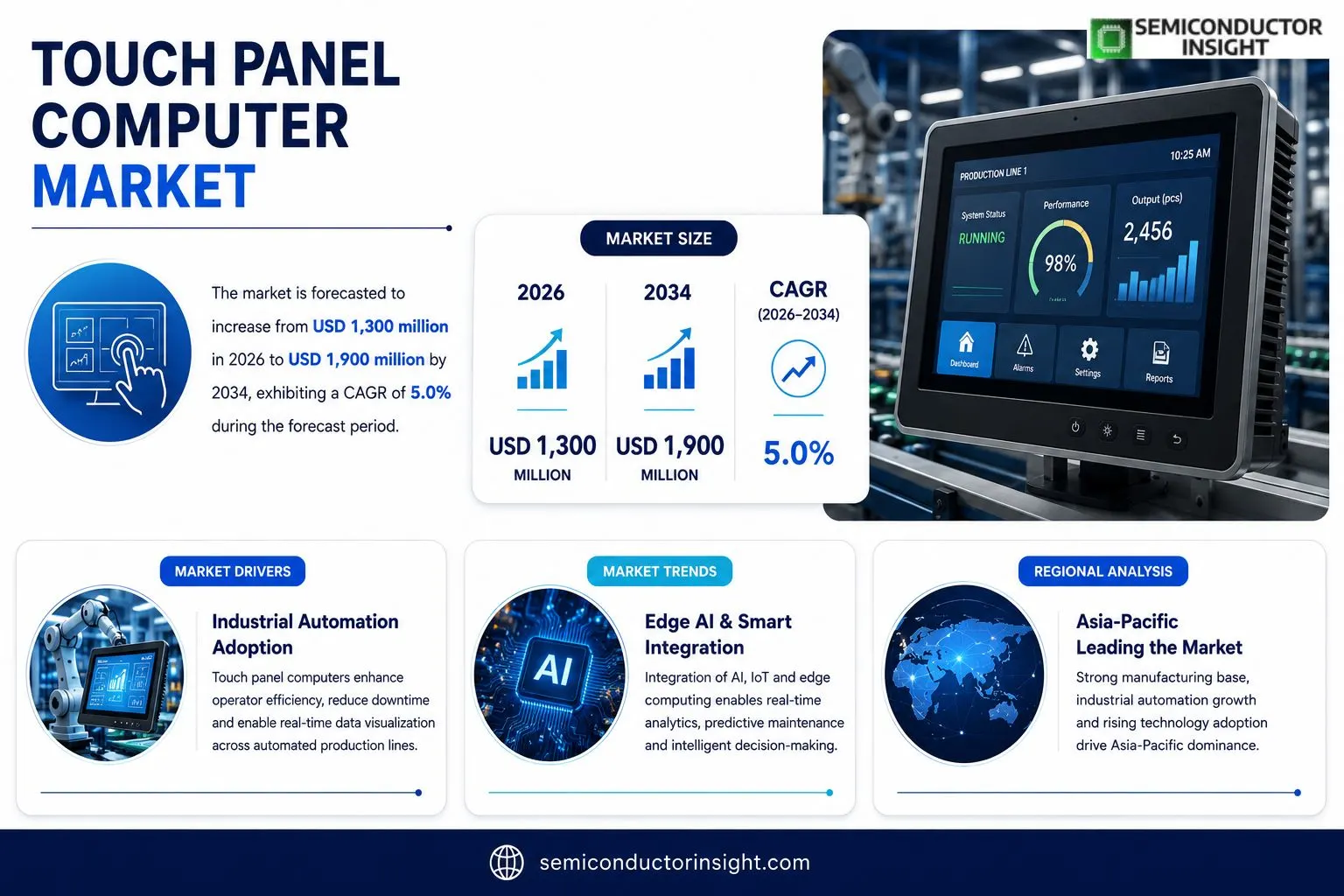
Touch Panel Computer market size was valued at USD 1,220 million in 2025. The market is forecasted to increase from USD 1,300 million in 2026 to USD 1,900 million by 2034, exhibiting a CAGR of approximately 5.0 % during the forecast period.
A panel PC serves as a durable human‑machine interface that combines a display and an embedded computer into a single unit. It delivers intuitive control for machinery, supports rugged operation in harsh production environments, and is employed across HMI, vehicle‑mounted systems, inventory management stations, kiosks and industrial control stations.The expansion reflects broader adoption in education, healthcare, retail and manufacturing because customers seek integrated solutions that reduce footprint while improving reliability. Recent product launches from Advantech, Siemens and Kontron illustrate how manufacturers are addressing demand for larger touch screens and enhanced connectivity options.
MARKET DRIVERS
Industrial Automation Adoption
Manufacturers are integrating touch-enabled compute units into assembly lines to replace legacy button panels. The shift reduces mechanical failure rates and shortens change‑over times, delivering a measurable lift in line efficiency. Operators benefit from intuitive interfaces, which shortens training cycles and improves data capture accuracy.
Retail Experience Transformation
Brick‑and‑mortar retailers are deploying interactive kiosks powered by Touch Panel Computer Market to personalize shopping journeys. Real‑time product visualizations and contactless payment options resonate with post‑pandemic consumer expectations, prompting owners to allocate a larger share of capital budgets to these devices.
➤ “When a storefront can instantly render 3‑D product models on a touch screen, dwell time climbs and conversion rates follow suit,” noted a senior analyst at a leading consultancy.
The convergence of affordable high‑resolution panels with embedded AI inference engines is creating a feedback loop: better user experiences drive higher hardware demand, which in turn fuels further software innovation across Touch Panel Computer Market.
MARKET CHALLENGES
Supply Chain Volatility
Fluctuations in semiconductor output have lengthened lead times for LCD and OLED drivers, forcing OEMs to hold larger inventories. The resulting cost pressure squeezes margins, especially for mid‑tier suppliers that lack the bargaining power of larger players.
Other Challenges
Cost Sensitivity
Enterprise purchasers often benchmark touch computers against traditional PCs, scrutinizing total cost of ownership. If price premiums are not justified by demonstrable productivity gains, adoption rates may stall.
MARKET RESTRAINTS
Regulatory Compliance Burden
In sectors such as healthcare and transportation, touch‑enabled devices must meet stringent safety and hygiene certifications. The time and expense required to achieve IEC 60601 or ISO 26262 compliance often dissuade smaller vendors from entering Touch Panel Computer Market.
MARKET OPPORTUNITIES
Edge Computing Integration
Embedding AI inference at the edge transforms a simple touch interface into a decision engine capable of real‑time anomaly detection, predictive maintenance alerts, and adaptive UI personalization. Companies that can bundle these capabilities with ruggedized hardware stand to capture a growing slice of Touch Panel Computer Market, especially in logistics hubs and smart‑factory deployments.
Touch Panel Computer Market Trends
Industrial Adoption Accelerates
Manufacturers of heavy‑duty equipment are increasingly selecting rugged panel PCs to replace legacy button‑panel consoles. The shift is rooted in the need for durable interfaces that survive temperature swings, vibration, and dust while delivering real‑time visibility into process parameters. Operators benefit from intuitive touch screens, which reduce training time and lower the risk of human error on the shop floor. As automation projects scale, suppliers are tailoring enclosure designs and extending warranty terms to meet the reliability expectations of demanding production lines.
Other Trends
Healthcare Integration
Hospitals and diagnostic centers are deploying touch‑enabled computing devices to streamline patient intake, bedside monitoring, and imaging workflows. The health sector values the hygiene‑centric design of sealed displays, which can be cleaned with disinfectants without compromising functionality. By consolidating multiple peripherals onto a single interactive screen, facilities can free up physical space and reduce cable clutter, supporting the broader agenda of creating smarter, more patient‑focused environments.
Emergence of Edge AI Capabilities
Recent processor advances enable panel computers to execute AI inference locally, eliminating the latency associated with cloud‑based analytics. Edge AI empowers applications such as predictive maintenance, defect detection, and adaptive user interfaces to operate offline, a critical advantage in remote factories or locations with limited connectivity. Vendors that integrate dedicated neural‑processing units into their designs are gaining traction among OEMs seeking to embed intelligence at the point of interaction, thereby enhancing operational efficiency and reducing data‑transfer costs.
COMPETITIVE LANDSCAPE
Key Industry Players
Touch Panel Computer Market – Competitive Overview
Advantech maintains a dominant position in the Touch Panel Computer arena, largely because its portfolio spans ruggedized industrial panels, embedded solutions for logistics, and highly integrated HMI devices for manufacturing floors. The company leverages a vertically integrated supply chain that shortens lead times and secures component quality, allowing it to capture a sizable share of high‑value contracts in automotive assembly and medical imaging. Siemens, with its extensive automation ecosystem, complements the market by bundling panel PCs with proprietary PLC and SCADA software, creating a seamless value proposition for large‑scale plant upgrades. Both firms benefit from recurring revenue streams linked to service contracts and firmware upgrades, which reinforce customer lock‑in and elevate overall market concentration around a few internationally recognized brands.Beyond the headline names, a cadre of specialized manufacturers fills gaps in niche segments that larger players tend to overlook. Winmate excels in ultra‑thin, fan‑less designs suited for retail kiosks, while Axiomtek focuses on modular chassis that cater to edge‑computing deployments in smart factories. Companies such as Beckhoff Automation and B&R Industrial Automation differentiate themselves through deep integration with motion‑control platforms, positioning their panel PCs as core components of advanced robotics cells. Smaller but agile firms like Cincoze and STX Technology target price‑sensitive markets in Southeast Asia, offering stripped‑down yet reliable units that meet local certification requirements. This layered competitive structure generates a dynamic environment where differentiation is driven by form factor, software ecosystem, and regional compliance expertise.
List of Key Touch Panel Computer Companies Profiled
- Advantech
- Siemens
- Winmate
- Axiomtek
- Beckhoff Automation
- B&R Industrial Automation
- Kontron
- ADLINK Technology
- DFI
- NEXCOM
- ARBOR Technology
- IEI Integration Corp
- Cincoze
- STX Technology
Segment Analysis:
| Segment Category | Sub-Segments | Key Insights |
| By Type |
|
11‑17 inch
|
| By Application |
|
Manufacturing
|
| By End User |
|
Industrial Automation
|
| By Interaction Technology |
|
Capacitive Touch
|
| By Deployment Environment |
|
Harsh Environments
|
Regional Analysis: Touch Panel Computer Market
Asia-Pacific
China, Vietnam, and Malaysia dominate the production landscape, offering dense networks of component suppliers that shave lead times dramatically. Their ability to scale volumes while maintaining cost discipline encourages brands to locate assembly lines within the region, creating a feedback loop that draws further investment in automation and quality‑control technologies.
Heavy‑industry operators in Japan and South Korea are integrating touch panel computers into control rooms and production floors, valuing the seamless transition between data visualization and command input. Their procurement strategies prioritize long‑term durability and firmware upgradability, prompting vendors to differentiate on service contracts rather than price alone.
Urban consumers in India and Indonesia increasingly expect interactive displays in retail, hospitality, and education settings. The rise of mobile payment platforms and localized content drives demand for larger, multitouch panels that can support simultaneous user interactions without latency.
Regional standards bodies are harmonizing safety and electromagnetic compatibility requirements, reducing barrier entry for new players. Simultaneously, data‑privacy regulations in markets like Singapore compel manufacturers to embed secure boot and encryption, adding a layer of differentiation for security‑focused offerings.
North America
In the United States and Canada, the market is driven by demand from health‑care facilities and logistics firms that need rugged, low‑latency interfaces. Procurement decisions are often influenced by long‑term service agreements and the ability to integrate with existing enterprise resource planning systems. The prevalence of cloud‑based analytics encourages vendors to embed connectivity options that facilitate real‑time data streaming from the touch panel computers. Although cost pressures exist, buyers prioritize reliability and the capacity to support specialized software stacks over pure price competition.
Europe
European adopters exhibit a strong focus on sustainability and modular design. Regulations around electronic waste push manufacturers toward recyclable materials and easily upgradable hardware. Industries such as aerospace and public transport value the precision of touch response for mission‑critical dashboards, prompting a shift toward high‑resolution, anti‑glare panels. Moreover, multilingual user interfaces are a prerequisite for cross‑border deployments, compelling vendors to invest in localization services that can be toggled on demand.
South America
Brazil and Argentina lead regional uptake, where touch panel computers find applications in point‑of‑sale systems and agricultural monitoring stations. The economic climate encourages cost‑effective solutions, yet there is a growing appetite for devices that can operate in high‑temperature and dust‑laden environments. Local distributors often act as system integrators, adding value through installation and after‑sales support, which influences purchasing preferences toward brands with strong channel networks.
Middle East & Africa
In the Gulf states, premium installations in smart‑city projects and oil‑field monitoring drive demand for high‑performance touch panel computers equipped with advanced networking capabilities. Conversely, sub‑Saharan markets prioritize durability against extreme heat and intermittent power. Partnerships with regional system integrators enable vendors to tailor solutions to disparate infrastructure realities, making after‑market service a decisive factor in winning contracts.
Report Scope
This market research report provides a comprehensive analysis of the Touch Panel Computer Market , covering the forecast period 2026–2034. It offers detailed insights into market dynamics, technological advancements, competitive landscape, and key trends shaping the industry.
Key focus areas of the report include:
- Market Overview: The report begins with an overview outlining its current market scenario, key growth indicators, and industry transformation drivers. It discusses macroeconomic factors, demand–supply balance, regulatory landscape, and the strategic role of semiconductors in powering advancements across industries such as automotive, telecommunications, consumer electronics, and industrial automation.
- Market Size & Forecast: Historical data and future projections for revenue, unit shipments, and market value across major regions and segments.
- Segmentation Analysis: Detailed breakdown by product type, technology, application, and end-user industry to identify high-growth segments and investment opportunities.
- Regional Insights: Insights into market performance across North America, Europe, Asia-Pacific, Latin America, and the Middle East & Africa, including country-level analysis where relevant.
- Competitive Landscape: Profiles of leading market participants, including their product offerings, R&D focus, manufacturing capacity, pricing strategies, and recent developments such as mergers, acquisitions, and partnerships.
- Technology Trends & Innovation: Assessment of emerging technologies, integration of AI/IoT, semiconductor design trends, fabrication techniques, and evolving industry standards.
- Market Drivers & Restraints: Evaluation of factors driving market growth along with challenges, supply chain constraints, regulatory issues, and market-entry barriers.
- Stakeholder Insights: Insights for component suppliers, OEMs, system integrators, investors, and policymakers regarding the evolving ecosystem and strategic opportunities.
Primary and secondary research methods are employed, including interviews with industry experts, data from verified sources, and real-time market intelligence to ensure the accuracy and reliability of the insights presented.
FREQUENTLY ASKED QUESTIONS:
What is the current market size of Touch Panel Computer Market?
-> Touch Panel Computer Market was valued at USD 1,164 million in 2024 and is expected to reach USD 1,634 million by 2031 with a CAGR of 5.1% during the forecast period.
Which key companies operate in Touch Panel Computer Market?
-> Key players include Advantech, Beckhoff Automation, Siemens, Kontron, B&R Industrial Automation, Winmate, Axiomtek, Contec, ADLINK Technology, DFI, NEXCOM, ARBOR Technology, IEI Integration Corp, Ennoconn Technologies, Avalue Technology, AAEON, Cincoze, Teguar Computers, STX Technology.
What are the key growth drivers?
-> Key growth drivers include expanding applications in education, healthcare, retail and industrial sectors, increasing demand for rugged HMI solutions, technological advancements, and growing adoption of IoT and AI in industrial automation.
Which region dominates the market?
-> Asia dominates the market, driven by strong demand in China, Japan, South Korea and Southeast Asia.
What are the emerging trends?
-> Emerging trends include integration of AI and edge computing, larger touchscreen sizes, enhanced ruggedness, 5G connectivity and increased use of panel PCs in smart factory and IoT applications.
Get Sample Report PDF for Exclusive Insights
Report Sample Includes
- Table of Contents
- List of Tables & Figures
- Charts, Research Methodology, and more...
 Download Sample Report PDF