Key Statistics
Key Takeaways
- ARM-based MPUs lead the architecture mix because the ecosystem combines broad IP availability with strong adoption in mobile, embedded and increasingly automotive computing, allowing vendors to tune performance per watt rather than optimise solely for peak clock speed.
- Enterprise and data-center computing is the highest-value demand pool, where processor selection is increasingly tied to accelerator integration, memory bandwidth, virtualization features, security capabilities and total cost of ownership rather than a single benchmark.
- Asia Pacific is the largest regional market because major electronics manufacturing, smartphone assembly, cloud infrastructure and semiconductor supply chains are concentrated across China, Taiwan, South Korea, Japan and Southeast Asia.
- AI acceleration and heterogeneous computing are changing the processor value proposition as CPUs increasingly coordinate with GPUs, NPUs, DSPs and specialized accelerators, increasing the importance of software compatibility and platform-level optimisation.
- Advanced-node cost, power density and supply-chain concentration constrain the market because leading processors require expensive design, packaging, validation and manufacturing capacity, making mistakes in product qualification materially costly for vendors and customers.
- Chiplets and custom silicon are shifting competition away from monolithic CPU performance toward modular compute platforms, allowing system companies and hyperscalers to combine processor cores with accelerators and connectivity blocks for targeted workloads.
Microprocessor Market Overview
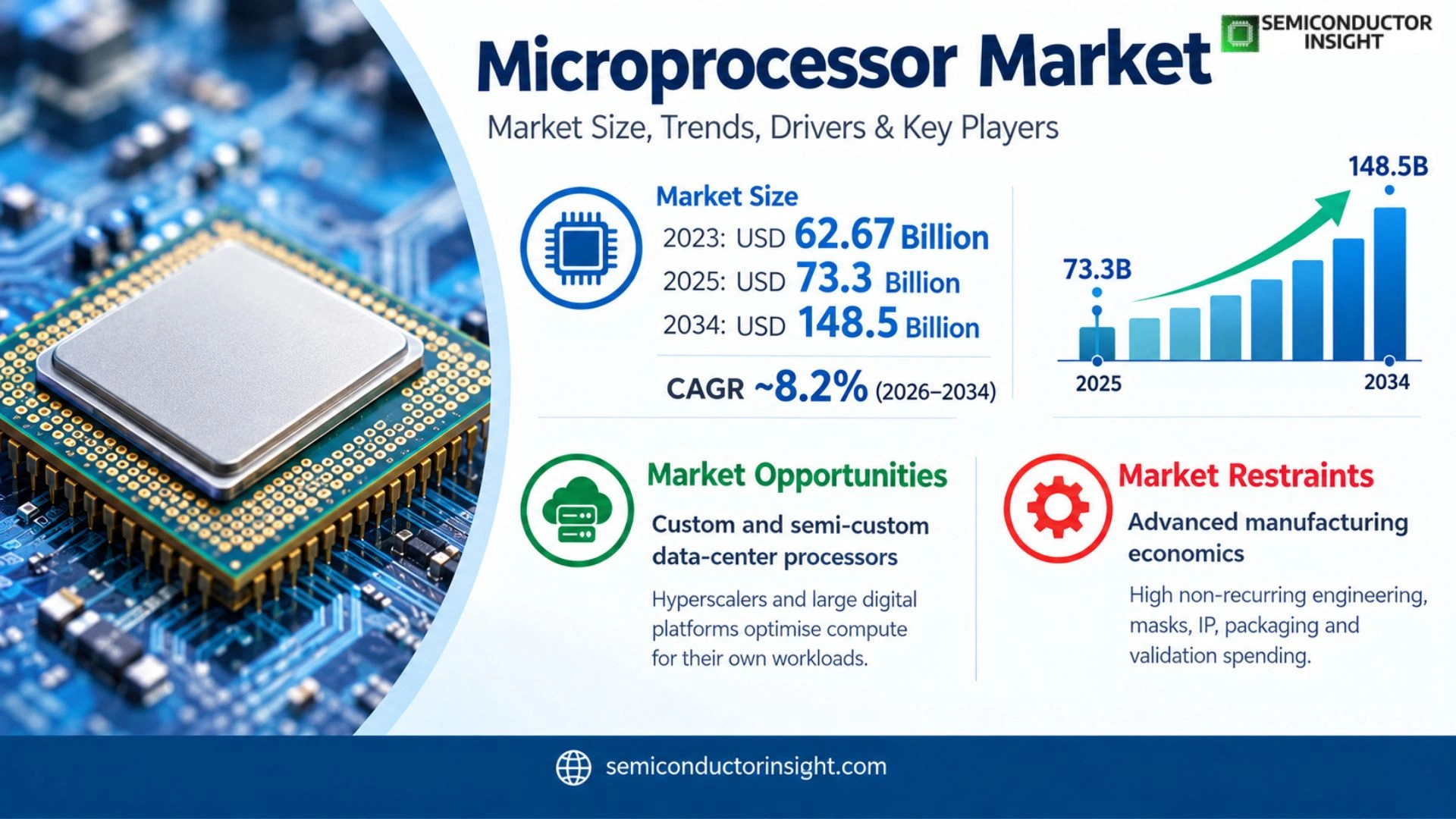
Microprocessor Market was valued at USD 62.67 billion in 2023 and, using the report-page growth anchors for the target window, reaches approximately USD 148.5 billion by 2034 from a rebased USD 73.3 billion in 2025, corresponding to a 8.2% CAGR during 2026–2034. Asia Pacific is the largest regional demand center, reflecting its concentration of device manufacturing, semiconductor assembly and large-scale digital infrastructure.
A microprocessor is a programmable semiconductor device that executes instructions and manages the computational tasks of a system through arithmetic, control, memory and input-output operations. Modern microprocessors may be used as stand-alone CPUs or as the principal compute engine within a larger platform that also contains memory controllers, graphics engines, AI accelerators, security blocks and connectivity interfaces. The commercial market therefore spans processors designed for personal computing, servers, communications, embedded equipment, industrial systems and other computing-intensive products.
The purchasing requirement has moved from raw processing speed toward balanced performance per watt, predictable software behaviour, secure execution and workload-specific acceleration. Data-center operators need processors that deliver high throughput while controlling rack power and cooling requirements, while PCs and mobile platforms place greater emphasis on battery life and responsiveness. Automotive and industrial customers add long qualification periods, extended availability and functional-safety considerations, creating a market in which the technical product and the supporting ecosystem are sold together.
Processor architecture is also being reorganized around heterogeneous computing. A CPU may now coordinate multiple core classes, graphics engines, neural accelerators, media blocks and high-speed memory interfaces, while chiplet architectures allow designers to combine compute and I/O functions with different process technologies. This model helps suppliers improve yield, shorten product cycles and target workload-specific performance, but it increases requirements for packaging, firmware, interconnect standards, software tooling and system validation.
Demand is changing now because AI, cloud infrastructure and edge intelligence have created workloads that are more diverse than the traditional PC-centric model. Intel reported 2025 Data Center and AI revenue of USD 16.9 billion and Client Computing revenue of USD 32.2 billion, while AMD reported 2025 Data Center revenue of USD 16.6 billion and Client revenue of USD 10.6 billion. These company results illustrate how processor economics increasingly depend on both data-center acceleration and client-platform refresh cycles. Intel 2025 results
Segment Analysis: By Type
The report scope divides microprocessors into ARM-Based MPUs, X86-Based MPUs and Others. ARM-based designs have the broadest expansion path across mobile and embedded computing, while x86 remains deeply established in PCs and servers. The Others category includes alternative instruction-set and implementation approaches that gain relevance where customers value customization, openness or specialised workload optimisation.
| Type | Architecture / role | Market position |
|---|---|---|
| ARM-Based MPUs | ARM instruction-set implementations used across mobile, embedded, automotive and selected data-center systems. The model supports licensing and custom core design, enabling different vendors to tune performance, power and integration for their target products. | Largest strategic growth platform. Competitive strength comes from a mature software ecosystem, broad IP availability and flexibility to create application-specific compute products. The key commercial test is not only core performance but compatibility, development support, security and long product availability. |
| X86-Based MPUs | Processors built around the x86 instruction-set ecosystem and widely deployed in PCs, workstations and enterprise servers. They benefit from a very large installed software base, extensive operating-system support and decades of application compatibility. | Established high-value segment. Its installed base creates switching costs, while server and PC customers increasingly evaluate performance per watt, platform security, memory bandwidth and accelerator integration alongside traditional benchmark results. |
| Others | Alternative architectures and implementation approaches, including emerging RISC-V deployments and specialised processor platforms that do not fit the two primary categories. Adoption depends on software ecosystem maturity and the economic value of customisation. | Smaller but strategically important. Growth is strongest where customers need architectural control, domain-specific optimisation or reduced dependence on established licensing structures. Adoption remains constrained by software migration, validation and ecosystem depth. |
Architecture economics and design selection
Processor architecture decisions are increasingly made at the platform level rather than by selecting a CPU in isolation. A mobile device may combine an ARM CPU cluster with an NPU, GPU, ISP and modem, while a server platform can pair general-purpose CPU cores with accelerators and high-bandwidth memory. Customers therefore assess software portability, developer tools, compiler support, power envelopes, memory architecture and lifecycle support. This broad decision set allows architecture suppliers to capture value through ecosystems and reference platforms as well as processor silicon.
Segment Analysis: By Application
The report identifies PCs, Servers, Mainframes; Tablets; Cellphones; and Embedded MPUs as the principal application groups. PCs and servers remain major revenue pools, but mobile and embedded applications expand the addressable market through energy-efficient computing, edge intelligence and increasing silicon content in connected equipment.
| Application | Demand characteristics |
|---|---|
| PCs, Servers & Mainframes | Purchasing is tied to refresh cycles, cloud expansion, workload consolidation and demand for higher performance per watt. Enterprise buyers also evaluate virtualization, security, memory capacity and platform stability, which makes processor validation a multi-year decision rather than a simple component purchase. |
| Tablets | Demand is driven by lightweight computing, media consumption, productivity and increasingly on-device AI features. Battery efficiency and integrated graphics are significant purchasing triggers because thermal limits and enclosure size constrain sustained performance. Processor suppliers compete through platform efficiency and strong mobile software compatibility. |
| Cellphones | Smartphone designs integrate the CPU into highly integrated application processors where imaging, connectivity, AI, graphics and power management work together. The purchase trigger is system-level performance per watt, with processor selection closely tied to modem integration, camera pipelines, display support and device lifecycle requirements. |
| Embedded MPUs | Industrial, automotive, networking and edge devices prioritise deterministic behaviour, long availability, security and environmental robustness. Buyers may accept lower peak performance in exchange for low power, extended support and predictable software behaviour, which gives specialised processor platforms room to compete against high-volume consumer parts. |
Regional Analysis
Asia Pacific is the largest regional microprocessor market, supported by the concentration of electronics assembly, smartphone production, semiconductor manufacturing and growing cloud infrastructure. North America remains a major design and data-center market, Europe is strong in automotive and industrial computing, while Latin America and Middle East & Africa are smaller but increasingly linked to connected devices, digital infrastructure and local industrial automation.
How do regional processor economics differ across the global market?
Regional demand is shaped by different commercial mechanisms. Asia Pacific combines high-volume device manufacturing with expanding data-center and automotive capacity, North America concentrates processor design, cloud infrastructure and enterprise purchasing power, and Europe places greater weight on automotive reliability and industrial control. Latin America depends more heavily on imported systems and channel availability, while Middle East & Africa demand is linked increasingly to data infrastructure, telecom modernisation and national digitalisation programmes. These differences affect product mix, qualification needs, distribution strategy and service models.
| Region | Position | Growth outlook | Demand profile | Supplier selection |
|---|---|---|---|---|
| Asia Pacific | Largest | Highest | Manufacturing + digital infrastructure | Local ecosystem, power efficiency, platform compatibility |
| North America | Second | High | Cloud, enterprise + design | Performance, software ecosystem, supply assurance |
| Europe | Third | Moderate-high | Automotive + industrial | Functional safety, longevity, energy efficiency |
| Latin America | Fourth | Moderate | Imported platforms + enterprise | Channel access, price-performance, serviceability |
| Middle East & Africa | Emerging | Moderate-high | Data infrastructure + telecom | Supply continuity, systems integration, support |
Competitive Landscape
The competitive landscape is concentrated around a small number of processor architecture and silicon platforms with large software ecosystems, extensive developer tools and long-standing OEM relationships. Key Industry Players compete through core performance, energy efficiency, integrated acceleration, memory and I/O capability, security, packaging, software compatibility and supply assurance. The most defensible positions are created when the processor becomes part of a complete platform covering silicon, firmware, compilers, operating systems, reference designs and customer support.
Intel and AMD remain major x86 suppliers across PC and server markets, while Arm influences a broad ecosystem through instruction-set and core licensing. Apple, Qualcomm, MediaTek and Samsung develop highly integrated processors or application processors for mobile and client devices, and NVIDIA is expanding CPU participation alongside its accelerator leadership. Competition increasingly occurs at the platform level because customers compare complete compute architectures, not only the processor die. This favours companies with strong software stacks, developer ecosystems and the ability to integrate CPUs with accelerators and high-speed memory.
The data-center market intensifies the focus on workload-specific efficiency. AMD reported 2025 Data Center revenue of USD 16.6 billion, while Intel reported 2025 DCAI revenue of USD 16.9 billion. These figures are company revenues, not market shares, but they show the scale of the two suppliers’ exposure to enterprise compute. Competitive pressure is therefore moving toward AI integration, memory bandwidth, networking, virtualization, security and total cost of ownership, with customer deployments increasingly evaluating processor platforms over multi-year procurement cycles.
Key Industry Players
| Player | Competitive role |
|---|---|
| Intel Corporation | Major x86 supplier across client and data-center processors, with broad OEM relationships, platform software and manufacturing capabilities. Buyer decisions typically combine processor performance, software compatibility, power efficiency, supply continuity, security and lifecycle support rather than a single specification. |
| Advanced Micro Devices, Inc. | x86 processor supplier spanning EPYC server processors and Ryzen client products, with a growing emphasis on chiplets and performance per watt. Buyer decisions typically combine processor performance, software compatibility, power efficiency, supply continuity, security and lifecycle support rather than a single specification. |
| Arm Holdings plc | Architecture and IP provider supporting a broad ecosystem of licensees across mobile, embedded, automotive and increasingly server computing. Buyer decisions typically combine processor performance, software compatibility, power efficiency, supply continuity, security and lifecycle support rather than a single specification. |
| Apple Inc. | Designs highly integrated Apple silicon processors for Macs and mobile products, emphasising vertical hardware-software integration and energy efficiency. Buyer decisions typically combine processor performance, software compatibility, power efficiency, supply continuity, security and lifecycle support rather than a single specification. |
| Qualcomm Technologies, Inc. | Develops Arm-based compute platforms for smartphones, PCs, automotive and edge devices, with strong connectivity integration. Buyer decisions typically combine processor performance, software compatibility, power efficiency, supply continuity, security and lifecycle support rather than a single specification. |
| MediaTek Inc. | Large fabless processor supplier for mobile, consumer and edge devices, competing through integration, power efficiency and cost-performance. Buyer decisions typically combine processor performance, software compatibility, power efficiency, supply continuity, security and lifecycle support rather than a single specification. |
| Samsung Electronics Co., Ltd. | Develops processor and semiconductor platforms for mobile and broader electronics applications and participates deeply in the Asian semiconductor ecosystem. Buyer decisions typically combine processor performance, software compatibility, power efficiency, supply continuity, security and lifecycle support rather than a single specification. |
| NVIDIA Corporation | Extending processor participation alongside GPUs and accelerated computing platforms, particularly in data-center and AI infrastructure. Buyer decisions typically combine processor performance, software compatibility, power efficiency, supply continuity, security and lifecycle support rather than a single specification. |
| Broadcom Inc. | Provides semiconductor platforms for networking, connectivity and custom compute applications, supporting infrastructure-level processing requirements. Buyer decisions typically combine processor performance, software compatibility, power efficiency, supply continuity, security and lifecycle support rather than a single specification. |
| Renesas Electronics Corporation | Embedded processor supplier serving automotive, industrial and infrastructure applications where long lifecycle and integration requirements are important. Buyer decisions typically combine processor performance, software compatibility, power efficiency, supply continuity, security and lifecycle support rather than a single specification. |
| NXP Semiconductors N.V. | Embedded processing supplier with strong automotive and industrial exposure, combining processors with connectivity and security functions. Buyer decisions typically combine processor performance, software compatibility, power efficiency, supply continuity, security and lifecycle support rather than a single specification. |
| Texas Instruments Incorporated | Broad embedded processor and microcontroller supplier for industrial, automotive and personal electronics applications, supported by long product lifecycles. Buyer decisions typically combine processor performance, software compatibility, power efficiency, supply continuity, security and lifecycle support rather than a single specification. |
| STMicroelectronics N.V. | Supplies microprocessors and embedded computing solutions across automotive, industrial and consumer markets with emphasis on integrated systems. Buyer decisions typically combine processor performance, software compatibility, power efficiency, supply continuity, security and lifecycle support rather than a single specification. |
| Microchip Technology Incorporated | Embedded processor and microcontroller supplier serving industrial, automotive, aerospace and infrastructure applications. Buyer decisions typically combine processor performance, software compatibility, power efficiency, supply continuity, security and lifecycle support rather than a single specification. |
| SiFive, Inc. | RISC-V processor IP company enabling customised processor implementations for embedded and specialised compute applications. Buyer decisions typically combine processor performance, software compatibility, power efficiency, supply continuity, security and lifecycle support rather than a single specification. |
How competition is won
Processor wins are usually determined before volume production begins because architecture, software and validation choices become embedded deeply into the customer platform. A supplier that offers strong development tools, predictable firmware, reference boards, operating-system support and long-term supply can reduce engineering risk enough to justify a processor premium. This is especially important in automotive, industrial and data-center deployments, where qualification can span multiple design cycles and where an unexpected change in the processor roadmap can force expensive system revalidation.
Production Capacity Analysis
Microprocessor capacity is constrained by a combination of advanced semiconductor fabrication, leading-edge packaging, substrate availability, memory and I/O components, test capacity and engineering qualification. The industry is not capacity-constrained in exactly the same way as a commodity semiconductor market: a supplier may have access to wafer capacity but still face limits in advanced packaging, high-end substrate supply, validation throughput or the availability of a specific fabrication node. Capacity planning therefore requires coordination across design, foundry and packaging partners.
Leading processors increasingly use chiplet architectures and advanced packaging to combine compute, I/O, cache, accelerators and other functions. This can improve design economics and yield, but it increases dependence on packaging substrates, interconnect technology and assembly-test capacity. TSMC reported that 3 nm represented 24% of its 2025 wafer revenue and that advanced technologies at 7 nm and below accounted for 74%, illustrating how strongly leading compute products depend on advanced process capacity. The commercial implication is that processor suppliers must secure foundry and packaging availability early to support product ramps.
Capacity risk also arises from geographical concentration. Intel’s 2025 annual report showed customer-billing revenue across the United States, China, Singapore, Taiwan and other regions, while TSMC’s customer base remained heavily weighted to North America by billing location. These figures do not measure manufacturing capacity directly, but they illustrate a globally distributed demand base that depends on a relatively concentrated semiconductor production ecosystem. Supply interruptions, export controls or packaging bottlenecks can therefore affect product availability across multiple end markets simultaneously.
Market Dynamics
The market is being pulled forward by AI-enabled workloads, cloud expansion, edge computing and higher electronic content in vehicles, but the shape of growth is changing. Performance per watt, memory bandwidth, software compatibility, security and advanced packaging now influence purchase decisions alongside raw compute throughput. At the same time, advanced-node economics, product qualification and geopolitical sourcing risks make the processor business more capital intensive and less forgiving of design or supply-chain errors.
Market Drivers
| Driver | Directional impact* | Mechanism |
|---|---|---|
| AI and accelerated computing | High | AI workloads require processors that can coordinate CPUs with GPUs, NPUs and other accelerators, increasing demand for platforms with high memory bandwidth, strong interconnects and efficient scheduling. |
| Cloud and data-center expansion | High | New and upgraded data-center capacity creates recurring demand for server processors where operators optimise performance per watt, rack density and total cost of ownership. |
| Automotive electronic content | Medium-high | ADAS, infotainment, gateways and zonal architectures raise the need for embedded compute with stronger safety, security and networking capabilities. |
| Edge and IoT computing | Medium-high | Local inference and real-time control move computation closer to sensors and machines, expanding demand for low-power processors and embedded MPUs. |
| Chiplet adoption | Medium | Modular processor design allows suppliers to combine compute and I/O functions more flexibly, supporting product differentiation and potentially improving design economics. |
AI is changing processor architecture
AI workloads require more than CPU arithmetic. Systems increasingly combine general-purpose cores with accelerators, high-speed memory and software runtimes that divide work according to latency and energy requirements. Processor suppliers therefore invest in heterogeneous architectures and on-chip or package-level acceleration. The commercial implication is that CPU vendors that can provide the full platform are better placed to capture AI-driven spending than vendors competing solely on conventional general-purpose benchmark scores.
Data-center efficiency is a purchasing metric
Data-center customers pay for electricity, cooling and physical space as well as processor acquisition. A processor that reduces work per watt can therefore create operating savings over several years, even when the initial component price is higher. This changes competition toward energy efficiency, memory architecture, software optimisation and platform density, rewarding suppliers that can demonstrate system-level economics rather than isolated peak performance.
Automotive electronics increase embedded compute value
Vehicle architectures are moving toward more centralised and zonal compute, concentrating functions that were previously distributed across many controllers. That creates demand for more capable processors with secure boot, networking, functional-safety support and long-term availability. Suppliers that win early vehicle programmes can retain demand for many years, making automotive processor qualification strategically attractive despite its longer development cycle and higher validation burden.
Edge computing extends the processor addressable market
Factories, cameras, robots, gateways and connected equipment increasingly require local processing because sending every workload to a remote cloud can add latency, bandwidth cost or security exposure. Embedded processors therefore gain value when they can deliver sufficient compute under constrained power and thermal envelopes. Vendors can capture this opportunity through integrated connectivity, security and acceleration that simplifies system design.
Market Restraints
| Restraint | Directional impact* | Mechanism |
|---|---|---|
| Advanced-node and packaging cost | High negative | Leading processors require expensive design, wafers, advanced packaging, validation and engineering resources, raising financial risk when volumes or yields differ from plan. |
| Power and thermal limits | Medium-high negative | Higher compute density increases cooling and power-management requirements, limiting how much performance can be added without system-level redesign. |
| Software ecosystem dependence | Medium negative | Architectural changes can require toolchain, operating-system and application adaptation, making ecosystem maturity a major barrier to new entrants. |
| Supply-chain concentration | Medium-high negative | Foundry, substrate, advanced-packaging and specialised component concentration can create shortages that constrain processor shipments even when end demand remains strong. |
| Qualification cycles | Medium negative | Automotive, industrial and enterprise customers require extensive validation, lengthening sales cycles and raising the cost of product or supplier changes. |
Advanced manufacturing economics
Processor development at leading nodes requires substantial non-recurring engineering, mask, IP, packaging and validation spending. The investment can be justified at very large volumes, but products targeting smaller niches face a higher cost burden per device. This reinforces the power of established vendors and large platform customers while encouraging chiplet reuse, shared IP and modular designs that can spread engineering costs across several products.
Thermal density limits performance scaling
As transistor density and workload intensity rise, thermal design becomes a system-level constraint. Faster cores, larger accelerator blocks and higher memory bandwidth can create heat that must be removed from increasingly compact packages. Designers therefore balance frequency, core count, accelerator utilisation and power management rather than simply maximising theoretical throughput. Suppliers that cannot manage thermal behaviour risk lower sustained performance even when peak specifications appear competitive.
Software migration slows architecture shifts
Processors are valuable partly because applications, operating systems, compilers and developer tools already work with them. A new architecture may provide technical advantages but still face adoption resistance if customers must port or validate large software estates. The barrier is strongest in enterprise, industrial and embedded environments where software can remain in service for years, making ecosystem investment essential to gaining architectural share.
Qualification increases switching cost
Automotive, industrial and other reliability-sensitive markets evaluate processor changes through extensive testing, documentation and lifecycle planning. Once a processor is qualified, buyers have strong incentives to keep the same family unless performance, cost or supply security improves materially. This protects incumbents but also makes each new design win highly valuable because the resulting revenue can persist across multiple product generations.
Market Opportunities
Custom and semi-custom data-center processors
Hyperscalers and large digital platforms increasingly optimise compute for their own workloads. Suppliers can benefit by providing modular CPU architectures, custom accelerators, chiplet integration and advanced packaging that allow customers to differentiate while avoiding a fully independent semiconductor-development stack. The opportunity is concentrated among companies able to deliver both silicon and ecosystem support at large production scale.
Automotive domain and zonal processors
Centralised vehicle architectures increase compute concentration, creating opportunities for processors that combine CPU performance, AI acceleration, networking, safety features and security. Semiconductor suppliers can capture value by supporting reference architectures and long qualification cycles. The commercial benefit is potentially longer product revenue duration, while the main differentiator becomes predictable lifecycle support rather than short consumer refresh cycles.
Edge AI and industrial compute
Factories, cameras, robots and gateways require local intelligence with low latency and controlled power consumption. Processors that integrate AI acceleration, connectivity, security and real-time control can reduce system complexity and simplify deployment. Suppliers benefit when they provide development tools and reference designs that enable industrial customers to move from pilot systems into repeatable product architectures without building a new software stack for every device.
RISC-V and architecture diversification
Alternative instruction-set ecosystems create an opportunity for customers that value architectural control, customisation or reduced dependence on established processor licensing structures. The commercial opportunity is strongest in embedded and specialised workloads where software scope is manageable and differentiation can be built into the hardware. Winning requires a mature toolchain, operating-system support, verification capability and a clear migration path for developers.
Supply Chain Analysis
Architecture and IP
The first stage captures value through processor core design, instruction-set architecture, interconnects, security blocks and workload-specific acceleration. Companies with mature IP can reuse proven building blocks across product families, lowering engineering risk while still customising memory, cache and accelerator arrangements. The bottleneck is increasingly verification and software enablement because a processor that is technically correct but poorly supported can struggle to secure platform adoption.
Wafer fabrication
Fabrication determines transistor density, power characteristics and a substantial part of processor cost. Leading products require access to advanced process technologies, while embedded and industrial products may use mature nodes where long-term capacity and predictable supply are more important. Foundry access therefore becomes a strategic commercial asset, and processor suppliers must coordinate forecasts early enough to protect capacity during product transitions and demand spikes.
Advanced packaging and test
Modern processors increasingly rely on advanced packaging to connect multiple dies, memory stacks and I/O components. This raises the importance of substrates, package assembly, thermal interfaces and test capacity. Packaging can become the practical bottleneck even when wafer output is sufficient, particularly for products with complex chiplet configurations. Suppliers that secure packaging capacity and maintain strong test processes can reduce launch risk and improve product availability.
System integration
The final value capture occurs when processor silicon becomes part of a PC, server, phone, vehicle platform or industrial system. OEMs and system integrators evaluate software compatibility, validation, thermals, board design, security and service support alongside processor specifications. Winning this stage establishes recurring demand, but the supplier must preserve product continuity and documentation because system redesigns can be expensive and customers prefer stable platforms across multiple product generations.
Recent Developments
February 24, 2025 — Intel expands Xeon 6 with P-core processors for AI and networking
Intel announced additional Xeon 6 processors with Performance-cores for data-center and infrastructure workloads and described support for AI, networking and consolidation use cases. The development matters to the microprocessor market because it shows how server processors are being differentiated around workload characteristics, accelerator integration and efficiency rather than a single general-purpose performance target. The commercial effect is greater segmentation of processor families and more opportunity for customers to match processor design to workload economics. Source: Intel Newsroom
January 2026 — AMD reports strong 2025 processor demand across data center and client markets
AMD reported full-year 2025 revenue of USD 34.6 billion, with Data Center revenue of USD 16.6 billion and Client revenue of USD 10.6 billion. The result demonstrates that processor demand is being supported simultaneously by cloud infrastructure and PC refresh cycles. AMD also reported a 15% increase in processor unit shipments and a 31% increase in processor average selling price in its client business, highlighting how product performance and mix can change processor economics as premium platforms gain adoption. Source: AMD 2025 10-K
January 2026 — TSMC reports advanced technologies at 74% of 2025 wafer revenue
TSMC reported that 3 nm technology contributed 24% of total wafer revenue in 2025 and that technologies at 7 nm and below represented 74% of total wafer revenue. This matters to the processor market because leading CPUs increasingly depend on advanced process nodes to balance performance, power and transistor density. The result reinforces the strategic importance of foundry relationships and advanced packaging access for processor suppliers preparing products for AI, data-center and premium client workloads. Source: TSMC
October 2025 — Intel previews Core Ultra 3 and Xeon 6+ on Intel 18A
Intel’s 2025 technology tour highlighted Core Ultra 3 and Xeon 6+ products using Intel 18A and identified Fab 52 in Arizona as a manufacturing site for these products. The development is commercially important because it links processor roadmap competition with domestic advanced-node manufacturing and provides a concrete example of how processor suppliers are using new process technologies to improve power efficiency and product differentiation. It also demonstrates the increasing strategic importance of manufacturing geography in advanced processor supply. Source: Intel Newsroom
Report Scope & Segmentation
| Attribute | Details |
|---|---|
| Market | Global Microprocessor Market covering programmable CPU/MPU products used in personal computing, enterprise infrastructure, embedded systems, mobile devices and other computing platforms. |
| Target window | 2025 base year with forecast period 2026–2034; historical context referenced from 2020 onward where relevant to market evolution and company results. |
| By Type | ARM-Based MPUs; X86-Based MPUs; Others. |
| By Application | PCs, Servers, Mainframes; Tablets; Cellphones; Embedded MPUs. |
| By End User | Consumer Electronics; Enterprise & Datacenter; Industrial Automation. |
| By Architecture Ecosystem | Licensed Cores such as ARM; Proprietary Architectures such as x86; RISC-V. |
| By Performance Tier | High-Performance Computing; Mainstream & Mobile; Ultra-Low Power. |
| Regions | North America; Europe; Asia Pacific; Latin America; Middle East & Africa, with country-level examples covering major processor demand and manufacturing ecosystems. |
| Key Industry Players | Intel Corporation; Advanced Micro Devices, Inc.; Arm Holdings plc; Apple Inc.; Qualcomm Technologies, Inc.; MediaTek Inc.; Samsung Electronics Co., Ltd.; NVIDIA Corporation; Broadcom Inc.; Renesas Electronics Corporation; NXP Semiconductors N.V.; Texas Instruments Incorporated; STMicroelectronics N.V.; Microchip Technology Incorporated; SiFive, Inc. |
Frequently Asked Questions
What was the microprocessor market size used for the 2025 rebased baseline?
The market was anchored to the report-page value of USD 62.67 billion in 2023 and the USD 126.91 billion value for 2032, producing a rebased 2025 baseline of approximately USD 73.3 billion when the target-window arithmetic is applied. The same growth factor produces a 2034 value of approximately USD 148.5 billion and a computed CAGR of about 8.2% for 2026–2034.
What is the projected microprocessor market size for 2034?
The 2034 rebased market size is approximately USD 148.5 billion. This endpoint is derived from the two report-page anchors used for the market series and the constant annual growth factor between those anchors. The 2034 figure therefore represents the consistent continuation of the source-page series into the requested 2025–2034 target window rather than a new estimate from a separate market-sizing source.
What is the expected CAGR during 2026–2034?
The computed CAGR is approximately 8.2% for 2026–2034. The rate follows from the annual growth factor implied by the USD 62.67 billion 2023 anchor and USD 126.91 billion 2032 anchor. It is the internally consistent growth rate of that series and is carried into the article’s statistics, regional interpretation and scope framing.
Which region is the largest microprocessor market?
Asia Pacific is treated as the largest regional market because the region combines major electronics manufacturing, smartphone and PC production, semiconductor fabrication, automotive electronics and expanding data-center infrastructure. These overlapping demand and supply ecosystems create a broader processor opportunity than any single application market in another region and reinforce the importance of local ecosystem relationships for suppliers.
Which processor architecture has the strongest strategic growth position?
ARM-based MPUs have the strongest strategic expansion path because ARM architectures support a broad range of mobile, embedded and automotive products while also gaining relevance in other computing environments. Their flexibility allows suppliers to customise performance, power and integration, although the commercial outcome still depends heavily on software support, developer tools, customer qualification and long-term platform stability.
What are the main microprocessor applications?
The defined applications are PCs, Servers and Mainframes; Tablets; Cellphones; and Embedded MPUs. These applications create different purchasing requirements: data centers prioritise performance per watt and total cost of ownership, mobile devices prioritise integration and battery life, while embedded systems emphasise long availability, security, deterministic operation and reliable support throughout the customer product lifecycle.
Why are AI workloads important to microprocessor demand?
AI workloads increase the amount and diversity of computation required at the data center and at the edge. Processors increasingly coordinate general-purpose cores with GPUs, NPUs, memory subsystems and specialised accelerators, raising the value of high-bandwidth interconnects and efficient scheduling. This changes processor competition from peak CPU speed toward complete platforms that can deliver useful AI throughput within practical power and thermal limits.
What are the main restraints on the market?
Key restraints include advanced-node and packaging cost, thermal limits, software ecosystem dependence, supply-chain concentration and long qualification cycles. These factors raise the cost of entering or changing processor platforms and can delay adoption even when a new architecture offers technical benefits. Customers therefore tend to favour suppliers that can demonstrate long-term roadmap stability, dependable supply and strong software support.
Who are the major industry players?
The main companies profiled for the market include Intel, AMD, Arm, Apple, Qualcomm, MediaTek, Samsung Electronics, NVIDIA, Broadcom, Renesas, NXP, Texas Instruments, STMicroelectronics, Microchip Technology and SiFive. These companies participate through processor silicon, architecture IP or embedded processing platforms and compete across different combinations of client, data-center, mobile, automotive and industrial applications.
How does the supply chain affect processor availability?
Processor supply depends on coordinated access to architecture IP, semiconductor fabrication, advanced packaging and test, and final system integration. A constraint at any stage can delay finished product availability. Leading-edge processors are particularly sensitive to foundry and advanced-packaging capacity, while embedded products can be more sensitive to long-term mature-node availability. Effective suppliers therefore manage wafer, package and test commitments well ahead of commercial ramps.
Get Sample Report PDF for Exclusive Insights
Report Sample Includes
- Table of Contents
- List of Tables & Figures
- Charts, Research Methodology, and more...
 Download Sample Report PDF