
Mobile Phone Enclosure Market Insights
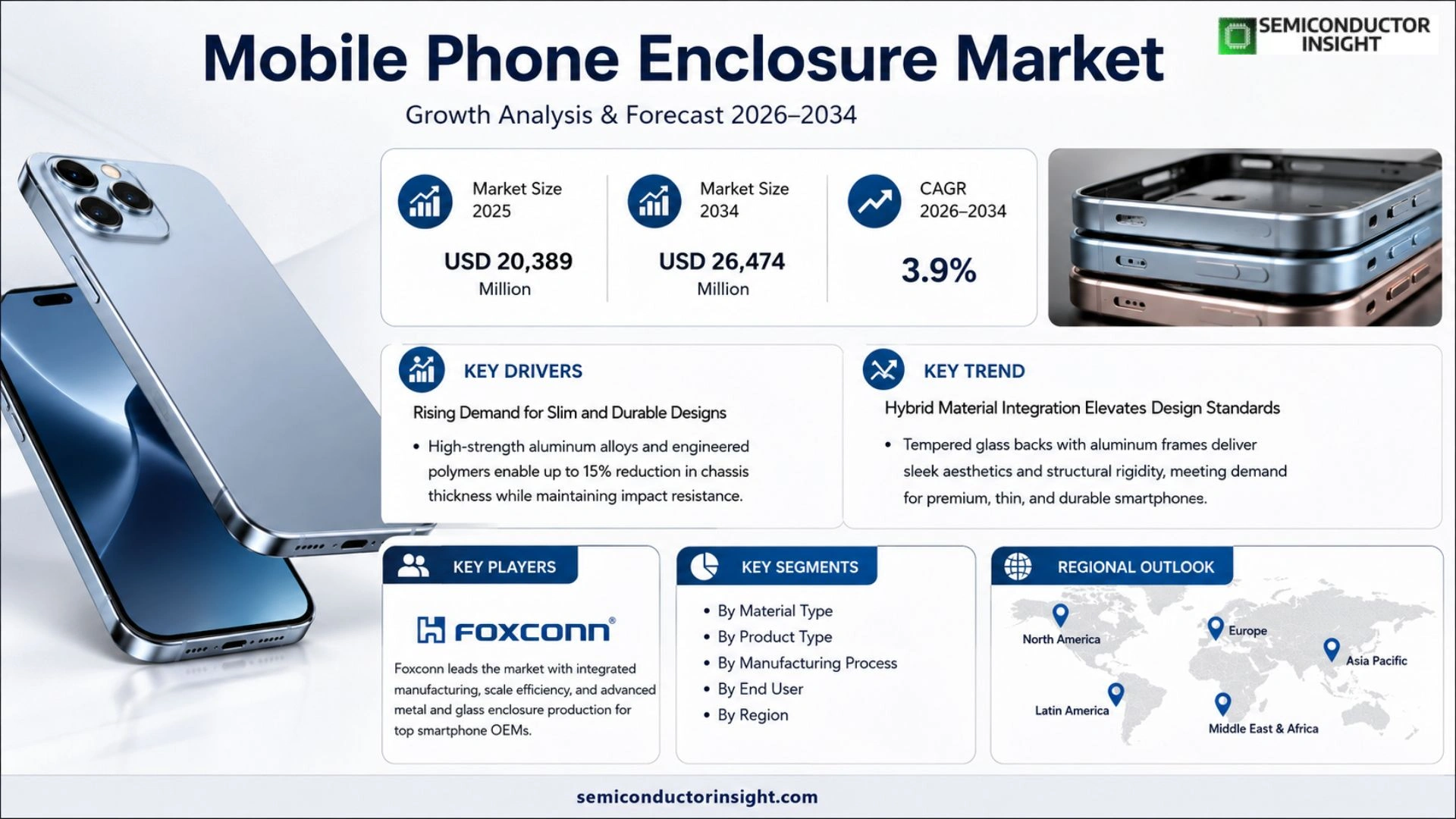
Global Mobile Phone Enclosure market was valued at USD 20,389 million in 2025 and is projected to reach USD 26,474 million by 2034, at a CAGR of 3.9% during the forecast period.
Mobile phone enclosures serve as the structural backbone of smartphones, delivering mechanical support, protection, and exterior aesthetics. Typical components include back covers, mid‑frames or integrated frames, and they are closely linked with displays, buttons, camera modules and antenna systems. Materials range from aluminum alloys and stainless steel to glass, engineering plastics and composites; premium devices often combine glass backs with metal or composite frames to balance strength, tactile feel and wireless performance.
The upward trend reflects manufacturers’ push for thinner designs, higher durability and differentiated looks. As antenna integration becomes more complex and thermal management tighter, suppliers that can offer precision‑machined metal frames or high‑quality glass backs enjoy margin advantages of roughly 15‑25%, while standardized plastic solutions remain lower‑margin.
MARKET DRIVERS
Rising Demand for Slim and Durable Designs
Mobile Phone Enclosure Market is being reshaped by consumer expectations for thinner profiles without compromising structural integrity. Manufacturers are investing in high‑strength aluminum alloys and engineered polymers that allow a reduction of chassis thickness by up to 15 % while maintaining impact resistance. This material shift translates into higher unit sell‑through for premium enclosures and forces OEMs to recalibrate their design pipelines.
Shift Toward Sustainable Materials
Environmental legislation across Europe and Asia is compelling handset makers to adopt recyclable or bio‑based plastics for housings. Companies that have already qualified their supply base for circular‑economy credentials report a 7 % uplift in brand perception, which in turn drives repeat purchases in the high‑end segment. The transition is not merely regulatory; it aligns with a growing consumer willingness to pay a modest premium for greener products.
➤ “Our roadmap now places recyclable enclosure solutions at the core of every new model, because durability and sustainability are no longer optional,they’re expected.” – Senior VP, Global Design, leading handset brand
Advanced thermal‑management techniques, such as graphene‑infused backplates, are emerging as a differentiation point. By dissipating heat more efficiently, these enclosures extend battery life and allow higher‑performance processors without additional cooling fans, thereby creating a tangible competitive edge for early adopters.
MARKET CHALLENGES
Cost Pressures from Premium Material Adoption
While high‑performance alloys and bio‑plastics improve device aesthetics and durability, they also lift the bill of materials. Mid‑tier manufacturers face a narrow margin window, and any delay in cost‑reduction cycles can erode profitability. The challenge intensifies as rivals compress launch timelines, leaving little room for extended material qualification.
Other Challenges
Supply Chain Volatility
Fluctuations in raw‑material prices, especially for rare‑earth elements used in alloy formulations, create forecasting uncertainty. Recent geopolitical tensions have amplified lead times for imported composites, prompting some firms to explore regional sourcing strategies that add complexity to logistics networks.
MARKET RESTRAINTS
Regulatory Hurdles in Emerging Markets
Many fast‑growing economies impose stringent electromagnetic‑compatibility (EMC) and fire‑safety standards on handset housings. Compliance testing is costly and time‑consuming, which can delay market entry for innovative enclosure designs. As a result, some manufacturers prioritize established markets, slowing the diffusion of next‑generation packaging solutions.
MARKET OPPORTUNITIES
Growth in Foldable Phone Segment
The advent of foldable smartphones creates a niche for flexible yet robust enclosures. Engineers are experimenting with ultra‑thin stainless‑steel hinges and hybrid polymer‑metal composites that can endure repeated bending cycles. Companies that master these materials stand to capture a sizable share of a segment projected to exceed several hundred million units within the next few years, unlocking new revenue streams for Mobile Phone Enclosure Market.
Mobile Phone Enclosure Market Trends
Hybrid Material Integration Elevates Design Standards
Mobile Phone Enclosure Market is witnessing a pronounced shift toward hybrid constructions that meld tempered glass backs with aluminum‑based frames. This combination satisfies consumer demand for a sleek tactile feel while preserving structural rigidity needed for thinner devices. Manufacturers are fine‑tuning the thickness of glass layers to avoid compromising antenna efficiency, a balance that directly influences the perceived premium quality of flagship smartphones. Because high‑end glass‑metal assemblies command superior processing accuracy, they generate better gross margins, reinforcing the strategic focus of tier‑one OEMs on differentiated aesthetics rather than pure cost competition.
Other Trends
Manufacturing Process Evolution
Advanced CNC machining and precision stamping have become the backbone of Mobile Phone Enclosure Market as product cycles accelerate. Whereas traditional injection molding still serves volume‑price segments, the rise of ultra‑thin frames pushes suppliers toward tighter tolerances achievable only through CNC and laser‑assisted forming. These processes reduce post‑production rework, shorten lead times, and enable rapid adaptation to design revisions mandated by emerging sensor arrays. The operational shift also encourages investment in automation, which gradually lifts the overall profitability profile of the sector.
Supply Chain Realignment and OEM Collaboration
Regional dynamics are reshaping Mobile Phone Enclosure Market, with North American and Asian OEMs redefining their sourcing strategies. U.S. manufacturers are prioritizing near‑shore partners capable of delivering high‑grade glass substrates, while Chinese brands continue to leverage scale in metal alloy production. This bifurcation creates a competitive environment where flexibility and material‑specific expertise become decisive factors. Companies that can synchronize design intent with supply‑chain agility are better positioned to negotiate favorable terms and sustain market share amid escalating demand for premium‑grade enclosures.
COMPETITIVE LANDSCAPE
Key Industry Players
Mobile Phone Enclosure Market – Competitive Overview
Foxconn continues to dominate the enclosure segment, leveraging its scale‑driven manufacturing footprint and deep integration with leading smartphone OEMs. The company’s ability to coordinate CNC machining, injection molding, and surface‑treatment processes under a single roof translates into shorter lead‑times and tighter cost control, which is especially valuable as OEMs chase slimmer, premium‑grade designs. Foxconn’s margin profile benefits from high‑mix, high‑volume production of metal frames and engineered glass backs, allowing it to sustain a pricing advantage over smaller assemblers while maintaining sufficient profitability to fund next‑generation tooling investments.
Beyond the market leader, a constellation of specialized firms adds depth to the competitive picture. Catcher Technology and BYD Electronics have built reputations around advanced aluminum alloy frames and composite solutions, respectively, and both are expanding capacity to serve emerging flagship programs. Lens Technology excels in high‑precision glass processing, while BIEL Crystal supplies specialty crystal components for camera integration. Tongda Group and Shenzhen Everwin Precision Technology focus on cost‑effective metal stamping and CNC services for mid‑range devices. Ju Teng International, Chaozhou Three‑Circle, and Xingke Electronics occupy niche positions in customized structural modules, often partnering with regional ODMs. Wistron and Compal, traditionally known for full‑device assembly, are increasingly offering enclosure‑only services to diversify revenue streams.
List of Key Mobile Phone Enclosure Companies Profiled
- Foxconn
- Catcher Technology
- BYD Electronics
- Lens Technology
- BIEL Crystal
- Tongda Group
- Shenzhen Everwin Precision Technology
- Ju Teng International
- Chaozhou Three-Circle
- Xingke Electronics
- Wistron
- Compal
Segment Analysis:
| Segment Category | Sub-Segments | Key Insights |
| By Type |
|
Metal continues to dominate design conversations because it delivers a balance of rigidity, premium feel and reliable antenna performance. • Designers favour metal frames for their ability to integrate structural support with heat dissipation pathways. • Advances in CNC machining and surface‑treatment enable intricate patterns that enhance tactile quality while preserving thin‑profile ambitions. • Metal enclosures are increasingly paired with glass backs to satisfy consumer expectations for a high‑end aesthetic without compromising durability. |
| By Application |
|
Flagship enclosures shape brand perception by marrying cutting‑edge materials with flawless finish. • Premium glass‑back designs signal technological leadership and reinforce the tactile premium narrative. • Integration of composite frames allows for ultra‑thin crowns while preserving structural integrity under dynamic loads. • Surface‑coating innovations, such as matte or glossy finishes, are leveraged to differentiate visual identity across successive flagship cycles. |
| By End User |
|
Smartphone OEMs drive the evolution of enclosure specifications through close collaboration with design teams. • OEMs prioritize enclosure solutions that harmonize with internal component layout, especially antenna placement and thermal pathways. • Rapid product cycles compel OEMs to seek flexible manufacturing partners capable of scaling from high‑volume metal frames to low‑volume bespoke glass finishes. • Sustainability considerations are prompting OEMs to explore recyclable composites without compromising perceived premium quality. |
| By [Segment Category 3]] |
|
Leading Segment description with qualitative insights only [Pointers preferred in bullets atleast 2-3]. |
| By [Segment Category 4]] |
|
Leading Segment description with qualitative insights only [Pointers preferred in bullets atleast 2-3]. |
Regional Analysis: Mobile Phone Enclosure Market
Asia‑Pacific
OEMs are blending magnesium‑alloy frames with bio‑based polymers to trim weight without sacrificing rigidity, a move that satisfies premium‑segment aesthetics while addressing environmental scrutiny across the region.
Diversification of foundry locations,from Taiwan to the Philippines,mitigates disruption risk, allowing firms to maintain steady enclosure output even when single‑source plants face geopolitical pressures.
New standards on hazardous substance limits in South Korea and India compel manufacturers to overhaul coating processes, accelerating adoption of water‑based finishes that are both compliant and cost‑effective.
Millennial and Gen‑Z buyers in urban centres prioritize sleek, minimalist enclosures, prompting brands to reduce visible seams and integrate tactile surface treatments that enhance perceived quality.
North America
North America continues to prioritize high‑performance enclosures tailored for flagship devices, with a noticeable tilt toward aerospace‑grade aluminum and premium glass backs. The market is shaped by stringent durability expectations from corporate procurement and a fervent early‑adopter culture that rewards cutting‑edge design. Firms that can align enclosure engineering with rapid software‑driven feature rollouts gain a strategic edge, as device makers frequently bundle new sensors and antennas that impose strict spatial constraints. Sustainability narratives are gaining traction among US consumers, nudging suppliers to highlight recycled content and end‑of‑life recyclability in their product literature, which in turn influences purchasing decisions of enterprise clients focused on ESG compliance.
Europe
European manufacturers exhibit a strong preference for modular enclosures that facilitate easy repair, a trend reinforced by right‑to‑repair legislation in several EU member states. This regulatory pressure translates into design shifts toward detachable back panels and standardized fastening systems, which also open aftermarket revenue streams for component distributors. Luxury‑grade finishes, particularly brushed metal and matte‑coated composites, dominate the premium segment in markets such as Germany and France, where consumers equate tactile refinement with brand prestige. Providers that can marry these aesthetic demands with compliance‑first engineering are best positioned to capture contracts with both flagship OEMs and niche boutique phone makers.
South America
In South America, cost‑sensitivity drives demand for robust yet affordable polycarbonate enclosures that can endure harsh climatic conditions without compromising visual appeal. Local distributors frequently negotiate bulk‑volume agreements that hinge on predictable lead‑times, prompting manufacturers to establish regional dosing centers in Brazil and Chile. Mobile operators in the region prioritize device durability to extend network lifecycles, encouraging enclosure designs that incorporate reinforced corners and impact‑absorbing shock layers. Companies that can deliver consistent quality at competitive pricing while offering localized after‑sales support tend to dominate the fragmented market landscape.
Middle East & Africa
The Middle East & Africa region presents a divergent set of drivers: high disposable income in Gulf Cooperation Council states fuels demand for opulent, metal‑accented enclosures, whereas many African markets prioritize ruggedized housing capable of withstanding dust, heat, and rough handling. Mobile service providers in Sub‑Saharan Africa often bundle devices with extended warranties, creating a niche for enclosures that simplify field repairs. Strategic partnerships with regional assembly plants allow manufacturers to adapt material blends that balance premium feel with resilience, a combination that resonates with both affluent consumers and cost‑conscious buyers across the continent.
Report Scope
This market research report provides a comprehensive analysis of the Mobile Phone Enclosure Market , covering the forecast period 2026–2034. It offers detailed insights into market dynamics, technological advancements, competitive landscape, and key trends shaping the industry.
Key focus areas of the report include:
- Market Overview: The report begins with an overview outlining its current market scenario, key growth indicators, and industry transformation drivers. It discusses macroeconomic factors, demand–supply balance, regulatory landscape, and the strategic role of semiconductors in powering advancements across industries such as automotive, telecommunications, consumer electronics, and industrial automation.
- Market Size & Forecast: Historical data and future projections for revenue, unit shipments, and market value across major regions and segments.
- Segmentation Analysis: Detailed breakdown by product type, technology, application, and end-user industry to identify high-growth segments and investment opportunities.
- Regional Insights: Insights into market performance across North America, Europe, Asia-Pacific, Latin America, and the Middle East & Africa, including country-level analysis where relevant.
- Competitive Landscape: Profiles of leading market participants, including their product offerings, R&D focus, manufacturing capacity, pricing strategies, and recent developments such as mergers, acquisitions, and partnerships.
- Technology Trends & Innovation: Assessment of emerging technologies, integration of AI/IoT, semiconductor design trends, fabrication techniques, and evolving industry standards.
- Market Drivers & Restraints: Evaluation of factors driving market growth along with challenges, supply chain constraints, regulatory issues, and market-entry barriers.
- Stakeholder Insights: Insights for component suppliers, OEMs, system integrators, investors, and policymakers regarding the evolving ecosystem and strategic opportunities.
Primary and secondary research methods are employed, including interviews with industry experts, data from verified sources, and real-time market intelligence to ensure the accuracy and reliability of the insights presented.
FREQUENTLY ASKED QUESTIONS:
What is the current market size of Mobile Phone Enclosure Market?
-> Mobile Phone Enclosure market was valued at USD 20,389 million in 2025 and is projected to reach USD 26,474 million by 2034
Which key companies operate in Mobile Phone Enclosure Market?
-> Key players include Foxconn, Catcher Technology, BYD Electronics, Lens Technology, BIEL Crystal, Tongda Group, Shenzhen Everwin Precision Technology, Ju Teng International, Chaozhou Three-Circle, Xingke Electronics, among others.
What are the key growth drivers?
-> Key growth drivers include the shift toward thinner, premium smartphone designs, increasing demand for high‑strength and aesthetically appealing enclosures, advancements in material systems such as glass‑metal hybrid structures, and the need for improved thermal coordination and antenna performance.
Which region dominates the market?
-> Asia‑Pacific dominates Mobile Phone Enclosure market, driven by the concentration of major smartphone OEMs and EMS/ODM partners in China, Japan, South Korea and the broader region.
What are the emerging trends?
-> Emerging trends include integration of premium glass backs with metal or composite frames, increased use of CNC machining and precision forming for high‑margin metal frames, and the development of composite materials that balance strength, weight and wireless performance.
Get Sample Report PDF for Exclusive Insights
Report Sample Includes
- Table of Contents
- List of Tables & Figures
- Charts, Research Methodology, and more...
 Download Sample Report PDF


