AI Accelerator Chip Market Insights
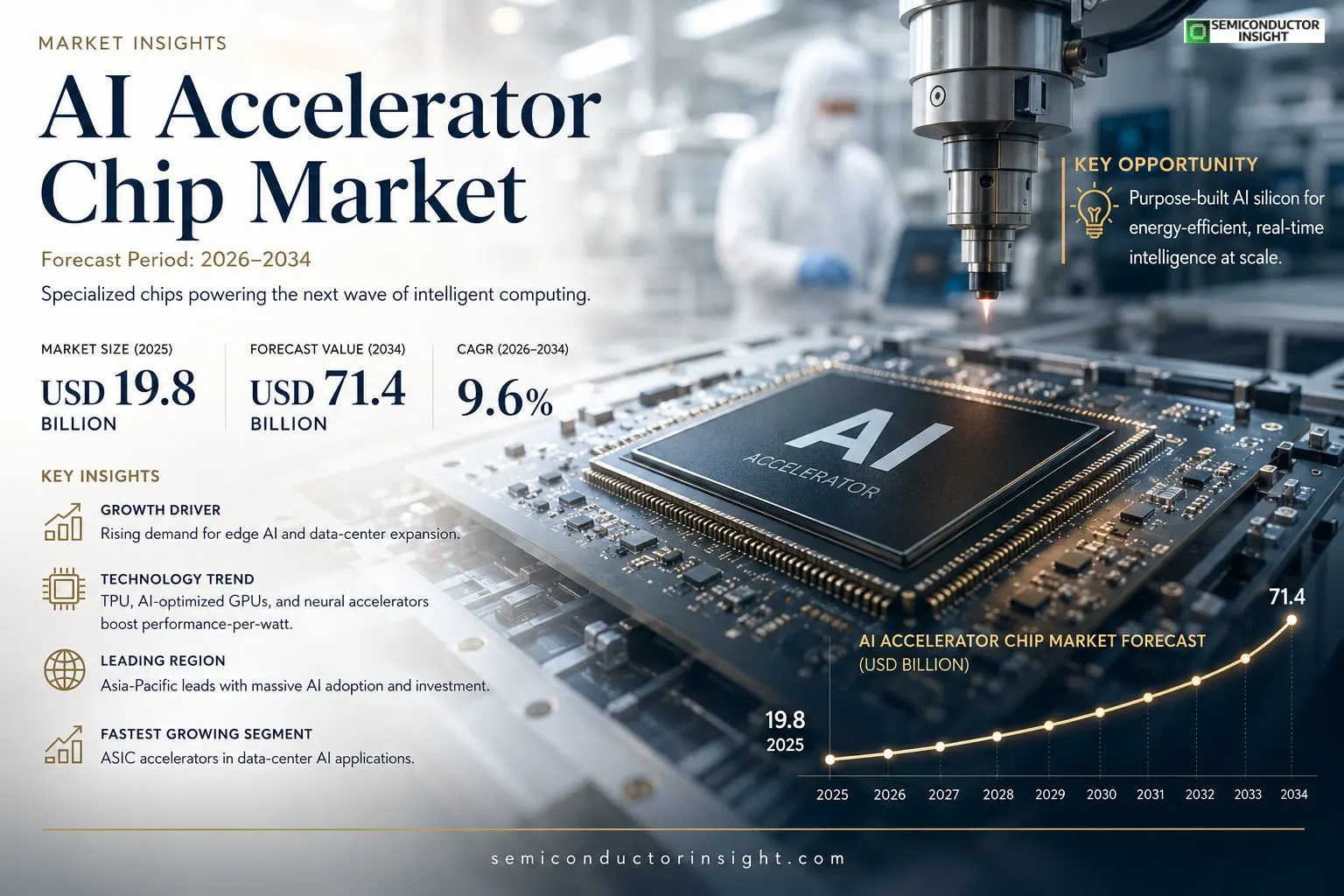
Global AI accelerator chip market size was valued at ,USD 19.8 billion, in 2025. The market is projected to grow from ,USD 19.8 billion, in 2025 to ,USD 71.4 billion, by 2034, exhibiting a ,CAGR of 9.6%, during the forecast period.
AI accelerator chips are specialized semiconductor devices designed to accelerate artificial‑intelligence workloads such as deep‑learning inference and training. They incorporate architectures like tensor processing units, graphics processing units optimized for AI, and dedicated neural network accelerators, enabling higher throughput and lower power consumption compared with general‑purpose CPUs.The market is experiencing rapid growth because enterprises are investing heavily in AI‑driven digital transformation, while data‑center expansion and edge‑computing deployments further boost demand. However, supply‑chain constraints and rising R&D costs present challenges. Furthermore, collaborations between leading fabless designers and foundries are accelerating product innovation, positioning key players such as NVIDIA, AMD, Google (TPU), and Intel at the forefront of AI Accelerator Chip Market.
MARKET DRIVERS
Rising Demand for Edge AI
The surge in edge‑computing applications is prompting OEMs to integrate AI accelerator chips directly into devices. ,Manufacturers, benefit from lower latency and reduced bandwidth costs, which accelerates adoption across smart cameras, autonomous drones, and industrial IoT gateways.
Advancements in Chip Architecture
Recent breakthroughs in heterogeneous integration and 3‑nm processes enable ,significantly higher performance‑per‑watt, compared with legacy GPUs. This architectural efficiency makes AI accelerator chips viable for both data‑center and edge workloads.
➤ Industry analysts note that the convergence of software‑defined AI frameworks and hardware specialization is creating a virtuous cycle of innovation.
Strategic partnerships between silicon vendors and cloud providers are further expanding the ecosystem, ensuring that developers have ready access to optimized toolchains and scalable deployment options.
MARKET CHALLENGES
Design Complexity and Time‑to‑Market
Developing AI accelerator chips requires deep expertise in both semiconductor process technology and machine‑learning workloads. ,Extended design cycles, increase capital exposure, especially for start‑ups lacking established IP libraries.
Other Challenges
Supply Chain Constraints
Global wafer shortages and limited advanced‑node capacity create bottlenecks that can delay product launches and compress margins for chip manufacturers.
MARKET RESTRAINTS
High Capital Expenditure
Investing in cutting‑edge fabs and design tools demands ,multi‑billion‑dollar outlays,, which raises the entry barrier for new entrants and can limit competitive dynamics in the AI accelerator space.
MARKET OPPORTUNITIES
Expansion into Emerging Verticals
Verticals such as healthcare imaging, precision agriculture, and robotics are beginning to adopt specialized AI accelerator chips to meet domain‑specific performance requirements, opening ,significant revenue upside, for vendors that tailor architectures to niche workloads.Furthermore, the growing emphasis on sustainable AI computing drives demand for chips that deliver ,greater compute density with lower power consumption,, positioning energy‑efficient designs as a strategic advantage.
AI Accelerator Chip Market Trends
Rising Enterprise Investment in AI Infrastructure
Enterprises are allocating larger portions of their capital budgets to AI workloads, driving demand for purpose‑built silicon that can handle intensive inference and training tasks. The shift from general‑purpose CPUs to specialized AI accelerator chips reduces latency and energy consumption, enabling more responsive services in sectors such as finance, healthcare, and automotive. This investment momentum is reinforced by cloud providers expanding AI‑focused offerings, which in turn creates a feedback loop that accelerates the adoption of dedicated AI accelerator hardware across the broader AI Accelerator Chip Market.
Other Trends
Edge Computing Expansion
Deployment of AI models at the edge is gaining traction as latency‑sensitive applications,such as autonomous robotics, smart cameras, and real‑time analytics,require on‑device processing. Manufacturers are integrating compact AI accelerator chips into edge devices, balancing performance with power efficiency. This trend pushes design teams to prioritize low‑power architectures and supports a diversified ecosystem that extends the reach of AI Accelerator Chip Market beyond traditional data‑center environments.
Supply‑Chain Resilience
Recent disruptions in semiconductor fabrication have highlighted the importance of supply‑chain resilience. Companies are forging tighter collaborations between fabless designers and foundry partners to secure production slots and accelerate technology rollouts. These partnerships also encourage the co‑development of advanced packaging techniques that improve yields and reduce time‑to‑market, mitigating risks that could otherwise slow the pace of innovation in AI Accelerator Chip Market.
Strategic Collaboration and Ecosystem Growth
Strategic alliances among leading chip designers, software developers, and cloud platforms are shaping the competitive landscape. Joint development programs enable optimized software stacks that fully exploit hardware capabilities, delivering measurable performance gains for end users. At the same time, open‑source initiatives around AI frameworks encourage broader developer participation, fostering a virtuous cycle where software demand stimulates hardware advancement. This collaborative momentum ensures that AI Accelerator Chip Market remains dynamic, with continuous entry of new players and evolving product roadmaps that cater to emerging AI workloads.
COMPETITIVE LANDSCAPE
Key Industry Players
AI Accelerator Chip Market – Competitive Overview
AI Accelerator Chip Market is dominated by a handful of large‑scale semiconductor firms that have leveraged deep‑learning workloads to reshape their product portfolios. NVIDIA leads the segment with its CUDA‑optimized GPUs and the newer Hopper architecture, capturing the bulk of data‑center AI spend. AMD follows closely, differentiating through its Instinct line and the integration of Xilinx’s adaptive compute capabilities after the acquisition. Google’s Tensor Processing Units (TPU) embody a vertically integrated approach, offering custom silicon for both cloud and on‑premise AI services. Intel, through its Habana Gaudi accelerators and the acquisition of Habana Labs, provides a diversified portfolio that spans training, inference, and edge deployments. Collectively, these titans set pricing benchmarks, drive performance roadmaps, and command the majority of R&D investment, creating a tiered market where smaller innovators must specialize or partner to compete.Beyond the marquee players, a vibrant ecosystem of niche and emerging companies intensifies competition in specific domains. Qualcomm’s AI Engine embeds AI acceleration into mobile SoCs, targeting edge and IoT scenarios. Graphcore’s IPU architecture emphasizes fine‑grained parallelism for model training efficiency. Cerebras delivers wafer‑scale engines that break traditional size constraints for massive deep‑learning models. SambaNova and Tenstorrent focus on flexible, high‑throughput training solutions, while Groq offers deterministic inference pipelines. Huawei’s Ascend series and Baidu’s Kunlun chips cater to the Chinese market with integrated AI ecosystems. Apple’s Neural Engine powers on‑device intelligence across its product line, and Mythic advances analog compute for ultra‑low‑power inference. These players diversify the supply chain, foster innovation, and pressure incumbents to accelerate feature development and cost optimization.
List of Key AI Accelerator Chip Companies Profiled
- NVIDIA
- AMD
- Google (TPU)
- Intel
- Qualcomm
- Graphcore
- Cerebras
- SambaNova
- Tenstorrent
- Groq
- Huawei (Ascend)
- Baidu (Kunlun)
- Apple (Neural Engine)
- Mythic
Segment Analysis:
| Segment Category | Sub-Segments | Key Insights |
| By Type |
|
ASIC Accelerators – These custom‑designed chips dominate because they provide the highest efficiency for AI workloads.
|
| By Application |
|
Data‑Center AI – This application drives the most intensive demand for accelerator chips, influencing design priorities across the market.
|
| By End User |
|
Cloud Service Providers – These users set the performance bar for accelerator chips, steering roadmap decisions.
|
| By Architecture |
|
Tensor Processing Units – TPUs have become a reference architecture for large‑scale AI, influencing many subsequent designs.
|
| By Integration Approach |
|
Heterogeneous Chiplet Integration – This approach is gaining traction as manufacturers seek flexibility and faster time‑to‑market.
|
Regional Analysis: North America
North America
The North American market is at the forefront of technological advancements in AI accelerator chips, with constant development of novel architectures and process technologies. This includes exploring advanced materials and innovative chip designs to enhance performance and reduce power consumption.
North America hosts several key players in AI Accelerator Chip Market, including established semiconductor giants and emerging startups, fostering a dynamic competitive environment. Strategic partnerships between technology companies and research institutions are crucial for driving innovation in this sector.
Government initiatives and substantial funding support are playing a vital role in accelerating the development and adoption of AI accelerator chips within North America. These programs aim to promote research, foster innovation, and create a skilled workforce in the AI field.
The adoption of AI accelerator chips in North America is expanding rapidly across diverse applications, particularly in areas like autonomous driving, medical imaging, and natural language processing, reflecting the region’s strong focus on these high-growth sectors.
Europe
Europe is witnessing a significant upswing in its AI Accelerator Chip Market, propelled by a commitment to digital transformation and a growing emphasis on data-driven innovation across industries. The region’s strength lies in its well-established industrial base, strong research capabilities, and supportive government policies aimed at fostering technological advancements. While facing challenges in terms of manufacturing capacity compared to North America and Asia-Pacific, Europe is actively investing in strengthening its semiconductor ecosystem and attracting talent in AI and chip design. The focus is on developing energy-efficient and highly specialized AI accelerator chips for applications in automotive, industrial automation, and edge computing.
Asia-Pacific
Asia-Pacific represents the largest and fastest-growing market for AI Accelerator Chips. Driven by massive data generation, a large consumer base, and proactive government support, the region is experiencing exponential growth in AI adoption across various sectors. China, in particular, is emerging as a dominant force in AI Accelerator Chip Market, with significant investments in both chip manufacturing and AI application development. Other key markets in the region, like Japan, South Korea, and India, are also making substantial strides in developing AI capabilities and expanding the demand for advanced AI accelerator chips. The focus is on developing cost-effective and high-performance chips catering to the needs of the rapidly expanding AI ecosystem.
South America
South America is an emerging market for AI Accelerator Chips, with growing adoption in sectors like finance, retail, and agriculture. While the market size is currently smaller compared to other regions, the region presents significant growth potential driven by increasing internet penetration, rising disposable incomes, and a growing awareness of AI benefits. The focus is on deploying AI solutions for optimizing operations, improving customer experiences, and driving innovation across various industries. Investments in AI infrastructure and talent development are expected to further accelerate growth in the coming years.
Middle East & Africa
The Middle East & Africa represents a nascent but promising market for AI Accelerator Chips. With increasing investments in digital infrastructure, smart city initiatives, and the adoption of AI in sectors like healthcare, finance, and energy, the region is poised for substantial growth. The demand for AI accelerator chips is being driven by the need for efficient data processing, predictive analytics, and advanced automation solutions. Government initiatives focused on technological advancement and economic diversification are expected to further fuel the adoption of AI technologies and the demand for specialized AI hardware.
Report Scope
This market research report provides a comprehensive analysis of the AI Accelerator Chip Market , covering the forecast period 2026–2034. It offers detailed insights into market dynamics, technological advancements, competitive landscape, and key trends shaping the industry.
Key focus areas of the report include:
- Market Overview: The report begins with an overview outlining its current market scenario, key growth indicators, and industry transformation drivers. It discusses macroeconomic factors, demand–supply balance, regulatory landscape, and the strategic role of semiconductors in powering advancements across industries such as automotive, telecommunications, consumer electronics, and industrial automation.
- Market Size & Forecast: Historical data and future projections for revenue, unit shipments, and market value across major regions and segments.
- Segmentation Analysis: Detailed breakdown by product type, technology, application, and end-user industry to identify high-growth segments and investment opportunities.
- Regional Insights: Insights into market performance across North America, Europe, Asia-Pacific, Latin America, and the Middle East & Africa, including country-level analysis where relevant.
- Competitive Landscape: Profiles of leading market participants, including their product offerings, R&D focus, manufacturing capacity, pricing strategies, and recent developments such as mergers, acquisitions, and partnerships.
- Technology Trends & Innovation: Assessment of emerging technologies, integration of AI/IoT, semiconductor design trends, fabrication techniques, and evolving industry standards.
- Market Drivers & Restraints: Evaluation of factors driving market growth along with challenges, supply chain constraints, regulatory issues, and market-entry barriers.
- Stakeholder Insights: Insights for component suppliers, OEMs, system integrators, investors, and policymakers regarding the evolving ecosystem and strategic opportunities.
Primary and secondary research methods are employed, including interviews with industry experts, data from verified sources, and real-time market intelligence to ensure the accuracy and reliability of the insights presented.
FREQUENTLY ASKED QUESTIONS:
What is the current market size of AI Accelerator Chip Market?
-> AI Accelerator Chip Market was valued at USD 19.8 billion in 2025 and is expected to reach USD 71.4 billion by 2034, reflecting a robust growth trajectory.
Which key companies operate in AI Accelerator Chip Market?
-> Key players include NVIDIA, AMD, Google (TPU), and Intel, among other leading semiconductor innovators.
What are the key growth drivers?
-> Key growth drivers include AI‑driven digital transformation initiatives, rapid data‑center expansion, and increasing edge‑computing deployments, all of which intensify demand for specialized accelerator hardware.
Which region dominates the market?
-> The reference material does not specify a single dominant region; however, adoption trends are strong across North America, Europe, and Asia‑Pacific.
What are the emerging trends?
-> Emerging trends include advancements in tensor processing units, AI‑optimized GPUs, and dedicated neural‑network accelerators that improve throughput while reducing power consumption.

Get Sample Report PDF for Exclusive Insights
Report Sample Includes
- Table of Contents
- List of Tables & Figures
- Charts, Research Methodology, and more...
 Download Sample Report PDF