Chiplet IC Market Insights
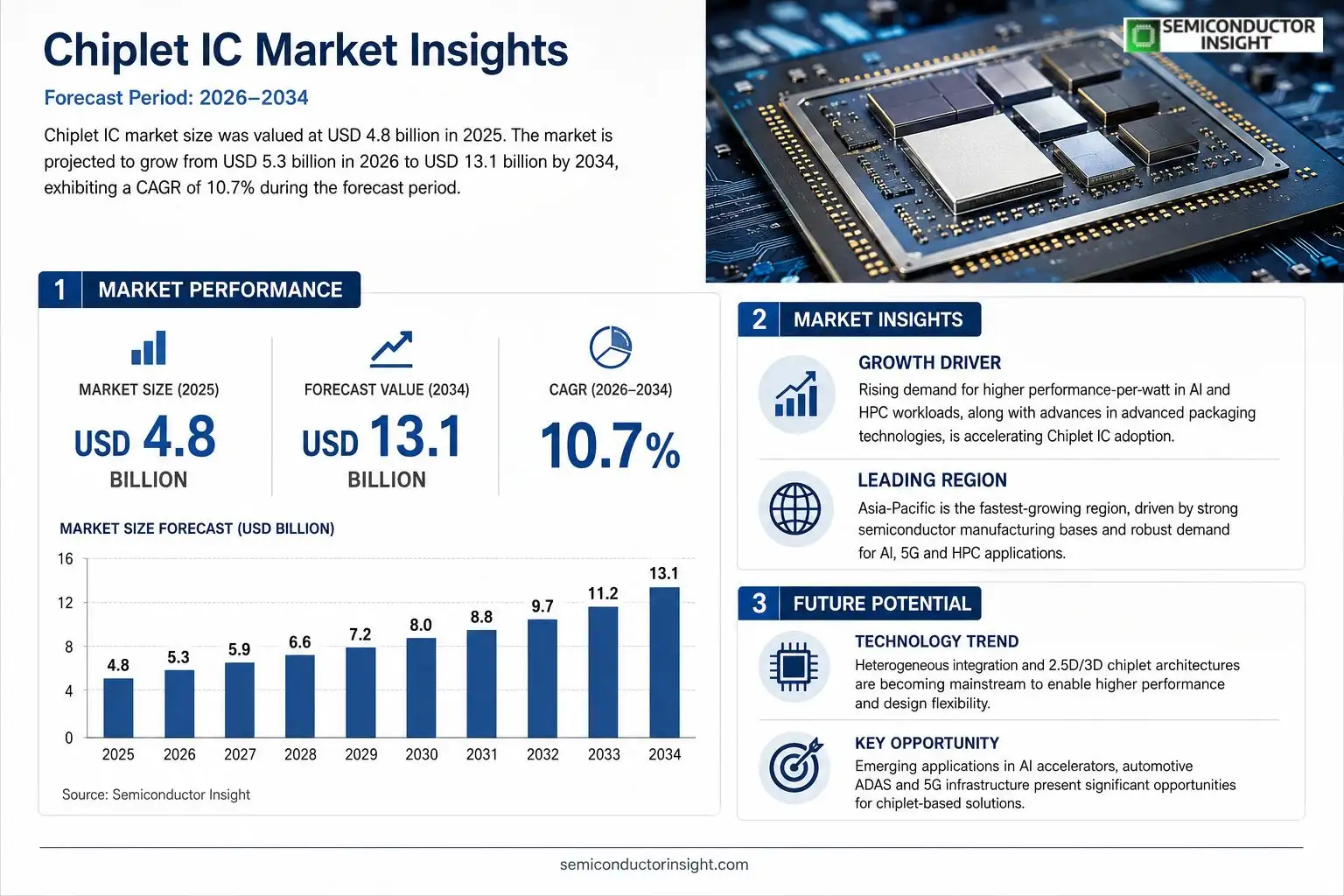
Chiplet IC market size was valued at USD 4.8 billion in 2025. The market is projected to grow from USD 5.3 billion in 2026 to USD 13.1 billion by 2034, exhibiting a CAGR of 10.7% during the forecast period.
Chiplet ICs are modular semiconductor building blocks that can be assembled into a single package‑on‑package or interposer‑based system‑in‑package solution, enabling heterogeneous integration of logic, memory, RF and analog functions while reducing time‑to‑market and manufacturing complexity.
The market is experiencing rapid growth because semiconductor manufacturers are seeking higher performance per watt for AI and high‑performance computing workloads, and because traditional monolithic scaling faces physical limits. Furthermore, advances in advanced packaging technologies such as silicon interposers and fan‑out wafer‑level packaging are lowering barriers for adoption. Recent collaborationssuch as Intel’s expansion of its Foveros® technology and AMD’s partnership with TSMC on advanced chiplet architecturesare further accelerating deployment across data center and automotive segments.
MARKET DRIVERS
Technology Integration and Performance Gains
Chiplet IC Market is propelled by the ability of chiplets to integrate heterogeneous functions onto a single package, delivering higher performance per watt compared with monolithic ICs. This modular approach enables designers to adopt the latest process nodes for critical blocks while reusing mature technologies for others, reducing time‑to‑market.
Cost Efficiency and Volume Scaling
Manufacturers are achieving significant cost savings by leveraging wafer‑level chiplet assembly, which minimizes wastage of high‑priced advanced silicon. As production volumes increase, the economies of scale further compress the bill of materials, making chiplet‑based solutions economically attractive for a broad range of applications.
➤ “Adopting chiplet architectures can accelerate product cycles by up to 30 % while cutting development costs dramatically.”
Regulatory push for energy‑efficient electronics and the rise of data‑center workloads are also reinforcing demand, positioning Chiplet IC Market for sustained expansion through 2030.
MARKET CHALLENGES
Design Complexity and Ecosystem Maturity
Engineers must manage intricate interconnect standards and validation processes, which introduces design overhead and longer verification cycles. The relative immaturity of a unified design ecosystem can deter smaller firms from adopting chiplet solutions.
Other Challenges
Supply Chain Coordination
Coordinating multiple foundries for disparate chiplet components raises logistical risks, potentially impacting lead times and inventory management.
MARKET RESTRAINTS
Standardization Gaps
While initiatives like OIF and IEEE are advancing open standards, the lack of universally accepted specifications for chiplet interfaces restrains widespread adoption and can lead to compatibility issues across vendors.Additionally, the need for specialized testing equipment adds capital expenses, which may limit market entry for cost‑conscious manufacturers.
MARKET OPPORTUNITIES
Emerging Application Segments
Growth areas such as artificial intelligence accelerators, 5G infrastructure, and high‑performance automotive processors present significant upside for Chiplet IC Market. These segments demand heterogeneous integration that chiplet architectures can uniquely satisfy.Investments in advanced packaging technologies, such as silicon interposers and fan‑out wafer‑level packaging, are unlocking new performance envelopes, creating a fertile environment for innovative chiplet‑based products.
Chiplet IC Market Trends
Heterogeneous Integration Drives Adoption
Chiplet IC Market is increasingly shaped by the need for heterogeneous integration, where logic, memory, RF, and analog functions are combined within a single package‑on‑package or interposer‑based solution. This modular approach shortens development cycles and reduces manufacturing complexity, allowing designers to respond quickly to AI and high‑performance computing workloads that demand higher performance per watt. By moving away from monolithic scaling, which is approaching physical limits, semiconductor firms are able to tailor chiplet configurations to specific application requirements, delivering more efficient power‑to‑performance ratios while maintaining cost competitiveness.
Other Trends
Advanced Packaging Innovations
Advanced packaging technologies such as silicon interposers and fan‑out wafer‑level packaging are lowering the technical barriers for chiplet adoption. These techniques provide high‑density interconnects and improved thermal performance, enabling denser routing of signals between heterogeneous blocks. The result is a more reliable and scalable substrate that supports the growing complexity of modern systems without a proportional increase in footprint. As the industry refines these processes, the time‑to‑market for new chiplet‑based products continues to shrink, reinforcing the momentum of Chiplet IC Market.
Strategic Partnerships Expand Ecosystem
Strategic collaborations are accelerating ecosystem development. Intel’s expansion of its Foveros® technology and AMD’s partnership with TSMC on advanced chiplet architectures illustrate how leading players are pooling expertise to standardize interconnect methods and co‑develop design libraries. These joint efforts are particularly evident in data‑center and automotive segments, where the need for robust, high‑performance modules is most acute. By aligning road‑maps and sharing best practices, the partnerships create a virtuous cycle of innovation, delivering more mature design flows and a broader supply chain that benefits the entire Chiplet IC Market.
COMPETITIVE LANDSCAPEKey Industry Players
Chiplet IC Market Competitive Landscape Overview
Chiplet IC Market is presently anchored by a handful of technology leaders that have integrated chiplet architectures into their product roadmaps and advanced packaging capabilities. Intel remains the foremost driver, leveraging its Foveros® 3D‑stacking technology to deliver high‑performance compute chiplets for data‑center processors. AMD, in partnership with TSMD, has expanded its EPYC and Ryzen families through heterogeneous chiplet designs, reinforcing a duopolistic dynamic in the high‑performance segment. TSMC’s CoWoS (chip‑on‑wafer‑on‑substrate) platform provides a critical foundry service, enabling fabless customers to adopt chiplets without owning proprietary interposer expertise. Samsung’s advanced packaging division complements this ecosystem with its X‑CMOS and ICV technologies, targeting AI accelerators and automotive SoCs. Collectively, these incumbents shape a tiered structure where fabless designers rely on a small set of foundry and packaging partners to realize chiplet‑based solutions, driving economies of scale and accelerating market growth.Beyond the dominant trio, a diverse cohort of niche and emerging players enriches the competitive landscape by addressing specific functional blocks or vertical markets. NXP Semiconductors focuses on automotive and edge‑compute chiplets, integrating specialized RF and sensor functions. Qualcomm’s Snapdragon chiplet strategy emphasizes heterogeneous integration of cellular, AI, and graphics IP for mobile platforms. Broadcom and Marvell provide high‑speed networking and storage chiplets, catering to data‑center interconnects. Infineon and Texas Instruments deliver power‑management and analog chiplets that support heterogeneous integration in industrial IoT devices. ON Semiconductor, Renesas, STMicroelectronics and IBM contribute domain‑specific chiplet portfolios, ranging from automotive safety to quantum‑computing research, thereby broadening the supplier base and fostering innovation across multiple application domains.
List of Key Chiplet IC Companies Profiled
- Intel
- Intel
- AMD
- AMD
- TSMC
- TSMC
- Samsung Electronics
- Samsung
- NXP Semiconductors
- Qualcomm
- Broadcom
- Marvell Technology Group
- Infineon Technologies
- Texas Instruments
- ON Semiconductor
- Renesas Electronics
- STMicroelectronics
- IBM
Segment Analysis:
| Segment Category | Sub-Segments | Key Insights |
| By Type |
|
Logic Chiplets dominate discussion due to their flexibility in building heterogeneous compute blocks.
|
| By Application |
|
AI Acceleration benefits from chiplet flexibility, letting designers mix inference engines with memory and interconnect blocks.
|
| By End User |
|
Data Centers are a primary driver for chiplet adoption, seeking performance density and energy efficiency.
|
| By Integration Approach |
|
Interposer‑Based integration offers the highest bandwidth channels for complex chiplet ecosystems.
|
| By Target Industry |
|
System Integrators play a pivotal role in assembling chiplet‑based solutions for end markets.
|
Regional Analysis: North America
United States
The demand for high-performance computing, artificial intelligence, and telecommunications infrastructure in the U.S. is fueling the adoption of chiplet-based solutions. Several key players are actively developing and deploying chiplet architectures for a variety of applications, from data centers to automotive electronics. Government initiatives aimed at bolstering domestic chip manufacturing and supply chain resilience further accelerate the market’s expansion. The emphasis on modularity and flexibility offered by chiplets is particularly attractive to industries seeking to optimize design cycles and reduce costs.
The Chiplet IC Market is experiencing a surge in innovation, with advancements in interconnect technologies and packaging solutions. Heterogeneous integration, involving the combination of different chiplets with varying functionalities, is gaining traction. The industry is also witnessing increasing collaboration between chiplet designers, foundries, and system integrators to accelerate product development.
The primary drivers for the Chiplet IC Market growth include the increasing complexity of semiconductor designs, the need for improved performance and power efficiency, and the desire for greater design flexibility. Chiplets offer a pathway to overcome the challenges associated with monolithic die fabrication, enabling manufacturers to create more powerful and cost-effective solutions.
The Chiplet IC Market is highly competitive, with a mix of established semiconductor companies and emerging fabless design houses vying for market share. Key players are investing heavily in chiplet R&D and expanding their manufacturing capabilities. Partnerships and acquisitions are common strategies employed to enhance technological capabilities and broaden product portfolios.
The long-term outlook for the Chiplet IC Market remains positive, with substantial growth expected over the next decade. The increasing adoption of chiplet architectures across various applications will continue to drive demand. Technological advancements in chiplet design and manufacturing will further enhance the market’s potential.
Europe
Europe is making significant strides in the Chiplet IC Market, leveraging its strong tradition in microelectronics and its focus on specialized applications. The region’s strengths lie in areas such as automotive electronics, industrial automation, and aerospace & defense, where chiplet-based solutions offer compelling advantages. Government initiatives, particularly within the European Union, are actively supporting the development of a robust domestic chiplet ecosystem.
The emphasis on energy efficiency and sustainability is also a key driver for chiplet adoption in Europe, as these technologies can contribute to lower power consumption and reduced carbon footprints. Collaboration between European research institutions, universities, and industry players is fostering innovation and accelerating the commercialization of chiplet technologies.
Asia-Pacific
Asia-Pacific represents the largest and fastest-growing market for the Chiplet IC Market. Driven by the rapid expansion of the electronics industry in countries like China, Japan, and South Korea, the region is witnessing substantial demand for chiplet-based solutions. The strong presence of leading semiconductor manufacturers in Asia-Pacific, along with significant government investments in R&D, further fuels the market’s growth.
The demand for chiplets in high-performance computing, 5G infrastructure, and consumer electronics is particularly strong in the region. The focus on cost competitiveness and rapid prototyping makes chiplets an attractive option for many Asian manufacturers. The region is also a key hub for chiplet manufacturing, with several foundries expanding their production capacity to meet the growing demand.
South America
South America presents a nascent but promising market for the Chiplet IC Market. The increasing adoption of digital technologies across various sectors, including telecommunications, retail, and healthcare, is driving demand for advanced semiconductor solutions. While the market is currently smaller compared to North America and Asia-Pacific, it is expected to witness significant growth in the coming years.
The region’s focus on infrastructure development and its growing digital economy are key drivers for chiplet adoption. The increasing availability of affordable computing devices and the expansion of internet access are also contributing to market growth. Government initiatives aimed at promoting technological innovation and attracting foreign investment are expected to further accelerate the development of the chiplet market in South America.
Middle East & Africa
The Chiplet IC Market in the Middle East and Africa is at an early stage of development but holds considerable future potential. The region’s growing investments in infrastructure projects, particularly in areas such as smart cities and renewable energy, are creating opportunities for chiplet-based solutions.
The increasing adoption of mobile technologies and the expansion of internet access are also driving demand for advanced semiconductor devices. While the market faces certain challenges, such as limited domestic manufacturing capabilities and a relatively small installed base, the long-term outlook remains positive. Government initiatives aimed at fostering technological innovation and attracting foreign investment are crucial for unlocking the full potential of the chiplet market in the region.
Report Scope
This market research report provides a comprehensive analysis of the Chiplet IC Market , covering the forecast period 2026–2034. It offers detailed insights into market dynamics, technological advancements, competitive landscape, and key trends shaping the industry.
Key focus areas of the report include:
- Market Overview: The report begins with an overview outlining its current market scenario, key growth indicators, and industry transformation drivers. It discusses macroeconomic factors, demand–supply balance, regulatory landscape, and the strategic role of semiconductors in powering advancements across industries such as automotive, telecommunications, consumer electronics, and industrial automation.
- Market Size & Forecast: Historical data and future projections for revenue, unit shipments, and market value across major regions and segments.
- Segmentation Analysis: Detailed breakdown by product type, technology, application, and end-user industry to identify high-growth segments and investment opportunities.
- Regional Insights: Insights into market performance across North America, Europe, Asia-Pacific, Latin America, and the Middle East & Africa, including country-level analysis where relevant.
- Competitive Landscape: Profiles of leading market participants, including their product offerings, R&D focus, manufacturing capacity, pricing strategies, and recent developments such as mergers, acquisitions, and partnerships.
- Technology Trends & Innovation: Assessment of emerging technologies, integration of AI/IoT, semiconductor design trends, fabrication techniques, and evolving industry standards.
- Market Drivers & Restraints: Evaluation of factors driving market growth along with challenges, supply chain constraints, regulatory issues, and market-entry barriers.
- Stakeholder Insights: Insights for component suppliers, OEMs, system integrators, investors, and policymakers regarding the evolving ecosystem and strategic opportunities.
Primary and secondary research methods are employed, including interviews with industry experts, data from verified sources, and real-time market intelligence to ensure the accuracy and reliability of the insights presented.
FREQUENTLY ASKED QUESTIONS:
What is the current market size of Chiplet IC Market?
-> Chiplet IC Market was valued at USD 4.8 billion in 2025 and is expected to reach USD 13.1 billion by 2034, exhibiting a CAGR of 10.7% during the forecast period.
Which key companies operate in Chiplet IC Market?
-> Key players include Intel, AMD, TSMC, Samsung Electronics, and GlobalFoundries, among others.
What are the key growth drivers?
-> Key growth drivers include rising AI and high‑performance computing workloads, demand for higher performance‑per‑watt, and advances in advanced packaging technologies such as silicon interposers and fan‑out wafer‑level packaging.
Which region dominates the market?
-> Asia‑Pacific is the fastest‑growing region, while North America remains a dominant market.
What are the emerging trends?
-> Emerging trends include heterogeneous integration, 2.5D/3D chiplet architectures, and AI‑optimized chiplet designs.
Get Sample Report PDF for Exclusive Insights
Report Sample Includes
- Table of Contents
- List of Tables & Figures
- Charts, Research Methodology, and more...
 Download Sample Report PDF