Industrial SiC Power Module Market Insights
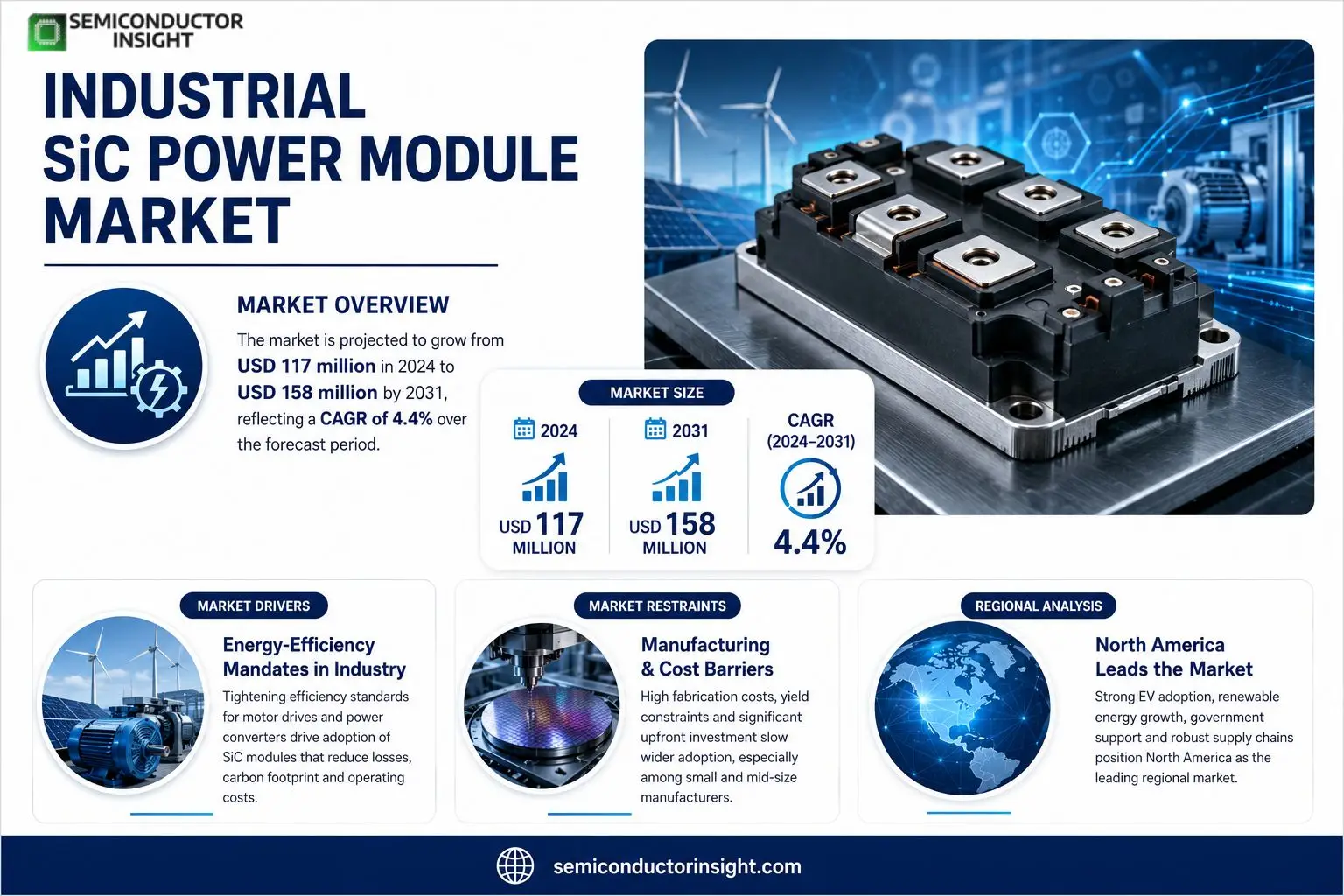
Industrial SiC Power Module market size was valued at USD 117 million in 2024 and is forecasted to reach USD 158 million by 2034 reflecting a CAGR of 4.4% over the period.
Industrial SiC Power Modules combine silicon‑carbide semiconductor devices into integrated packages that deliver higher voltage capability, lower conduction losses and improved thermal handling than conventional silicon counterparts. These attributes make them essential for high‑efficiency power conversion in electric vehicles, photovoltaic inverters, motor drives and other industrial power‑supply applications.The upward trajectory is driven by accelerating electric‑vehicle penetration, growing renewable‑energy deployments and heightened demand for compact yet robust power electronics. Recent industry activity includes the launch of 8‑inch SiC wafer production lines and strategic alliances among major semiconductor manufacturers. Prominent players such as Rohm Semiconductor, Infineon, Mitsubishi Electric, STMicroelectronics, Wolfspeed, and ON Semiconductor are expanding product portfolios and scaling capacity to meet emerging demand.
MARKET DRIVERS
Energy‑efficiency mandates in heavy‑industry
Industrial SiC Power Module Market is buoyed by tightening efficiency standards for motor drives, welding equipment, and high‑power converters. Operators are forced to replace legacy silicon devices because SiC modules can cut conduction losses by up to 30 %, translating into lower operating expenses and a smaller carbon footprint. This pressure creates a clear incentive for manufacturers to qualify SiC solutions across their product lines.
Rising adoption of renewable‑energy interfaces
Grid‑integration projects for solar inverters and wind‑farm converters increasingly rely on SiC power modules to manage high voltages while maintaining compact footprints. The ability of SiC to survive harsh temperature swings reduces cooling‑system complexity, a factor that system integrators cite when selecting components for offshore and desert installations.
➤ “Switching to SiC can shrink inverter size by 40 % and shave several kilowatts of loss, directly affecting the bottom line of utility‑scale projects.”
Beyond regulatory drivers, the rollout of electric‑drive solutions in material‑handling equipment pushes OEMs toward SiC because the technology supports higher power densities without compromising reliability. Companies that lock in SiC supply chains now enjoy a competitive edge as buyers demand longer service intervals and lower total‑ownership cost.
MARKET CHALLENGES
Manufacturing yield constraints
Silicon‑carbide wafer fabrication remains a capital‑intensive operation, and defect rates are still higher than those of mature silicon processes. The limited number of high‑volume fabs means that any yield dip immediately reverberates through downstream module assembly, inflating unit costs and discouraging price‑sensitive buyers.
Other Challenges
Supply‑chain bottlenecks
The concentration of raw SiC material suppliers in a few geographic regions creates exposure to geopolitical shifts and logistical disruptions. When shipment delays occur, OEMs often revert to silicon alternatives, undermining the momentum of the SiC transition.
MARKET RESTRAINTS
High upfront capital outlays
Although lifecycle cost analyses favor SiC, the initial investment for tooling, qualification, and design re‑work can exceed the budgets of small‑ and medium‑size manufacturers. This capital barrier slows broader market penetration, especially in regions where financing options for advanced semiconductor equipment are limited.The requirement for extensive reliability testing in harsh industrial environments adds another layer of expense. End‑users frequently demand accelerated life‑testing data before committing to SiC modules, a process that can add months to product development cycles and deter rapid adoption.
MARKET OPPORTUNITIES
Emerging automotive‑industrial crossover applications
The convergence of automotive power‑train technologies with industrial machinerysuch as autonomous forklifts and electric haul truckscreates a niche where SiC modules can deliver both high efficiency and ruggedness. Suppliers that tailor modules for these hybrid use‑cases stand to capture a growing slice of the overall market.Additionally, the rollout of 5G‑enabled factories introduces dense power‑distribution networks that demand compact, high‑frequency converters. SiC’s superior switching speed positions it as the preferred technology for these next‑generation manufacturing cells, opening a pathway for vendors to embed SiC modules into modular, plug‑and‑play solutions.
Industrial SiC Power Module Market Trends
Increasing Adoption of SiC Modules in High‑Power Industrial Applications
Demand for higher efficiency and thermal robustness is reshaping equipment design in sectors such as motor drives, photovoltaic inverters, and heavy‑duty power supplies. As SiC devices tolerate higher switching frequencies, manufacturers can reduce filter size and overall system footprint, which in turn lowers material usage and installation time. This engineering advantage translates into lower capital expenditure for plant upgrades, prompting end‑users to prioritize SiC modules despite a modest price premium. The shift is most evident in Europe’s renewable‑energy installations, where stricter emissions standards compel plant owners to seek conversion efficiencies above 95 %. In parallel, supply‑chain analysts note that the gradual decline in wafer‑price differentials is making Industrial SiC Power Module Market more attractive to mid‑size OEMs seeking to differentiate on performance rather than cost alone.
Other Trends
Scaling of Wafer Sizes from 6‑inch to 8‑inch
The industry is moving beyond the entrenched 6‑inch substrate base. Early‑stage pilot lines for 8‑inch SiC wafers are entering production in China, supported by government incentives that lower capital risk and encourage technology transfer. Larger wafers improve material utilisation, cut per‑die cost, and enable higher voltage ratings within a single module, which is essential for next‑generation industrial converters. Companies that secure 8‑inch capacity are likely to gain a cost advantage, pressuring rivals still reliant on 6‑inch processes. Early adopters report yield improvements of up to 12 % after process optimisation, hinting at a forthcoming reduction in overall module price.\
Geographic Concentration of New Entrants in China
Chinese firms are expanding their SiC portfolios, leveraging domestic supply chains and a talent pool focused on wide‑bandgap semiconductors. The surge of local players is diversifying the competitive landscape, challenging established US, European, and Japanese incumbents. For multinational manufacturers, the implication is two‑fold: collaborate with Chinese partners to access volume, or differentiate through advanced packaging and reliability guarantees that cater to safety‑critical markets such as aerospace and rail. Investment analysts observe a modest uptick in M&A activity aimed at acquiring intellectual property around high‑temperature packaging, suggesting that the competitive pressure will translate into strategic consolidation over the next five years.
COMPETITIVE LANDSCAPE
Key Industry Players
Industrial SiC Power Module market: competitive configuration and strategic positioning
Rohm Semiconductor dominates the industrial SiC power module segment, leveraging its vertically integrated supply chain that spans SiC wafer production to module assembly. By consolidating substrate sourcing and packaging in‑house, Rohm can command tighter cost structures and accelerate time‑to‑market for high‑voltage modules used in motor drives and renewable‑energy converters. Infineon Technologies’ strong foothold in automotive‑grade SiC devices translates into a sizeable presence in industrial power conversion, where its wide‑bandgap portfolio benefits from extensive R&D spend and a sales network. Wolfspeed, a subsidiary of Cree Inc., distinguishes itself through a focus on 8‑inch wafer scale‑up, positioning the company to capture volume orders as OEMs shift toward larger substrate formats. These three firms collectively shape market pricing tiers and dictate the pace of technology adoption, forcing smaller entrants to either specialize in niche applications or seek strategic alliances.Beyond the sector leaders, a cluster of manufacturers contributes depth to the competitive arena. Mitsubishi Electric leverages its extensive power electronics heritage to supply SiC modules for industrial inverter systems, while STMicroelectronics applies its broad semiconductor portfolio to offer hybrid SiC solutions that blend SiC and silicon components for cost‑effective performance. Fuji Electric and Microchip Technology target mid‑range power supplies, emphasizing reliability and thermal management. ON Semiconductor and Semikron have built modular product lines that cater to factory automation and rail traction, where ruggedness is paramount. European and Asian players such as Danfoss, Toshiba, Shanghai SiC Power, and San’an Optoelectronics expand regional coverage, often tailoring modules to local standards and supply‑chain preferences. Emerging Chinese firms, including RG SiC and NXP Semiconductors, are quickly scaling production capacity, which could recalibrate the competitive balance by introducing aggressive pricing and localized support.
List of Key Industrial SiC Power Module Companies Profiled
- Rohm Semiconductor
- Infineon Technologies AG
- Wolfspeed, Inc.
- Mitsubishi Electric Corporation
- STMicroelectronics
- Fuji Electric Co., Ltd.
- Microchip Technology Inc.
- ON Semiconductor
- Semikron GmbH
- Danfoss A/S
- Toshiba Corporation
- Shanghai SiC Power Ltd.
- San’an Optoelectronics Co., Ltd.
- RG SiC
- NXP Semiconductors
Segment Analysis:
| Segment Category | Sub-Segments | Key Insights |
| By Type |
|
Hybrid SiC Modules are emerging as the leading segment because they blend the advantages of silicon and silicon‑carbide, allowing manufacturers to balance cost and performance while easing transition for existing silicon‑based designs.
|
| By Application |
|
Motor Drive stands out as the dominant application segment owing to the growing demand for high‑efficiency drives in manufacturing automation, robotics, and electric‑vehicle propulsion.
|
| By End User |
|
Electric‑Vehicle Manufacturers represent the most influential end‑user group, driving the push for higher efficiency and lighter power electronics.
|
| By Power Rating |
|
High Power modules are gaining traction as system designers target higher voltage and current thresholds for industrial drives and grid‑connected converters.
|
| By Innovation Focus |
|
Advanced Packaging leads the innovation narrative, as manufacturers invest in compact, high‑density interconnects that unlock new design freedoms.
|
Regional Analysis: Industrial SiC Power Module Market
North America
The continental push toward zero‑emission vehicles accelerates SiC adoption, especially for power‑train inverters that must sustain high currents without overheating. Tier‑1 suppliers are locking in long‑term contracts with major automakers, ensuring a steady pipeline of module designs tailored to the stringent automotive reliability standards.
U.S. hyperscale operators are retrofitting legacy infrastructure with SiC‑based converters to curtail power‑losses in dense rack environments. The financial incentive to lower operational expenditure dovetails with silicon‑carbide’s ability to operate at higher switching frequencies, shrinking magnetic footprints and freeing up valuable floor space.
Government procurement programs favor SiC modules for radar and high‑power RF systems, where weight and thermal management are critical. The defense sector’s willingness to fund advanced component development sustains niche but strategically important demand streams.
Federal incentives aimed at clean‑energy technology adoption lower the effective cost of SiC integration for industrial equipment makers, encouraging broader market penetration beyond flagship applications.
Europe
European manufacturers are navigating a regulatory landscape that emphasizes grid stability and decarbonization, prompting utility‑scale converters to incorporate SiC modules for improved efficiency. While the region’s production capacity lags behind North America, collaborative R&D initiativesparticularly in Germany and Franceare closing the technology gap. The emergence of automotive clusters around electric‑driving and high‑speed rail provides a steady demand tail, encouraging component suppliers to customize packaging solutions for local standards.
Asia‑Pacific
Asia‑Pacific’s burgeoning industrial base fuels a diversified need for silicon‑carbide power modules, from heavy‑industry drives to consumer electronics chargers. China’s aggressive electrification agenda and Japan’s longstanding semiconductor expertise create a fertile environment for rapid scaling. However, disparate quality controls across the region introduce variability, compelling multinational firms to establish localized testing hubs to assure consistency across varied applications.
South America
In South America, the modest yet growing renewable‑energy sectorthe result of large‑scale solar and wind projectsrequires robust power conversion hardware. Local OEMs are beginning to source SiC modules to meet the reliability demands of remote installations where maintenance windows are limited. Limited domestic production keeps import dependence high, but emerging partnerships with Latin‑American distributors hint at a nascent supply chain formation.
Middle East & Africa
The Middle East & Africa region presents a mixed picture; oil‑rich economies are investing heavily in grid‑modernization to support rising electricity consumption, while African nations pursue off‑grid solar solutions that benefit from SiC’s high‑temperature tolerance. These contrasting pathways stimulate demand for both high‑power industrial modules and more compact, cost‑effective variants. Strategic alliances with silicon‑carbide vendors are beginning to surface, driven by the need to secure reliable component access for emerging projects.
Report Scope
This market research report provides a comprehensive analysis of the Industrial SiC Power Module Market , covering the forecast period 2026–2034. It offers detailed insights into market dynamics, technological advancements, competitive landscape, and key trends shaping the industry.
Key focus areas of the report include:
- Market Overview: The report begins with an overview outlining its current market scenario, key growth indicators, and industry transformation drivers. It discusses macroeconomic factors, demand–supply balance, regulatory landscape, and the strategic role of semiconductors in powering advancements across industries such as automotive, telecommunications, consumer electronics, and industrial automation.
- Market Size & Forecast: Historical data and future projections for revenue, unit shipments, and market value across major regions and segments.
- Segmentation Analysis: Detailed breakdown by product type, technology, application, and end-user industry to identify high-growth segments and investment opportunities.
- Regional Insights: Insights into market performance across North America, Europe, Asia-Pacific, Latin America, and the Middle East & Africa, including country-level analysis where relevant.
- Competitive Landscape: Profiles of leading market participants, including their product offerings, R&D focus, manufacturing capacity, pricing strategies, and recent developments such as mergers, acquisitions, and partnerships.
- Technology Trends & Innovation: Assessment of emerging technologies, integration of AI/IoT, semiconductor design trends, fabrication techniques, and evolving industry standards.
- Market Drivers & Restraints: Evaluation of factors driving market growth along with challenges, supply chain constraints, regulatory issues, and market-entry barriers.
- Stakeholder Insights: Insights for component suppliers, OEMs, system integrators, investors, and policymakers regarding the evolving ecosystem and strategic opportunities.
Primary and secondary research methods are employed, including interviews with industry experts, data from verified sources, and real-time market intelligence to ensure the accuracy and reliability of the insights presented.
FREQUENTLY ASKED QUESTIONS:
What is the current market size of Industrial SiC Power Module Market?
-> Industrial SiC Power Module Market was valued at USD 117 million in 2024 and is expected to reach USD 158 million by 2034
Which key companies operate in Industrial SiC Power Module Market?
-> Key players include Rohm Semiconductor, Infineon, Mitsubishi Electric, STMicroelectronics, Fuji Electric, Microchip, Wolfspeed, ON Semiconductor, Semikron, Danfoss, Toshiba.
What are the key growth drivers?
-> Key growth drivers include strong demand from electric vehicles (EV), need for higher‑efficiency power modules, transition to larger 8‑inch SiC wafers, and expanding applications in photovoltaic and motor‑drive sectors.
Which region dominates the market?
-> Asia (particularly China) is emerging as the dominant region, driven by increasing investments and new manufacturers.
What are the emerging trends?
-> Emerging trends include deployment of 8‑inch SiC wafers, growth of hybrid and full SiC module offerings, and rising adoption in EV powertrains and renewable‑energy applications.
Get Sample Report PDF for Exclusive Insights
Report Sample Includes
- Table of Contents
- List of Tables & Figures
- Charts, Research Methodology, and more...
 Download Sample Report PDF