Silicon Carbide (SiC) Power Device Market Insights
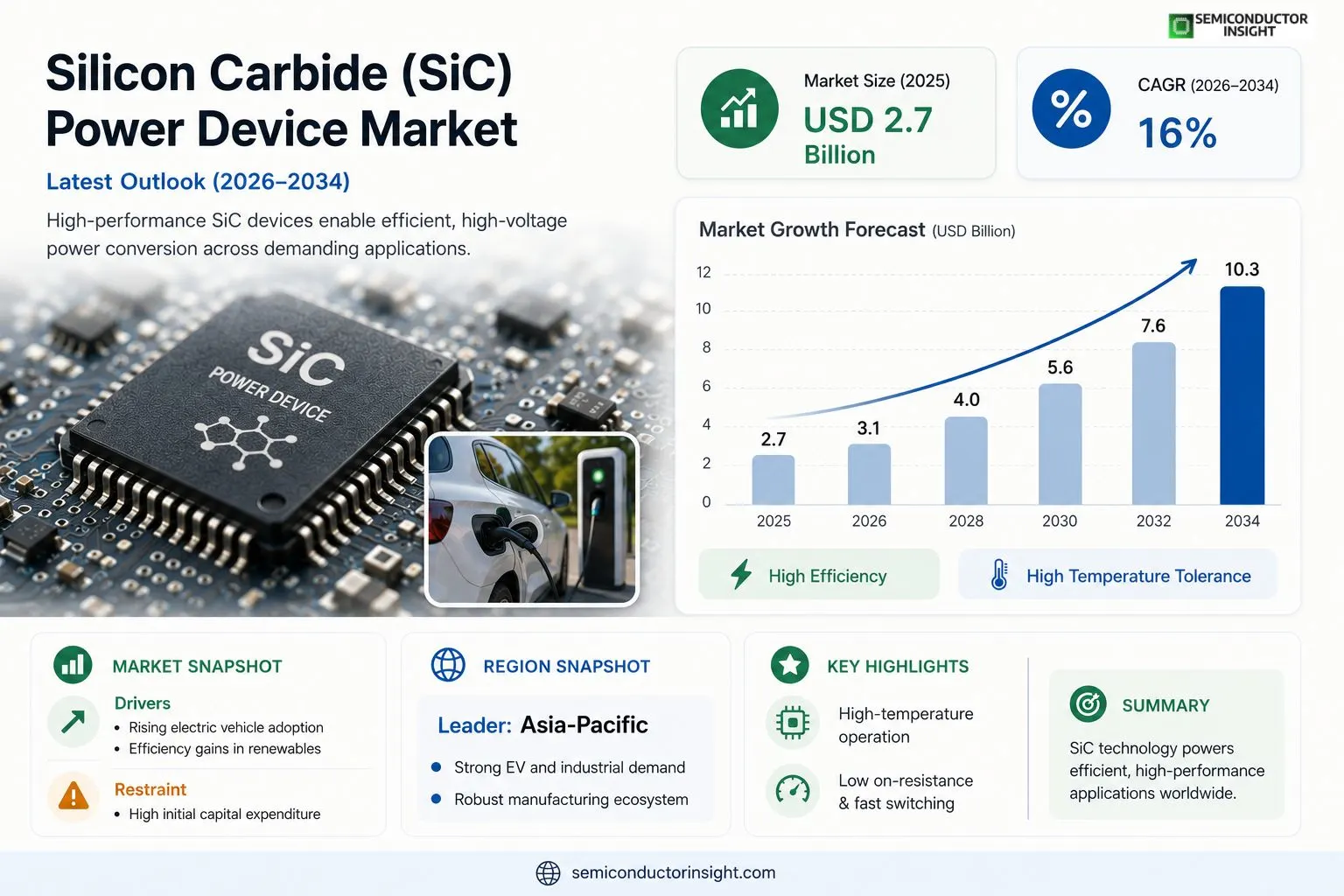
Global Silicon Carbide (SiC) Power Device Market size was valued at USD 2 billion in 2023.The market is projected to grow from USD 2·7 billion in 2025 to USD 10·3 billion by 2034, exhibiting a CAGR of 16% during the forecast period.
Silicon carbide power devices are high‑performance semiconductor components that enable efficient conversion of electrical energy across a wide temperature range.These devices,such as Schottky diodes, MOSFETs and JFETs,offer lower on‑resistance and higher switching speeds compared with traditional silicon counterparts, making them essential for electric vehicles, renewable‑energy converters and industrial motor drives.The market is accelerating because automotive electrification demands higher efficiency while data‑center power supplies seek reduced losses.Furthermore, government incentives for clean energy and recent capacity expansions
MARKET DRIVERS
Rising Electric Vehicle Adoption
Global shift toward electric vehicles (EVs) is accelerating demand for high‑efficiency power conversion. Silicon Carbide (SiC) Power Device Market players are benefiting from automotive OEMs seeking lighter, smaller, and cooler power modules to extend vehicle range.
Efficiency Gains in Renewable Energy Systems
Utility‑scale solar‑inverter and wind‑turbine manufacturers are integrating SiC devices to achieve >30% higher efficiency compared with traditional silicon solutions, thereby lowering Levelized Cost of Energy (LCOE).
➤ SiC devices can tolerate junction temperatures up to 200 °C, reducing the need for bulky heat‑sinks and cutting system cost.
In addition, data‑center power supplies are transitioning to SiC technology to support higher power density, which aligns with the broader Silicon Carbide (SiC) Power Device Market growth trajectory.
MARKET CHALLENGES
High Initial Capital Expenditure
Manufacturers face steep upfront costs for SiC wafer production and device fabrication, which can delay adoption for cost‑sensitive OEMs.
Other Challenges
Supply‑Chain Constraints
Limited availability of high‑purity SiC substrates leads to longer lead times, creating bottlenecks for large‑scale deployments.
Reliability Concerns in Harsh Environments
While SiC devices promise superior thermal performance, long‑term reliability under extreme voltage spikes remains a focus of ongoing research, influencing procurement decisions in aerospace and defense sectors.
MARKET RESTRAINTS
Cost Competitiveness with Silicon Technologies
The per‑watt cost of SiC power devices still exceeds that of mature silicon counterparts, limiting market penetration in price‑sensitive applications such as consumer electronics.Furthermore, the need for specialized design expertise and redesign of existing power architectures can deter smaller manufacturers from transitioning to SiC solutions.
MARKET OPPORTUNITIES
Emerging 5G Infrastructure
5G base stations require high‑efficiency power amplifiers and converters, presenting a substantial growth avenue for SiC devices that can deliver low loss at high frequencies.Additionally, advancements in SiC wafer scaling are expected to drive down production costs, unlocking new segments such as electric aircraft propulsion and high‑power industrial motor drives.Strategic collaborations between semiconductor foundries and end‑user OEMs are accelerating technology transfer, which will further expand Silicon Carbide (SiC) Power Device Market in the next five years.
Silicon Carbide (SiC) Power Device Market Trends
Automotive Powertrain Efficiency Gains
The shift toward battery‑electric vehicles is accelerating adoption of high‑performance semiconductor components that can tolerate extreme temperatures while minimizing energy loss. Silicon carbide power devices, particularly Schottky diodes and MOSFETs, deliver substantially lower on‑resistance and faster switching compared with conventional silicon parts. This technical advantage translates into lighter inverter designs, reduced cooling requirements, and ultimately longer vehicle range. OEMs are integrating these devices across traction inverters, on‑board chargers, and auxiliary power systems to meet stricter efficiency regulations and consumer expectations for performance. The trend is reinforced by collaborative development programs between automotive manufacturers and leading SiC producers, ensuring that supply‑chain readiness aligns with projected volume growth.
Other Trends
Renewable Energy Converter Modernization
Grid‑connected renewable installations increasingly rely on power converters that must operate efficiently under wide temperature swings and variable load conditions. Silicon carbide technology offers the thermal robustness needed for offshore wind turbines and large‑scale solar farms, where conventional silicon solutions would suffer from higher thermal degradation. System designers are favoring SiC‑based converters to achieve higher power density, enabling smaller, lighter gearboxes and simplifying installation logistics. Government incentives for clean‑energy infrastructure further motivate utilities to upgrade legacy equipment, creating a feedback loop that drives demand for next‑generation SiC components across the energy sector.
Industrial Motor Drive Expansion
Industrial manufacturers are upgrading motor‑drive systems to meet global efficiency standards and reduce operational expenditures. Silicon carbide power devices support higher switching frequencies, which allows for compact drive designs and lower harmonic distortion in motor control loops. These improvements are especially valuable in high‑speed applications such as CNC machinery, pumps, and compressors, where precise speed control and energy savings are critical. Recent capacity expansions by major SiC fabs, including new production lines announced by Wolfspeed, have improved availability and reduced lead times, encouraging broader adoption in factories seeking to modernize equipment while complying with increasingly stringent environmental regulations.
COMPETITIVE LANDSCAPEKey Industry Players
Silicon Carbide (SiC) Power Device Market – Competitive Overview
Wolfspeed, the SiC business unit of Cree, remains the dominant force in the SiC power device arena, leveraging its vertically integrated wafer‑to‑package model and a robust portfolio that spans Schottky diodes, MOSFETs, and JFETs. The company’s aggressive capacity expansions in the United States have positioned it as the primary supplier for high‑growth segments such as electric‑vehicle powertrains and renewable‑energy converters. Close behind, Infineon Technologies and STMicroelectronics command significant market share through deep automotive relationships and extensive design‑win libraries, while ROHM Semiconductor differentiates itself with a focus on high‑temperature modules for industrial motor drives. ON Semiconductor rounds out the top tier by offering a broad catalog of SiC devices that cater to data‑center power supplies, reinforcing a market structure where a handful of well‑capitalized firms dominate volume sales and dictate pricing trends.Beyond the leading quartet, a cadre of niche yet strategically important players contributes to ecosystem diversity and drives innovation in specialized applications. Nexperia and Texas Instruments have accelerated SiC roadmap introductions to capture emerging automotive and grid‑storage opportunities. Mitsubishi Electric leverages its power‑electronics heritage to deliver SiC converters for rail and aerospace markets. MagnaChip Semiconductor and GeneSiC focus on high‑efficiency power modules for industrial automation. Globalfoundries provides foundry services that enable fab‑light entrants, while Soitec supplies engineered substrates that improve device thermal performance. These companies, although smaller in volume, enhance competition by targeting vertical‑specific niches, fostering technology differentiation, and expanding the overall supply base for the rapidly growing SiC market.
List of Key Silicon Carbide (SiC) Companies Profiled
- Wolfspeed
- Infineon Technologies
- STMicroelectronics
- ROHM Semiconductor
- ON Semiconductor
- Nexperia
- Texas Instruments
- Mitsubishi Electric
- MagnaChip Semiconductor
- GeneSiC Semiconductor
- Globalfoundries
- Soitec
Segment Analysis:
| Segment Category | Sub-Segments | Key Insights |
| By Type |
|
Schottky Diodes dominate the type segment because they provide exceptionally low forward voltage drop, enabling highly efficient power conversion in demanding applications. • Their fast recovery characteristics reduce reverse‑recovery losses in high‑frequency circuits. • Robust thermal performance allows operation in harsh environments without extensive cooling infrastructure. • Simplicity of drive requirements makes them a preferred choice for compact power modules. |
| By Application |
|
Electric Vehicles emerge as the leading application segment, driven by the need for higher drivetrain efficiency and reduced thermal stress. • SiC devices enable compact inverter designs that support higher power density. • Their ability to operate across wide temperature ranges reduces cooling system complexity. • Enhanced switching speed contributes to smoother torque delivery and regenerative braking performance. |
| By End User |
|
Automotive OEMs are the primary end‑user, prioritizing reliability and energy‑efficiency in next‑generation electric drivetrains. • They value the reduced weight and size of SiC power modules, contributing to vehicle range improvements. • The technology’s resilience to high‑temperature operation aligns with aggressive durability targets. • OEMs are integrating SiC solutions early in platform development to secure supply chain advantages. |
| By Voltage Rating |
|
Medium‑Voltage devices garner attention because they balance performance and cost for a broad set of applications. • They provide sufficient blocking capability for automotive inverters while maintaining manageable gate drive requirements. • In renewable‑energy converters, medium‑voltage SiC modules enable compact transformer‑less architectures. • The technology’s inherent low loss profile at these ratings supports higher system efficiency without extensive thermal management. |
| By Market Driver |
|
Efficiency Demands drive adoption across all segments, as designers seek to minimize energy loss. • SiC’s low on‑resistance directly translates to reduced conduction losses. • Faster switching reduces dynamic losses, improving overall system performance. • The cumulative effect supports longer product lifespans and lower operating costs, aligning with sustainability objectives. |
Regional Analysis: Asia-Pacific
Asia-Pacific
The burgeoning electric vehicle market in countries like China, Japan, and South Korea is a primary driver for SiC adoption in power electronics for on-board chargers and power inverters. The need for higher efficiency and power density in EV charging systems directly translates to a greater demand for advanced SiC devices.
The increasing deployment of solar and wind power necessitates efficient power conversion systems. SiC’s high switching frequency and thermal performance make it ideal for inverters used in renewable energy generation and grid integration, contributing to improved efficiency and reliability.
Industrial applications such as motor drives, welding equipment, and power tools are increasingly adopting SiC power devices to enhance energy efficiency, reduce size and weight, and improve overall performance. The demand for more robust and power-dense power supplies is fueling SiC adoption in this sector.
Data centers and telecommunication infrastructure are utilizing SiC power devices for power supplies and energy management systems to achieve higher efficiency and reduce operating costs. The growing demand for data processing and connectivity is driving the need for energy-efficient power solutions.
North America
North America exhibits steady growth in the SiC Power Device Market, driven by the strong automotive industry and increasing investments in renewable energy projects. The United States, in particular, is a key market with significant research and development activities focused on SiC technology. The adoption rate is gradually increasing, focusing on high-performance applications and power electronics for electric vehicles and industrial sectors. Concerns regarding supply chain resilience and geopolitical factors are also influencing market dynamics in this region.
Europe
Europe’s SiC Power Device Market is characterized by a strong emphasis on energy efficiency and sustainability. Stringent environmental regulations are driving the adoption of SiC technology across various applications, including electric vehicles and industrial motor drives. Germany, France, and the UK are leading markets, with significant investments in research and development and manufacturing capabilities. The European Union’s focus on the green transition is further accelerating SiC adoption within the power electronics sector.
South America
South America presents a relatively nascent but promising market for SiC Power Devices. The growth is being spurred by increasing adoption in the renewable energy sector, particularly in solar power projects. The automotive industry is also beginning to explore SiC applications for electric vehicles, although at a slower pace compared to North America and Asia-Pacific. Government initiatives aimed at promoting renewable energy and industrial modernization are expected to fuel further growth in the coming years.
Middle East & Africa
The Middle East & Africa region represents an emerging market for SiC Power Devices, driven by investments in infrastructure development and the growing adoption of renewable energy sources. The demand for energy-efficient power solutions in industries such as oil and gas, mining, and telecommunications is creating opportunities for SiC technology. Rapid urbanization and increasing automotive sales are also contributing to market growth in certain countries within the region.
Report Scope
This market research report provides a comprehensive analysis of the Silicon Carbide (SiC) Power Device Market , covering the forecast period 2026–2034. It offers detailed insights into market dynamics, technological advancements, competitive landscape, and key trends shaping the industry.
Key focus areas of the report include:
- Market Overview: The report begins with an overview outlining its current market scenario, key growth indicators, and industry transformation drivers. It discusses macroeconomic factors, demand–supply balance, regulatory landscape, and the strategic role of semiconductors in powering advancements across industries such as automotive, telecommunications, consumer electronics, and industrial automation.
- Market Size & Forecast: Historical data and future projections for revenue, unit shipments, and market value across major regions and segments.
- Segmentation Analysis: Detailed breakdown by product type, technology, application, and end-user industry to identify high-growth segments and investment opportunities.
- Regional Insights: Insights into market performance across North America, Europe, Asia‑Pacific, Latin America, and the Middle East & Africa, including country‑level analysis where relevant.
- Competitive Landscape: Profiles of leading market participants, including their product offerings, R&D focus, manufacturing capacity, pricing strategies, and recent developments such as mergers, acquisitions, and partnerships.
- Technology Trends & Innovation: Assessment of emerging technologies, integration of AI/IoT, semiconductor design trends, fabrication techniques, and evolving industry standards.
- Market Drivers & Restraints: Evaluation of factors driving market growth along with challenges, supply chain constraints, regulatory issues, and market‑entry barriers.
- Stakeholder Insights: Insights for component suppliers, OEMs, system integrators, investors, and policymakers regarding the evolving ecosystem and strategic opportunities.
Primary and secondary research methods are employed, including interviews with industry experts, data from verified sources, and real‑time market intelligence to ensure the accuracy and reliability of the insights presented.
FREQUENTLY ASKED QUESTIONS:
What is the current market size of Silicon Carbide (SiC) Power Device Market?
-> Silicon Carbide (SiC) Power Device Market was valued at USD 2.7 billion in 2025 and is expected to reach USD 10.3 billion by 2034, reflecting a CAGR of 16 % over the forecast period.
Which key companies operate in Silicon Carbide (SiC) Power Device Market?
-> Key players include Wolfspeed, STMicroelectronics, Infineon Technologies, ROHM Semiconductor, and ON Semiconductor, among others.
What are the key growth drivers?
-> Key growth drivers include automotive electrification demanding higher efficiency, data‑center power‑supply optimization, and government incentives for clean‑energy technologies.
Which region dominates the market?
-> Asia‑Pacific is a leading region due to robust automotive production and industrial adoption, while North America also holds a significant share driven by advanced semiconductor manufacturing.
What are the emerging trends?
-> Emerging trends include capacity expansions by manufacturers such as Wolfspeed, development of higher‑voltage SiC devices, and integration of AI‑assisted design workflows.

Get Sample Report PDF for Exclusive Insights
Report Sample Includes
- Table of Contents
- List of Tables & Figures
- Charts, Research Methodology, and more...
 Download Sample Report PDF