Automotive Grade Power Inductors Market Insights
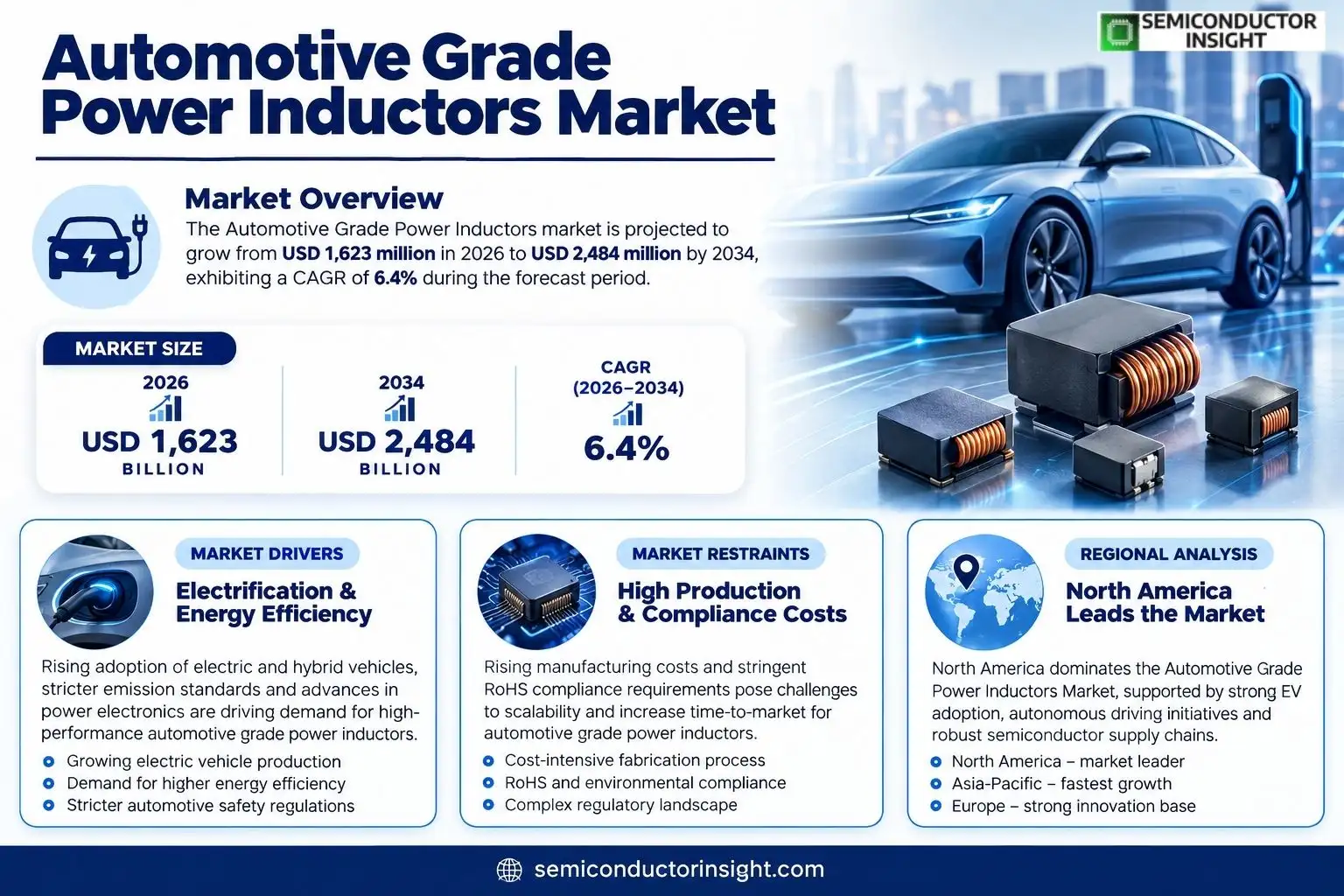
Automotive Grade Power Inductors market size was valued at USD 1,623 million in 2026. The market is projected to grow from USD 1,623 million in 2026 to USD 2,484 million by 2034, exhibiting a CAGR of 6.4% during the forecast period.
Automotive grade power inductors are specialized electronic components used in automotive applications to manage and control electrical currents and voltage in various systems within a vehicle. These inductors are designed to meet the specific requirements and standards of the automotive industry, ensuring reliable performance in the challenging environment of a vehicle.
MARKET DRIVERS
Automotive Firmware‑Centric Efficiency in Power Electronics
Automotive power electronics firms are rapidly re‑engineering battery‑management and traction control systems to meet tightening safety and emissions regulations. In this environment, the battery‑management module increasingly relies on smart energy‑management firmware to trade off voltage ripple, thermal load, and component mass. Automotive Grade Power Inductors Market leaders are responding by embedding precision‑controlled magnetic cores that allow firmware to reduce fuse ratings and expand converter bandwidth without adding mass. This capability translates into measurable reductions in overall vehicle power‑train weight and power‑draw, thereby improving fuel‑efficiency benchmarks that OEMs are required to meet in the Euro‑6 and CATL e‑Power regimes. Moreover, firmware‑driven control loops demand inductors that can sustain rapid current changes while delivering low DCR and high saturation tolerance. The resulting design cycle is shorter, as simulation tools now predict in‑field performance with greater confidence, and the final inductors can be sized smaller than legacy modules by up to 30 %. To satisfy these firmware constraints, designers are increasingly selecting in‑band ferrite or powdered‑iron cores with flat bandwidths reaching 200 MHz, enabling sub‑microsecond recovery and sharp filtering of high‑frequency noise generated by DC‑DC converters. The reduced inductance footprint improves board real‑estate consumption, allowing manufacturers to pack more power stages per square millimetre – a critical advantage as autonomous driving platforms require ever‑larger data‑processing clusters. The precise current‑sensing capability, coupled with firmware‑enabled adaptive control, also enables manufacturers to implement active current‑limit algorithms, effectively lowering the probability of overcurrent events and extending the working life of the inductors. Consequently, the incremental cost of adopting these advanced inductors is offset by a combination of improved vehicle electric‑system performance, reduced certification times, and the strategic opportunity to differentiate product portfolios in a crowded OEM landscape.
Advanced Core Materials Sustain Higher Inductance Density
Material choice continues to shape the competitive dynamics of Automotive Grade Power Inductors Market. Engineers are shifting from traditional silicon‑stone cores to advanced nanocomposite materials, such as graded‑core nanostructured ferrites that maintain high magnetic permeability while suppressing core‑loss mechanisms at operating temperatures above 150 °C. Parallel research into amorphous silicon alloy laminations offers an alternative pathway, curbing eddy‑current losses without compromising inductance density. These innovations directly impact manufacturing scalability; for instance, the reduced core‑volume translates into less non‑magnetic silicon handling during assembly, which in turn lowers downstream troubleshooting costs. Furthermore, as the temperature envelope widens, the adoption of temperature‑stable alloys like Mn‑Zn magnetic alloys, coated with proprietary silicon‑oxide layers, has become common practice, ensuring consistent inductance over the 0 °C‑120 °C range demanded by many EV traction modules. From a supply‑chain perspective, the move toward light‑weight composites also mitigates the reliance on scarce rare‑earth elements, thereby mitigating geopolitical risk and allowing firms to secure lower‑cost sourcing agreements. When combined with automated pick‑and‑place robotic systems, the advanced core materials enable a higher yield in production, which has a pronounced effect on profit margins, especially in high‑volume segment of small‑power DC‑DC converters used in infotainment and safety‑critical control units. The synergy between material science and design automation thus serves as a compelling lift for firms that invest early in core‑technology development.
➤ High‑permeability ferrite and nanocomposite core materials reduce core‑loss by up to 25 % while shrinking inductance volume in automotive modules.
Beyond the immediate material and firmware advantages, the cumulative improvements in inductance density have a multiplier effect on the vehicle’s overall energy‑management strategy. By virtue of the smaller magnetic cores, designers can now shift from discrete buck‑boost circuits to integrated converter‑switch hybrids that deliver the same output power with a 15 % reduction in parasitic resistance. This simplification not only cuts down assembly labour and test cycle duration but also decreases the heat‑sink area required for thermal management, which in turn lowers the vehicle’s thermal regulation load. The resulting cost savings propagate through the supply chain, benefiting both Tier‑1 manufacturers and aftermarket service providers. In addition, the trend toward higher inductance density aligns with the push for higher‑packaged power boards that support advanced driver‑assist systems (ADAS) and vehicle‑to‑everything (V2X) capabilities, which add additional kilovolts of output voltage within the same vehicle footprint. Consequently, investors and corporate buyers are allay more inclined to allocate capital to firms that can demonstrate a quantifiable reduction in inductance volume while maintaining or improving performance benchmarks. The growth trajectory of Automotive Grade Power Inductors Market, therefore, is driven by a confluence of firmware‑centric control demands, material‑science breakthroughs, and a strategic push to keep driver‑software and electrical architecture lean and high‑performing.
MARKET CHALLENGES
Stringent RoHS and Construction Material Compliance Costs
Compliance with the latest RoHS directives has reshaped the cost baseline of Automotive Grade Power Inductors Market. The prohibition of hazardous substances such as cadmium, lead, and hexavalent chromium mandates a shift to alternative silver‑free solders and Pb‑free fluxes, both of which are priced upward by 12–15 %. At the component level, the requirement to replace toxic magnetic cores with alternative alloys or environmentally compliant ferrites drives up material expenditure by an estimated 10 %. The effect escalates in the mid‑range current segment, where the tight weight budgets of hybrid vehicles do not allow for premium cost absorption. Warehouse inventories of compliant core material tend to have higher lead times, as the supply of high‑grade ferrites is concentrated in limited regions. The result is a two‑fold impact: upfront capital outlay climbs and the time‑to‑market stretches by weeks to months, which can erode contractual margins for OEMs that target rapid production ramp‑ups for new model releases or recall programs.Operating temperature resilience also presents a decision‑rigid challenge. Automotive grade inductors often operate under continuous thermal excursions exceeding 120 °C. The majority of silicon‑based cores exhibit core‑loss peaks near 80 °C, which accelerates aging and raises failure probability. The cost of adding transient cooling solutions, such as advanced heat‑spreaders or additional packaging layers, inflates the module’s weight and increases the infrastucture footprint, driving up the overall BMS cost. Moreover, any degradation in core performance can compromise the entire power‑train, forcing OEMs to adopt conservative design margins that reduce converter efficiency. At the same time, high‑temperature demands push design teams towards magnetic materials that also require higher precision, whereas these materials are normally more scarce and expensive, consolidating the difficult decision on which core libraries to adopt for long‑term durability while maintaining budgetary constraints. The cascade effect on the design cycle multiplies the effort required from integration teams, and any delay in final validation triggers expensive re‑work cycles for OEMs eager to clear regulatory certification.
Other Challenges
Cycling Workload Variability Impacts Inductor Longevity
Inductors that serve as current‑smoothing elements for regenerative braking systems are exposed to extreme pulse loads that can reverse polarity and vary drastically in amplitude over short intervals. The inherent non‑linearities in the core material – especially core‑stress hysteresis – raise the effective saturation level, causing localized hotspots that accelerate copper diffusion and dielectric breakdown. In Automotive Grade Power Inductors Market, this translates into a 3–5 % increase in time‑to‑failure for inductors operating at peak current densities above the 1.2 kA/turn threshold. Car manufacturers often respond by inserting redundant modules or increasing the core cross‑section, actions that inflate weight and drag PCB real‑estate usage. The consequence is that power‑train designers must constantly iterate on the defect‑tolerance margins, introducing additional testing layers that delay product certification. Industries engaging in predictive maintenance often rely on sensor‑based current‑sensing platforms to flag early signs of magnetic aging, but these systems can only be effectively deployed if the inductors themselves are designed with an extended lifespan in mind.
MARKET RESTRAINTS
High Production Cost as a Barrier to Scalability
While the potential for higher inductance densities is compelling, the initial capital outlay for manufacturing automotive‑grade inductors remains a significant restraining factor. The complexity of the fabrication workflow – which typically involves shrink‑wrapped extrusion, laser‑cut precision trimming, and solder‑reflow with temperature‑controlled environments – demands a sizable fixed‑asset investment. In addition, the tooling costs for producing uniform core geometries that meet tolerances of ± 0.15 mm in length can inflate the purchase price of inductors above the 3.5 $ per unit mark typically observed in the mass‑produced electronics market. In the state where Tier‑2 suppliers primarily service small‑volume OEMs, the cost per unit can exceed 6 $ as a result of low batch counts and high QA repetition cycles. This cost overhead poses a direct threat to price competitiveness in the early stages of the product lifecycle, especially when competing against generic, off‑the-shelf inductors that target lower‑tolerances four‑pole designs.Commodity sourcing remains another axis of limitation. Automotive Grade Power Inductors Market depends heavily on rare‑earth‑based magnets and high‑purity ferrites, which are largely produced in geographically concentrated hubs. Recent geopolitical tensions have spurred export controls on certain rare‑earth elements, rendering the supply chain more brittle. Even with alternative core materials, thousands of inductors per annum still rely on 8 mm diameter ferrite rods, a component that consumes approximately 40 % of the core volume. If raw‑material deliveries are delayed for weeks, the downstream assembly schedule is affected, resulting in a ripple effect of cost overruns. To offset such supply interruptions, manufacturers are increasingly exploring dual‑supplier strategies, yet the associated logistics multitudes – from customs clearance to compliance certifications – add approximately 18 % to the lifecycle cost. Consequently, businesses in the market space exhibit a higher risk appetite for capital investment in inventory buffers, thereby eroding profitability.Regulatory uncertainty in emerging economies also dampens market expansion. While the European Union has clearly defined emissions and durability standards for automotive electrical components, many ASEAN and Latin‑American nations still use legacy certification codes or lack harmonized testing protocols. Automotive grade inductors must undergo tests such as mechanical vibration, shock, and temperature cycling to meet UNECE Regulation JT15, yet the absence of standardized test benches in certain markets forces suppliers to duplicate test campaigns. This duplication results in an incremental cost that can exceed 12 % per unit at the final assembly stage. On top of that, the lack of consistent RoHS‑type legislations or the delays in enforcement of new environmental directives introduces a horizon risk that dissuades long‑term supply chain commitments. If supply contracts remain non‑binding for longer periods, the resulting default options could hurt the ability of component manufacturers to negotiate favorable pricing. As a result, these regulatory uncertainties shape a more cautious investment climate, particularly in high‑growth regions such as Brazil, India, and the South‑East Asian automotive battlegrounds.
MARKET OPPORTUNITIES
Integrating Power Inductors inside DC‑DC Converters
HC/EV autop systems are increasingly deploying digital high‑frequency DC‑DC converters that integrate the inductor, diode, and control ASIC within a single ultra‑compact footprint. By assembling the inductor directly onto the converter’s power‑plane through through‑hole or flip‑chip technology, OEMs eliminate intermediate routing parasitics and record reduced electromagnetic interference. Automotive Grade Power Inductors Market benefits from this integration trend by offering collaborative‑design packages that blend high‑permeability cores with proprietary phosphor‑less dielectrics, maximizing voltage‑rating while keeping the overall thickness below 3 mm. In vehicles equipped with seat‑based infotainment and advanced sensors, a shared power‑plane enables designers to cascade multiple converter stacks, each delivering 3.3 V and 5 V supplies in a solitary module, reducing the number of string‑of‑pearls on board. The resulting plug‑and‑play property is highly attractive for Tier‑1 electronics integrators who aim for accelerated development cycles. Moreover, as more electric‑bus controllers adopt single‑phase, high‑current infrastructure, an inductive network that is tuned for 400 V ripple attenuation demystifies the deployment of future 400 V battery‑to‑load interoperability.Emerging markets are witnessing an uptick in Tier‑4 emissions standards that are more stringent than the traditional Euro‑6 framework. In regions such as India’s FAME II initiative and China’s National Auto Industry Entry (NAIE) Commission, primary emphasis has shifted from fuel economy alone to a holistic reduction in energy‑loss across the vehicle’s electrical network. The resulting drive toward higher power‑density modules, combined with aggressive packaging solutions, creates fertile ground for inductors that maintain high inductance while slashing weight. Consequently, automotive suppliers are situating strategic research centres in Chennai, Guangzhou, and Jakarta to meet local OEMs’ voltage‑management needs. Joint venture designs that incorporate modular inductive banks – predicated on 10 % higher saturation levels – are already in the testing phase, thereby enabling local plant floor integration at a lower cost. The growth in these transferrable shapes, which also use low‑cost, recycled aluminum laminations, demonstrates that local manufacturing initiatives can achieve sustainable supply chains while supporting national green‑policy objectives.Strategic alliances between component suppliers and Tier‑1 automakers are becoming the normalised pathway to fast‑track high‑efficiency inductive solutions. Automotive grade suppliers often partner with high‑frequency IC designers to develop an end‑to‑end power‑train architecture that includes micro‑inductors and integrated magnetics. The volume commitment of a Tier‑1 automotive OEM, as evidenced by new series production lines, privileges the supplier to royalty programs, encouraging the supplier to invest heavily in semiconductor‑grade magnet core research. At the same time, the OEM’s need for low weight, high‑reliability inductors for next‑generation electric vehicles pushes the investor decisions toward quick prototyping labs that embrace 3D printing of magnetic cores. This proves essential in the time‑to‑market agenda as the simulation‑to‑production cycle shrinks from 9 months to 4 months. Finally, the cross‑parity in industry standards fosters inbound revenue streams for suppliers that can anticipate future pricing windows tied to novel brushless motor control algorithms, creating a tangible lever for long‑term profit potential amid the decade‑long automotive electric‑transformation.
Automotive Grade Power Inductors Market Trends
Electric Vehicle Uptick Drives Inductor Demand
The surge in electric vehicle deployment has redefined power electronics demands. As manufacturers prioritise lighter, higher‑capacity batteries, the necessity for compact, efficient inductors that can reliably switch at higher frequencies has intensified. As Automotive Grade Power Inductors sit at the core of battery management systems, traction inverters, and advanced driver assistance electronics, anyone needing high quality factors and tighter impedance control finds the new components indispensable. United and European fleets, bound by tightening emissions regulations, further amplify the need for robust inductive solutions that assure system longevity while reducing chassis weight.
Moreover, the growing focus on wear‑resistant coatings to mitigate spark erosion during high‑current pulses has influenced component life expectancy. Manufacturers are investing in nickel‑plated bores and laser‑sintered copper traces to retain inductive performance over extended runtime.
Other Trends
Miniaturization and Advanced Materials
The pursuit of smaller vehicle footprints has spurred component down‑scaling. Manufacturers are integrating nano‑structured ferrites, high‑performance ceramic cores and graphene‑enhanced laminates to maintain inductance while cutting volume. The adoption of additive manufacturing techniques enables complex core geometries that reduce stray flux and heat. Additionally, the push for coefficient‑of‑thermal‑expansion‑matched substrate composites reduces solder joint fatigue, thereby prolonging product reliability. Thermal management strategies incorporating phase‑change materials within the coil housing further stabilize inductive performance across wide operating temperatures. Combined, these advances reduce unit cost by improving yield rates and enabling mass‑production routing of interchangeable coils across vehicle platforms.
Strategic Consolidation Among Leading OEMs
At the strategic level, the landscape is tightening as incumbents pursue consolidation to secure component supply chains and accelerate research into emerging power architectures. Cross‑border mergers between core suppliers and automotive electronics OEMs create vertical synergies that reduce lead times and integrate design expertise from the outset. Companies that lock in privileged access to high‑performance inductors gain a competitive edge, enabling them to offer differentiated power‑train solutions while streamlining warranty risk. The convergence of component standardisation with rapid prototyping methods lowers entry thresholds for smaller players willing to target niche markets like connected‑vehicle modules. The regulatory push for zero‑emission flagship models in key export markets has increased the value chain’s emphasis on component sourcing. Automotive Grade Power Inductors that meet stringent REACH and RoHS compliance carve out early‑adopter advantage in German and French automakers, who dedicate significant engineering resources to component validation. Industry analysts estimate that early integration of embedded monitoring will drive aftermarket service revenue streams, reinforcing OEM partnership agreements.
COMPETITIVE LANDSCAPE
Key Industry Players
Automotive Grade Power Inductors Market Landscape (2026-2034)
At the core of the automotive grade power inductor segment, TDK emerges as a dominant force, commanding roughly a quarter of revenues in 2022. The company’s integrated supply chainencompassing acquisition of raw materials, precision winding, and final testingallows it to maintain tight quality control and respond swiftly to Tier‑1 OEM specifications. TDK’s focus on proprietary ferrite‑core formulations and advanced shielding solutions provides consistent noise‑reduction performance in harsh automotive environments, thereby bolstering its appeal in both combustion‑engine and electric‑vehicle platforms. The geographic spread of TDK’s sales, with significant volumes in North America and Europe, is matched by a balanced investment in APAC manufacturing nodes that protect against turnover risks. Market structure therefore shows a consolidation of a few high‑capability players offering high‑value, differentiated products, while a long tail of niche manufacturers supply lower‑cost, standardized solutions. TDK’s recent acquisition of a German inductor OEM enhances its European footprint, and its joint research initiative with several universities drives the material‑science frontier forward.Beyond TDK, the next tier of leadersMurata, Delta Electronics, and YAGEOcapture combined market share approaching 40% in 2022. Murata’s emphasis on integrated electric‑drive inductors aligns with the rapid expansion of battery‑powered platforms, while Delta’s portfolio of non‑shielded coils caters to cost‑sensitive automotive infotainment subsystems. YAGEO’s strong position in the Asian market and its agile small‑volume production lines allow it to capture niche segments such as micro‑LED lighting and advanced driver‑assistant systems. Other noteworthy participants include Taiyo Yuden, Panasonic, and Vishay, each bringing distinct expertise: Taiyo Yuden in high‑frequency transformers, Panasonic in modular inverter components, and Vishay in precision diagnostic inductors for on‑board diagnostics. The presence of specialized firms such as DARFON, Coilcraft, Shenzhen Sunlord, Sumida, and Bourns further diversifies the market, offering tight‑space solutions, high‑magnetic‑density cores, and rapid prototyping capabilities. Meanwhile, supplier alliances, such as the partnership between Coilcraft and a hybrid‑electric drivetrain manufacturer, illustrate the importance of intimate OEM collaboration to secure aftermarket volume. Collectively, this mix facilitates a vibrant competitive environment where differentiation hinges on material science, manufacturing scalability, and geographic proximity to Tier‑1 suppliers.
List of Key Automotive Grade Power Inductors Companies Profiled
- TDK Corporation
- Murata Manufacturing
- Delta Electronics
- YAGEO
- Taiyo Yuden
- Panasonic
- Vishay
- DARFON
- Coilcraft
- Shenzhen Sunlord Electronics
- Sumida
- Bourns
Segment Analysis:
| Segment Category | Sub-Segments | Key Insights |
| By Type |
|
Shielded Power Inductors offer superior performance in noisy automotive environments, protecting critical circuitry from electromagnetic interference. – Improved signal integrity in infotainment and advanced driver assistance systems. – Enhanced durability due to robust encapsulation against temperature fluctuations. – Facilitates compliance with stringent automotive regulatory requirements. |
| By Application |
|
Driver Assistance Systems as the leading use‑case, demanding high‑precision power regulation for sensors and processors. – Enables rapid switching and low ripple currents critical for LiDAR, radar and camera modules. – Supports integration into modular electronic control units, reducing assembly complexity. – Provides adaptability for future autonomy upgrades. |
| By End User |
|
Light Vehicle Manufacturers lead in adoption, focusing on efficiency and weight reduction. – Priority on compact, low‑profile inductors that fit tight chassis constraints. – Emphasis on long lifecycle and reliability for budget‑conscious models. – Drive continuous R&D for higher power density in fuel‑efficient platforms. |
| By Material |
|
Ferrite Core remains dominant due to magnetic properties and cost‑effectiveness. – High permeability supports low voltage drop across wide signal ranges. – Resistance to saturation maintains performance in high‑biasing scenarios. – Compatibility with both shielded and non‑shielded designs allows versatile application. |
| By Packaging |
|
Surface Mount packaging is favored for mass production and easy automation. – Simplifies assembly with existing SMT lines, lowering manufacturing time. – Allows high‑density component placement, critical in compact power modules. – Supports uniform thermal management across board layouts. |
Regional Analysis: Automotive Grade Power Inductors Market
North America
The United States’ focus on high‑end EV platforms combined with a nationwide push for autonomous driving modules fuels a steady stream of inductors that prioritize reduced inductive noise and precise current shaping. Complementary policy incentives for green vehicles create a supportive environment for component suppliers seeking to capture a share of the expanding power‑electronics ecosystem.
Innovations in powdered core materials and flexible winding techniques have introduced magnetic assemblies offering lower loss at higher frequencies. Integration of embedded sensors allows real‑time temperature monitoring, enhancing reliability in harsh automotive climates. These design breakthroughs enable manufacturers to meet tightening emission standards while preserving power‑density goals.
Updated safety standards for battery‑management systems and stricter electromagnetic compatibility (EMC) requirements shape component specifications. Compliance mandates drive OEMs to specify inductors with robust shielding and predictable thermal profiles, influencing procurement decisions across the supply chain.
Consolidation among Tier‑1 suppliers and a few large component firms concentrates market power, fostering collaborations that merge hardware production with software‑based control units. Emerging niche players offer customized high‑grade assemblies, providing an alternative pathway for differentiation in a highly specialized segment.
Europe
The European segment remains a critical hub for Automotive Grade Power Inductors, driven by the EU Green Deal’s electric‑vehicle targets and a steady rollout of low‑emission vehicles. Germany, France, and the Netherlands host dense concentrations of OEMs and Tier‑1 suppliers keen on meeting the strictest electromagnetic compatibility and safety standards set for smart‑grid connectivity. The region’s investment in automotive research, especially in advanced driver‑assist technologies, steers component demand toward inductors that deliver minimal loss and high thermal stability under sustained load. Policy incentives at the national level, coupled with a robust supply of high‑quality magnetic alloys, provide an environment where component manufacturers enjoy a stable, if demanding, market. However, pressure to reduce warranty costs and extend product longevity encourages early adoption of materials research programs focused on low‑core‑loss ferrites. Supply‑chain resilience remains a topic of priority, with a growing trend towards dual‑source strategies for critical cores and winding materials. The overall strategic outlook suggests a steady consolidation around a few well‑established suppliers who can simultaneously satisfy diverse OEM specifications within the European market framework.
Asia‑Pacific
Asia‑Pacific represents a dynamic growth engine for Automotive Grade Power Inductors, buoyed by the region’s dominant automotive manufacturing bases in China, Japan, and South Korea. Government‑backed EV incentives, heightened safety mandates, and expanding production lines for autonomous driving modules drive a steady uptick in component volume. Local demand for compact, high‑frequency inductors aligns with the push toward silicon‑based power electronics that demand tighter magnetic coupling. The convergence of large automotive OEMs and a flourishing supplier ecosystem gives rise to a competitive field where regional vendors aggressively innovate to secure OEM contracts. Investment in precision manufacturing and additive‑manufacturing techniques populates the market with inductors capable of meeting advanced thermal‑management and compact‑size requirements. Despite this momentum, market participants face challenges in balancing material costs and production scalability. Volatile prices of core metals necessitate alternative sourcing strategies and a continuous search for cost‑effective, low‑loss substitutes. Supply‑chain fragmentation, however, is gradually being mitigated through strategic partnerships that enhance component traceability and accelerate certification timelines. Accordingly, the Asia‑Pacific region is poised to maintain a robust share of the inductors market as automotive electrification deepens.
South America
The South American segment exhibits a moderate yet emerging demand for Automotive Grade Power Inductors, driven principally by the region’s expanding vehicle production and electrification initiatives in Brazil and Argentina. Local OEMs increasingly collaborate with international suppliers to acquire high‑grade inductive components that satisfy new safety and emission regulations brought about by trade agreements and bilateral environmental accords. Supply‑chain structures in the region favor a mix of import‑heavy procurement and small‑scale local manufacturing, allowing flexibility in meeting fluctuating demand. However, currency volatility and import duties on magnetic cores can constrain cost‑effective scaling, making strategic sourcing a staple practice. Despite a comparatively lower market size, South American manufacturers are investing in engineering capabilities that enable custom, high‑performance inductors tailored to specific regional requirements such as elevated engine‑temperature tolerance. As the region gradually enhances its production capacity for electric vehicles, aftermarket segments are expected to grow, fostering opportunities for dedicated component suppliers aiming to capture niche markets within the broader automotive ecosystem.
Middle East & Africa
Middle East & Africa present a niche market for Automotive Grade Power Inductors, largely influenced by a diversified automotive landscape that blends traditional internal combustion vehicles with an emerging shift toward electrified powertrains. Regulatory developments in Jordan, Saudi Arabia, and emerging African countries increasingly mandate enhanced safety and emission standards, raising the profile of high‑grade inductive components. Local and regional OEMs lean on established supply chains that prioritize reliability and cost efficiency, leading manufacturers to adopt core materials that balance performance with affordability. Additionally, the region’s focus on developing charging infrastructure for electric vehicles is creating niche opportunities for inductors that support fast‑charging converters and grid‑integrated solutions. The Middle East & Africa market is characterized by increasing collaboration between the private sector and public agencies to reduce vehicle emissions and improve energy efficiency. While the overall demand presently remains modest compared to other regions, targeted investment in component development and local manufacturing capabilities is gradually expanding the region’s role as an emerging contributor to the Automotive Grade Power Inductors Market.
Report Scope
This market research report provides a comprehensive analysis of the Automotive Grade Power Inductors Market , covering the forecast period 2026–2034. It offers detailed insights into market dynamics, technological advancements, competitive landscape, and key trends shaping the industry.
Key focus areas of the report include:
- Market Overview: The report begins with an overview outlining its current market scenario, key growth indicators, and industry transformation drivers. It discusses macroeconomic factors, demand–supply balance, regulatory landscape, and the strategic role of semiconductors in powering advancements across industries such as automotive, telecommunications, consumer electronics, and industrial automation.
- Market Size & Forecast: Historical data and future projections for revenue, unit shipments, and market value across major regions and segments.
- Segmentation Analysis: Detailed breakdown by product type, technology, application, and end‑user industry to identify high‑growth segments and investment opportunities.
- Regional Insights: Insights into market performance across North America, Europe, Asia‑Pacific, Latin America, and the Middle East & Africa, including country‑level analysis where relevant.
- Competitive Landscape: Profiles of leading market participants, including their product offerings, R&D focus, manufacturing capacity, pricing strategies, and recent developments such as mergers, acquisitions, and partnerships.
- Technology Trends & Innovation: Assessment of emerging technologies, integration of AI/IoT, semiconductor design trends, fabrication techniques, and evolving industry standards.
- Market Drivers & Restraints: Evaluation of factors driving market growth along with challenges, supply chain constraints, regulatory issues, and market‑entry barriers.
- Stakeholder Insights: Insights for component suppliers, OEMs, system integrators, investors, and policymakers regarding the evolving ecosystem and strategic opportunities.
Primary and secondary research methods are employed, including interviews with industry experts, data from verified sources, and real‑time market intelligence to ensure the accuracy and reliability of the insights presented.
FREQUENTLY ASKED QUESTIONS:
What is the current market size of Automotive Grade Power Inductors Market?
-> Automotive Grade Power Inductors Market was valued at USD 1623 million in 2026 and is projected to reach USD 2484 million by 2034 at a CAGR of 6.4% during the forecast period.
Which key companies operate in Automotive Grade Power Inductors Market?
-> Key players include TDK, Murata Manufacturing, Delta Electronics, YAGEO, Taiyo Yuden, Panasonic, Vishay, DARFON, Coilcraft, Shenzhen Sunlord Electronics among others.
What are the key growth drivers?
-> Key growth drivers include electrification of vehicles, demand for higher energy efficiency, stricter automotive safety and emission standards, and advances in high‑frequency power electronics.
Which region dominates the market?
-> North America remains the dominant region with the highest revenue and market share, followed closely by Asia‑Pacific which has the fastest growth rate.
What are the emerging trends?
-> Emerging trends include miniaturization of inductors, high‑frequency operation, integration with battery management systems, and adoption of advanced magnetic materials for improved efficiency.
Get Sample Report PDF for Exclusive Insights
Report Sample Includes
- Table of Contents
- List of Tables & Figures
- Charts, Research Methodology, and more...
 Download Sample Report PDF