FD-SOI (Fully Depleted Silicon on Insulator) Foundry Market Insights
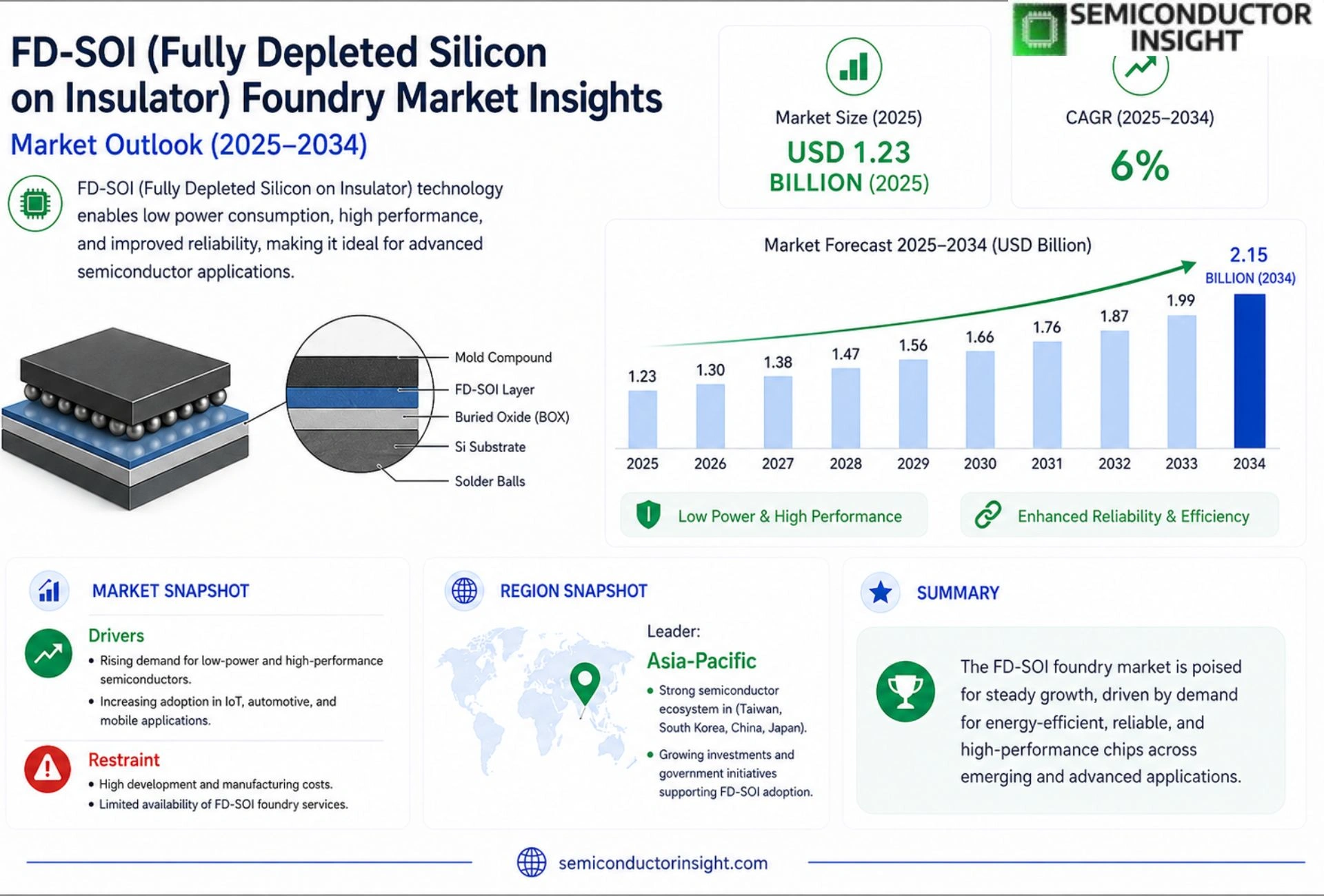
FD‑SOI (Fully Depleted Silicon on Insulator) Foundry Market size was valued at USD 1.23 billion in 2025. The market is projected to grow from USD 1.30 billion in 2026 to USD 2.15 billion by 2034, exhibiting a CAGR of 6% during the forecast period.
FD‑SOI technology employs a thin silicon layer isolated by a buried oxide insulator, delivering superior electro‑static control while reducing power consumption compared with bulk CMOS.
This architecture enables high‑performance processors for automotive ADAS systems, edge AI accelerators, and low‑power IoT devices.
The market’s rapid expansion stems from rising demand for energy‑efficient chips in electric vehicles and connected devices.
Furthermore, major foundries such as GlobalFoundries, STMicroelectronics and Samsung have announced new FD‑SOI process nodes and strategic collaborations with semiconductor IP providers.
These initiatives,combined with increasing design wins in automotive ASICs,are fueling sustained growth across the sector.
MARKET DRIVERS
Power‑Efficiency and Performance Gains
FD-SOI (Fully Depleted Silicon on Insulator) Foundry Market is being propelled by its superior power‑efficiency combined with high performance at near‑threshold voltages. Designers are increasingly choosing FD‑SOI for mobile processors and edge AI chips because it delivers up to 30% lower dynamic power compared with bulk silicon while maintaining comparable speed.
Automotive and Industrial Expansion
Stringent reliability and safety standards in automotive electronics are driving OEMs toward FD‑SOI platforms. The technology’s inherent immunity to latch‑up and radiation makes it a preferred substrate for advanced driver‑assistance systems (ADAS) and power‑train control units, supporting the market’s steady upward trend.
➤ “FD‑SOI enables designers to achieve a 2‑3x reduction in power consumption for the same silicon area, accelerating time‑to‑market for low‑power IoT devices.”
In addition, the emergence of 5G infrastructure and edge‑computing workloads is creating a demand for chips that can operate efficiently under constrained thermal envelopes, positioning FD‑SOI as a strategic enabler for next‑generation connectivity solutions.
MARKET CHALLENGES
High Initial Design Costs
Adopting FD‑SOI often requires redesign of existing IP blocks, which can increase upfront engineering expenditures. Small and mid‑size fabless companies may find the cost‑benefit analysis less favorable when projected volume is uncertain.
Other Challenges
Supply‑Chain Constraints
The limited number of fab sites offering mature FD‑SOI processes creates capacity bottlenecks, especially during peak demand periods for automotive and IoT applications.
MARKET RESTRAINTS
Process Maturity and Ecosystem Support
Although FD‑SOI has demonstrated robust performance, the ecosystem of design tools, libraries, and verification flows is still catching up with more established bulk‑CMOS platforms. This relative immaturity can deter risk‑averse customers who prioritize proven development paths.
MARKET OPPORTUNITIES
Emerging Edge‑AI and Secure Computing
Edge‑AI accelerators that require low power, high security, and rapid turnaround are well‑matched to FD‑SOI’s characteristics. The growing emphasis on on‑device inference for privacy‑sensitive data offers a sizable growth avenue for FD-SOI (Fully Depleted Silicon on Insulator) Foundry Market, as more OEMs explore secure enclaves embedded directly in the silicon.
Trends
Rising Demand for Energy‑Efficient Chip Solutions
FD-SOI (Fully Depleted Silicon on Insulator) Foundry Market is being reshaped by a clear shift toward low‑power, high‑performance silicon. The technology’s thin silicon layer over a buried oxide delivers superior electro‑static control, which translates into measurable power savings for automotive advanced driver‑assistance systems (ADAS), edge‑AI accelerators, and battery‑powered IoT devices. Designers cite the ability to meet stringent thermal envelopes without compromising clock speeds, making FD‑SOI an attractive alternative to bulk CMOS for many power‑constrained applications. Leading foundries such as GlobalFoundries, STMicroelectronics and Samsung have announced new FD‑SOI process nodes, reinforcing the supply chain and encouraging silicon‑IP partners to optimize their libraries for this platform. This coordinated effort is driving a steady flow of silicon wins across sectors that prioritize efficiency and reliability.
Other Trends
Automotive ASIC Adoption
Automotive manufacturers are increasingly selecting FD‑SOI based ASICs for safety‑critical functions, particularly in ADAS and autonomous‑driving modules. The architecture’s reduced leakage and fast switching facilitate the integration of multiple sensor‑fusion algorithms on a single die, lowering overall system cost. Recent collaborations between tier‑one automotive suppliers and foundries have resulted in design‑for‑FD‑SOI silicon that meets the rigorous functional‑safety standards required for vehicle‑grade deployments. These partnerships are expanding the design ecosystem and creating a virtuous cycle of innovation that benefits both the automotive and broader semiconductor communities.
Expansion of FD‑SOI Process Nodes
Beyond automotive, the broader electronics landscape is seeing a diversification of FD‑SOI node offerings. Process advancements now target sub‑20 nm geometries, enabling higher transistor density while retaining the inherent power advantages of the insulator‑based substrate. Foundries are investing in specialized manufacturing equipment to ensure uniform buried‑oxide quality, which is critical for yield stability at these advanced nodes. As the node roadmap matures, software tools and design‑for‑manufacturing guidelines are being refined, lowering the barrier to entry for designers who previously relied on legacy processes. This systematic expansion of capability is expected to sustain the market’s momentum for the foreseeable future.
COMPETITIVE LANDSCAPE
Key Industry Players
FD‑SOI Foundry Market Competitive Overview
The FD‑SOI foundry segment is presently led by a small group of global fabs that have invested heavily in dedicated process nodes and ecosystem partnerships. GlobalFoundries commands a sizable share through its 22FDX platform, which offers a robust design‑win pipeline in automotive ADAS and edge‑AI applications. Samsung Electronics follows with its 28FDSOI offering, emphasizing low‑power IoT and 5G front‑end modules, while STMicroelectronics leverages its strong automotive portfolio and collaborative R&D with IP vendors to differentiate its FD‑SOI solutions. These three players together shape the supply chain, dictate pricing dynamics, and set the technical baseline for performance, power, and cost efficiency across the market.
Niche and regional players are expanding the competitive fabric by targeting specialized segments. Tower Semiconductor (now part of Intel) supplies niche FD‑SOI wafers for sensor and RF markets, whereas Soitec provides high‑quality silicon‑on‑insulator substrates that enable cost‑effective scaling. Companies such as Renesas, NXP Semiconductors, Texas Instruments, and Infineon are introducing FD‑SOI variants tailored to automotive power‑train and safety‑critical ASICs. Intel’s research arm and IBM’s emerging labs are exploring FD‑SOI for next‑generation compute, while ON Semiconductor and Analog Devices focus on low‑power analog front ends. This diversified ecosystem fuels innovation and offers customers a broader choice set, reinforcing market resilience despite the concentration at the top tier.
List of Key FD-SOI Foundry Companies Profiled
- GlobalFoundries
- Samsung Electronics
- STMicroelectronics
- Tower Semiconductor
- Soitec
- Renesas Electronics
- NXP Semiconductors
- Texas Instruments
- Infineon Technologies
- Intel Corporation
- IBM Research
- Analog Devices
- ON Semiconductor
Segment Analysis:
| Segment Category | Sub-Segments | Key Insights |
| By Type |
|
N‑Channel FD‑SOI
|
| By Application |
|
Automotive ADAS
|
| By End User |
|
Automotive OEMs
|
| By Process Node |
|
22 nm FD‑SOI
|
| By Design Target |
|
Power Efficiency
|
Regional Analysis:
The automotive sector is increasingly requiring chips with enhanced reliability and power efficiency, making FD-SOI a compelling choice. The stringent requirements of autonomous driving and connected car technologies are driving demand for low-power, high-performance solutions.
The explosive growth of the Internet of Things (IoT) is creating a massive demand for energy-efficient microchips. FD-SOI’s low power consumption makes it an ideal technology for battery-powered IoT devices, extending their operational lifespan.
The adoption of advanced packaging techniques, such as chiplets, is further boosting the demand for FD-SOI. This allows for the integration of multiple functionalities onto a single chip, optimizing performance and power consumption.
The rollout of 5G networks necessitates high-performance and energy-efficient chips for base stations and network equipment. FD-SOI’s capabilities in high-frequency operation and power efficiency are well-suited for these demanding applications.
Europe
Europe represents a significant and growing market for FD-SOI. Driven by strong industrial sectors and a commitment to technological innovation, European countries are actively investing in FD-SOI research and development. The European Union’s strategic initiatives, such as the Chips Act, aim to enhance the region’s semiconductor competitiveness and reduce reliance on foreign suppliers. The automotive and industrial sectors are key consumers of FD-SOI in Europe, with increasing adoption in applications requiring high reliability and low power dissipation. Collaboration between European research institutions and industry players is fostering innovation in FD-SOI technology. Furthermore, the focus on sustainable manufacturing practices aligns well with the energy efficiency benefits of FD-SOI. The European market is characterized by a strong emphasis on design and advanced manufacturing.
Asia-Pacific
Asia-Pacific, particularly China, Japan, and South Korea, is emerging as a dynamic market for FD-SOI. The region’s massive manufacturing base and burgeoning electronics industries are driving significant demand for advanced semiconductor technologies. China’s government is actively promoting domestic semiconductor development, including FD-SOI, through substantial investments and supportive policies. Japan and South Korea have long been leaders in semiconductor innovation and are focusing on FD-SOI for advanced applications such as AI, high-performance computing, and automotive electronics. The strong presence of major semiconductor foundries in the region, coupled with a robust ecosystem of suppliers and customers, is fostering the growth of the FD-SOI market. Competition is intense, with various players vying for market share.
South America
South America presents a smaller but steadily growing market for FD-SOI. The region’s expanding electronics and automotive industries are creating a demand for advanced semiconductor solutions. While the adoption rate is currently lower compared to North America and Asia-Pacific, the potential for growth is significant. The increasing focus on industrial automation and connected devices is driving interest in FD-SOI’s low-power capabilities. Government initiatives aimed at promoting technological development and attracting foreign investment could further accelerate the growth of the FD-SOI market in the region. The automotive sector in Brazil and Argentina represents a key downstream market for FD-SOI.
Middle East & Africa
The Middle East and Africa represent relatively nascent markets for FD-SOI. However, rapid economic growth and increasing investments in infrastructure are creating opportunities for semiconductor adoption. The expansion of the automotive industry in countries like Saudi Arabia and the UAE is expected to drive demand for FD-SOI in automotive applications. The growing focus on smart city initiatives and industrial digitalization is also contributing to the demand for advanced semiconductor technologies. While the market size is currently small, the long-term growth potential is substantial, particularly with continued infrastructure development and economic diversification efforts. The region’s strategic location and access to energy resources are also factors attracting investment in the semiconductor sector.
Report Scope
This market research report provides a comprehensive analysis of the FD-SOI (Fully Depleted Silicon on Insulator) Foundry Market , covering the forecast period 2026–2034. It offers detailed insights into market dynamics, technological advancements, competitive landscape, and key trends shaping the industry.
Key focus areas of the report include:
- Market Overview: The report begins with an overview outlining its current market scenario, key growth indicators, and industry transformation drivers. It discusses macroeconomic factors, demand–supply balance, regulatory landscape, and the strategic role of semiconductors in powering advancements across industries such as automotive, telecommunications, consumer electronics, and industrial automation.
- Market Size & Forecast: Historical data and future projections for revenue, unit shipments, and market value across major regions and segments.
- Segmentation Analysis: Detailed breakdown by product type, technology, application, and end-user industry to identify high-growth segments and investment opportunities.
- Regional Insights: Insights into market performance across North America, Europe, Asia-Pacific, Latin America, and the Middle East & Africa, including country-level analysis where relevant.
- Competitive Landscape: Profiles of leading market participants, including their product offerings, R&D focus, manufacturing capacity, pricing strategies, and recent developments such as mergers, acquisitions, and partnerships.
- Technology Trends & Innovation: Assessment of emerging technologies, integration of AI/IoT, semiconductor design trends, fabrication techniques, and evolving industry standards.
- Market Drivers & Restraints: Evaluation of factors driving market growth along with challenges, supply chain constraints, regulatory issues, and market-entry barriers.
- Stakeholder Insights: Insights for component suppliers, OEMs, system integrators, investors, and policymakers regarding the evolving ecosystem and strategic opportunities.
Primary and secondary research methods are employed, including interviews with industry experts, data from verified sources, and real-time market intelligence to ensure the accuracy and reliability of the insights presented.
FREQUENTLY ASKED QUESTIONS:
What is the current market size of FD-SOI (Fully Depleted Silicon on Insulator) Foundry Market?
-> FD‑SOI (Fully Depleted Silicon on Insulator) Foundry Market size was valued at USD 1.23 billion in 2025. The market is projected to grow from USD 1.30 billion in 2026 to USD 2.15 billion by 2034, exhibiting a CAGR of 6% during the forecast period.
Which key companies operate in FD-SOI (Fully Depleted Silicon on Insulator) Foundry Market?
-> Key players include GlobalFoundries, STMicroelectronics, and Samsung, among others.
What are the key growth drivers?
-> Key growth drivers include rising demand for energy‑efficient chips in electric vehicles and connected IoT devices, new FD‑SOI process node introductions, and strategic collaborations with semiconductor IP providers.
Which region dominates the market?
-> The reference does not specify a dominant region.
What are the emerging trends?
-> Emerging trends include integration of FD‑SOI technology in automotive ADAS processors, edge AI accelerators, and low‑power IoT applications.

Get Sample Report PDF for Exclusive Insights
Report Sample Includes
- Table of Contents
- List of Tables & Figures
- Charts, Research Methodology, and more...
 Download Sample Report PDF