Key Statistics
Key Takeaways
- FOUP remains the larger product type. Its role is tied to in-process automation across 300 mm fabs, where carriers repeatedly dock with load ports and must preserve wafer cleanliness, electrostatic control, mechanical alignment and automation compatibility. This makes FOUP demand structurally linked to wafer starts, equipment utilisation and replacement cycles, rather than only to one-time fab construction.
- FOSB demand is more logistics-sensitive. FOSBs are used to move completed wafer lots from wafer producers toward device manufacturers and across facilities, so purchasing responds to inter-fab flows, outsourcing and cross-border semiconductor logistics. Their commercial specification is therefore more influenced by mechanical protection, sealing, traceability and shipping reliability than by repeated load-port docking inside the fab.
- Asia Pacific is the commercial centre of gravity. The report page identifies Taiwan at 19.74% and the United States at 19.30% of consumption in 2022, while the broader fab-building cycle is concentrated heavily in Asia. Suppliers therefore win through proximity to wafer fabs, validated automation interfaces and responsive replacement inventories in Japan, Taiwan, Korea and China.
- Advanced carrier engineering is moving beyond basic particle isolation. Entegris now markets 300 mm FOUPs for thin, thick and warped wafers, with purge options, barrier materials, ESD protection and RFID identification. Shin-Etsu Polymer similarly specifies conductivity, sealing and cleaning-cycle advantages. The competitive opportunity is shifting toward specialised microenvironment control, lower outgassing and reliable integration with automated material handling.
- Fab construction is the principal demand engine. SEMI reported 18 new fab construction projects beginning in 2025, including 15 300 mm facilities, with most expected to start operations in 2026–2027. Each greenfield 300 mm line creates a large initial fleet requirement spanning FOUPs, FOSBs, cleaning, inspection, refurbishment and replenishment services, raising the value of supplier qualification before equipment ramps.
- Standardisation remains a barrier to rapid switching. SEMI carrier standards define mechanical interfaces and interoperability expectations, while individual fabs add contamination, identification and automation requirements. Suppliers therefore compete on validated compatibility and field reliability as much as unit price, which favours established players with installed fleets, global service coverage and the ability to preserve carrier performance after repeated cleaning and process exposure.
300 mm Wafer FOUP and FOSB Market Overview
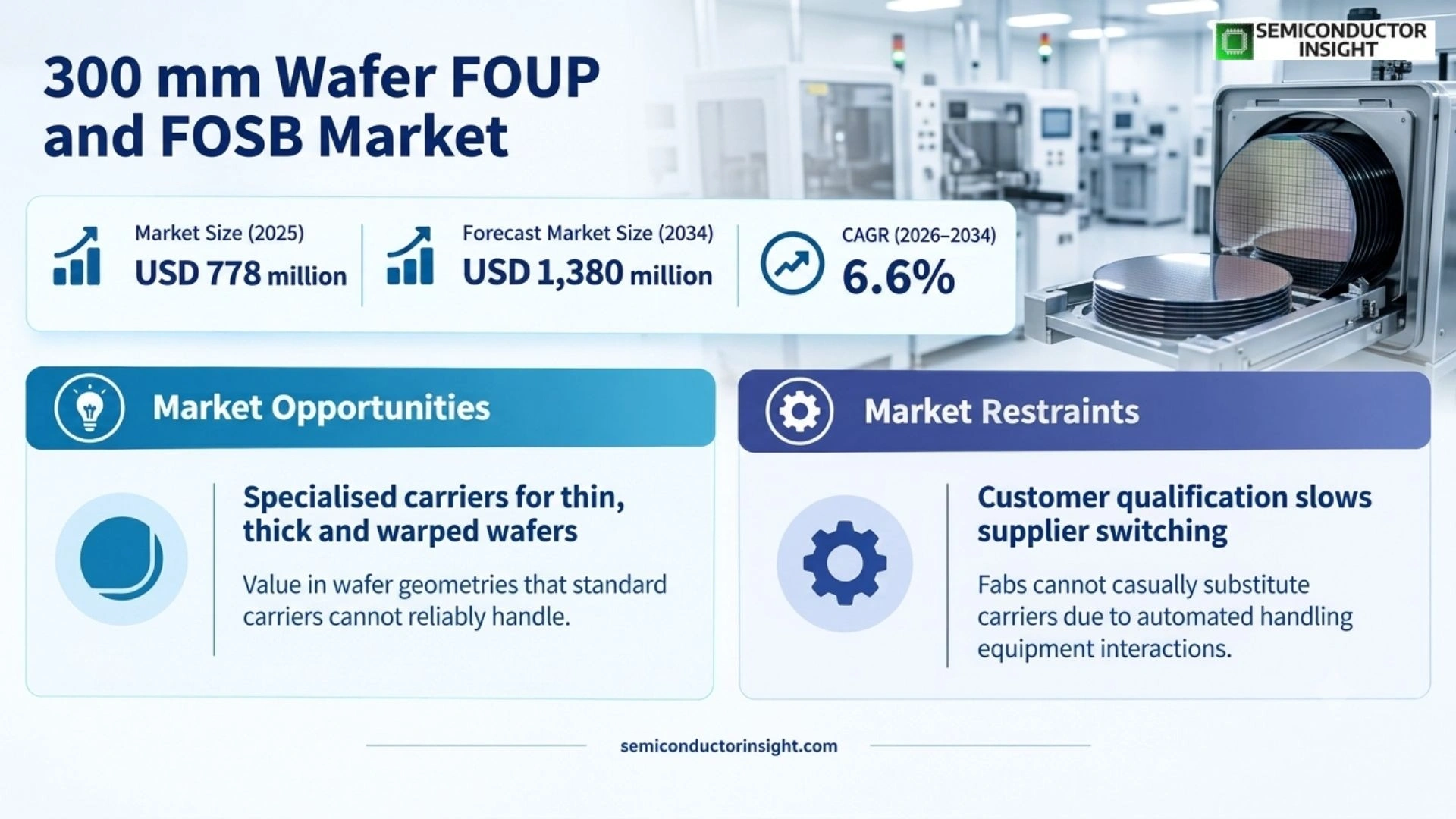
300 mm wafer FOUP and FOSB market was anchored at USD 730 million in 2024 and USD 1,215 million in 2032; rebasing the published series to the requested 2025–2034 window gives a 2025 market size of USD 778 million and a 2034 value of USD 1,380 million, corresponding to a 6.6% CAGR for 2026–2034. Asia Pacific is the largest demand centre, supported by the concentration of 300 mm wafer fabrication and the region’s expanding automation infrastructure.
A 300 mm front opening unified pod, or FOUP, is a sealed semiconductor carrier designed to hold and transport a defined wafer lot between automated process steps while shielding wafers from particles, humidity, oxygen, volatile contamination and electrostatic exposure. A front opening shipping box, or FOSB, serves a different stage: it protects 300 mm wafers during shipment between a wafer producer, device manufacturer or external facility. The distinction matters commercially because FOUPs are repeatedly handled by automated fab equipment, while FOSBs are optimised for safe inter-facility transport and acceptance workflows.
The market therefore combines two adjacent but operationally distinct products within one carrier ecosystem. FOUPs must preserve repeatable kinematic and load-port interfaces over repeated thermal, chemical and cleaning cycles, while FOSBs must survive vibration, impact, sealing and transport conditions without introducing contamination or wafer damage. Suppliers increasingly add RFID, barcode identification, electrostatic-dissipative materials, purge options, humidity control and specialised support geometries because fabs value stable handling performance across thousands of production moves rather than merely the initial container purchase price.
The current demand mechanism is overwhelmingly linked to 300 mm wafer production. SEMI reported 18 new fab construction projects starting in 2025, of which 15 are 300 mm facilities, and most are expected to begin operations during 2026–2027. This creates a multi-stage carrier demand curve: initial fleet purchases during tool installation, qualification and pilot runs, followed by replenishment, refurbishment and replacement as production moves toward high utilisation. The commercial consequence is that suppliers with early engineering engagement and strong automation qualification can capture recurring fleet value beyond the first shipment.
Technical architecture is shaped by the semiconductor carrier standards ecosystem. SEMI E47.1 governs mechanical specifications for FOUPs used to transport and store 300 mm wafers, while SEMI M31 addresses FOSBs used to ship 300 mm wafers from wafer suppliers to customers. These standards support interchangeability at critical interfaces without eliminating customer-specific requirements. The result is a market where the product is standardised enough to support automation, yet differentiated through material formulation, dimensional stability, cleaning behaviour, microenvironment control, identification, serviceability and specialised carrier designs.
The market is changing now because 300 mm fabs are being added in multiple regions while advanced-node and specialty processes place tighter demands on contamination control and carrier performance. New carrier requirements are also appearing around thin, warped, bonded and 3D-IC wafers, while SEMI committees are extending carrier concepts into adjacent advanced-packaging workflows. Suppliers are therefore broadening portfolios from standard FOUP and FOSB products toward specialised carriers, refurbishment services and data-enabled fleet management, increasing the share of value captured after the initial unit sale.
Segment Analysis: By Type
By type, the market is segmented into FOUP and FOSB. FOUP is the larger segment because every automated 300 mm fab requires large in-process carrier fleets that interface repeatedly with load ports and material-handling systems. FOSB remains a critical second segment because wafer producers and device manufacturers need controlled inter-facility transport, but its purchasing cycle is more exposed to shipping volumes, outsourcing patterns and carrier turnover.
| Type | Primary operating role | Market position and buying logic |
|---|---|---|
| FOUP | A front-opening carrier used inside semiconductor fabrication facilities to protect and automate the movement of 300 mm wafer lots between process tools, stockers, load ports and other material-handling interfaces. The design must preserve wafers against particles and other microenvironment risks while maintaining mechanical registration with equipment automation during repeated handling. | Largest product segment. Demand is primarily tied to fab capacity, wafer starts and automation density. Buyers evaluate contamination control, dimensional stability, ESD performance, door and seal life, purge capability, carrier identification and interoperability. Fleet standardisation makes replacement business attractive after qualification, while specialised FOUPs for thin, warped or heavy wafers create higher-value niches. |
| FOSB | A front-opening shipping box intended primarily for controlled transport of 300 mm wafers between wafer manufacturers and device manufacturers, rather than repeated use as a production carrier inside the fabrication process. Mechanical protection, closure integrity and shipment stability are central to the design because the carrier must preserve wafer quality across external logistics and acceptance steps. | A smaller but strategically important segment. Demand follows wafer shipments, outsourced manufacturing and cross-site logistics. Buyers emphasise impact resistance, cleanliness, sealing, identification and compatibility with downstream transfer into FOUPs or related carriers. As supply chains become more geographically distributed, FOSB suppliers gain opportunities to add traceability, higher protection and regional replenishment services. |
Pricing and lifecycle economics by type
FOUP economics are shaped less by the initial plastic enclosure cost than by the value of maintaining a validated carrier fleet over its service life. A carrier that remains dimensionally stable after repeated cleanings, thermal exposure and automated handling can reduce wafer incidents and the need for emergency replacement. FOSB economics are more sensitive to transport risk and loss prevention because its value is realised outside the fab, where a damaged lot can trigger delays, reinspection, claims or additional logistics. This difference allows suppliers to defend differentiated pricing through measurable operational consequences rather than commodity material cost alone.
Segment Analysis: By Application
By application, the report page identifies Wafer Foundry and IDM as the two principal customer groups. Both rely on large-scale 300 mm carrier fleets, but the purchasing trigger differs: foundries manage high-mix customer production across multiple process technologies and require broad carrier compatibility, while IDMs often operate vertically integrated flows and can impose tighter internal fleet, cleaning and logistics standards.
| Application | Demand characteristics |
|---|---|
| Wafer Foundry | Foundry demand is driven by the number of 300 mm process lines, customer wafer-start commitments and the breadth of technologies running across a single site. Because foundries must accommodate multiple customer programs without interrupting automation, they place high value on carrier interoperability, contamination control, fleet availability and rapid replacement support. Qualification can be demanding because a carrier change touches material handling, metrology and process-control assumptions across many tools. |
| IDM | IDM demand is closely connected to integrated production networks spanning wafer fabrication, internal logistics, testing and device programs. Purchasing teams can optimise total fleet standards across sites and may favour long-term supply contracts that include cleaning, inspection or refurbishment. The trigger is therefore not only incremental fab capacity; it is also the need to keep a controlled carrier population available as older fleets age, new technologies enter production and internal transfer routes become more automated. |
Regional Analysis
Asia Pacific is the largest regional market and the strongest growth centre because the region combines the highest concentration of 300 mm semiconductor fabrication with continued fab construction in Taiwan, China, Korea, Japan and Southeast Asia. The United States is a major demand centre in its own right, while Europe is expanding selectively as governments support local semiconductor manufacturing and strategic resilience.
How does regional demand differ across the 300 mm wafer FOUP and FOSB market?
Regional demand differs because the carrier is purchased as part of a fab operating system, not as an isolated packaging component. Asia Pacific combines dense wafer manufacturing clusters with new greenfield capacity and established carrier supplier relationships. North America is more influenced by large new fabs, advanced packaging and replacement within existing sites. Europe’s demand is more project-led and policy-supported, while Japan and Korea combine sophisticated automation with long-established semiconductor materials ecosystems. Latin America and the Middle East & Africa remain smaller, mainly serving specialised electronics, assembly and logistics requirements.
| Region | Position | Growth outlook | Demand profile | Supplier selection |
|---|---|---|---|---|
| Asia Pacific | Largest | Highest | Fab-centric and automation-heavy | Qualification, cleanroom performance, local service, fleet replenishment and compatibility with regional equipment ecosystems. |
| North America | Major second centre | High | Greenfield fab plus advanced-node expansion | Automation qualification, supply assurance, customer engineering support, contamination control and multi-site service coverage. |
| Europe | Established but smaller | Moderate-high | Strategic fab projects and specialised production | Traceability, environmental compliance, technical documentation, service responsiveness and long-term supplier continuity. |
| Latin America | Smaller base | Selective | Imported semiconductor and electronics flows | Landed cost, distributor capability, transport protection and reliable availability of standardised carriers. |
| Middle East & Africa | Emerging base | Selective | Project and logistics led | Supply reliability, project logistics, climate protection, technical support and compatibility with imported fab infrastructure. |
Competitive Landscape
Competition in the 300 mm wafer FOUP and FOSB market is concentrated around a relatively small group of qualified suppliers because carrier changes can affect automated handling, contamination control and wafer-loss risk. The practical competitive test is not simply unit price. Buyers compare proven dimensions, particle performance, ESD control, door and seal reliability, cleaning compatibility, identification options, availability, field support and the supplier’s ability to maintain identical specifications over large fleets and multiple fabs.
The leading supplier group competes through broad carrier portfolios, repeatable materials engineering, automation compatibility and established fab qualifications. Scale matters because a carrier program can span initial validation, production fleets, replacement pools, accessories and lifecycle services. Suppliers with multiple product configurations can address standard, thin, warped and other specialised wafer conditions without forcing customers to rebuild their entire handling ecosystem.
Specialist suppliers strengthen competition through product engineering focused on sealing, electrostatic dissipation, dimensional accuracy, cleaning behaviour and regional support. This creates a market where proximity to fab clusters and the ability to respond quickly to qualification or replacement requirements can offset differences in corporate scale. Buyer decisions therefore balance unit economics with demonstrated field performance, documentation quality, supply continuity and technical service.
Key Industry Players
| Player | Competitive role |
|---|---|
| Entegris | Large global supplier covering FOUPs, FOSBs, specialised wafer carriers, accessories and broader contamination-control products. |
| Shin-Etsu Polymer | FOUP and FOSB supplier with dedicated 300 mm carrier products and established semiconductor materials relationships. |
| Miraial | Specialist semiconductor wafer-container supplier focused on carrier products for controlled wafer handling and transport. |
| Chuang King Enterprise | Regional carrier supplier with a focus on wafer transport and FOSB-oriented semiconductor logistics. |
| Gudeng Precision | Semiconductor handling and container supplier serving advanced wafer transport and related automation ecosystems. |
| 3S Korea | Korean carrier supplier participating in semiconductor wafer-handling and container applications. |
| Dainichi Shoji | Specialised supplier serving semiconductor wafer-container and handling requirements. |
How competition is won
The decisive competitive advantage is usually the ability to become a trusted fleet standard. A fab that uses thousands of carriers cannot tolerate frequent dimensional drift, unpredictable cleaning behaviour or intermittent availability. Suppliers therefore invest in material formulation, tooling repeatability, inspection, quality documentation and service coverage. Specialised products for thin or warped wafers create additional differentiation because buyers need demonstrated handling performance before releasing the design into automated production.
Production Capacity Analysis
Production capacity in this market sits within specialised polymer processing, precision tooling, controlled assembly, clean manufacturing and inspection networks that can reproduce carrier dimensions and contamination performance at high volume. The main capacity constraint is therefore not raw plastic availability alone; it is the ability to maintain stable material properties, tooling accuracy, cleaning performance, identification features and quality yields while expanding fleet output for new fabs.
Carrier production begins with high-purity engineering polymers, conductive or barrier formulations and precision moulds designed around SEMI interfaces. The process requires controlled moulding conditions, low-defect surfaces, reliable door and seal assembly and extensive inspection because small dimensional errors can affect automated docking or wafer alignment. This creates a hidden capacity constraint: adding moulding machines without adding qualified tooling, inspection and process-control capability does not necessarily increase usable output at the same rate.
Upstream concentration risk is particularly relevant for specialised materials and precision components. Entegris uses ultrapure polycarbonate, carbon-filled engineering materials, thermoplastic elastomer seals and moisture-barrier material across selected FOUP platforms, while Shin-Etsu Polymer specifies ESD materials and moulded structures. Suppliers that control materials and process engineering internally can respond faster to specification changes, but they also carry higher fixed costs and qualification responsibilities when customers introduce new wafer formats or advanced packaging needs.
Capacity planning is now increasingly linked to the fab construction cycle. When a 300 mm facility moves from construction into tool installation, carrier purchases can rise sharply before wafer starts reach steady state. Suppliers must therefore stage resin, tooling, clean assembly, inspection and logistics capacity ahead of demand. The commercial winners are likely to be those that can add capacity without changing validated specifications, because unplanned changes in materials or mould geometry can trigger costly customer requalification.
Market Dynamics
The market expands when 300 mm semiconductor manufacturing grows, automation density rises and wafer logistics become more distributed across sites and geographies. The strongest forces therefore come from fab capacity additions, higher contamination-control requirements, specialised wafer formats, and the increasing operational value of carrier fleets. Counterforces include high qualification costs, product standardisation, long carrier life in some applications, price competition in standard models and the possibility that future manufacturing architecture changes could alter carrier requirements.
Market Drivers
| Driver | Directional impact* | Commercial mechanism |
|---|---|---|
| 300 mm fab capacity expansion | High | Every new automated 300 mm fab requires an initial carrier population plus replenishment, creating direct equipment-linked demand. The customer requirement is matched by carrier engineering, followed by supplier qualification and fleet deployment, making the effect visible in recurring market demand rather than one-off product trials. |
| Automation of wafer movement | High | More automated material handling increases the value of repeatable FOUP interfaces, identification and reliable carrier geometry. The customer requirement is matched by carrier engineering, followed by supplier qualification and fleet deployment, making the effect visible in recurring market demand rather than one-off product trials. |
| Advanced wafer formats | Medium | Thin, warped and bonded wafers require specialised supports, barrier materials and microenvironment control, expanding premium carrier niches. The customer requirement is matched by carrier engineering, followed by supplier qualification and fleet deployment, making the effect visible in recurring market demand rather than one-off product trials. |
| Distributed semiconductor logistics | Medium | Cross-site and cross-border wafer movement supports FOSB demand and increases the value of secure transport and traceability. The customer requirement is matched by carrier engineering, followed by supplier qualification and fleet deployment, making the effect visible in recurring market demand rather than one-off product trials. |
300 mm fab additions create an installed-fleet multiplier
SEMI’s January 2025 forecast identified 18 new fab construction projects beginning in 2025, including 15 300 mm facilities, with most expected to start operations in 2026 or 2027. The commercial implication is larger than the value of an initial FOUP purchase because each automated fab requires a fleet that moves repeatedly through load ports, stockers and process tools. As utilization rises, the installed carrier pool becomes an operating asset that must be inspected, cleaned, replaced and replenished.
Automation raises the cost of carrier inconsistency
The growth of automated material handling makes dimensional consistency and interface stability economically important. A FOUP does not simply contain wafers; it becomes a mechanical interface between the wafer lot and a network of load ports, stockers and transport equipment. Buyers therefore reward carriers that maintain fit, seal integrity and identification performance across repeated cycles. Suppliers able to prove this through quality systems and installed references can defend share even when lower-priced competitors offer similar nominal dimensions.
Specialised wafer structures increase premium carrier demand
Entegris markets dedicated FOUP designs for thin, thick, bonded, 3D-IC and warped 300 mm wafers, showing how carrier requirements are expanding beyond a single standard geometry. These products use specialised supports, purge configurations, barrier materials and ESD options to protect wafer shape and microenvironment. The commercial opportunity is attractive because the qualification burden is high, which reduces rapid price switching and allows suppliers to capture additional value from engineering-led carrier programs.
Traceability and clean logistics raise FOSB value
As wafer manufacturing becomes more geographically distributed, the FOSB moves from being a simple transport enclosure toward a controlled logistics asset. Suppliers can add barcodes, RFID, sealing features and mechanical protection because fabs and wafer manufacturers need to know where a carrier has been, what process or cleaning history it has, and whether the package remained within acceptable transport conditions. This changes the purchasing discussion from container price toward lot protection, traceability and supply-chain resilience.
Market Restraints
| Restraint | Directional impact* | Commercial mechanism |
|---|---|---|
| Long qualification cycles | Medium | New carrier designs often require engineering evaluation and production qualification because failures can affect wafer handling and contamination risk. The constraint influences supplier economics by extending sales cycles, limiting interchangeable products or reducing annual unit turnover in mature fabs, which can slow market expansion even when the installed carrier base remains strategically important. |
| Standardisation and price pressure | Medium | Basic FOUP and FOSB designs are constrained by SEMI interfaces, limiting differentiation in commodity configurations. The constraint influences supplier economics by extending sales cycles, limiting interchangeable products or reducing annual unit turnover in mature fabs, which can slow market expansion even when the installed carrier base remains strategically important. |
| Carrier fleet longevity | Low | A well-maintained fleet can remain in service for years, reducing replacement frequency during periods of weak wafer starts. The constraint influences supplier economics by extending sales cycles, limiting interchangeable products or reducing annual unit turnover in mature fabs, which can slow market expansion even when the installed carrier base remains strategically important. |
| Tool and architecture changes | Low | Future changes in wafer formats or material-handling systems could reduce demand for some established carrier configurations. The constraint influences supplier economics by extending sales cycles, limiting interchangeable products or reducing annual unit turnover in mature fabs, which can slow market expansion even when the installed carrier base remains strategically important. |
Customer qualification slows supplier switching
The restraint created by qualification is structural: a fab cannot casually substitute a carrier if the product interacts with automated handling equipment and sensitive wafer processes. Engineers may need to verify dimensions, seal behaviour, particle generation, outgassing, ESD characteristics and transport performance before a new supplier can be deployed at scale. This protects incumbents but also means new entrants can struggle to translate a technically sound product into revenue without reference fleets and long validation programs.
Standardised interfaces intensify commodity competition
SEMI standards are economically beneficial because they support interoperability, but they also constrain differentiation in basic carrier geometries. A standard FOUP that satisfies the same mechanical interface can become price-sensitive unless the supplier adds measurable advantages in cleanliness, materials, service or lifecycle cost. This creates a two-tier competitive structure in which standard products face margin pressure while specialised carriers for thin, warped or advanced applications offer more scope for value-based pricing.
Long service life can flatten replacement demand
Carrier fleets are capital goods in miniature: they can be cleaned, inspected and reused rather than discarded after one production cycle. When wafer starts stagnate, customers can extend replacement intervals and focus spending on refurbishment. This creates a lag between semiconductor production recovery and carrier demand because customers often first increase utilisation of existing fleets before ordering replacement pools. Suppliers with cleaning and refurbishment services can partially offset this effect but not eliminate the underlying fleet-life dynamic.
Process and handling changes can alter the carrier specification
Carrier demand is ultimately tied to how wafers move through a fab. Changes in wafer thickness, packaging architecture, advanced-node processing or material-handling systems can create new requirements while making certain legacy configurations less relevant. The risk is not a sudden disappearance of the carrier category; it is a gradual shift in mix that forces suppliers to invest in new tooling, validation and service capabilities before the replacement cycle becomes commercially visible.
Market Opportunities
Specialised carriers for thin, thick and warped wafers
The clearest value opportunity is in wafer geometries that cannot be handled reliably by a standard carrier. Entegris already specifies dedicated 300 mm products for thin and warped wafers, using larger supports, barrier materials, purge options and optional ESD shells. Suppliers benefit where advanced process flows make wafer shape control more critical. The commercial implication is premium pricing, lower supplier substitutability and stronger engineering relationships with fabs adopting non-standard substrates.
Carrier fleet services and refurbishment
The installed base creates recurring revenue opportunities beyond new-unit sales. Cleaning, inspection, door and gasket replacement, performance qualification and fleet tracking can become integrated services because fabs need stable carrier quality throughout the fleet lifecycle. Suppliers that combine new-carrier manufacturing with refurbishment can smooth sales across semiconductor cycles, improve customer retention and collect operational data that strengthens future product qualification.
Data-enabled traceability and identification
RFID, barcodes and configuration management can turn carriers into traceable assets within automated wafer logistics. As factories add more stockers and automated routes, knowing the carrier identity, cleaning status and movement history becomes commercially useful. Suppliers benefit by embedding identification options into the carrier and pairing hardware with fleet-management or service workflows, increasing switching costs while creating a clearer lifecycle value proposition.
Expansion around new 300 mm fab geographies
New fab projects in Asia, North America and Europe create opportunities for suppliers that establish engineering relationships before tool installation. Winning early design-in can lock in initial fleet standards and subsequently capture replacement, specialised-carrier and service demand. The commercial implication is that geography strategy should follow fab construction rather than only current carrier consumption, because the first supplier qualified in a greenfield site can gain a long-duration installed-base advantage.
Supply Chain Analysis
High-purity polycarbonate, conductive/barrier materials, seals and specialty components
Tooling, moulding, trimming, door systems, supports and identification hardware
Dimensional inspection, contamination checks, ESD testing, functional verification and cleaning
Qualification, delivery, fleet management, refurbishment, replacement and service
The first stage captures value through polymer purity and material formulation. FOUP shells can use ultrapure polycarbonate or barrier materials, while contact areas may use conductive or high-temperature engineering plastics. Material selection affects outgassing, moisture behaviour, dimensional stability and ESD performance, so suppliers with internal formulation and process-control capability can defend specifications more effectively than assemblers that depend on off-the-shelf materials. Upstream risk is therefore concentrated in validated grades and consistent material supply rather than in plastic volume alone.
The second stage is precision moulding and assembly. Carrier geometry must be reproducible because the same fleet can interact with hundreds of automated interfaces. Door systems, wafer supports, seals and identification features add process steps that have to remain within controlled tolerances. The supplier response is investment in tooling, mould maintenance and repeatable assembly. Market implications appear through qualification lead times: a production expansion that requires new tooling can still be bottlenecked by validation even when polymer supply is readily available.
The third stage is clean inspection and qualification, where suppliers capture value by demonstrating that the product is suitable for semiconductor use. Dimensional checks, particle or contamination testing, ESD behaviour, door operation and cleaning compatibility become part of the evidence package presented to fabs. This stage is especially important for new carriers because the customer is not purchasing only a physical enclosure; it is purchasing predictable handling behaviour that protects a high-value wafer lot.
The final stage is fab deployment and lifecycle management. Once a carrier is qualified, commercial value can continue through replenishment, cleaning, inspection, replacement doors, seals and specialist configurations. Service networks matter because the fleet is geographically distributed and because downtime or delayed replacement can constrain production. Suppliers therefore benefit from local stock, repair capabilities and customer engineering support, turning a polymer carrier into a recurring fleet-management relationship.
Recent Developments
September 26, 2025
SEMI approved formation of a task force focused on a 310 mm square panel FOUP standard for advanced-packaging factories, with a goal of reusing existing 300 mm carrier infrastructure such as load-port and AMHS interfaces. The development matters because adjacent packaging formats can extend carrier technologies beyond conventional wafer flows. It creates a pathway for qualified FOUP suppliers to reuse established automation knowledge while developing new carrier geometries. SEMI task force document.
December 17–19, 2025
Shin-Etsu Polymer exhibited FOUP300EX and AQUAPROOF FOUP300EX at SEMICON Japan 2025, highlighting one-piece moulding, ESD options, sealing, long life and low-humidity control. The significance is commercial rather than purely product-level: suppliers are differentiating mature 300 mm carrier categories through cleaning efficiency, humidity management and specialised fleet requirements. Shin-Etsu Polymer.
January 7, 2025
SEMI reported 18 new semiconductor fab construction projects beginning in 2025, including 15 300 mm facilities, with most scheduled to begin operations in 2026–2027. The development creates an immediate carrier qualification pipeline because new fabs purchase automated handling fleets before full wafer production begins. SEMI.
December 2021; reaffirmed in current standards ecosystem
SEMI E184 and E185 established specifications for 300 mm tape-frame FOUPs and related load ports, extending the sealed-carrier concept into post-process environments. The long-term impact is that carrier suppliers can serve more advanced packaging and back-end flows using standardised interfaces rather than building entirely separate transport architectures. SEMI standards article.
Current product cycle
Entegris continues to offer multiple 300 mm FOUP platforms, including standard, thin-wafer and heavy-duty designs, with purge options, ESD protection, specialised supports and RFID identification. This confirms that the leading-edge carrier market is moving toward application-specific configurations around the same 300 mm platform rather than relying solely on a single commodity design. Entegris.
Report Scope & Segmentation
| Attribute | Details |
|---|---|
| Report title | 300 mm Wafer FOUP and FOSB Market, Trends, Business Strategies 2026-2034. The client page provides the controlling published market scope and anchor values. |
| 2025 market size | USD 778 million. |
| 2034 projected size | USD 1,380 million. |
| CAGR | 6.6% for 2026–2034. |
| By Type | FOUP; FOSB. |
| By Application | Wafer Foundry; IDM. |
| Regions | Asia Pacific; North America; Europe; Latin America; Middle East & Africa. |
| Company universe | Entegris; Shin-Etsu Polymer; Miraial; Chuang King Enterprise; Gudeng Precision; 3S Korea; Dainichi Shoji. |
Frequently Asked Questions
What is the 300 mm wafer FOUP and FOSB market size in 2025?
The global market is approximately USD 778 million in 2025, with the outlook extending through 2034.
What is the projected 2034 market size?
The market reaches approximately USD 1,380 million by 2034, with growth continuing across the 2025–2034 outlook.
What CAGR applies from 2026 to 2034?
The market is expected to grow at a 6.6% CAGR during 2026–2034, supported by expanding 300 mm wafer fabrication, higher automation density and recurring carrier replacement demand.
Which product type is larger?
FOUP is the larger product type because it supports repeated automated wafer movement inside 300 mm fabs. Its purchasing demand is tightly tied to wafer fabrication capacity, automated handling density and the size and age of installed carrier fleets.
What are the two applications in the report scope?
The report identifies Wafer Foundry and IDM as the principal application groups. Foundries typically need broad interoperability across customer production programs, while IDMs can place stronger emphasis on consistent fleet standards across integrated manufacturing networks.
Which region leads the market?
Asia Pacific is the leading region because of its concentration of 300 mm wafer fabrication and the pipeline of new semiconductor manufacturing projects. The report page also identifies Taiwan and the United States as large consumption markets, with Taiwan at 19.74% and the United States at 19.30% in 2022.
What does a FOUP do?
A FOUP protects and transports 300 mm wafers within a semiconductor fabrication environment while providing a standardised interface for automated handling. Modern FOUP designs can incorporate purge capability, ESD protection, barrier materials, identification features and specialised wafer supports for different wafer conditions.
What does a FOSB do?
A FOSB is primarily used to ship and protect 300 mm wafers between wafer suppliers and semiconductor manufacturers. Its design is oriented toward transport protection, controlled cleanliness and reliable transfer into a FOUP or related carrier after the shipment arrives at the device-manufacturing site.
Why are semiconductor carrier standards important?
Standards such as SEMI E47.1 for 300 mm FOUP mechanical specifications and SEMI M31 for 300 mm FOSBs provide interoperability and a common mechanical framework. They reduce the risk of proprietary incompatibility while still allowing suppliers to differentiate through materials, contamination control, ESD design, service and specialised carrier configurations.
Which companies are covered in the competitive universe?
The profiled company set includes Entegris, Shin-Etsu Polymer, Miraial, Chuang King Enterprise, Gudeng Precision, 3S Korea and Dainichi Shoji. These companies span global, Japanese, Korean and regional supply positions across FOUP and FOSB applications.
Get Sample Report PDF for Exclusive Insights
Report Sample Includes
- Table of Contents
- List of Tables & Figures
- Charts, Research Methodology, and more...
 Download Sample Report PDF