MARKET INSIGHTS
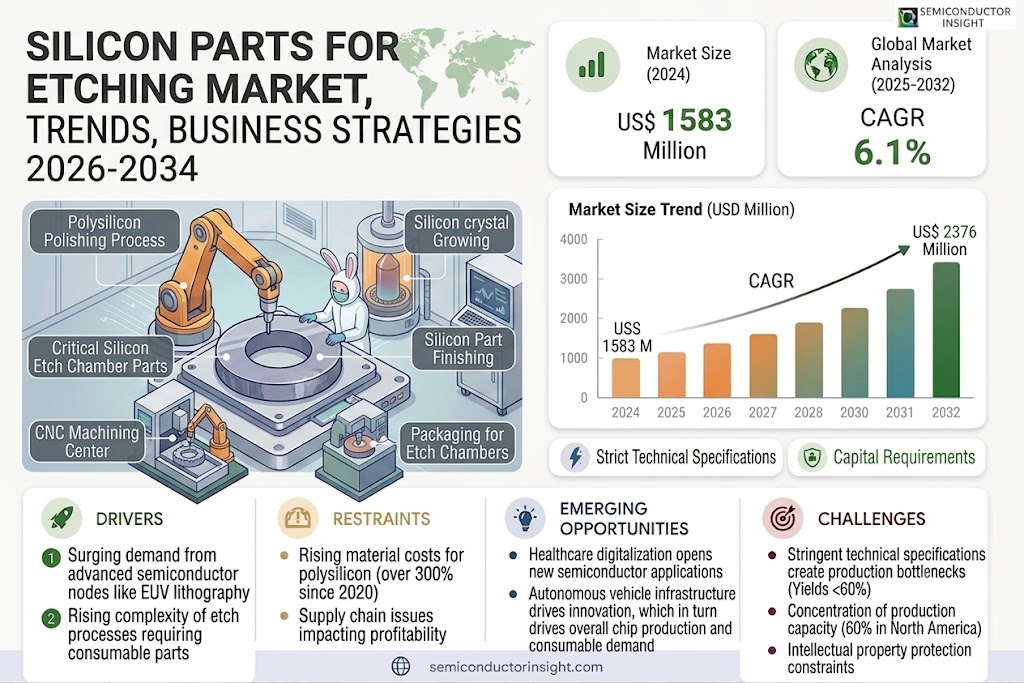
The global Silicon Parts for Etching Market was valued at 1583 million in 2024 and is projected to reach US$ 2376 million by 2032, at a CAGR of 6.1% during the forecast period.

Silicon Parts for Etching include silicon electrodes and silicon rings, which are critical components in plasma etching machines used for semiconductor manufacturing. These high-purity silicon components ensure uniform electrical properties during wafer processing, with silicon rings typically requiring replacement after processing approximately 200 wafers due to wear characteristics. The market is segmented by component size, with 12-inch parts currently dominating with an 80% share, projected to reach 84% by 2029.
Market growth is driven by increasing semiconductor demand across applications like 5G, AI, and IoT devices. North America leads production with 60% market share, followed by South Korea. The top seven manufacturers, including Silfex Inc. and Hana Materials Inc., collectively hold 85% revenue share. While OEM customers dominate (70% share), wafer fabrication plants are emerging as significant end-users as foundry capacities expand globally.
 MARKET DYNAMICS
MARKET DRIVERS
Expansion of Semiconductor Manufacturing to Fuel Silicon Etching Parts Demand
The global semiconductor industry is experiencing unprecedented growth, driven by the proliferation of 5G networks, artificial intelligence applications, and electric vehicles – creating substantial demand for silicon etching components. Foundries worldwide are rapidly expanding production capacity, with over 40 new semiconductor fabrication plants announced between 2021-2023. This expansion directly correlates with increased consumption of silicon electrodes and rings, as each 300mm wafer fab requires approximately 10,000 silicon parts annually for plasma etching processes. The move toward smaller nanometer processes has further amplified this demand, as advanced nodes require more frequent replacement of etching components.
Transition to Larger Wafer Sizes Accelerating Market Growth
Semiconductor manufacturers are rapidly transitioning to 300mm wafer production – a trend that significantly benefits the silicon parts for etching market. Compared to 200mm wafers, 300mm silicon rings and electrodes offer 2.25 times more die area, driving their adoption despite higher upfront costs. Currently representing 80% of the market, 300mm silicon parts are projected to reach 84% market share by 2029. This transition is particularly evident in new fab construction, where virtually all greenfield facilities are being designed for 300mm production. The resulting economies of scale and improved yield performance make the adoption of 300mm etching components increasingly attractive to foundry operators.
➤ For instance, leading foundries like TSMC and Samsung have publicly announced their roadmaps for complete transition to 300mm production capacity despite significant capital expenditure requirements.
Technology Advancements Driving Replacement Cycle Acceleration
Breakthroughs in dry plasma etching technology are creating new demand drivers for high-performance silicon components. Advanced etching systems now operate at higher power densities and use more aggressive chemistries, which accelerates wear on silicon rings and electrodes. Where a silicon ring previously lasted through 300 wafer cycles, modern systems now require replacement after approximately 200 cycles – a 33% increase in consumption frequency. This trend is particularly pronounced in leading-edge nodes below 7nm, where etching uniformity requirements have become increasingly stringent. Equipment manufacturers are responding with next-generation silicon parts featuring improved material purity and structural designs to meet these evolving technical demands.
MARKET CHALLENGES
Stringent Technical Specifications Create Production Bottlenecks
Manufacturing silicon parts for etching applications presents significant technical hurdles that limit market supply. These components must meet exacting standards for resistivity (5-100 ohm-cm), oxygen content (<15ppma), and surface finish (Ra <0.2μm) while maintaining critical dimensional tolerances of ±0.05mm. The stringent requirements result in yield rates below 60% for many manufacturers, creating supply constraints. Recent industry surveys indicate lead times for qualified silicon parts have extended to 18-24 months as suppliers struggle to ramp production. This situation is particularly acute for parts destined for extreme ultraviolet (EUV) lithography applications, where material specifications are even more rigorous.
Other Challenges
Concentration of Production Capacity
The silicon parts supply chain remains highly concentrated, with North America accounting for 60% of global production capacity. This geographic concentration creates logistical challenges and supply vulnerabilities, as evidenced during recent global trade disruptions. Diversification of manufacturing bases has been slow due to the substantial capital requirements and proprietary know-how needed to establish production facilities.
Intellectual Property Protection
Proprietary designs and manufacturing processes create barriers to market entry while raising concerns about technology transfer. Leading suppliers invest heavily in material science research, with development costs for new silicon part formulations often exceeding $5 million and requiring 3-5 years from concept to production. This high barrier to entry limits competition but also constrains supply during periods of peak demand.
MARKET RESTRAINTS
Rising Material Costs and Supply Chain Issues Impacting Profitability
The silicon parts market faces significant margin pressures from escalating raw material costs and supply chain inefficiencies. High-purity polysilicon, the primary material input, has seen price increases exceeding 300% since 2020 due to energy market volatility and production capacity constraints. This cost inflation has been compounded by rising energy expenses for crystal growth processes, which account for nearly 60% of total manufacturing costs. While some suppliers have implemented price increases of 15-20%, these adjustments have failed to fully offset cost inflation due to long-term contracts with major semiconductor manufacturers.
Furthermore, geopolitical tensions have introduced additional supply chain complexities, particularly for rare earth dopants and specialized quartz components used in manufacturing. These factors collectively constrain market growth by limiting manufacturers’ ability to expand capacity while maintaining profitability. The situation has prompted increased vertical integration strategies, with leading suppliers investing in captive raw material sources to mitigate these challenges.
MARKET OPPORTUNITIES
Emerging Applications in Advanced Packaging Creating New Growth Frontiers
The rapid evolution of semiconductor packaging technologies presents significant opportunities for silicon parts suppliers. Advanced packaging approaches like chiplets and 3D IC stacking require innovative etching solutions, creating demand for specialized silicon components with tailored geometries and material properties. Market analysis suggests the advanced packaging sector will grow at 12% CAGR through 2030, significantly outpacing traditional front-end semiconductor manufacturing. Leading suppliers are already developing next-generation silicon rings optimized for through-silicon via (TSV) etching and wafer-level packaging applications.
Strategic Partnerships Expanding Market Reach
Collaborative development agreements between silicon part manufacturers and equipment OEMs are creating new avenues for market expansion. Recent years have seen multiple joint development programs announced between material suppliers and leading etch tool manufacturers to co-engineer application-specific solutions. These partnerships not only drive technology innovation but also establish long-term supply relationships that stabilize revenue streams. The trend is particularly evident in the transition to atomic layer etching (ALE) technologies, where material requirements differ substantially from conventional plasma etching processes.
➤ For example, several prominent collaborations have emerged to develop silicon components specifically engineered for high-aspect ratio etching in 3D NAND flash memory production.
Additionally, the increasing adoption of vendor-managed inventory programs presents opportunities for suppliers to deepen customer relationships while smoothing production planning. Under these arrangements, suppliers maintain onsite inventories at customer facilities and replenish based on actual consumption, creating mutually beneficial supply chain efficiencies.
SILICON PARTS FOR ETCHING MARKET TRENDS
Semiconductor Industry Expansion Driving Silicon Etching Components Demand
The global semiconductor industry’s rapid growth is fueling unprecedented demand for high-precision silicon etching components. As wafer fabrication plants expand capacity to meet needs across 5G, AI, and IoT applications, consumption of critical components like silicon electrodes and rings continues to rise sharply. Current estimates indicate annual demand for 12-inch silicon rings alone exceeds 500,000 units globally, creating a substantial market opportunity. This surge is particularly evident in foundry operations, where a single silicon ring typically requires replacement after processing approximately 200 wafers – demonstrating the remarkably cyclical nature of consumption in high-volume production environments.
Other Trends
Technology Node Miniaturization
The relentless push toward smaller semiconductor nodes below 7nm is creating both opportunities and challenges for silicon parts manufacturers. Advanced nodes demand unprecedented levels of purity and structural precision in etching components, with surface roughness tolerances now measuring in the atomic scale. This technological arms race has significantly increased the average selling price of premium silicon parts while creating substantial barriers to entry. Manufacturers capable of meeting these exacting specifications are seeing particularly strong demand from leading-edge foundries investing heavily in next-generation process capabilities.
Supply Chain Localization Efforts
Ongoing supply chain disruptions have accelerated regionalization efforts in silicon parts production. While North America still commands approximately 60% of global production capacity, significant investments are flowing into manufacturing hubs across Asia to reduce logistical vulnerabilities. South Korea and Japan have emerged as particularly strong secondary production bases, benefiting from proximity to major semiconductor clusters and established materials science expertise. This geographic diversification comes as wafer fabrication capacity expands globally, with new facilities requiring localized suppliers to minimize supply chain risks and transportation costs.
COMPETITIVE LANDSCAPE
Key Industry Players
Strategic Alliances and Technological Advancements Drive Market Competition
The global silicon parts for etching market exhibits a moderately consolidated structure, where established semiconductor materials suppliers coexist with specialized manufacturers. Silfex Inc. (a subsidiary of Lam Research) currently leads the market through its vertically integrated manufacturing capabilities and strong relationships with leading foundries. The company’s dominance stems from its ability to deliver high-purity silicon components meeting stringent semiconductor fabrication requirements.
Hana Materials Inc. and Mitsubishi Materials represent the second tier of competitors, collectively accounting for nearly 30% of market share. These Asia-based players have gained traction through cost-competitive manufacturing and rapid response to regional demand spikes, particularly in South Korea and China’s expanding semiconductor clusters.
The competitive intensity has increased significantly with CoorsTek and RS Technologies expanding their silicon parts portfolios through both organic R&D and targeted acquisitions. Industry observers note these companies are actively developing next-generation silicon components with extended operational lifetimes – a critical factor for reducing wafer fabrication costs.
Emerging Chinese suppliers like ThinkonSemi and Chongqing Genori Technology are disrupting traditional supply chains through aggressive pricing strategies and government-supported capacity expansions. While currently focused on domestic markets, their improving quality standards position them as potential global competitors in the coming years.
List of Key Silicon Parts for Etching Manufacturers
- Silfex Inc. (U.S.)
- Hana Materials Inc. (South Korea)
- Worldex Industry & Trading Co., Ltd. (South Korea)
- Mitsubishi Materials (Japan)
- CoorsTek (U.S.)
- SiFusion (U.S.)
- KC Parts Tech., Ltd. (South Korea)
- RS Technologies Co., Ltd. (Japan)
- ThinkonSemi (Fujian Dynafine) (China)
- Techno Quartz Inc. (Japan)
- Chongqing Genori Technology Co., Ltd (China)
- Ruijiexinsheng Electronic Technology (WuXi) Co., Ltd (China)
Segment Analysis:
By Type
Silicon Rings Dominate the Market Due to High Replacement Frequency in Semiconductor Manufacturing
The market is segmented based on type into:
- Silicon Electrode
- Silicon Ring
- Other Components
By Application
OEM Segment Leads Due to High Demand from Semiconductor Equipment Manufacturers
The market is segmented based on application into:
- OEM (Original Equipment Manufacturer)
- Wafer FAB (Fabrication)
- Semiconductor Equipment Maintenance
By Size
12-inch Silicon Parts Dominate Due to Advanced Semiconductor Node Requirements
The market is segmented based on size into:
- 8-inch (200mm)
- 12-inch (300mm)
By End-User Industry
Semiconductor Industry Leads Due to Exponential Growth in Chip Manufacturing
The market is segmented based on end-user industry into:
- Semiconductor Manufacturing
- Integrated Circuit Production
- Microelectronics
Regional Analysis: Silicon Parts for Etching Market
North America
North America dominates the silicon parts for etching market, accounting for approximately 60% of global production due to its advanced semiconductor manufacturing ecosystem. The United States is home to major players like Silfex Inc. and CoorsTek, which benefit from R&D investments and established partnerships with leading semiconductor fabs. The region’s market growth is further driven by the CHIPS and Science Act, which allocates $52 billion for domestic semiconductor production, indirectly boosting demand for etching components. While 12-inch silicon parts dominate the market, manufacturers are increasingly focusing on quality control to meet the stringent requirements of advanced nodes (5nm and below).
Europe
Europe maintains a specialized position in the market, with Germany and France being key hubs for high-precision silicon components used in automotive and industrial semiconductor applications. The region has seen growing demand for 300mm silicon rings to support the EU’s goal of achieving 20% global semiconductor production share by 2030. However, the market faces challenges from higher production costs compared to Asian competitors. European manufacturers are investing in automated quality inspection systems to differentiate their products, particularly for applications requiring ultra-low particle contamination.
Asia-Pacific
As the largest consumption region, Asia-Pacific is projected to grow at above-average rates, driven by expanding wafer fab capacities in China, Taiwan, and South Korea. Hana Materials and RS Technologies lead regional production, benefiting from proximity to major semiconductor clusters. The 12-inch segment accounts for over 80% market share in the region as fabs transition to larger wafer sizes. While Japanese manufacturers traditionally dominated etching component quality standards, Chinese suppliers are rapidly improving their technical capabilities through partnerships and acquisitions, though concerns about material consistency persist among some buyers.
South America
The region remains a minor player in silicon parts production but shows potential as semiconductor packaging and testing operations expand in Mexico and Brazil. Currently, most demand is met through imports from North America and Asia. Local manufacturers face challenges in scaling production due to limited access to high-purity polysilicon feedstock and specialized machining equipment. Some Brazilian companies are attempting to enter the market by focusing on 8-inch silicon rings for legacy node applications, but competition from Asian suppliers makes this a difficult segment to penetrate.
Middle East & Africa
This emerging market is attracting attention as countries like Saudi Arabia and Israel invest in technology hubs. While local production remains negligible, the planned $100 billion Saudi semiconductor city could create future demand for etching components. Currently, regional fabs source silicon parts primarily from European and Japanese suppliers who can provide the required documentation and quality assurances. Some Israeli startups are exploring niche opportunities in silicon components for MEMS applications, but large-scale etching part manufacturing is unlikely to develop in the near term without significant infrastructure investments.
Report Scope
This market research report provides a comprehensive analysis of the global and regional Silicon Parts for Etching markets, covering the forecast period 2025–2032. It offers detailed insights into market dynamics, technological advancements, competitive landscape, and key trends shaping the semiconductor etching components industry.
Key focus areas of the report include:
- Market Size & Forecast: Historical data and future projections for revenue, unit shipments, and market value across major regions and segments. The global market was valued at USD 1,583 million in 2024 and is projected to reach USD 2,376 million by 2032 at a CAGR of 6.1%.
- Segmentation Analysis: Detailed breakdown by product type (silicon electrodes vs rings), wafer size (8-inch vs 12-inch), application (OEM vs wafer FAB), and end-user industry to identify high-growth segments.
- Regional Outlook: Insights into market performance across North America (60% production share), Asia-Pacific (led by South Korea), Europe, and other regions, including country-level semiconductor manufacturing capacity analysis.
- Competitive Landscape: Profiles of leading manufacturers including Silfex Inc., Hana Materials, Mitsubishi Materials, covering their product portfolios, R&D investments, and market strategies (top 7 players hold 85% revenue share).
- Technology Trends & Innovation: Assessment of high-purity silicon manufacturing techniques, electrical parameter optimization, and evolving semiconductor fabrication standards.
- Market Drivers & Restraints: Evaluation of 5G, AI, IoT adoption vs supply chain constraints in high-purity silicon material sourcing.
- Stakeholder Analysis: Strategic insights for semiconductor equipment manufacturers, foundries, and material suppliers regarding the silicon components ecosystem.
The research employs both primary interviews with industry executives and analysis of verified market data, including production statistics from major semiconductor hubs and consumption patterns across 200mm-300mm wafer fabs.
FREQUENTLY ASKED QUESTIONS:
What is the current market size of Global Silicon Parts for Etching Market?
->The global Silicon Parts for Etching Market was valued at 1583 million in 2024 and is projected to reach US$ 2376 million by 2032, at a CAGR of 6.1% during the forecast period.
Which key companies dominate the Silicon Parts for Etching Market?
-> Market leaders include Silfex Inc., Hana Materials, Worldex Industry, Mitsubishi Materials, and CoorsTek, with the top 7 players controlling 85% market share.
What are the primary growth drivers?
-> Key growth drivers are expansion of 300mm wafer production, semiconductor industry growth (5G/AI/IoT adoption), and increasing etch process steps in advanced nodes.
Which region leads in silicon parts production?
-> North America dominates production with 60% share, followed by South Korea as the second largest manufacturing hub.
What are the critical technical specifications?
-> Key parameters include resistivity (0.01-100 ohm-cm), oxygen content (<5ppma), surface roughness (<0.5μm), and strict dimensional tolerances for plasma uniformity.

Get Sample Report PDF for Exclusive Insights
Report Sample Includes
- Table of Contents
- List of Tables & Figures
- Charts, Research Methodology, and more...
 Download Sample Report PDF