MARKET INSIGHTS
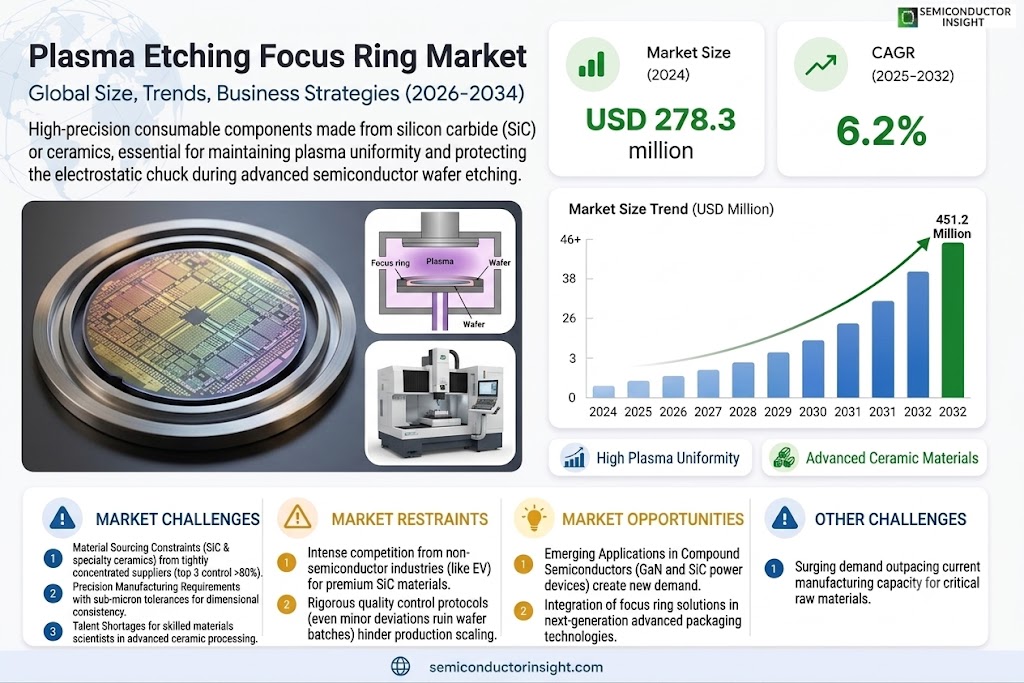
The global Plasma Etching Focus Ring Market size was valued at US$ 278.3 million in 2024 and is projected to reach US$ 451.2 million by 2032, at a CAGR of 6.2% during the forecast period 2025-2032.

Plasma etching focus rings are critical components in semiconductor manufacturing equipment, designed to protect wafers from plasma damage while ensuring uniform etching patterns. These precision components are fabricated from highly durable materials such as silicon carbide (SiC) or quartz to withstand extreme plasma environments in etching processes like Reactive Ion Etching (RIE) and Deep Reactive Ion Etching (DRIE).
The market growth is primarily driven by the semiconductor industry’s push toward smaller node technologies and 3D NAND flash memory production. 300mm wafer processing dominates current demand, though the transition to 450mm wafer compatibility presents future opportunities. Key challenges include material degradation issues and the need for longer component lifespans. Major players like Hana Materials and Silfex are investing in advanced ceramic composites to address these requirements while improving etch uniformity.
MARKET DYNAMICS
MARKET DRIVERS
Increasing Semiconductor Miniaturization Demands Precise Plasma Etching
The semiconductor industry’s relentless pursuit of smaller, more powerful chips is driving substantial growth in the plasma etching focus ring market. As transistor sizes shrink below 3nm nodes, the tolerance for etching imperfections approaches zero, creating unprecedented demand for ultra-precise etching control components. Focus rings play a critical role in maintaining plasma density uniformity across 300mm wafers, with leading foundries reporting up to 30% yield improvements when using premium focus rings in advanced nodes. The transition to extreme ultraviolet (EUV) lithography further amplifies this need because each defective chip in these multi-patterning processes represents significantly higher financial losses.
Expansion of Memory Chip Production Fuels Equipment Demand
Global memory manufacturers are currently engaged in a capacity expansion race, with planned DRAM and NAND fab constructions projected to require over 15,000 new plasma etchers by 2026. Each etcher typically contains multiple focus rings that require periodic replacement due to plasma-induced wear. The memory industry’s shift toward high-aspect-ratio etching for 3D NAND and advanced DRAM architectures particularly benefits silicon carbide (SiC) focus ring suppliers, as these materials demonstrate 3-5 times longer lifespans in aggressive etching chemistries. Major Korean and Chinese memory makers have reportedly increased focus ring procurement budgets by 40% year-over-year to support their production ramp-ups.
Material Innovation Drives Product Premiumization
Breakthroughs in advanced ceramics and composite materials are enabling a new generation of focus rings with unprecedented durability and process stability. Industry leaders have introduced silicon carbide focus rings with proprietary coating technologies that reduce particle contamination by up to 60% compared to conventional designs. These innovations come at a critical time as foundries implement more frequent preventive maintenance cycles to ensure yield stability at advanced nodes. While premium focus rings command 30-50% price premiums over standard models, their adoption is accelerating because they can reduce costly chamber downtime by extending maintenance intervals by nearly 40%.
MARKET RESTRAINTS
Geopolitical Tensions Disrupt Semiconductor Supply Chains
The plasma etching focus ring market faces mounting challenges from escalating trade restrictions and export controls on semiconductor equipment. Recent regulations targeting advanced chipmaking technologies have created significant supply chain uncertainties, particularly for suppliers with production concentrated in single geographic regions. These disruptions come at a particularly inopportune time, as foundries were already struggling with 20-30 week lead times for critical etching components prior to the implementation of new trade barriers. The resulting supply-demand imbalance has caused spot prices for certain focus ring models to surge by over 60% in secondary markets.
Other Restraints
Intense Cost Pressure from Chipmakers
Semiconductor manufacturers facing capital expenditure constraints are aggressively negotiating component pricing, forcing focus ring suppliers to absorb rising material and energy costs. This pricing pressure is particularly acute for legacy node products, where profit margins are already compressed below 15% for many suppliers.
Technological Obsolescence Risks
The rapid pace of semiconductor process innovation renders existing focus ring designs obsolete within 3-5 years, creating substantial R&D burdens for manufacturers. Each new etching chemistry or wafer size transition requires costly requalification processes that strain smaller suppliers’ resources.
MARKET CHALLENGES
Material Sourcing Constraints Threaten Production Stability
The plasma etching focus ring industry confronts significant challenges in securing reliable supplies of high-purity silicon carbide and specialty ceramics. Global silicon carbide wafer production capacity remains tightly concentrated, with just three suppliers controlling over 80% of the market. This bottleneck has been exacerbated by surging demand from the electric vehicle industry, which competes for the same premium-grade SiC materials. Multiple focus ring manufacturers have reported 6-9 month delays in receiving crucial raw material shipments, forcing them to implement allocation programs for key customers.
Other Challenges
Precision Manufacturing Requirements
Producing focus rings with sub-micron dimensional tolerances requires specialized equipment and highly controlled environments, creating substantial barriers to production scaling. Even minor deviations in ring geometry can cause plasma uniformity variations that ruin entire wafer batches, necessitating rigorous quality control protocols.
Talent Shortages in Specialty Materials
The industry faces an acute shortage of materials scientists and engineers skilled in advanced ceramic processing techniques. With compensation packages in the semiconductor sector lagging behind those offered by the battery and aerospace industries, focus ring manufacturers struggle to attract and retain critical technical talent.
MARKET OPPORTUNITIES
Emerging Applications in Compound Semiconductors Create New Demand
The accelerating adoption of gallium nitride (GaN) and silicon carbide (SiC) power devices presents a major growth opportunity for focus ring manufacturers. These wide-bandgap semiconductors require specialized etching processes that generate significantly more intense plasma conditions compared to traditional silicon processing. As power semiconductor fabs ramp production to meet surging demand from automotive and renewable energy applications, they are driving 30% annual growth in the market for ruggedized focus rings designed specifically for these harsh environments. Early adopters of GaN/SiC-compatible focus rings are capturing substantial market share by offering products that demonstrate 2-3x longer operational lifespans in these applications.
Advanced Coatings Enable Service-Based Business Models
Breakthroughs in protective coating technologies are enabling focus ring suppliers to transition from product sales to performance-based service contracts. New nanocomposite coatings that allow in-situ refurbishment of worn focus rings directly in the etching chamber could revolutionize the market’s economics. These coatings reduce the need for physical replacements while maintaining consistent plasma performance, potentially extending ring service intervals beyond 10,000 wafer starts. Leading equipment manufacturers are actively partnering with materials specialists to commercialize these solutions, anticipating they could reduce customers’ total cost of ownership by up to 35% over five years.
Regional Capacity Expansion Drives Localization Efforts
Government incentives and supply chain security concerns are prompting significant investments in regional semiconductor ecosystems, creating opportunities for focus ring manufacturers to establish local production and service hubs. Multiple countries have announced plans to double domestic chipmaking capacity within five years, with facility construction already underway in previously underserved regions. Suppliers that can establish qualified local manufacturing and fulfillment capabilities stand to gain privileged access to these emerging fabs while avoiding import tariffs and logistics bottlenecks. Several leading focus ring companies have already announced plans to build dedicated application labs near major new fab clusters to provide faster technical support and reduced lead times.
PLASMA ETCHING FOCUS RING MARKET TRENDS
Expansion in Semiconductor Fabrication to Drive Market Demand
The plasma etching focus ring market is experiencing significant growth due to the rapid expansion of semiconductor fabrication facilities worldwide. With the global semiconductor industry projected to reach $1.38 trillion by 2029, manufacturers are investing heavily in advanced etching equipment to meet the demand for cutting-edge chips. Plasma etching focus rings play a crucial role in maintaining process stability, particularly as node sizes shrink below 5nm. Recent advances in focus ring design, including improved thermal management and wear resistance, have extended component lifetimes by over 30% in some applications, directly impacting fab operational costs.
Other Trends
Emergence of Alternative Materials
While silicon carbide (SiC) dominates as the preferred focus ring material for many etching applications, the market is witnessing increased adoption of advanced ceramic composites and quartz-based solutions. These alternatives demonstrate superior performance in critical applications such as high-power RF environments, with some proprietary materials lasting over 50,000 wafer cycles before requiring replacement. The ongoing materials research correlates with the semiconductor industry’s emphasis on reducing mean time between failures (MTBF) across all process components.
Integration with Smart Factory Solutions
The Industry 4.0 revolution is transforming focus ring utilization through real-time monitoring systems. Modern etching chambers increasingly incorporate sensor-equipped focus rings that provide continuous data on component wear, plasma uniformity, and thermal dynamics. This integration enables predictive maintenance strategies that can reduce unplanned downtime by up to 40% in advanced fabrication facilities. Furthermore, the collected process data feeds into machine learning algorithms that optimize etching parameters for specific wafer types, creating a feedback loop that enhances both component longevity and process yield.
COMPETITIVE LANDSCAPE
Key Industry Players
Technological Innovation and Expansion Define Market Competition
The global plasma etching focus ring market exhibits a semi-consolidated structure, with dominant players competing alongside emerging regional suppliers. Hana Materials leads the market with an estimated 28% revenue share in 2024, owing to its vertically integrated manufacturing capabilities and strong supply chain partnerships with leading semiconductor equipment manufacturers.
Silfex (a division of Lam Research) and SKC Solmix collectively account for approximately 35% of global sales, driven by their expertise in silicon carbide (SiC) focus rings for advanced node semiconductor fabrication. These companies benefit from increasing adoption of SiC rings in sub-7nm process technologies due to superior plasma resistance and thermal stability.
Market leaders are actively expanding production capacities to meet surging demand from foundries and IDMs. For instance, Hana Materials completed a $120 million facility expansion in South Korea during Q1 2024, increasing its annual production capacity to 150,000 units. Meanwhile, MMC is strengthening its European footprint through strategic partnerships with ASML and Infineon to supply focus rings for power semiconductor manufacturing.
The competitive intensity is further heightened by technological differentiation. Waldex recently introduced a patented multi-layer silicon focus ring with 40% longer service life compared to conventional designs, while TCK focuses on cost-competitive solutions for mature node applications. Emerging players are gaining traction in China’s domestic semiconductor market through local manufacturing and favorable government policies supporting equipment component localization.
List of Key Plasma Etching Focus Ring Companies Profiled
- Hana Materials (South Korea)
- Silfex (U.S.)
- MMC (Japan)
- SKC Solmix (South Korea)
- Waldex (Japan)
- TCK (Taiwan)
Segment Analysis:
By Type
Silicon Focus Ring Segment Dominates Due to Superior Etching Uniformity and Cost-Effectiveness
The market is segmented based on material type into:
- Silicon Focus Ring
- SiC (Silicon Carbide) Focus Ring
- Quartz Focus Ring
- Alumina (Aluminum Oxide) Focus Ring
By Application
Reactive Ion Etching (RIE) Segment Leads Owing to Widespread Use in Semiconductor Fabrication
The market is segmented based on application into:
- Reactive Ion Etching (RIE)
- Inductively Coupled Plasma Etching (ICP)
- Deep Reactive Ion Etching (DRIE)
- Other Plasma Etching Processes
By End-Use Industry
Semiconductor Manufacturing Segment Dominates Due to Rising Chip Demand
The market is segmented by end-use industry into:
- Semiconductor Manufacturing
- Solar Cell Production
- Microelectromechanical Systems (MEMS)
- Optoelectronics
By Distribution Channel
Direct Sales Segment Prevails Due to Need for Technical Support
The market is segmented by distribution channel into:
- Direct Sales (OEM)
- Distributors
- Online Platforms
Regional Analysis: Plasma Etching Focus Ring Market
North America
The North American plasma etching focus ring market is driven by the region’s strong semiconductor manufacturing base, particularly in the United States, home to major chipmakers like Intel and Texas Instruments. The U.S. CHIPS and Science Act, allocating $52.7 billion for domestic semiconductor production, is fueling demand for advanced etching components. Focus rings made of silicon carbide (SiC) are gaining traction due to their superior plasma-resistant properties. However, high production costs and stringent material certification requirements pose challenges for suppliers. The region is also witnessing increased R&D investment in next-generation plasma etching technologies for 2nm and 3nm chip production.
Europe
Europe maintains steady demand for plasma etching focus rings, supported by the presence of semiconductor equipment manufacturers like ASML and Infineon. The region emphasizes innovation in complex etching processes for automotive and industrial applications. German and French manufacturers are leading in precision manufacturing of quartz and ceramic focus rings. The EU’s Carbon Border Adjustment Mechanism (CBAM) is pushing suppliers to adopt cleaner production methods, increasing costs but driving material efficiency. While growth is moderate compared to Asia, the European market prioritizes high-reliability components with extended lifespans to reduce fab downtime.
Asia-Pacific
Asia-Pacific dominates the global plasma etching focus ring market, accounting for over 60% of consumption due to concentrated semiconductor production in Taiwan (TSMC), South Korea (Samsung), and mainland China. The region’s rapid adoption of extreme ultraviolet (EUV) lithography is creating demand for ultra-precise focus rings with tighter tolerances. China’s push for semiconductor self-sufficiency under its “Made in China 2025” initiative is driving local focus ring production, though quality inconsistencies remain a concern. Japan maintains leadership in advanced ceramic focus rings, while Southeast Asia emerges as a cost-competitive manufacturing hub. Market growth is tempered by geopolitical tensions affecting semiconductor supply chains.
South America
South America represents a niche market for plasma etching focus rings, primarily serving regional electronics assembly operations rather than full-scale semiconductor fabs. Brazil shows limited demand from its microelectronics sector, but infrastructure limitations and high import dependence constrain market growth. The lack of local component manufacturers forces regional buyers to rely on European, North American, and Asian suppliers. While some Brazilian universities conduct semiconductor research, commercial adoption remains minimal. The market primarily consumes standard silicon focus rings due to cost considerations, with little demand for advanced materials.
Middle East & Africa
This region shows nascent potential in plasma etching focus ring demand, primarily driven by academic research institutions and small-scale electronics manufacturing in Israel and the UAE. Saudi Arabia’s planned NEOM tech city could stimulate future semiconductor-related investments. Currently, the market relies entirely on imports, with no local manufacturing capabilities. Focus ring adoption is limited by the absence of cutting-edge semiconductor fabs, though some growth is expected from regional photonics and MEMS applications. Geopolitical instability in parts of the region creates supply chain uncertainties for high-tech components.
Report Scope
This market research report provides a comprehensive analysis of the global and regional Plasma Etching Focus Ring markets, covering the forecast period 2025–2032. It offers detailed insights into market dynamics, technological advancements, competitive landscape, and key trends shaping the industry.
Key focus areas of the report include:
- Market Size & Forecast: Historical data and future projections for revenue, unit shipments, and market value across major regions and segments.
- Segmentation Analysis: Detailed breakdown by product type (Silicon Focus Ring, SiC Focus Ring), application (RIE, ICP, DRIE, Others), and end-user industry to identify high-growth segments and investment opportunities.
- Regional Outlook: Insights into market performance across North America, Europe, Asia-Pacific, Latin America, and the Middle East & Africa, including country-level analysis where relevant.
- Competitive Landscape: Profiles of leading market participants, including their product offerings, R&D focus, manufacturing capacity, pricing strategies, and recent developments such as mergers, acquisitions, and partnerships.
- Technology Trends & Innovation: Assessment of emerging semiconductor fabrication techniques, material science advancements, and evolving industry standards for plasma etching components.
- Market Drivers & Restraints: Evaluation of factors driving market growth along with challenges, supply chain constraints, regulatory issues, and market-entry barriers.
- Stakeholder Analysis: Insights for component suppliers, semiconductor equipment manufacturers, foundries, investors, and policymakers regarding the evolving ecosystem and strategic opportunities.
Primary and secondary research methods are employed, including interviews with industry experts, data from verified sources, and real-time market intelligence to ensure the accuracy and reliability of the insights presented.
FREQUENTLY ASKED QUESTIONS:
What is the current market size of Global Plasma Etching Focus Ring Market?
-> Plasma Etching Focus Ring Market size was valued at US$ 278.3 million in 2024 and is projected to reach US$ 451.2 million by 2032, at a CAGR of 6.2% during the forecast period 2025-2032..
Which key companies operate in Global Plasma Etching Focus Ring Market?
-> Key players include Hana Materials, Silfex, MMC, SKC Solmix, Waldex, and TCK, among others.
What are the key growth drivers?
-> Key growth drivers include increasing semiconductor device miniaturization, rising demand for advanced ICs, and expansion of semiconductor fabrication facilities globally.
Which region dominates the market?
-> Asia-Pacific dominates the market, accounting for over 65% of global demand, driven by semiconductor manufacturing hubs in Taiwan, South Korea, and China.
What are the emerging trends?
-> Emerging trends include development of advanced ceramic materials, integration of IoT in etching equipment monitoring, and increasing adoption of 300mm wafer processing.
Get Sample Report PDF for Exclusive Insights
Report Sample Includes
- Table of Contents
- List of Tables & Figures
- Charts, Research Methodology, and more...
 Download Sample Report PDF