MARKET INSIGHTS
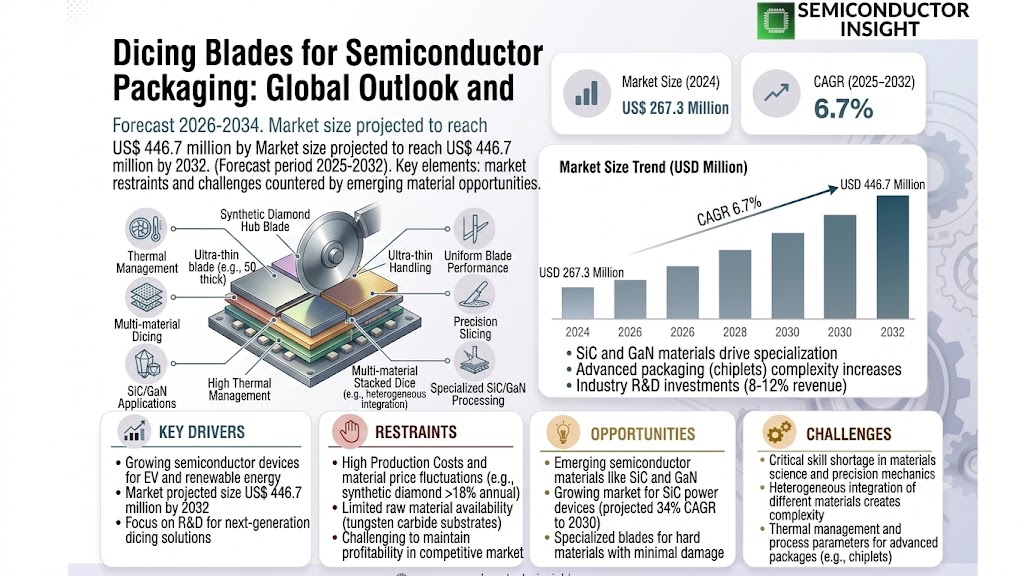
The global Dicing Blades for Semiconductor Packaging Market size was valued at US$ 267.3 million in 2024 and is projected to reach US$ 446.7 million by 2032, at a CAGR of 6.7% during the forecast period 2025-2032. This growth aligns with the broader semiconductor industry expansion, which was valued at USD 579 billion in 2022 and is expected to reach USD 790 billion by 2029 at 6% CAGR.
Dicing blades are precision cutting tools used in semiconductor manufacturing for wafer singulation – the process of separating individual chips from silicon wafers. These blades utilize diamond abrasives to achieve micron-level precision cuts while minimizing chipping and thermal damage. The market offers two primary configurations: hubless type for high-precision applications and hub type for standard production needs, with hubless blades currently holding 62% market share.
The market growth is driven by increasing demand for advanced packaging technologies like 3D ICs and fan-out wafer-level packaging, which require ultra-precise dicing solutions. While 300mm wafers dominate current production (74% market share), the emergence of larger wafer sizes presents new opportunities. However, the industry faces challenges from alternative singulation methods like laser dicing, particularly for ultra-thin wafers below 50μm. Key players including DISCO, K&S, and Asahi Diamond Industrial are investing in advanced dicing technologies to maintain market leadership, with DISCO currently holding 28% of global market share.
MARKET DYNAMICS
MARKET DRIVERS
Growing Semiconductor Industry Driving Demand for Precision Dicing Solutions
The semiconductor packaging market is experiencing robust growth, fueled by increasing demand for advanced electronic devices across industries. The global semiconductor market, valued at $579 billion in 2022, is projected to reach $790 billion by 2029, growing at a 6% CAGR. This expansion directly correlates with rising demand for high-precision dicing blades, which play a critical role in wafer processing. Advanced packaging technologies such as fan-out wafer-level packaging (FOWLP) and 3D IC integration require exceptionally precise dicing solutions, creating substantial growth opportunities for manufacturers specializing in ultra-thin and high-performance dicing blades.
Increasing Adoption of 300mm Wafers Creating New Requirements
The industry’s transition to larger 300mm wafer sizes is significantly impacting the dicing blades market. While 200mm wafers accounted for approximately 38% of the market share in 2023, 300mm wafer adoption is growing at nearly 12% annually. This shift requires dicing blades with enhanced stability and extended service life to handle the increased wafer surface area. Modern 300mm wafer production lines demand blades capable of consistent performance across thousands of cuts while maintaining micron-level precision, driving innovation in blade materials and design.
Advancements in IoT and 5G Technologies Stimulating Market Expansion
The proliferation of IoT devices and 5G infrastructure is creating unprecedented demand for semiconductor components. With over 29 billion connected IoT devices projected by 2027, semiconductor manufacturers are increasing production capacity, subsequently driving dicing blade consumption. The unique requirements of RF and power semiconductor devices used in these applications necessitate specialized dicing solutions. Manufacturers are responding with optimized blade formulations that minimize chipping and delamination while processing these sensitive materials.
MARKET RESTRAINTS
High Production Costs and Limited Raw Material Availability
The dicing blade market faces significant challenges related to production costs and material scarcity. Synthetic diamond, a critical component of high-performance dicing blades, has seen price fluctuations exceeding 18% annually since 2021. Additionally, disruptions in the supply chain for tungsten carbide substrates have created bottlenecks in blade manufacturing. These factors contribute to increased product costs, making it challenging for manufacturers to maintain profitability while meeting customers’ price expectations in this competitive market.
Technical Challenges in Advanced Packaging Applications
Emerging packaging technologies like heterogeneous integration and chiplets present new challenges for dicing blade manufacturers. The process of dicing stacks of different materials with varying mechanical properties requires blades that can maintain uniform performance across dissimilar substrates. Thermal management during the dicing process becomes increasingly complex as package thickness decreases below 50 microns. These technical hurdles require substantial R&D investments, with leading manufacturers spending approximately 8-12% of their annual revenue on product development.
MARKET CHALLENGES
Skill Shortage in Precision Machining and Blade Technology
The industry faces a critical shortage of skilled professionals capable of designing and manufacturing advanced dicing blades. Specialized knowledge in materials science and precision mechanics is increasingly difficult to source, with an estimated 35% of manufacturing positions remaining unfilled for more than six months. This skills gap slows innovation and complicates the adoption of new manufacturing techniques, potentially delaying the introduction of next-generation products to market.
Equipment Compatibility Issues with Existing Production Lines
Integration of advanced dicing blades into existing semiconductor production lines presents significant operational challenges. Blade manufacturers must ensure compatibility with dozens of dicing saw variants from different equipment suppliers, each with unique specifications. The transition from conventional to ultra-thin blades often requires substantial modifications to handling systems and process parameters, potentially causing production downtime that semiconductor manufacturers are reluctant to accept.
MARKET OPPORTUNITIES
Emerging Materials Creating Demand for Specialized Dicing Solutions
The development of new semiconductor materials like silicon carbide (SiC) and gallium nitride (GaN) creates substantial opportunities for blade manufacturers. These wide-bandgap materials, particularly important for electric vehicle and renewable energy applications, require specialized dicing solutions. The market for SiC power devices alone is expected to grow at 34% CAGR through 2030, driving demand for blades capable of processing these exceptionally hard materials with minimal sub-surface damage.
Automation and Smart Manufacturing Driving Next-Generation Solutions
The integration of Industry 4.0 technologies into semiconductor manufacturing presents significant opportunities for dicing blade innovation. Smart blades embedded with sensors capable of monitoring wear and predicting failure are gaining traction, potentially reducing unplanned downtime by up to 40%. Additionally, automated blade change systems are becoming standard in advanced packaging facilities, creating demand for standardized blade interfaces and connectivity features.
DICING BLADES FOR SEMICONDUCTOR PACKAGING MARKET TRENDS
Miniaturization of Semiconductor Devices Drives Demand for Precision Dicing Blades
The semiconductor industry’s relentless push toward smaller, more powerful chips is creating unprecedented demand for high-performance dicing blades. With 3nm and 5nm node technologies becoming mainstream, manufacturers require blades capable of cutting ultra-thin wafers with micron-level precision. The global market for semiconductor dicing blades, valued at $210 million in 2024, is projected to grow at 6.2% CAGR through 2032. This growth directly correlates with similar projections for the semiconductor market, which is expected to expand from $579 billion in 2022 to $790 billion by 2029. Cutting-edge blade technologies incorporating advanced diamond abrasives and optimized bond systems now enable clean cuts at thicknesses below 50μm while maintaining exceptional edge quality and minimizing chipping.
Other Trends
Emergence of Compound Semiconductor Materials
Silicon carbide (SiC) and gallium nitride (GaN) dicing presents unique challenges that are reshaping blade technologies. These harder, more brittle materials require specialized blade formulations with superior wear resistance and thermal stability. The compound semiconductor market, projected to grow at 12% annually, is driving innovations in super-abrasive grain technologies and hybrid bonding systems. Manufacturers are developing multi-layer blade structures that combine different abrasive compositions across the blade profile to optimize cutting performance throughout the tool’s lifespan while maintaining consistent kerf width and cut quality.
Automation and Smart Manufacturing Integration
Industry 4.0 adoption is transforming dicing blade usage through predictive maintenance systems and AI-driven process optimization. Smart blades with embedded sensors now provide real-time data on wear patterns and cutting performance, reducing unplanned downtime by up to 30% in advanced packaging facilities. Major foundries are integrating dicing equipment with machine learning algorithms that automatically adjust spindle speeds, feed rates, and coolant delivery based on blade performance metrics. This digital transformation extends blade life while improving yield rates for delicate 300mm wafers, which now account for over 65% of global semiconductor production volume.
COMPETITIVE LANDSCAPE
Key Industry Players
Technological Innovation and Precision Engineering Drive Market Competition
The global dicing blades for semiconductor packaging market features a moderately consolidated competitive landscape, dominated by established players with strong technical expertise in precision cutting technologies. DISCO Corporation leads the market with an estimated 25-30% revenue share in 2024, owing to its proprietary diamond abrasive technologies and comprehensive product lineup for wafer dicing applications.
ADT (Advanced Dicing Technologies) and K&S (Kulicke & Soffa) hold significant positions in the market, particularly in high-precision blade solutions for 300mm wafer processing. Their growth is driven by increasing demand from advanced packaging applications like fan-out wafer-level packaging (FO-WLP) and 3D IC integration.
These leading companies are actively expanding their production capabilities and R&D investments to develop next-generation dicing blades with enhanced durability and cutting precision. Recent innovations include ultra-thin blades for 50μm street widths and specialized coatings to reduce chipping in brittle materials.
Meanwhile, regional players like Asahi Diamond Industrial in Japan and ACCRETECH are strengthening their positions through strategic partnerships with semiconductor equipment manufacturers. Their focus on cost-competitive solutions for mainstream applications helps maintain balance in the competitive environment.
List of Key Dicing Blades Manufacturers Profiled
- DISCO Corporation (Japan)
- ADT (Advanced Dicing Technologies) (Israel)
- Kulicke & Soffa (K&S) (Singapore)
- Ceiba Technologies (U.S.)
- UKAM Industrial Superhard Tools (U.S.)
- Kinik Company (Taiwan)
- ITI (International Tool Industries) (U.S.)
- Asahi Diamond Industrial (Japan)
- DSK Technologies (South Korea)
- ACCRETECH (Japan)
- Zhengzhou Sanmosuo (China)
- Shanghai Sinyang Semiconductor (China)
Segment Analysis:
By Type
Hubless Type Segment Leads Due to Higher Precision in Thin Wafer Dicing Applications
The market is segmented based on type into:
- Hubless Type
- Subtypes: Resin-bonded, Metal-bonded, Electroplated, and others
- Hub Type
- Subtypes: Nickel-based, Phenolic resin-based, and others
By Application
300mm Wafer Segment Dominates Owing to Higher Production Efficiency in Advanced Nodes
The market is segmented based on application into:
- 300mm Wafer
- 200mm Wafer
- Others (150mm and smaller wafers)
By Material
Diamond-Based Blades Hold Largest Share Due to Superior Cutting Performance
The market is segmented based on material into:
- Diamond Blades
- CBN (Cubic Boron Nitride) Blades
- Others (Abrasive-based)
By End-User
Foundries Lead Market Demand Driven by High-Volume Production Requirements
The market is segmented based on end-user into:
- Foundries
- IDMs (Integrated Device Manufacturers)
- OSAT (Outsourced Semiconductor Assembly and Test) Providers
- Research Institutions
Regional Analysis: Dicing Blades for Semiconductor Packaging Market
North America
The North American market for dicing blades is characterized by high technological adoption and stringent quality standards, driven largely by the United States’ advanced semiconductor manufacturing base. With substantial investments in domestic chip production under initiatives like the CHIPS and Science Act ($52.7 billion allocated), demand for precision dicing tools is accelerating. Major players such as DISCO and K&S dominate this region through localized supply chains. While hub-type blades remain prevalent for 200mm wafer applications, manufacturers are rapidly transitioning to hubless solutions for 300mm wafer processing to meet the requirements of next-gen nodes below 7nm. The focus on automotive and IoT semiconductors is particularly influencing blade specifications, with increasing requirements for thinner kerf widths and reduced chipping.
Europe
Europe maintains a strong position in specialty semiconductor applications, particularly automotive and industrial chips, creating steady demand for high-performance dicing blades. German manufacturers lead in adopting advanced hubless blades for power electronics, while French and Italian fabs show growing preference for diamond-embedded solutions. The region benefits from collaborative R&D initiatives between equipment manufacturers like ITI and academic institutions, driving innovations in blade longevity and cut quality. However, relatively slower adoption of extreme UV lithography compared to Asia-Pacific has moderated the pace of blade technology upgrades. Environmental regulations concerning abrasive materials are prompting manufacturers to develop more sustainable blade compositions without compromising cutting precision.
Asia-Pacific
As the global epicenter of semiconductor manufacturing, Asia-Pacific accounts for over 65% of dicing blade consumption, with China, Taiwan, South Korea and Japan being key markets. The concentration of advanced foundries (TSMC, Samsung, SMIC) has created massive demand for ultra-thin hubless blades capable of processing 300mm wafers at scale. Local manufacturers like Kinik and Zhengzhou Sanmosuo are gaining market share through cost-competitive alternatives to premium Japanese brands, particularly for mid-range applications. Southeast Asia is emerging as a growth hotspot, with Malaysia and Singapore expanding backend packaging facilities – driving demand for specialized blades for advanced packaging techniques like fan-out wafer-level packaging. The region’s rapid technology transitions (from 28nm to 7nm and below) create constant pressure on blade suppliers to improve performance metrics.
South America
The South American market presents a developing landscape for dicing blades, primarily serving local packaging and testing facilities rather than front-end fabs. Brazil shows the most activity, with investments in analog and mixed-signal chip packaging driving selective demand. However, the region faces challenges including limited local technical expertise in blade selection/optimization and reliance on imported equipment. The market remains price-sensitive, with simpler hub-type blades dominating due to lower infrastructure requirements for 200mm wafer processing. While some growth potential exists in serving the automotive electronics sector, the absence of comprehensive semiconductor ecosystems restricts broader market expansion.
Middle East & Africa
This region represents a nascent but strategically evolving market, with Israel and UAE showing particular promise. Israel’s thriving semiconductor design industry and growing packaging capabilities are creating specialized demand for blades suited to MEMS and sensors. The UAE’s technology diversification initiatives include planned investments in semiconductor test and packaging infrastructure, which may drive future blade requirements. However, across most of Africa, the semiconductor industry remains underdeveloped, limiting immediate opportunities. The region’s potential lies in serving as a secondary market for refurbished dicing equipment and cost-effective blade solutions as manufacturing bases gradually expand beyond oil and gas sectors.
Report Scope
This market research report provides a comprehensive analysis of the global and regional Dicing Blades for Semiconductor Packaging markets, covering the forecast period 2025–2032. It offers detailed insights into market dynamics, technological advancements, competitive landscape, and key trends shaping the semiconductor packaging industry.
Key focus areas of the report include:
- Market Size & Forecast: Historical data and future projections for revenue, unit shipments, and market value across major regions and segments. The global market was valued at US$ 267.3 million in 2024 and is projected to reach US$ 446.7 million by 2032, growing at a CAGR of 6.7.
- Segmentation Analysis: Detailed breakdown by product type (Hubless vs Hub Type), application (300mm vs 200mm wafers), and end-user industry to identify high-growth segments.
- Regional Outlook: Insights into market performance across North America, Europe, Asia-Pacific (dominant with 68% share), Latin America, and Middle East & Africa.
- Competitive Landscape: Profiles of leading participants including DISCO, K&S, Asahi Diamond Industrial, and ACCRETECH, covering their product portfolios and strategic developments.
- Technology Trends: Assessment of emerging dicing technologies, integration of AI in blade manufacturing, and advancements in diamond abrasive formulations.
- Market Drivers: Evaluation of factors including semiconductor industry growth (projected USD 790 billion by 2029), miniaturization trends, and advanced packaging adoption.
- Stakeholder Analysis: Strategic insights for semiconductor manufacturers, packaging service providers, equipment OEMs, and material suppliers.
The research employs primary interviews with industry experts and analysis of verified market data from semiconductor associations and equipment manufacturers to ensure accuracy.
FREQUENTLY ASKED QUESTIONS:
What is the current market size of Global Dicing Blades for Semiconductor Packaging Market?
-> The global Dicing Blades for Semiconductor Packaging Market size was valued at US$ 267.3 million in 2024 and is projected to reach US$ 446.7 million by 2032, at a CAGR of 6.7% during the forecast period 2025-2032.
Which key companies operate in this market?
-> Key players include DISCO, ADT, K&S, Ceiba, Asahi Diamond Industrial, and ACCRETECH, among others.
What are the key growth drivers?
-> Growth is driven by semiconductor industry expansion (6% CAGR), wafer size transitions, and advanced packaging adoption.
Which region dominates the market?
-> Asia-Pacific dominates with 68% market share, led by semiconductor manufacturing hubs in Taiwan, South Korea, and China.
What are the emerging trends?
-> Emerging trends include ultra-thin dicing blades, laser-assisted dicing, and diamond-like carbon coatings for improved blade longevity.
Get Sample Report PDF for Exclusive Insights
Report Sample Includes
- Table of Contents
- List of Tables & Figures
- Charts, Research Methodology, and more...
 Download Sample Report PDF