FinFET Market Insights
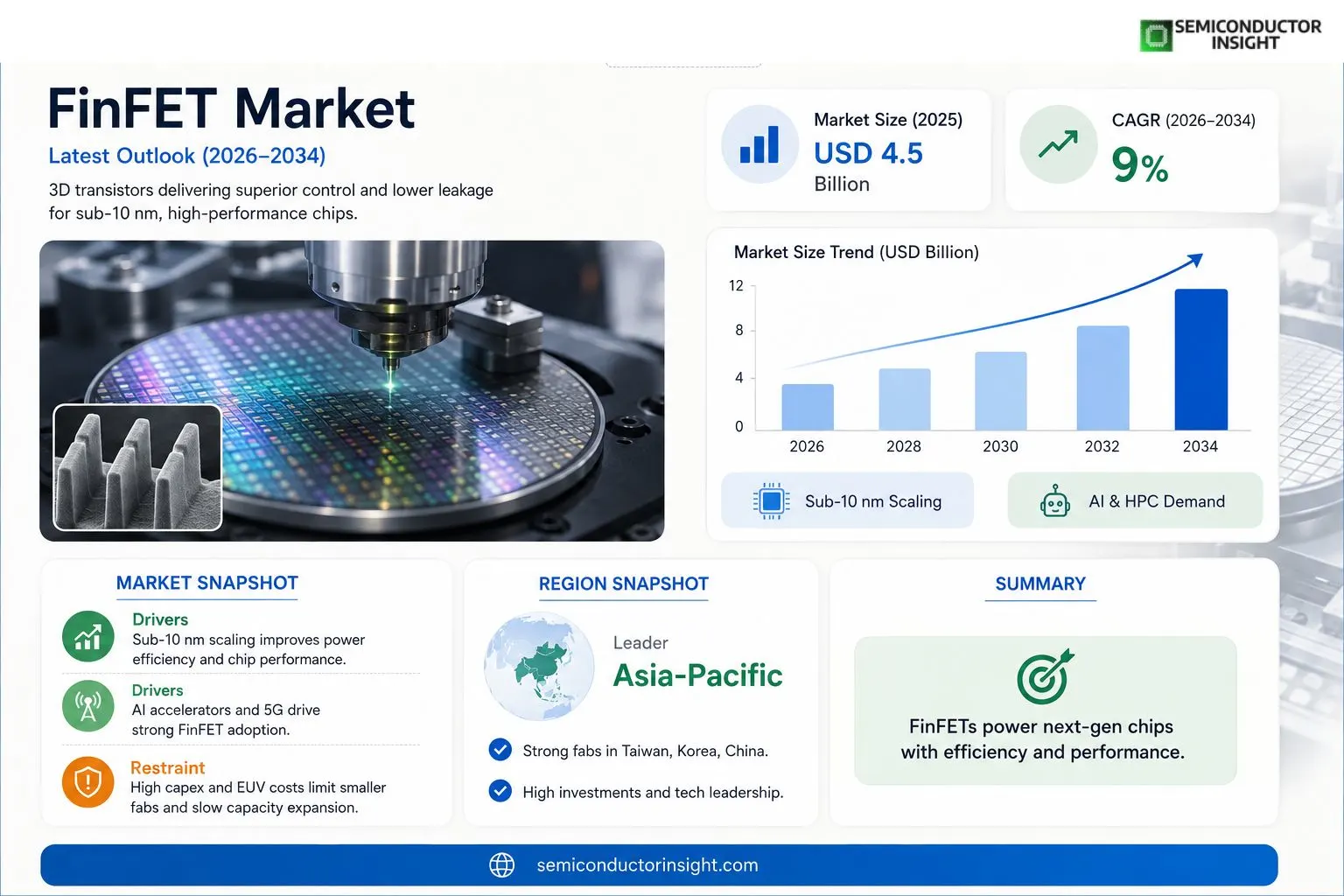
FinFET market size was valued at USD 4.5 billion in 2025. The market is projected to grow from USD 4.6 billion in 2026 to USD 9.8 billion by 2034, exhibiting a CAGR of 9 % during the forecast period.FinFETs (Fin Field‑Effect Transistors) are three‑dimensional transistors that provide superior control over channel leakage compared with planar MOSFETs, enabling continued scaling below 10 nm nodes for high‑performance computing and mobile applications.
The market is accelerating because leading foundries such as TSMC, Samsung and Intel are expanding their sub‑10 nm production lines that rely on FinFET architectures; recent investments include TSMC’s $12 billion Fab 12 expansion announced March 2024 and Samsung’s launch of a 7‑nm EUV‑enabled FinFET process in April 2024. These strategic moves, combined with rising demand for AI accelerators and smartphones, are driving robust growth.
MARKET DRIVERS
Technology Scaling and Power Efficiency
The transition to sub‑10 nm nodes has propelled the adoption of FinFET structures, delivering up to 30 % lower leakage power compared with planar transistors. This efficiency gain is a critical factor for mobile processors and data‑center chips, driving strong demand across the semiconductor supply chain.
Emerging Applications in 5G and AI
5G radio‑frequency front‑ends and AI accelerators require high‑performance logic with rapid switching speeds. FinFET technology provides the necessary drive current and reduced parasitic capacitance, enabling device manufacturers to meet stringent latency targets while maintaining energy budgets.
➤ “FinFET adoption is projected to exceed 80 % of all logic chips fabricated in 2025, underscoring its role as the dominant transistor architecture.”
International foundries report a 12 % year‑over‑year growth in wafer starts for FinFET‑based processes, confirming that the market momentum is sustained by both OEM demand and R&D investments.
MARKET CHALLENGES
Manufacturing Complexity
FinFET structures involve multi‑layer gate stacks and precise fin dimension control, increasing process variation risk. Yield enhancement therefore requires advanced lithography tools and rigorous metrology, raising the cost per wafer.
Other Challenges
Design Rule Constraints
Design teams must adopt new libraries and verification flows to accommodate the three‑dimensional geometry, extending product development cycles by an average of four months.
Supply‑chain bottlenecks for high‑purity epitaxial silicon also impact fab capacity, limiting the ability of manufacturers to scale production quickly in response to market spikes.
MARKET RESTRAINTS
High Capital Expenditure
Establishing a new FinFET line typically requires US$10‑12 billion in equipment and clean‑room upgrades. This steep investment creates a barrier for smaller fabs and constrains overall capacity expansion.FinFET lithography relies on extreme‑ultraviolet (EUV) sources, which are still limited in throughput. The high cost of EUV masks further adds to the financial strain on early adopters.These financial pressures can delay the rollout of next‑generation nodes, causing a temporary slowdown in market acceleration despite strong demand forecasts.
MARKET OPPORTUNITIES
Expanding Presence in Automotive Electronics
Advanced driver‑assistance systems (ADAS) and autonomous vehicle platforms increasingly require high‑performance, low‑power processors. FinFET’s superior thermal characteristics open new revenue streams for chip suppliers targeting the automotive sector.Integration of FinFET technology with emerging packaging solutions such as chip‑on‑wafer‑stack (CoWS) enables higher functional density, presenting a growth avenue for heterogeneous integration markets.Emerging markets in Asia‑Pacific are investing heavily in semiconductor fabs, offering strategic partnerships for technology licenses and knowledge transfer, which can accelerate market penetration.
FinFET Market Trends
Shift Toward Sub‑10 nm FinFET Adoption
FinFET Market is experiencing a pronounced acceleration as leading semiconductor manufacturers prioritize sub‑10 nm process nodes. Foundries such as TSMC, Samsung, and Intel have invested heavily in new production lines that rely on three‑dimensional FinFET architectures, citing their superior electrostatic control and reduced power leakage compared with planar devices. This transition enables continued scaling for high‑performance computing workloads and mobile platforms that demand both speed and energy efficiency. The strategic rollout of advanced EUV‑enabled tools in early 2024 further reduces cycle times, allowing customers to bring next‑generation chips to market faster while maintaining competitive cost structures.
Other Trends
Integration with AI Accelerators
AI‑driven workloads are reshaping FinFET Market by creating a demand for specialized accelerators that can handle massive parallelism. Chip designers are embedding FinFET‑based compute blocks directly into AI inference engines, leveraging the transistor’s ability to operate at lower voltages without sacrificing throughput. This integration supports edge devices and data‑center servers alike, where power budgets are tight but performance cannot be compromised. The trend also encourages co‑development between silicon providers and AI software firms, fostering ecosystems that align hardware capabilities with emerging machine‑learning models, thereby sustaining a virtuous cycle of innovation.
Expansion of Advanced Foundry Capacity
To meet the rising demand, FinFET Market is seeing a rapid expansion of advanced fab capacity across the globe. New wafer lines are being commissioned with a focus on high‑yield FinFET processes, incorporating next‑generation lithography and advanced metrology suites. These investments are not limited to traditional semiconductor hubs; emerging regions are also attracting capital as supply chain diversification becomes a strategic priority. The increased capacity shortens lead times for customers and improves overall ecosystem resilience, positioning the market for sustained growth amid evolving technology roadmaps.
COMPETITIVE LANDSCAPEKey Industry Players
FinFET Market Competitive Landscape Overview
FinFET Market is heavily concentrated among three foundries that command the bulk of sub‑10 nm production capacity. TSMC leads with its Fab 12 expansion, delivering a robust 7 nm EUV‑enabled FinFET line that serves high‑performance computing and flagship smartphones. Samsung Electronics follows closely, having launched a 7 nm FinFET process in early 2024 and investing heavily in next‑generation EUV tooling to secure AI‑accelerator demand. Intel utilizes its own IDM‑2.0 strategy, integrating FinFET nodes into its 10 nm and 7 nm product roadmaps while expanding its foundry services for external customers. Together, these leaders shape a market where economies of scale, advanced lithography, and deep R&D pipelines create high barriers to entry, driving the projected CAGR of roughly 9 % through 2034.Beyond the dominant trio, a diverse set of niche and emerging players enriches the competitive ecosystem. Foundries leverages its 12 nm FinFET platform to serve automotive and industrial IoT segments. SMIC focuses on cost‑effective FinFET solutions for the Chinese domestic market despite technology restrictions. Companies such as UMC, TowerJazz, and SEMI provide specialized process nodes or tooling services that support smaller fabs and research laboratories. Additional innovators—Imec, PowerVR, and STMicroelectronics—contribute advanced design‑enable IP, substrate engineering, and mixed‑signal FinFET capabilities, ensuring a vibrant supply chain that can adapt to rapid AI and mobile demand growth.
List of Key FinFET Companies Profiled
- TSMC
- Samsung Electronics
- Intel
- Foundries
- SMIC
- UMC
- TowerJazz
- Imec
- PowerVR
- STMicroelectronics
- ASE Technology Holding
- SK Hynix
- Renesas Electronics
- Qualcomm (FinFET design IP)
- MediaTek
Segment Analysis:
| Segment Category | Sub-Segments | Key Insights |
| By Type |
|
FinFET Evolution
|
| By Application |
|
AI‑Driven Demand
|
| By End User |
|
End‑User Priorities
|
| By Process Node |
|
Node‑Driven Innovation
|
| By Design Focus |
|
Strategic Design Themes
|
Regional Analysis: Asia-Pacific
Asia-Pacific
China is rapidly emerging as a key player in FinFET Market, with significant government initiatives aimed at achieving self-sufficiency in semiconductor technology. Investment in domestic FinFET manufacturing capabilities is accelerating, driven by the need to support its burgeoning electronics sector. The focus in China is on cost-effective FinFET solutions for a wide range of applications.
South Korea remains a vital hub for FinFET innovation and manufacturing, home to major semiconductor companies. Continued investments in R&D are crucial for maintaining its technological edge within the FinFET space. The emphasis is on developing cutting-edge FinFET solutions for advanced memory and logic devices.
Taiwan continues to be a significant contributor to the FinFET ecosystem, housing numerous foundries and equipment suppliers. The region plays a critical role in the supply chain, supporting the manufacturing of FinFET-based chips worldwide. Innovation efforts are directed towards improving yield and reducing production costs.
Japan is actively investing in FinFET technology, with a focus on high-performance applications in automotive and industrial sectors. Collaborations between research institutions and industry are fostering innovation in FinFET design and manufacturing.
North America
North America, particularly the United States, is a significant market for FinFET technology, driven by demand from the AI, cloud computing, and defense sectors. While not as dominant as Asia-Pacific, North America maintains a strong focus on R&D and advanced FinFET architectures, with key players investing heavily in next-generation FinFET technologies. The region benefits from a strong ecosystem of research institutions and innovative startups contributing to FinFET innovation. The focus is on high-performance, power-efficient FinFET solutions for data centers and specialized computing applications.
Europe
Europe represents a growing market for FinFET, with increasing adoption in automotive, industrial, and IoT applications. Government initiatives are supporting the development of a robust FinFET ecosystem within the region. Collaboration between European research institutions and industry is driving innovation in FinFET design and manufacturing. The primary focus remains enhancing energy efficiency and reliability of FinFET devices within industrial and automotive applications.
South America
South America is an emerging market for FinFET technology, with opportunities in consumer electronics and telecommunications. The market is relatively nascent, but is expected to grow steadily as digitalization and connectivity expand across the region. The adoption of FinFET is initially concentrated in high-end devices and specialized applications.
Middle East & Africa
The Middle East and Africa represent a smaller but growing market for FinFET, driven by increasing investments in infrastructure, telecommunications, and defense. Demand is primarily focused on applications in mobile devices, industrial automation, and smart cities. The region is expected to witness gradual adoption of FinFET technology as connectivity and technological penetration increase.
Report Scope
This market research report provides a comprehensive analysis of the FinFET Market , covering the forecast period 2026–2034. It offers detailed insights into market dynamics, technological advancements, competitive landscape, and key trends shaping the industry.
Key focus areas of the report include:
- Market Overview: The report begins with an overview outlining its current market scenario, key growth indicators, and industry transformation drivers. It discusses macroeconomic factors, demand–supply balance, regulatory landscape, and the strategic role of semiconductors in powering advancements across industries such as automotive, telecommunications, consumer electronics, and industrial automation.
- Market Size & Forecast: Historical data and future projections for revenue, unit shipments, and market value across major regions and segments.
- Segmentation Analysis: Detailed breakdown by product type, technology, application, and end-user industry to identify high-growth segments and investment opportunities.
- Regional Insights: Insights into market performance across North America, Europe, Asia-Pacific, Latin America, and the Middle East & Africa, including country-level analysis where relevant.
- Competitive Landscape: Profiles of leading market participants, including their product offerings, R&D focus, manufacturing capacity, pricing strategies, and recent developments such as mergers, acquisitions, and partnerships.
- Technology Trends & Innovation: Assessment of emerging technologies, integration of AI/IoT, semiconductor design trends, fabrication techniques, and evolving industry standards.
- Market Drivers & Restraints: Evaluation of factors driving market growth along with challenges, supply chain constraints, regulatory issues, and market-entry barriers.
- Stakeholder Insights: Insights for component suppliers, OEMs, system integrators, investors, and policymakers regarding the evolving ecosystem and strategic opportunities.
Primary and secondary research methods are employed, including interviews with industry experts, data from verified sources, and real-time market intelligence to ensure the accuracy and reliability of the insights presented.
FREQUENTLY ASKED QUESTIONS:
What is the current market size of FinFET Market?
-> FinFET Market was valued at USD 4.5 billion in 2025 and is expected to reach USD 9.8 billion by 2034.
Which key companies operate in FinFET Market?
-> Key players include TSMC, Samsung Electronics, Intel Corporation, Foundries, and United Microelectronics Corporation (UMC), among others.
What are the key growth drivers?
-> Key growth drivers include rising demand for AI accelerators, advanced smartphones, high‑performance computing workloads, and the need for sub‑10 nm scaling that relies on FinFET architectures.
Which region dominates the market?
-> Asia-Pacific leads the market, driven by strong manufacturing ecosystems in Taiwan, South Korea, and China, while North America remains a significant demand hub.
What are the emerging trends?
-> Emerging trends include EUV‑enabled FinFET processes, introduction of 3 nm and 2 nm nodes, and integration of FinFETs in AI‑centric GPUs and specialized ASICs.
Get Sample Report PDF for Exclusive Insights
Report Sample Includes
- Table of Contents
- List of Tables & Figures
- Charts, Research Methodology, and more...
 Download Sample Report PDF