Edge AI Chip Market Insights
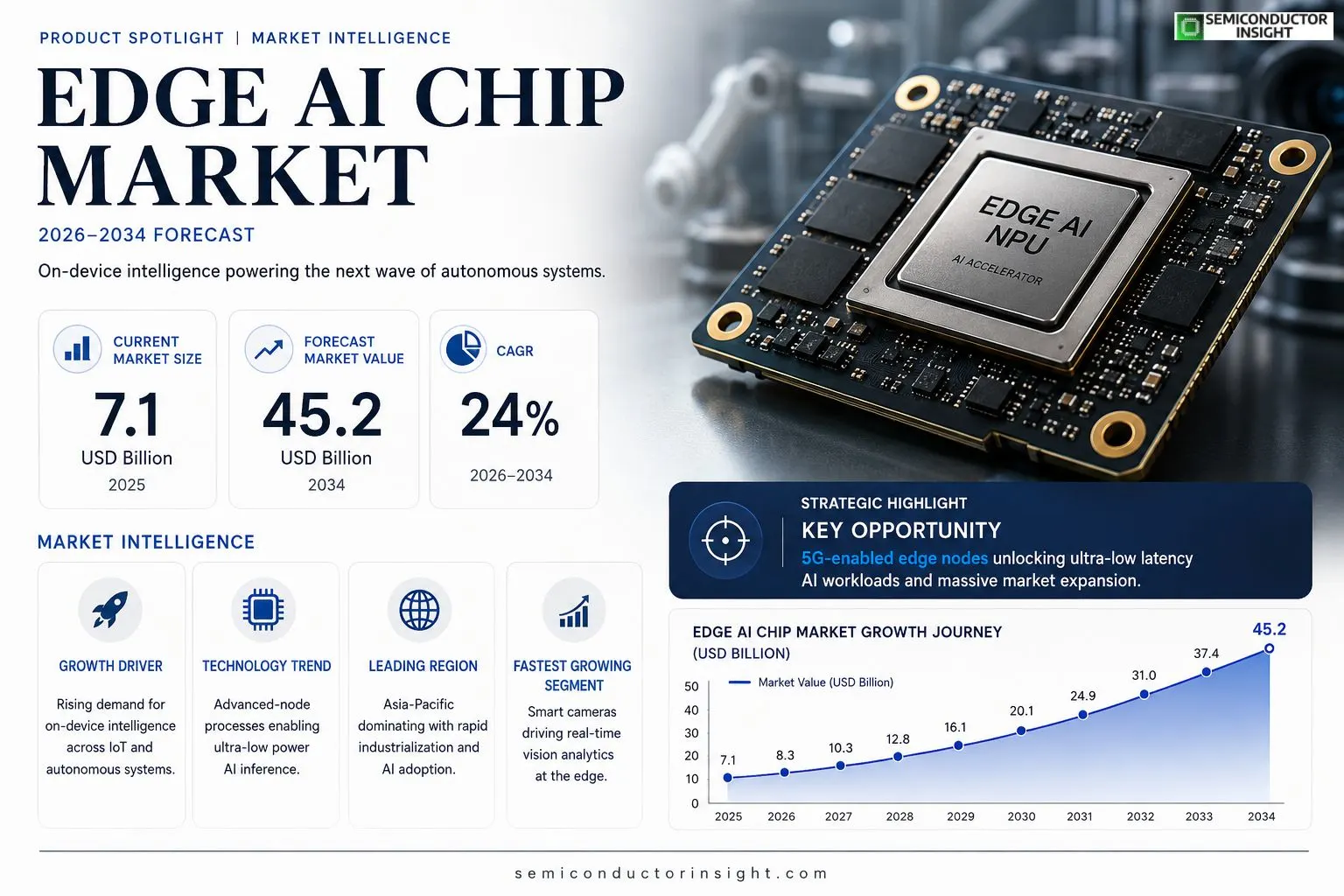
Edge AI Chip Market size was valued at USD 7.1 billion in 2025. The market is projected to grow from USD 8.3 billion in 2026 to USD 45.2 billion by 2034, exhibiting a CAGR of 24% during the forecast period.
Edge AI chips are specialized semiconductor devices that enable artificial‑intelligence inference directly on edge devices such as sensors, cameras, drones, and industrial controllers. These chips integrate low‑power neural‑network accelerators, heterogeneous compute units, and on‑chip memory optimized for real‑time processing while minimizing latency and bandwidth consumption.The market is experiencing rapid growth because enterprises are investing heavily in autonomous systems, smart manufacturing, and IoT deployments that demand on‑device intelligence. Furthermore, advancements in fabrication technologies,such as advanced‑node processes and heterogeneous integration,are reducing power envelopes while boosting performance per watt. Leading vendors including NVIDIA, Qualcomm, Intel, and Arm are expanding their portfolios through strategic partnerships and acquisitions, further accelerating adoption across sectors.
MARKET DRIVERS
Rising Demand for On‑Device Intelligence
Edge AI Chip Market is being propelled by the exponential growth of IoT devices that require real‑time analytics without relying on cloud latency. Enterprises are adopting edge processing to reduce bandwidth costs and improve data privacy.
Advancements in Low‑Power Architecture
Recent breakthroughs in sub‑10‑nanometer processes enable chips to deliver AI inference at milliwatt power levels, making them suitable for battery‑operated sensors and wearables. This technical progress expands the addressable market across automotive, healthcare, and smart‑city segments.
➤ “Edge‑optimized silicon now matches cloud‑level accuracy while consuming a fraction of the power.”
Furthermore, manufacturers are integrating heterogeneous compute blocks,CPU, GPU, NPU,on a single die, which accelerates time‑to‑market for AI‑enabled products and reinforces the growth trajectory of the market.
MARKET CHALLENGES
Complexity of Software Stacks
Developers face steep learning curves when porting deep‑learning models to diverse edge hardware, limiting adoption despite hardware availability. The need for unified toolchains remains a critical barrier.
Other Challenges
Security Concerns
Deploying AI at the edge introduces new attack surfaces; safeguarding models against tampering and data leakage is a pressing issue that can slow procurement cycles.
MARKET RESTRAINTS
High Initial Capital Expenditure
Organizations must invest in specialized design services and verification tools, which can be prohibitively expensive for small‑to‑mid‑size enterprises.Limited economies of scale for niche edge AI chips keep unit costs above those of generic microcontrollers, discouraging broad substitution.Regulatory compliance for safety‑critical applications, such as autonomous vehicles, adds additional validation steps that extend time‑to‑revenue.
MARKET OPPORTUNITIES
Expansion into 5G‑Enabled Edge Nodes
The rollout of 5G networks creates ultra‑low‑latency backhaul, enabling more sophisticated AI workloads at the edge. Vendors that align chip designs with 5G MEC (Multi‑Access Edge Computing) standards stand to capture significant share.AI‑driven predictive maintenance in industrial automation presents a sizable opportunity, as firms seek to minimize downtime through on‑site anomaly detection.Emerging verticals such as augmented reality eyewear and smart agriculture demand compact, power‑efficient AI chips, opening new revenue streams for early movers.
Edge AI Chip Market Trends
Accelerating Adoption in Autonomous Systems
Edge AI Chip Market is witnessing a swift shift as enterprises prioritize on‑device intelligence for autonomous vehicles, drones, and smart factories. By embedding neural‑network accelerators directly into edge devices, manufacturers reduce latency to milliseconds, enabling real‑time decision making without reliance on cloud connectivity. This architectural shift supports critical workloads such as object detection, predictive maintenance, and adaptive routing, where immediate response is essential. The convergence of low‑power design and heterogeneous compute units allows chips to operate within tight thermal envelopes while delivering performance comparable to traditional server‑grade processors. Consequently, organizations are reallocating capital from centralized AI clusters to distributed edge deployments, fostering a more resilient and scalable AI ecosystem.
Other Trends
Advancements in Low‑Power Architecture
Recent breakthroughs in semiconductor fabrication,particularly advanced‑node processes and 3D heterogeneous integration,have markedly lowered the power envelope of Edge AI chips. Manufacturers now achieve several tera‑ops per watt, a metric that directly translates to longer battery life for mobile sensors and reduced operational costs for industrial controllers. Coupled with on‑chip memory optimizations, these chips minimize data movement, cutting bandwidth demands and further conserving energy. The result is a new class of edge processors capable of sustaining continuous AI inference in remote or off‑grid locations, expanding the viable use cases for edge AI across logistics, agriculture, and environmental monitoring.
Strategic Partnerships Expand Ecosystem
Key players such as NVIDIA, Qualcomm, Intel, and Arm are amplifying their market presence through strategic alliances and targeted acquisitions. By integrating proprietary AI frameworks, software stacks, and reference designs, these vendors streamline the development cycle for OEMs and system integrators. Collaborative programs with cloud providers and edge platform specialists further bridge the gap between centralized training models and localized inference execution. This ecosystem consolidation accelerates time‑to‑market for new edge solutions, drives standardization of interfaces, and encourages a broader developer community to contribute optimized algorithms. As a result, Edge AI Chip Market is poised for sustained growth, driven by both technological innovation and a cohesive partner network.
COMPETITIVE LANDSCAPEKey Industry Players
Edge AI Chip Market – Competitive Overview and Growth Drivers
Edge AI Chip Market is dominated by a handful of large semiconductor firms that leverage extensive R&D budgets, advanced node fabs, and deep learning software ecosystems. NVIDIA leads with its Jetson family, offering GPU‑accelerated inference that balances performance and power for autonomous vehicles and robotics. Qualcomm’s Snapdragon Neural Processing Engine extends AI capabilities to smartphones and IoT gateways, while Intel’s OpenVINO‑optimized Xeon and Movidius lineups provide heterogeneous compute for industrial edge nodes. Arm’s architecture‑based designs, embodied in the Ethos series, supply a royalty‑based model that enables a broad spectrum of OEMs to integrate low‑power AI accelerators. These incumbents shape market structure through strategic acquisitions,such as Intel’s purchase of Habana Labs,and partnerships that embed AI inference directly into silicon, driving the forecasted CAGR of 24 % toward 2034.Beyond the tier‑one vendors, a vibrant set of niche players is expanding the functional envelope of edge AI. Graphcore’s IPU delivers fine‑grained parallelism for vision‑centric workloads, while Mythic’s analog compute chips promise sub‑100 mW power envelopes for always‑on sensors. Cerebras Systems introduced wafer‑scale engines that bring data‑center performance to edge servers, and Syntiant focuses on ultra‑low‑power audio classification. Emerging contributors such as MediaTek, Samsung Electronics, and NXP Semiconductors are integrating AI blocks into system‑on‑chips for consumer and automotive applications, whereas Chinese manufacturer Huawei (HiSilicon) continues to develop Kirin‑based AI processors despite geopolitical constraints. This diversified ecosystem intensifies competition and fuels rapid innovation across performance, power efficiency, and software stack integration.
List of Key Edge AI Chip Companies Profiled
- NVIDIA
- Qualcomm
- Intel
- Arm
- Google (Tensor)
- Apple (Neural Engine)
- Samsung Electronics
- MediaTek
- AMD (Xilinx)
- Texas Instruments
- Huawei (HiSilicon)
- Graphcore
- Cerebras Systems
- Mythic
- Syntiant
- NXP Semiconductors
Segment Analysis:
| Segment Category | Sub-Segments | Key Insights |
| By Type |
|
ASICs for Edge AI dominate this category because they deliver the highest inference performance per watt and can be tightly integrated with on‑chip memory.
|
| By Application |
|
Smart cameras have emerged as the leading application segment, driven by the need for on‑device vision processing.
|
| By End User |
|
Manufacturing is the dominant end‑user, where edge intelligence drives predictive maintenance and quality control.
|
| By Architecture |
|
Heterogeneous integration leads this architectural category, combining CPU, GPU, and dedicated accelerators on a single die.
|
| By Deployment Scenario |
|
On‑device processing is the most compelling scenario, allowing AI inference to occur directly within the endpoint.
|
Regional Analysis: North America
North America
The automotive sector is at the forefront of Edge AI Chip Market adoption, utilizing these chips for advanced driver-assistance systems (ADAS) and autonomous driving capabilities. The need for low-latency and high-performance processing is driving demand for specialized Edge AI Chip Market solutions in this segment.
Industrial automation is increasingly leveraging Edge AI Chip Market technology for predictive maintenance, quality control, and process optimization. The ability to analyze data locally enables faster decision-making and improved operational efficiency within Edge AI Chip Market.
The healthcare industry is employing Edge AI Chip Market solutions for medical imaging analysis, patient monitoring, and drug discovery. The emphasis on data privacy and real-time insights makes Edge AI Chip Market a crucial component in modern healthcare applications.
Retail and logistics are benefiting from Edge AI Chip Market applications such as inventory management, customer analytics, and supply chain optimization. Real-time processing at the edge enables quicker responses to changing market demands within Edge AI Chip Market.
North America
The North American Edge AI Chip Market is characterized by strong venture capital funding for startups developing innovative edge computing solutions. Key players in Edge AI Chip Market are focusing on developing energy-efficient and secure chips tailored for various applications. The competitive landscape is evolving rapidly, with both established semiconductor companies and emerging players vying for market share. Strategic partnerships between chip manufacturers and software providers are becoming increasingly common to deliver comprehensive edge AI solutions. The focus on data sovereignty and compliance with privacy regulations further shapes business strategies in Edge AI Chip Market within North America.
Europe
Europe’s Edge AI Chip Market is driven by the automotive and industrial sectors, with a strong emphasis on data privacy and security. Government initiatives supporting digital transformation and technological innovation are fostering growth in this region. While the pace of adoption may be slightly slower compared to North America, Europe presents a significant long-term opportunity for Edge AI Chip Market vendors. The focus on sustainable technologies also creates opportunities for energy-efficient Edge AI Chip Market solutions.
Asia-Pacific
Asia-Pacific is poised to become the largest Edge AI Chip Market in the coming years, driven by rapid industrialization and increasing adoption of AI across various industries. China, in particular, is investing heavily in edge AI infrastructure and chip development. The region’s large consumer base and growing digital economy present significant growth potential for Edge AI Chip Market players. However, navigating the complex regulatory landscape in different Asian countries is a key challenge for businesses in Edge AI Chip Market.
South America
Edge AI Chip Market in South America is still in its early stages of development but shows promising growth potential. The increasing adoption of IoT devices and the growing demand for industrial automation are key drivers. The region’s focus on resource management and agricultural optimization presents unique opportunities for Edge AI Chip Market applications. Addressing the infrastructure challenges and fostering local talent are crucial for sustained growth in Edge AI Chip Market.
Middle East & Africa
Edge AI Chip Market in the Middle East & Africa is experiencing steady growth, driven by investments in smart cities, oil and gas automation, and healthcare technology. The region’s focus on digital transformation and technological advancement is creating new opportunities for Edge AI Chip Market vendors. The availability of skilled talent and supportive government policies are further contributing to the growth of Edge AI Chip Market in this region.
Report Scope
This market research report provides a comprehensive analysis of the Edge AI Chip Market , covering the forecast period 2026–2034. It offers detailed insights into market dynamics, technological advancements, competitive landscape, and key trends shaping the industry.
Key focus areas of the report include:
- Market Overview: The report begins with an overview outlining its current market scenario, key growth indicators, and industry transformation drivers. It discusses macroeconomic factors, demand–supply balance, regulatory landscape, and the strategic role of semiconductors in powering advancements across industries such as automotive, telecommunications, consumer electronics, and industrial automation.
- Market Size & Forecast: Historical data and future projections for revenue, unit shipments, and market value across major regions and segments.
- Segmentation Analysis: Detailed breakdown by product type, technology, application, and end-user industry to identify high-growth segments and investment opportunities.
- Regional Insights: Insights into market performance across North America, Europe, Asia-Pacific, Latin America, and the Middle East & Africa, including country-level analysis where relevant.
- Competitive Landscape: Profiles of leading market participants, including their product offerings, R&D focus, manufacturing capacity, pricing strategies, and recent developments such as mergers, acquisitions, and partnerships.
- Technology Trends & Innovation: Assessment of emerging technologies, integration of AI/IoT, semiconductor design trends, fabrication techniques, and evolving industry standards.
- Market Drivers & Restraints: Evaluation of factors driving market growth along with challenges, supply chain constraints, regulatory issues, and market-entry barriers.
- Stakeholder Insights: Insights for component suppliers, OEMs, system integrators, investors, and policymakers regarding the evolving ecosystem and strategic opportunities.
Primary and secondary research methods are employed, including interviews with industry experts, data from verified sources, and real-time market intelligence to ensure the accuracy and reliability of the insights presented.
FREQUENTLY ASKED QUESTIONS:
What is the current market size of Edge AI Chip Market?
-> Edge AI Chip Market was valued at USD 7.1 billion in 2025 and is expected to reach USD 45.2 billion by 2034, reflecting a robust growth trajectory.
Which key companies operate in Edge AI Chip Market?
-> Key players include NVIDIA, Qualcomm, Intel, and Arm, among others, driving innovation through advanced AI accelerators and strategic partnerships.
What are the key growth drivers?
-> Key growth drivers include autonomous systems, smart manufacturing, and expanding IoT deployments that require on‑device intelligence.
Which region dominates the market?
-> Asia-Pacific is emerging as the fastest‑growing region, while North America maintains a strong lead in revenue share.
What are the emerging trends?
-> Emerging trends include advanced‑node semiconductor processes, heterogeneous integration, and low‑power neural‑network accelerators optimized for edge inference.
What is the projected CAGR for the forecast period?
-> The market is projected to grow at a CAGR of 24% from 2026 to 2034.

Get Sample Report PDF for Exclusive Insights
Report Sample Includes
- Table of Contents
- List of Tables & Figures
- Charts, Research Methodology, and more...
 Download Sample Report PDF