Consumer Electronics RF Modules Market Insights
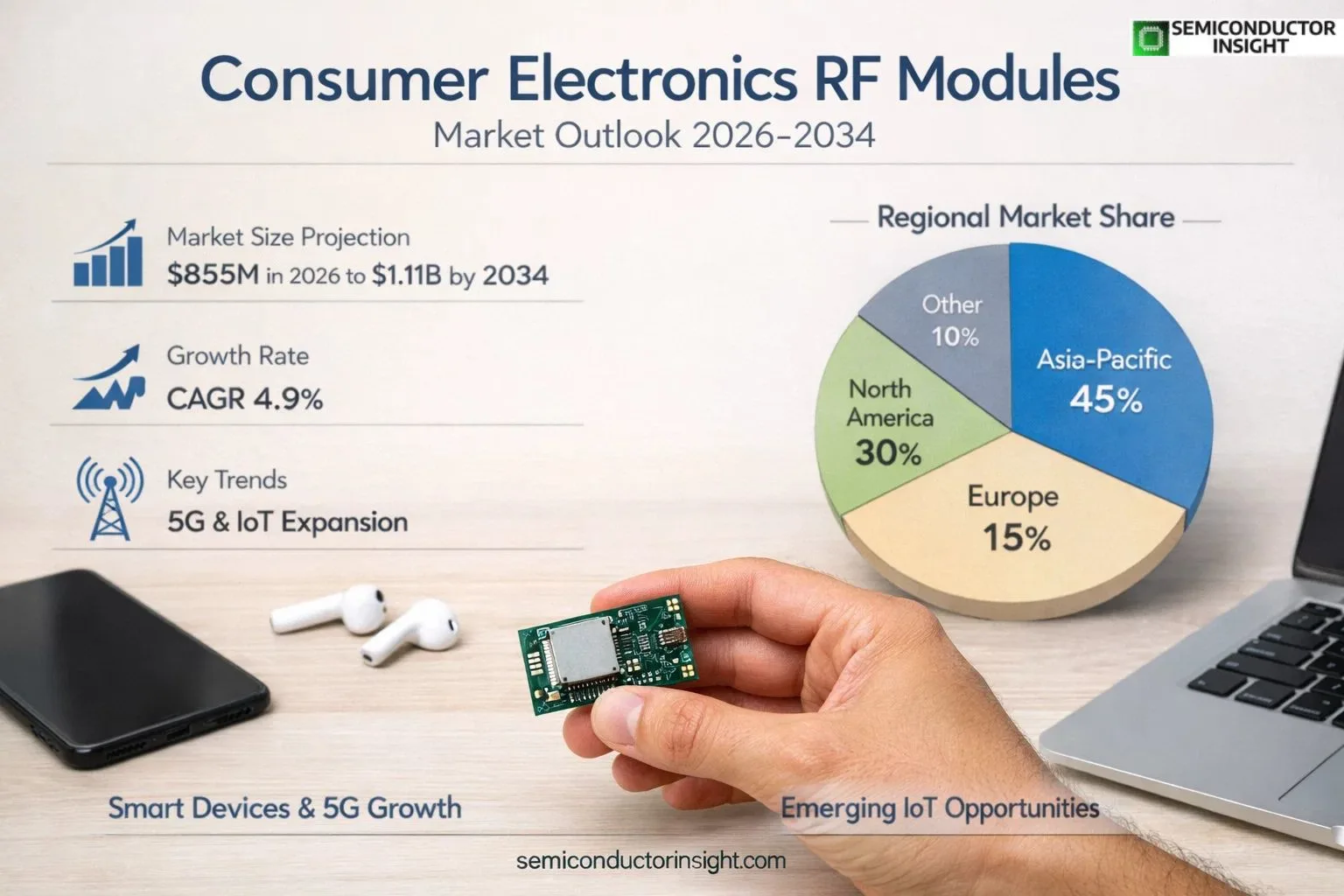
Global Consumer Electronics RF Modules market size was valued at USD 817 million in 2025. The market is projected to grow from USD 855 million in 2026 to USD 1,114 million by 2034, exhibiting a CAGR of 4.9% during the forecast period.
Consumer electronics RF modules are essential components used in wireless communication devices to convert radio frequency signals into digital signals and vice versa. These modules play a critical role in enabling seamless connectivity in devices such as smartphones, tablets, laptops, wearables, and IoT-enabled gadgets. The increasing demand for high-speed data transmission and the proliferation of smart devices are driving market growth.
The market expansion is further supported by advancements in wireless technologies like 5G and Wi-Fi 6, which require sophisticated RF modules for optimal performance. Key players such as Skyworks Solutions, Qualcomm, and Qorvo dominate the industry with innovative product offerings tailored for next-generation consumer electronics.
MARKET DRIVERS
Proliferation of Smart Home Devices
Consumer Electronics RF Modules Market is experiencing significant growth driven by the rapid adoption of smart home devices. Over 60% of households in developed markets now use at least one smart home product requiring RF connectivity. IoT integration in lighting, security, and appliances continues to create demand for reliable RF module solutions.
Advancements in Wireless Technologies
Technological innovations like Bluetooth 5.2 and Wi-Fi 6 have expanded capabilities for Consumer Electronics RF Modules, enabling faster data transfer rates and improved power efficiency. Manufacturers are developing modules that support multiple protocols to address diverse connectivity needs across Consumer electronics landscape.
➤ Global market for RF modules in consumer electronics is projected to maintain a 7.8% CAGR through 2028, driven by these technological and market factors.
5G network expansion is creating new requirements for RF front-end modules in consumer devices, particularly for smartphones and tablets that need to maintain backward compatibility with existing networks while supporting next-generation connectivity.
MARKET CHALLENGES
Design Complexity and Miniaturization
Consumer Electronics RF Modules Market faces technical challenges in meeting the shrinking form factor requirements of modern devices while maintaining performance. The need to integrate multiple RF technologies (cellular, Wi-Fi, Bluetooth, NFC) into single modules increases design complexity and testing requirements.
Other Challenges
Certification Requirements
Navigating global regulatory certifications for RF modules adds substantial time and cost to product development cycles, with different regions having varying compliance standards for radio frequency emissions.
MARKET RESTRAINTS
Price Sensitivity in Consumer Electronics
Consumer Electronics RF Modules Market faces margin pressures as OEMs demand lower-cost solutions to remain competitive in price-sensitive end markets. This is particularly evident in mid-range smartphones and IoT devices where component costs directly impact final product pricing.
MARKET OPPORTUNITIES
Emerging AR/VR Applications
The growing augmented and virtual reality market presents new opportunities for specialized Consumer Electronics RF Modules that can support low-latency, high-bandwidth wireless connections for headsets and related peripherals. Industry forecasts predict AR/VR hardware shipments will exceed 50 million units annually by 2026.
Consumer Electronics RF Modules Market Trends
5G Adoption Accelerating RF Module Demand
The rollout of 5G networks globally has significantly increased demand for advanced RF modules in smartphones and IoT devices. Manufacturers are developing compact, high-efficiency modules that support multiple frequency bands while minimizing power consumption. This trend is particularly evident in flagship smartphones requiring enhanced connectivity features.
Other Trends
Integration of AI Processing in RF Modules
Leading semiconductor companies are incorporating AI capabilities directly into RF modules to enable real-time signal optimization. This improves wireless performance while reducing latency in applications like AR/VR devices and smart home systems. The integration also allows for predictive maintenance in industrial IoT deployments.
Growing Demand for Miniaturized RF Solutions
Consumer electronics industry continues pushing for smaller form factors, driving innovation in system-in-package (SiP) and system-on-chip (SoC) RF solutions. Wearable devices and hearables particularly benefit from these advancements, with module sizes shrinking by 30% compared to 2022 designs while maintaining performance.
Expansion of Wi-Fi 6/6E Modules
The transition to Wi-Fi 6 standards has created new opportunities for RF module vendors, with shipments increasing by 47% year-over-year. Smart home devices and enterprise networking equipment represent the fastest-growing segments adopting these modules for improved throughput and reduced interference.
Supply Chain Diversification Strategies
Major RF module manufacturers are establishing production facilities across multiple regions to mitigate geopolitical risks. This includes expanding capacity in Southeast Asia and North America to complement existing operations in traditional manufacturing hubs.
COMPETITIVE LANDSCAPE
Key Industry Players
Consolidated Market with Top 5 Players Holding Significant Share
Consumer electronics RF modules market is dominated by established semiconductor giants, with Skyworks Solutions, Qualcomm, and Qorvo collectively holding substantial market share. Skyworks Solutions leads in analog semiconductor solutions for RF modules, particularly excelling in power amplifier modules for smartphones. Qualcomm maintains dominance through its integrated RF-front end solutions bundled with Snapdragon platforms, while Qorvo specializes in high-performance RF systems with strong positioning in Wi-Fi 6/6E modules.
Several Japanese and European companies are strengthening their positions through specialized RF module solutions. Murata Manufacturing leads in miniaturized RF modules for compact consumer devices, while Infineon Technologies has made significant advancements in 5G RF solutions. Niche players like Maxscend have gained traction in emerging markets through cost-competitive offerings, particularly for mid-range mobile devices.
List of Key Consumer Electronics RF Modules Companies Profiled
- Skyworks Solutions
- Qualcomm Technologies
- Infineon Technologies
- Qorvo
- NXP Semiconductors
- Broadcom
- Murata Manufacturing
- Digi International
- Texas Instruments
- Maxscend Technologies
- Unictron Technologies
- Taiyo Yuden
- Samsung Electro-Mechanics
- Tongyu Communication
- Vanchip Technologies
Segment Analysis:
| Segment Category | Sub-Segments | Key Insights |
| By Type |
|
PA Module dominates the type segment due to:
|
| By Application |
|
Mobile Phone application leads due to:
|
| By End User |
|
Consumer Electronics OEMs represent the primary end users because:
|
| By Technology Generation |
|
5G NR Modules show strongest growth potential as:
|
| By Integration Level |
|
Integrated RF Front-End solutions gain traction due to:
|
Regional Analysis: Consumer Electronics RF Modules Market
Asia-Pacific
Asia-Pacific’s mature semiconductor infrastructure enables vertically integrated RF module production from wafer fabrication to final testing, reducing time-to-market for consumer electronics manufacturers requiring customized RF solutions.
Early nationwide 5G rollouts across Asia-Pacific create demand for premium RF front-end modules capable of supporting millimeter wave frequencies and advanced beamforming techniques in flagship mobile devices.
High-density urban populations and tech-savvy consumers drive rapid adoption of RF-enabled smart home devices, particularly in markets like South Korea and Japan where automation penetration exceeds global averages.
Progressive spectrum allocation strategies for IoT applications across APAC countries enable RF module manufacturers to standardize designs for regional markets while meeting local certification requirements.
North America
The North American Consumer Electronics RF Modules Market thrives on premium device demand and early adoption of advanced wireless technologies. Major tech companies in Silicon Valley drive innovation in RF system-on-chip designs, particularly for high-performance WiFi 6E and Ultra-Wideband applications. The region’s stringent FCC regulations shape RF module development priorities, emphasizing interference mitigation in crowded frequency bands. Enterprise adoption of industrial IoT solutions creates specialized demand for ruggedized RF modules optimized for manufacturing environments across the U.S. and Canada.
Europe
Europe’s Consumer Electronics RF Modules Market emphasizes energy efficiency and compliance with RED directives governing wireless device emissions. German automotive electronics manufacturers integrate sophisticated RF modules for connected car infotainment systems. The region shows strong demand for sub-GHz RF solutions supporting long-range IoT applications in smart cities, with strict EU spectrum harmonization policies encouraging standardized module designs across member states.
South America
Emerging as a growth market, South America’s RF module adoption focuses on cost-optimized solutions for entry-level smartphones and basic IoT devices. Brazil leads regional demand, with local assembly operations requiring RF modules compatible with Anatel certification standards. The expanding middle class drives adoption of wireless consumer electronics, though market growth faces challenges from import restrictions on electronic components in several countries.
Middle East & Africa
The MEA region shows diversification in Consumer Electronics RF Modules Market demand, with Gulf countries adopting premium 5G-capable modules while African markets prioritize affordable 2.4GHz solutions. Smart city initiatives in UAE and Saudi Arabia create specialized demand for mesh networking RF modules, while South Africa emerges as a regional hub for electronics manufacturing requiring localization of RF component designs.
Report Scope
This market research report provides a comprehensive analysis of Consumer Electronics RF Modules Market, covering the forecast period 2026–2034. It offers detailed insights into market dynamics, technological advancements, competitive landscape, and key trends shaping the industry.
Key focus areas of the report include:
- Market Overview: The report begins with an overview outlining its current market scenario, key growth indicators, and industry transformation drivers. It discusses macroeconomic factors, demand–supply balance, regulatory landscape, and the strategic role of semiconductors in powering advancements across industries such as automotive, telecommunications, consumer electronics, and industrial automation.
- Market Size & Forecast: Historical data and future projections for revenue, unit shipments, and market value across major regions and segments.
- Segmentation Analysis: Detailed breakdown by product type, technology, application, and end-user industry to identify high-growth segments and investment opportunities.
- Regional Insights: Insights into market performance across North America, Europe, Asia-Pacific, Latin America, and the Middle East & Africa, including country-level analysis where relevant.
- Competitive Landscape: Profiles of leading market participants, including their product offerings, R&D focus, manufacturing capacity, pricing strategies, and recent developments such as mergers, acquisitions, and partnerships.
- Technology Trends & Innovation: Assessment of emerging technologies, integration of AI/IoT, semiconductor design trends, fabrication techniques, and evolving industry standards.
- Market Drivers & Restraints: Evaluation of factors driving market growth along with challenges, supply chain constraints, regulatory issues, and market-entry barriers.
- Stakeholder Insights: Insights for component suppliers, OEMs, system integrators, investors, and policymakers regarding the evolving ecosystem and strategic opportunities.
Primary and secondary research methods are employed, including interviews with industry experts, data from verified sources, and real-time market intelligence to ensure the accuracy and reliability of the insights presented.
FREQUENTLY ASKED QUESTIONS:
What is the current market size of Consumer Electronics RF Modules Market?
-> Consumer Electronics RF Modules Market was valued at USD 817 million in 2025 and is expected to reach USD 1114 million by 2034 at a CAGR of 4.9% during the forecast period.
Which key companies operate in Consumer Electronics RF Modules Market?
-> Key players include Skyworks Solutions, Qualcomm, Infineon Technologies, Qorvo, NXP Semiconductors, Broadcom, Murata Manufacturing, Digi International, Vegas, and Maxscend, among others.
What are the key growth drivers?
-> Key growth drivers include expanding wireless communication needs, proliferation of mobile devices, and increasing adoption of IoT technologies.
Which region dominates the market?
-> Asia remains the fastest-growing region, driven by strong demand from China, while North America holds a significant market share.
What are the emerging trends?
-> Emerging trends include advancements in 5G RF modules, integration of AI in wireless modules, and miniaturization of components.

Get Sample Report PDF for Exclusive Insights
Report Sample Includes
- Table of Contents
- List of Tables & Figures
- Charts, Research Methodology, and more...
 Download Sample Report PDF