Bluetooth Headphones Chips Market Insights
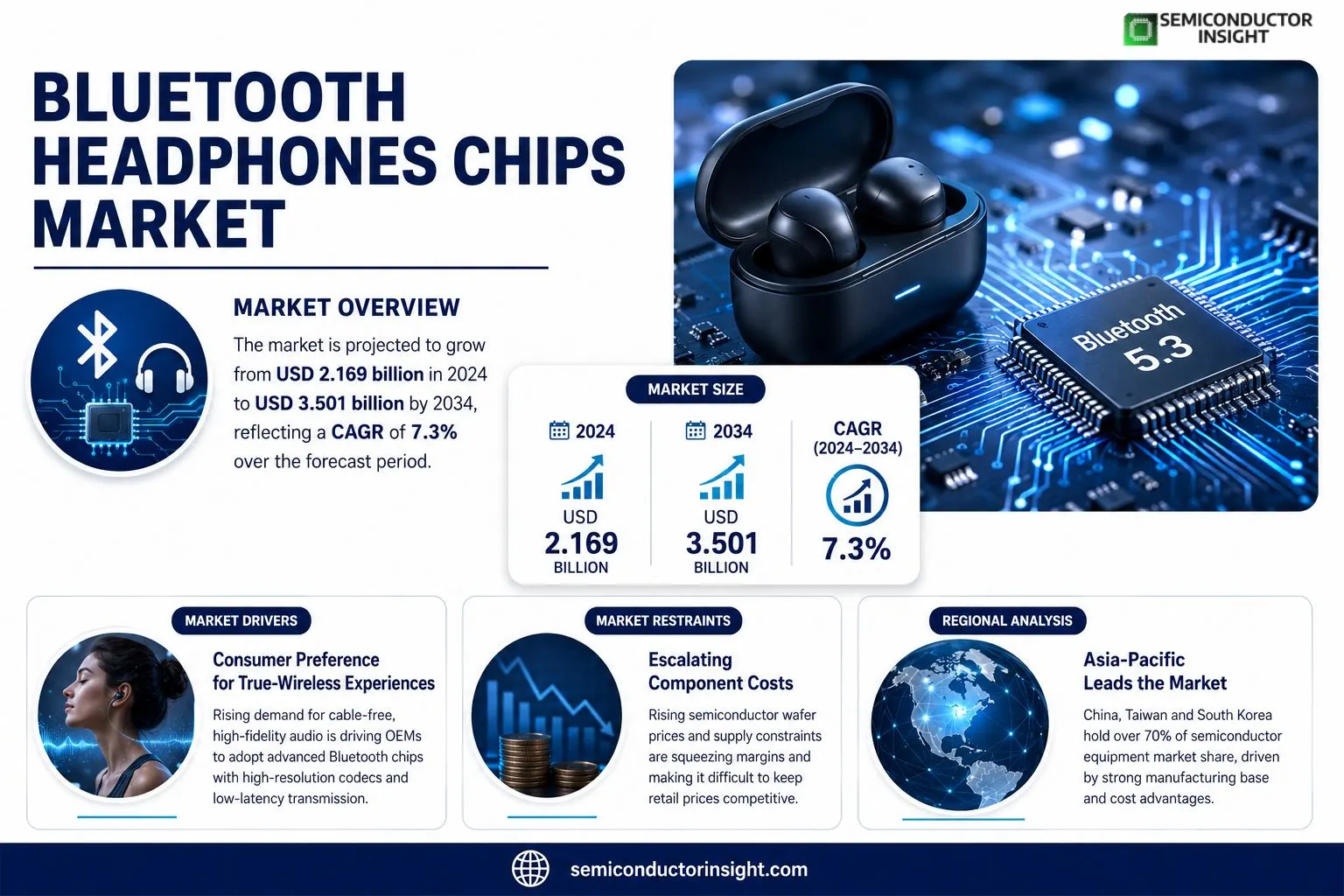
Bluetooth Headphones Chips market size was valued at USD 2.169 billion in 2024 and is forecasted to reach USD 3.501 billion by 2034, reflecting a CAGR of 7.3 % over the period.
Bluetooth chips are integrated circuits that enable short‑range wireless links in equipment such as computers, smartphones, keyboards and headphones. Within headphonesparticularly high‑end modelsBluetooth Headphones Chips act as the central element for audio streaming, power regulation and protocol handling.The broader semiconductor ecosystem underpins this growth; in 2022 semiconductor equipment sales totaled USD 109 billion. China mainland, Taiwan and South Korea together command more than 70 % of that market, while North America, Europe and Japan account for roughly 23 %. Key enablers include high‑performance computing, artificial‑intelligence workloads, cloud services, server demand, rollout of 5G networks and expanding electric‑vehicle connectivity.
MARKET DRIVERS
Consumer Preference for True‑Wireless Experiences
Listeners increasingly expect their headphones to operate without cables while delivering studio‑grade fidelity. This shift forces OEMs to embed more capable Bluetooth chips that can handle high‑resolution codecs and low‑latency transmission. As a result, the Bluetooth Headphones Chips Market is seeing a steady influx of new product launches designed to meet these expectations.
Integration of Voice Assistants and IoT Ecosystems
Manufacturers are bundling voice‑assistant functionality directly into the audio hardware, which requires chips with dedicated DSP cores and secure wake‑word detection. The convergence of wearables, smart homes, and mobile devices creates a compelling use case for chips that can act as a bridge across these environments. Companies that can deliver seamless cross‑platform connectivity gain a competitive edge.
➤ “Each new generation of Bluetooth chipset reduces power draw by roughly 15%, extending battery life and unlocking longer listening sessions for end‑users.”
Energy efficiency improvements translate into tangible market benefit: longer battery life reduces return rates and enhances brand perception. Chipmakers that prioritize low‑power architectures are positioning themselves to capture a larger share of the Bluetooth Headphones Chips Market.
MARKET CHALLENGES
Escalating Component Costs
supply constraints for semiconductor wafers have nudged pricing upward, pressuring marginal profit on headphones that compete primarily on price. Manufacturers must balance the cost of advanced Bluetooth modules with the need to keep retail prices attractive, a dilemma that can stall adoption of next‑gen features.
Other Challenges
Regulatory Fragmentation
Different regions enforce varying Bluetooth certification standards, complicating the rollout of a single chip design worldwide. Navigating these regulatory nuances adds development overhead and prolongs time‑to‑market.
MARKET RESTRAINTS
Limited Differentiation at the Chip Level
Beyond supporting the latest codecs, many Bluetooth chips offer comparable performance metrics. When the hardware advantage narrows, brand differentiation shifts to software and design, which may diminish the incentive for premium chip pricing.
Supply‑Chain Vulnerabilities
Geopolitical tensions and pandemic‑related factory shutdowns have exposed the fragility of single‑source semiconductor supply chains. Disruptions can lead to inventory shortages for headphone manufacturers, curtailing the volume of chips sold and restraining market momentum.
MARKET OPPORTUNITIES
Emerging Audio‑First Gaming Segment
Gamers are demanding ultra‑low‑latency Bluetooth solutions that can keep pace with fast‑action titles. Chip providers that can certify sub‑30 ms latency while preserving high‑fidelity sound stand to tap a rapidly expanding niche within the Bluetooth Headphones Chips Market.
Customization through Software‑Defined Radio (SDR)
SDR technology enables manufacturers to update Bluetooth profiles post‑production, offering flexibility to adapt to new codecs or regulatory changes without hardware redesign. This capability opens a recurring‑revenue model for chip vendors and gives headphone brands a roadmap for continual product improvement.
Bluetooth Headphones Chips Market Trends
Shift Toward Dual‑Mode and Low‑Energy Architectures
The Bluetooth Headphones Chips Market is seeing a decisive move away from single‑mode solutions toward dual‑mode chips that combine classic Bluetooth Classic with Bluetooth Low Energy (BLE) in a single die. This migration is fueled by premium headphone manufacturers demanding seamless audio streaming while preserving battery life for voice‑assistant interactions. Integrating BLE 5.3 enables faster pairing, higher‑throughput music channels, and more reliable coexistence with adjacent wireless standards such as Wi‑Fi 6E. As a result, chip designers are allocating more silicon area to advanced power‑management blocks and pairing algorithms, which compresses bill‑of‑materials while delivering richer user experiences.
Other Trends
Regional Supply‑Chain Concentration in East Asia
In the broader semiconductor ecosystem, China mainland, Taiwan and South Korea collectively hold well over 70 % of equipment market share, a pattern that mirrors the manufacturing footprint of Bluetooth Headphones Chips. This concentration grants manufacturers rapid access to cutting‑edge fab capacity and low‑cost assembly, yet it also creates exposure to geopolitical constraints and raw‑material bottlenecks. Companies that diversify packaging or adopt a fab‑less model coupled with strategic inventory buffers are better positioned to mitigate supply shocks and sustain pricing stability for OEMs across North America and Europe.
Emergence of True‑Wireless Stereo (TWS) Expansion
Consumer appetite for true‑wireless stereo earbuds has reshaped the Bluetooth Headphones Chips Market, prompting chip firms to embed multi‑channel audio codecs, enhanced echo‑cancellation, and adaptive noise‑reduction within a single package. The removal of a physical cable forces designers to resolve latency challenges and synchronize dual drivers in real time, which in turn drives adoption of integrated DSP cores. For market participants, the shift translates into higher R&D intensity but also opens premium pricing tiers, as manufacturers can differentiate their products through longer talk‑time, richer soundstage, and seamless transition between mono and stereo modes.
COMPETITIVE LANDSCAPE
Key Industry Players
Bluetooth Headphones Chips – Competitive Overview
Qualcomm continues to dominate the Bluetooth headphones‑chip arena, leveraging its extensive 5G and AI‑enabled SoC portfolio to embed high‑performance radio modules in premium ear‑bud lines. Its aggressive integration roadmap, coupled with strategic OEM alliances in North America and Europe, translates into a sizable share of the $3.5 billion market projected for 2034. MediaTek follows closely, differentiating through cost‑efficient dual‑mode solutions that appeal to fast‑fashion brands targeting the Asian consumer base. Broadcom’s niche lies in enterprise‑grade audio platforms where low‑latency streaming is paramount, while Apple’s in‑house silicon, although not disclosed as a separate supplier, shapes design specifications for its own ecosystem, indirectly influencing the broader supplier competition.Beyond the headline makers, a cluster of specialized firms fuels innovation in the TWS segment. Zhuhai Jieli Technology and Actions Technology concentrate on ultra‑compact single‑mode chips that enable sub‑10‑mm ear‑bud footprints, a critical factor for next‑generation invisible designs. Companies such as UNISO, Beken and Telink address the lower‑cost tier, offering scalable solutions for mass‑market earbuds sold through e‑commerce channels in Southeast Asia. Rockchip and Zgmicro Wuxi provide diversification for Chinese manufacturers seeking to reduce reliance on foreign IP, while Huawei’s chip‑division leverages its chipset expertise to create proprietary audio stacks for its own device line‑up. This mosaic of players sustains a competitive pressure that compels continuous performance gains and price optimisation across the value chain.
List of Key Bluetooth Headphones Chips Companies Profiled
- Qualcomm
- MediaTek
- Zhuhai Jieli Technology
- Actions Technology
- UNISO
- Apple
- Samsung
- Huawei
- Rockchip
- Bluetrum
- Broadcom
- Zgmicro Wuxi
- Bestechnic
- Beken
- Telink
Segment Analysis:
| Segment Category | Sub-Segments | Key Insights |
| By Type |
|
Dual‑Mode
|
| By Application |
|
TWS Bluetooth Headphones
|
| By End User |
|
Premium Consumers (Audiophiles)
|
| By Integration Level |
|
System‑on‑Chip (SoC) Solutions
|
| By Market Drivers |
|
AI‑augmented Audio Processing
|
Regional Analysis: Bluetooth Headphones Chips Market
North America
Localized fabs and strategic inventory buffers have become central to mitigating disruptions, allowing manufacturers to keep pace with fast‑changing design cycles while preserving cost structures.
The appetite for true‑wireless earbuds drives chip developers to embed advanced noise‑cancellation and adaptive equalization directly on silicon, reducing reliance on external DSP modules.
Stringent FCC guidelines on signal integrity compel vendors to adopt tighter testing regimes, which in turn raise the baseline quality of chips entering the market.
Partnerships between semiconductor firms and leading headphone brands accelerate time‑to‑market for next‑generation Bluetooth solutions, aligning product roadmaps across the value chain.
Europe
Europe’s Bluetooth Headphones Chips Market is defined by a fragmented supplier base that leverages strong design expertise across Germany, the UK, and France. Premium‑brand manufacturers in the region prioritize acoustic fidelity and secure wireless protocols, prompting chip producers to refine high‑definition audio codecs. Environmental directives encourage low‑power designs, nudging firms toward energy‑efficient architectures. The rising popularity of sport‑oriented wireless headphones among younger demographics adds pressure on chip developers to improve sweat‑resistance and rapid pairing features. Companies that can seamlessly integrate these capabilities while complying with EU safety standards are gaining a competitive edge.
Asia‑Pacific
In Asia‑Pacific, the market is propelled by rapid adoption of affordable wireless audio devices across China, India, and Southeast Asian economies. Manufacturers focus on cost‑effective silicon that still delivers acceptable latency and stable connections for mass‑market earbuds. The region’s intense price competition forces chip makers to optimize wafer yields and streamline packaging processes. Additionally, the proliferation of 5G and IoT ecosystems creates synergies, as Bluetooth modules increasingly share antenna resources with other wireless standards. Firms that balance price sensitivity with incremental performance upgrades are well placed to capture expanding user bases.
South America
South America presents a growing appetite for wireless audio, driven largely by Brazil and Argentina where mobile penetration remains high. Consumers favor versatile headphones that can transition between music streaming and voice‑assistant use, encouraging developers to embed multi‑profile support within chips. Limited local manufacturing capacity means many players rely on imports, making supply‑chain agility a decisive factor. Brands that secure reliable logistics and offer localized firmware updates are likely to strengthen market presence.
Middle East & Africa
The Middle East & Africa region shows a gradual shift from wired to wireless audio solutions, spurred by increasing disposable incomes and a youthful demographic eager for premium experiences. Retail channels emphasize brand storytelling, pushing chip suppliers to deliver modules that enable seamless firmware upgrades and robust connectivity in environments with variable network quality. Partnerships with regional distributors who understand nuanced market preferences are becoming critical for firms aiming to expand footholds across this diverse landscape.
Report Scope
This market research report provides a comprehensive analysis of the Bluetooth Headphones Chips Market , covering the forecast period 2026–2034. It offers detailed insights into market dynamics, technological advancements, competitive landscape, and key trends shaping the industry.
Key focus areas of the report include:
- Market Overview: The report begins with an overview outlining its current market scenario, key growth indicators, and industry transformation drivers. It discusses macroeconomic factors, demand–supply balance, regulatory landscape, and the strategic role of semiconductors in powering advancements across industries such as automotive, telecommunications, consumer electronics, and industrial automation.
- Market Size & Forecast: Historical data and future projections for revenue, unit shipments, and market value across major regions and segments.
- Segmentation Analysis: Detailed breakdown by product type, technology, application, and end-user industry to identify high-growth segments and investment opportunities.
- Regional Insights: Insights into market performance across North America, Europe, Asia-Pacific, Latin America, and the Middle East & Africa, including country-level analysis where relevant.
- Competitive Landscape: Profiles of leading market participants, including their product offerings, R&D focus, manufacturing capacity, pricing strategies, and recent developments such as mergers, acquisitions, and partnerships.
- Technology Trends & Innovation: Assessment of emerging technologies, integration of AI/IoT, semiconductor design trends, fabrication techniques, and evolving industry standards.
- Market Drivers & Restraints: Evaluation of factors driving market growth along with challenges, supply chain constraints, regulatory issues, and market-entry barriers.
- Stakeholder Insights: Insights for component suppliers, OEMs, system integrators, investors, and policymakers regarding the evolving ecosystem and strategic opportunities.
Primary and secondary research methods are employed, including interviews with industry experts, data from verified sources, and real-time market intelligence to ensure the accuracy and reliability of the insights presented.
FREQUENTLY ASKED QUESTIONS:
What is the current market size of Bluetooth Headphones Chips Market?
-> Bluetooth Headphones Chips Market was valued at USD 2,169 million in 2024 and is expected to reach USD 3,501 million by 2034, growing at a CAGR of 7.3% during the forecast period.
Which key companies operate in Bluetooth Headphones Chips Market?
-> Key players include Qualcomm, MediaTek, Zhuhai Jieli Technology, Actions Technology, UNISCO, Apple, Samsung, Huawei, Rockchip, Bluetrum, Broadcom, Zgmicro Wuxi, Bestechnic, Beken, Lenze Technology, Yichip, Telink.
What are the key growth drivers?
-> Key growth drivers include high‑performance computing, artificial intelligence, cloud computing, servers, 5G connectivity, and electric‑vehicle (EV) applications, all of which increase demand for advanced Bluetooth headphones chips in premium audio devices.
Which region dominates the market?
-> Asia dominates the market, with China mainland, Taiwan and South Korea together holding over 70% of semiconductor equipment market share, while North America, Europe and Japan account for about 23%.
What are the emerging trends?
-> Emerging trends include the shift toward dual‑mode and single‑mode chip architectures, growth of true‑wireless stereo (TWS) headphone applications, and increased integration of AI/IoT functionalities within Bluetooth chips.
Get Sample Report PDF for Exclusive Insights
Report Sample Includes
- Table of Contents
- List of Tables & Figures
- Charts, Research Methodology, and more...
 Download Sample Report PDF