Multi Channel Decoder Chip Market Insights
Global Multi Channel Decoder Chip market was valued at USD 2,152 million in 2025. The market is projected to reach USD 3,151 million by 2034, exhibiting a CAGR of 5.7% during the forecast period.
A multi-channel decoder chip is an integrated circuit that can simultaneously decode video or audio signals from multiple signal sources. This type of chip is typically designed for high-performance multimedia processing environments, supporting multi-channel input and real-time decoding, and is widely used in fields such as security monitoring, live streaming systems, intelligent transportation, and media servers.
The market is experiencing steady growth driven by expanding applications in surveillance systems and streaming media, alongside advancements in video codecs like H.264 and H.265. Rising deployments of smart transportation infrastructure further bolster demand. Key players such as Onsemi, Renesas, NXP, Fujitsu, Cirrus Logic, Texas Instruments, Diodes Incorporated, Realtek, Goodix, and Hunan Goke Microelectronics lead with robust portfolios, capturing significant market shares through continuous innovation
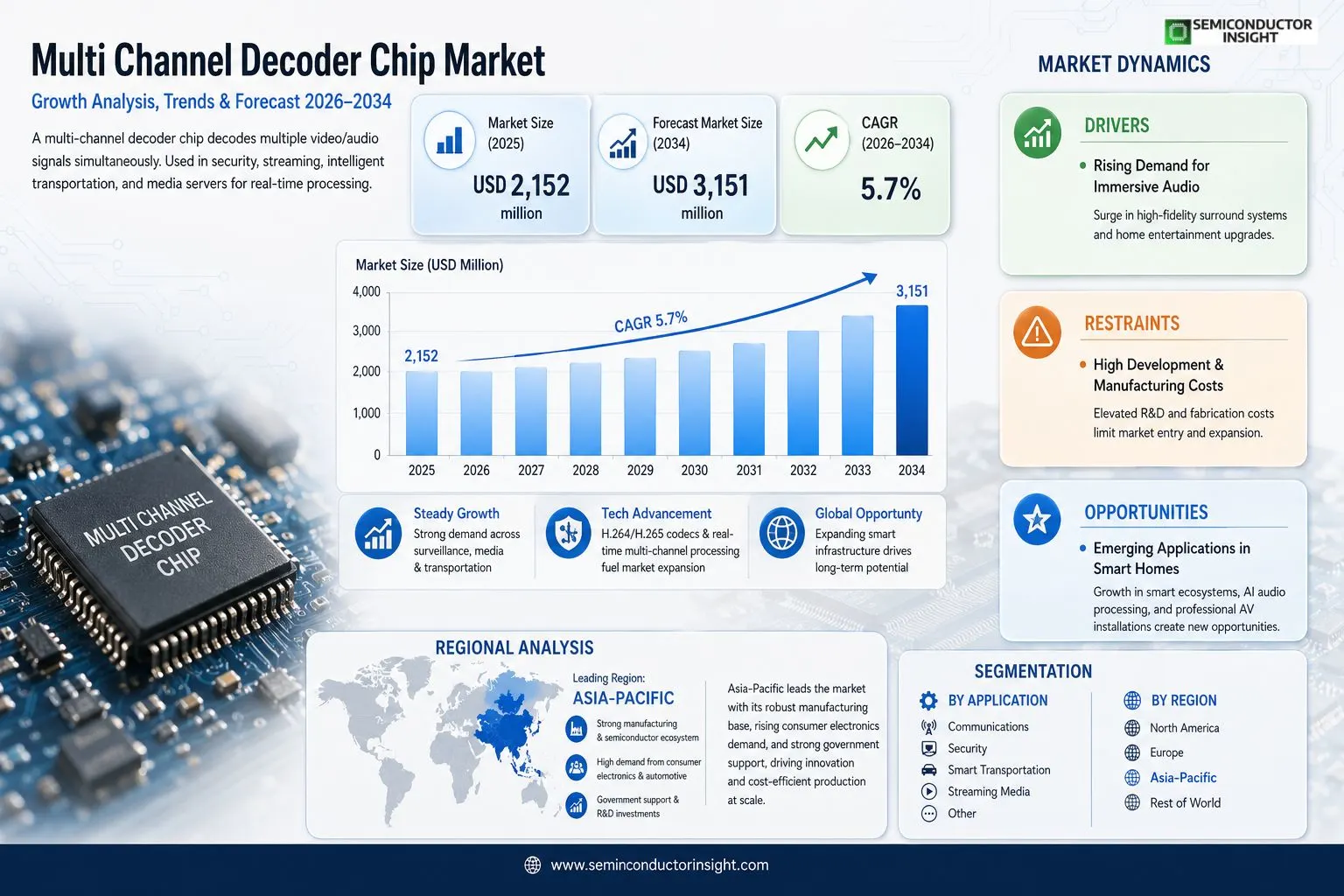
MARKET DRIVERS
Rising Demand for Immersive Audio
Multi Channel Decoder Chip Market is propelled by the surge in consumer preference for high-fidelity, surround sound systems in home entertainment setups. Technologies like Dolby Atmos and DTS:X require advanced decoding capabilities, driving chip demand as households upgrade to immersive audio solutions. Market growth is evident with the global home audio market expanding at a CAGR of 8.2% through 2028.
Expansion in Automotive Infotainment
Automotive sector integration of multi-channel audio enhances in-car experiences, with premium vehicles incorporating 20+ speaker systems. This fuels Multi Channel Decoder Chip Market, as manufacturers prioritize premium sound quality. Electric vehicle adoption further accelerates this, with over 15 million EVs projected by 2025 demanding efficient decoder chips.
➤ Consumer electronics sales reached $1.2 trillion in 2023, with audio decoders comprising a growing segment.
Streaming services and 4K/8K content proliferation necessitate robust decoding hardware, supporting Multi Channel Decoder Chip Market’s momentum. Innovations in low-latency processing align with gaming and VR applications, ensuring sustained driver influence.
MARKET CHALLENGES
Integration and Compatibility Issues
Multi Channel Decoder Chip Market faces hurdles in seamless integration with diverse platforms, including legacy systems and new IoT devices. Ensuring compatibility across protocols like HDMI 2.1 and IP-based audio strains development, leading to delays in product rollouts.
High power consumption in advanced chips poses thermal management challenges, particularly in compact devices like soundbars and portable speakers.
Other Challenges
Supply Chain Disruptions
Semiconductor shortages, exacerbated by geopolitical tensions, have increased lead times by 20-30% for Multi Channel Decoder Chip Market components, affecting OEM production schedules.Competition from software-based decoding solutions threatens hardware reliance, as cloud processing gains traction in budget segments.
MARKET RESTRAINTS
High Development and Manufacturing Costs
Elevated R&D expenses for fabricating nanoscale Multi Channel Decoder Chip Market components limit entry for smaller players. Costs have risen 15% annually due to advanced lithography needs, restraining market expansion in price-sensitive regions.Strict regulatory standards on electromagnetic compliance and energy efficiency impose additional testing burdens, slowing innovation cycles.Intellectual property disputes among key vendors like Cirrus Logic and Analog Devices create uncertainties, deterring investments in Multi Channel Decoder Chip Market.Maturing markets in developed economies show saturation, capping growth potential without diversification.
MARKET OPPORTUNITIES
Emerging Applications in Smart Homes
Multi Channel Decoder Chip Market stands to benefit from smart home ecosystems, where voice assistants and multi-room audio demand efficient decoding. Integration with Matter protocol could unlock a $50 billion opportunity by 2027.Adoption in professional AV installations for conferences and events offers growth, with the pro audio market projected to grow at 7.5% CAGR.Advancements in AI-enhanced audio processing open avenues for next-gen chips, improving spatial audio in Multi Channel Decoder Chip Market for AR/VR headsets.Expansion into Asia-Pacific developing markets, driven by rising middle-class disposable incomes, presents untapped potential for volume sales.
Multi Channel Decoder Chip Market Trends
Advancements in H.264 and H.265 Decoding Technologies
Multi Channel Decoder Chip Market is experiencing significant evolution driven by the shift towards more efficient video compression standards such as H.264 and H.265 formats. These advanced codecs enable simultaneous decoding of multiple high-definition streams with reduced bandwidth requirements, making them ideal for real-time applications. Key manufacturers like Renesas, NXP, and Texas Instruments are leading innovations in chip architectures that support these formats, enhancing performance in bandwidth-constrained environments. This trend is fueled by the growing need for high-quality video processing in diverse sectors, where multi-channel capabilities ensure seamless handling of inputs from various sources without latency issues. As systems integrate more channels, decoder chips are becoming more power-efficient, aligning with global sustainability goals in electronics manufacturing.
Other Trends
Growing Adoption in Security and Surveillance
Security applications represent a pivotal growth area within Multi Channel Decoder Chip Market, where chips facilitate real-time decoding for multi-camera surveillance systems. The demand stems from the expansion of intelligent video analytics, requiring robust decoding for numerous feeds simultaneously. Players such as Onsemi and Cirrus Logic are optimizing their offerings for edge computing in security setups, supporting features like motion detection across channels. This segment benefits from regional expansions, particularly in Asia and North America, where infrastructure investments bolster deployment. The integration of these chips in networked video recorders enhances system reliability, addressing challenges like signal interference in large-scale installations.
Expansion in Streaming Media and Smart Transportation
Streaming media platforms and smart transportation systems are propelling further developments in Multi Channel Decoder Chip Market. For streaming, chips from Realtek and Hunan Goke Microelectronics handle multi-format decoding for live broadcasts, supporting protocols that ensure low-latency delivery to end-users. In transportation, applications involve decoding feeds from traffic cameras and vehicle sensors, with Fujitsu and Diodes Incorporated providing solutions tailored for rugged environments. This dual focus underscores the versatility of multi-channel decoders, adapting to high-throughput needs. Competitive dynamics among top suppliers foster continuous improvements in integration density and thermal management, positioning the market for sustained relevance across telecommunications, media servers, and beyond.
COMPETITIVE LANDSCAPE
Key Industry Players
Leading Manufacturers in Multi-Channel Decoder Chip Market
Multi-Channel Decoder Chip Market exhibits a moderately concentrated structure, with the global top five players,onsemi, Renesas, NXP Semiconductors, Fujitsu, and Cirrus Logic,collectively accounting for a substantial revenue share in 2025. These industry leaders dominate due to their advanced integrated circuits capable of real-time decoding of multi-channel video and audio signals, particularly in MPEG-2, H.264, and H.265 formats. onsemi and Renesas lead with strong positions in high-performance applications like security monitoring and streaming media, leveraging extensive R&D investments and broad patent portfolios. The market, valued at US$2,152 million in 2025 and projected to reach US$3,151 million by 2034 at a 5.7% CAGR, is driven by demand in communications, smart transportation, and media servers, where these frontrunners provide scalable solutions with superior power efficiency and multi-input processing.
Beyond the top tier, niche players such as Texas Instruments, Diodes Incorporated, Realtek, Goodix, and Hunan Goke Microelectronics contribute significantly through specialized offerings tailored to emerging formats and cost-sensitive segments. These companies focus on innovation in H.265 decoding for bandwidth-intensive applications like live streaming and intelligent transportation systems, capturing growing shares in Asia-Pacific markets, particularly China. While the leaders emphasize premium, high-channel-count chips, these challengers excel in compact, low-power designs, fostering competition that accelerates technological advancements and price moderation. Overall, the competitive dynamics encourage strategic partnerships and mergers, as evidenced by recent industry consolidations, positioning the sector for sustained growth amid rising multimedia processing demands.
List of Key Multi Channel Decoder Chip Companies Profiled
- onsemi
- Renesas
- NXP Semiconductors
- Fujitsu
- Cirrus Logic
- Texas Instruments
- Diodes Incorporated
- Realtek
- Goodix
- Hunan Goke Microelectronics
- Analog Devices
- Broadcom
- STMicroelectronics
- MediaTek
- Ambarella
Segment Analysis:
| Segment Category | Sub-Segments | Key Insights |
| By Type |
|
H.264 and H.265 Format leads due to its advanced compression capabilities.
|
| By Application |
|
Security dominates as the primary application area.
|
| By End User |
|
Security & Surveillance Providers represent the forefront.
|
| By Channel Capacity |
|
9-16 Channels serves as the leading configuration.
|
| By Deployment Mode |
|
Embedded Systems holds the prominent position.
|
Regional Analysis: Multi Channel Decoder Chip Market
Asia-Pacific
The region’s vast foundry networks streamline Multi Channel Decoder Chip production, reducing lead times and costs. Specialized clusters in East Asia optimize yield rates for complex decoding architectures, supporting diverse applications from broadcast to gaming consoles. Strategic expansions ensure supply chain agility.
Booming smart TV and OTT platform adoption fuels decoder chip needs for seamless multi-channel content delivery. Integration with 5G enhances real-time processing, while automotive infotainment systems demand robust chips for multi-source decoding.
Focus on energy-efficient designs and software-defined decoding aligns with sustainability goals. Collaborations between fabs and software firms advance adaptive bitrate technologies, vital for next-gen broadcasting in Multi Channel Decoder Chip Market.
Venture funding and state-backed initiatives bolster fabless models, promoting custom decoder solutions. Mergers with display tech providers strengthen ecosystem integration, driving market leadership through forward-looking business strategies.
North America
North America plays a pivotal role in Multi Channel Decoder Chip Market through advanced R&D and design expertise. Tech hubs in the US and Canada spearhead chip architectures optimized for cloud gaming and virtual reality, emphasizing low-latency multi-channel decoding. Business strategies revolve around IP licensing and strategic alliances with Asian manufacturers, ensuring high-performance chips reach global markets. Trends highlight integration with edge computing for broadcast applications, supported by robust venture capital. Regulatory focus on data security influences decoder features, promoting encrypted multi-stream processing. While production is outsourced, innovation leadership shapes industry standards, with automotive and professional AV sectors driving demand.
Europe
Europe advances steadily in Multi Channel Decoder Chip Market, leveraging stringent standards for quality and sustainability. Nations like Germany and the UK excel in automotive-grade chips for ADAS and infotainment, prioritizing multi-channel audio-video synchronization. Collaborative R&D consortia foster open-source decoding frameworks, aligning with EU digital single market goals. Business strategies include vertical integration with set-top box makers, enhancing reliability. Emerging trends favor green manufacturing, with low-power designs for smart cities and digital signage. Geopolitical diversification efforts aim to reduce import dependencies, spurring local fab investments.
South America
South America exhibits growth potential in Multi Channel Decoder Chip Market, driven by expanding digital broadcasting and pay-TV penetration. Brazil and Mexico lead adoption in residential entertainment, favoring cost-effective decoder solutions for multi-channel sports and content delivery. Business strategies center on aftermarket upgrades and partnerships with regional broadcasters. Trends toward mobile decoding for 4G/5G networks address connectivity challenges in rural areas. Infrastructure investments gradually elevate demand, though import reliance tempers pace.
Middle East & Africa
The Middle East & Africa region witnesses rising traction in Multi Channel Decoder Chip Market via satellite TV dominance and smart city projects. Gulf states invest in high-end decoders for hospitality and oilfield monitoring, integrating multi-channel feeds. Business strategies emphasize distribution networks and localization to counter logistics hurdles. Trends spotlight hybrid OTT-satellite models, with decoder chips enabling seamless transitions. African markets focus on affordable solutions for emerging telecom infrastructures.
Report Scope
This market research report provides a comprehensive analysis of the Multi Channel Decoder Chip Market , covering the forecast period 2026–2034. It offers detailed insights into market dynamics, technological advancements, competitive landscape, and key trends shaping the industry.
Key focus areas of the report include:
- Market Overview: The report begins with an overview outlining its current market scenario, key growth indicators, and industry transformation drivers. It discusses macroeconomic factors, demand–supply balance, regulatory landscape, and the strategic role of semiconductors in powering advancements across industries such as automotive, telecommunications, consumer electronics, and industrial automation.
- Market Size & Forecast: Historical data and future projections for revenue, unit shipments, and market value across major regions and segments.
- Segmentation Analysis: Detailed breakdown by product type, technology, application, and end-user industry to identify high-growth segments and investment opportunities.
- Regional Insights: Insights into market performance across North America, Europe, Asia-Pacific, Latin America, and the Middle East & Africa, including country-level analysis where relevant.
- Competitive Landscape: Profiles of leading market participants, including their product offerings, R&D focus, manufacturing capacity, pricing strategies, and recent developments such as mergers, acquisitions, and partnerships.
- Technology Trends & Innovation: Assessment of emerging technologies, integration of AI/IoT, semiconductor design trends, fabrication techniques, and evolving industry standards.
- Market Drivers & Restraints: Evaluation of factors driving market growth along with challenges, supply chain constraints, regulatory issues, and market-entry barriers.
- Stakeholder Insights: Insights for component suppliers, OEMs, system integrators, investors, and policymakers regarding the evolving ecosystem and strategic opportunities.
Primary and secondary research methods are employed, including interviews with industry experts, data from verified sources, and real-time market intelligence to ensure the accuracy and reliability of the insights presented.
FREQUENTLY ASKED QUESTIONS:
What is the current market size of Multi Channel Decoder Chip Market?
-> Multi Channel Decoder Chip Market was valued at USD 2,152 million in 2025 and is expected to reach USD 3,151 million by 2034, at a CAGR of 5.7% during the forecast period.
Which key companies operate in Multi Channel Decoder Chip Market?
-> Key players include Onsemi, Renesas, NXP, Fujitsu, Cirrus Logic, Texas Instruments, Diodes Incorporated, Realtek, Goodix, Hunan Goke Microelectronics, among others.
What are the key growth drivers?
-> Key growth drivers include demand for multi-channel video and audio decoding in security monitoring, live streaming systems, intelligent transportation, and media servers.
Which region dominates the market?
-> Asia is the fastest-growing region, while North America remains a dominant market.
What are the emerging trends?
-> Emerging trends include support for H.264 and H.265 formats, real-time multi-channel processing, and integration in high-performance multimedia environments.

Get Sample Report PDF for Exclusive Insights
Report Sample Includes
- Table of Contents
- List of Tables & Figures
- Charts, Research Methodology, and more...