Key Statistics
Key Takeaways
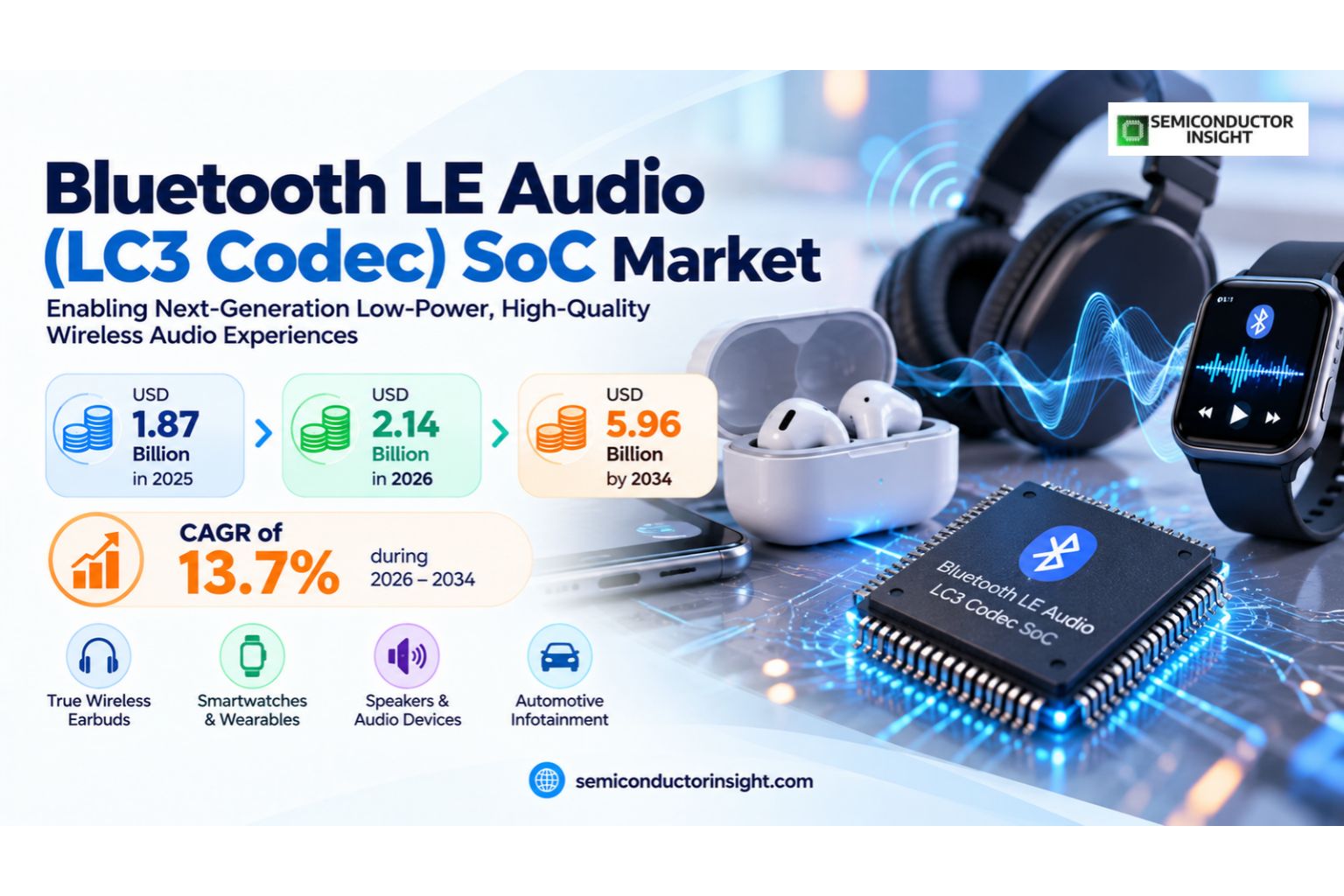
- The market is valued at USD 1.87 billion in 2025 and is projected to reach USD 5.96 billion by 2034, representing a 13.7% CAGR over 2026–2034.
- Entry-Level Audio SoCs is a major product segment, while adjacent variants are expanding as performance, integration and cost requirements evolve.
- TWS Earbuds & Headphones is a leading application area, supported by demand across Hearing Aids & Assistive Audio, Wireless Speakers.
- North America is the largest market in 2025 based on the current concentration of demand, manufacturing capacity and ecosystem maturity.
Bluetooth LE Audio (LC3 Codec) SoC Market Overview
Bluetooth LE Audio (LC3 Codec) SoC devices integrate Bluetooth radios, audio DSP, memory, power management and LC3 codec support for next-generation wireless sound. LC3 is designed to deliver strong audio quality at lower bitrates than legacy Bluetooth audio, helping earbuds, hearing devices and speakers extend battery life while supporting new connection models.
Commercial adoption is expanding as LE Audio features move from premium differentiation toward mainstream product requirements. Auracast broadcast audio creates new public-venue and assistive-listening use cases, while multi-stream audio improves earbud synchronization and device switching. Vendors increasingly combine LE Audio with ANC, AI-based noise suppression, spatial audio and classic Bluetooth compatibility.
Segment Analysis: By Type
Mid-tier programmable SoCs capture broad volume because they balance compute, ANC, codec support and cost, while premium platforms add stronger AI, spatial audio and advanced connectivity for flagship earbuds and headsets. Within this segment, customers increasingly compare lifecycle support, qualification requirements, integration effort and total ownership cost rather than relying on a single specification or upfront price.
| Type | Market relevance |
|---|---|
| Entry-Level Audio SoCs | Cost-sensitive earbuds and speakers. |
| Mid-Tier Programmable SoCs | Largest mainstream audio platform tier. |
| Premium AI-Enabled Audio SoCs | Flagship hearables with AI and spatial processing. |
Segment Analysis: By Application
TWS earbuds and headphones remain the largest application, while hearing aids and assistive listening are strategically important because LE Audio and Auracast were designed to support more accessible low-power audio experiences. Within this segment, customers increasingly compare lifecycle support, qualification requirements, integration effort and total ownership cost rather than relying on a single specification or upfront price.
| Application | Market relevance |
|---|---|
| TWS Earbuds & Headphones | Largest volume and fastest refresh cycle. |
| Hearing Aids & Assistive Audio | High-value low-power accessibility segment. |
| Wireless Speakers | Broadcast and shared-audio opportunity. |
| Enterprise & Gaming Audio | Low-latency communications and gaming. |
Segment Analysis: By Feature Set
Unicast LE Audio provides efficient point-to-point audio, Auracast enables one-to-many public and private broadcasts, and multi-stream audio improves synchronized left/right earbuds and multi-device experiences. Within this segment, customers increasingly compare lifecycle support, qualification requirements, integration effort and total ownership cost rather than relying on a single specification or upfront price.
| Feature Set | Market relevance |
|---|---|
| Unicast LE Audio | Core LE Audio streaming. |
| Auracast Broadcast Audio | New public/shared audio use cases. |
| Multi-Stream Audio | Synchronized multi-device audio. |
Segment Analysis: By Integration
Single-chip SoCs dominate compact hearables because they minimize area and power, while module-based solutions can shorten certification and development for speakers, transmitters and specialized products. Within this segment, customers increasingly compare lifecycle support, qualification requirements, integration effort and total ownership cost rather than relying on a single specification or upfront price.
| Integration | Market relevance |
|---|---|
| Single-Chip Audio SoC | Lowest size and power. |
| Companion / Module-Based Solution | Fast integration and certification path. |
Regional Analysis
North America is the largest value market through premium audio, hearing-health and semiconductor innovation, while Asia Pacific is the manufacturing center and fastest-moving volume region. Regional share also depends on supplier depth, local engineering support, channel structure and the speed at which new Bluetooth LE Audio (LC3 Codec) SoC designs can move from evaluation into repeat deployment.
| Region | 2025 Position | Growth Outlook | Demand Profile |
|---|---|---|---|
| North America | Largest | Very strong | Premium audio, hearing health and SoC design led |
| Europe | Strong accessibility market | Strong | Hearing aids, standards and consumer audio led |
| Asia Pacific | Manufacturing leader | Very strong | TWS, smartphones and electronics manufacturing led |
| South America | Emerging | Strong | TWS and smartphone led |
| Middle East & Africa | Developing | Strong from smaller base | Premium mobile and accessibility led |
Detailed Regional Blocks
Why is North America important to this market?
North America leads value demand because premium TWS, gaming headsets and OTC hearing devices adopt advanced LE Audio features rapidly. Qualcomm and other platform suppliers shape the feature roadmap from the region. In North America, buyers also weigh service coverage, logistics, qualification resources and long-term availability, so ecosystem maturity can materially influence adoption even when core product performance is similar.
| Country / Subregion | Role | Market Context |
|---|---|---|
| United States | Largest value market | Premium audio and OTC hearing aids support advanced SoCs. |
| Canada | Consumer and assistive audio | High wireless-audio penetration supports adoption. |
| Mexico | Electronics manufacturing | Assembly adds downstream volume. |
- Qualcomm’s QCC5181 supports LE Audio, Auracast and low-latency audio in a premium single-chip platform.
- Qualcomm’s S3 Gen 1 platform uses Bluetooth 5.4 and supports LE Audio and Auracast for mid-tier products.
- OTC hearing-aid availability expands the addressable market for low-power interoperable audio silicon.
Why is Europe important to this market?
Europe is important because major hearing-aid manufacturers and Bluetooth standards contributors are based in the region. Public-venue accessibility and assistive listening create a differentiated Auracast opportunity. In Europe, buyers also weigh service coverage, logistics, qualification resources and long-term availability, so ecosystem maturity can materially influence adoption even when core product performance is similar.
| Country / Subregion | Role | Market Context |
|---|---|---|
| Germany | Premium audio and hearing health | Assistive devices support LE Audio demand. |
| Nordic countries | Wireless technology and hearing aids | Strong audio and Bluetooth ecosystems support adoption. |
| United Kingdom | Consumer and professional audio | LE Audio expands device compatibility. |
- Bluetooth SIG published the second edition of its LE Audio guide in January 2025 covering updated broadcast and gaming profiles.
- Auracast can broadcast to an unlimited number of nearby compatible receivers according to Bluetooth SIG’s developer guidance.
- Public transport, theaters and conference venues are potential assistive-listening deployments.
Why is Asia Pacific important to this market?
Asia Pacific is the main production base for earbuds, speakers and consumer electronics. China, South Korea, Taiwan and Japan combine enormous device volume with growing local SoC design capability. In Asia Pacific, buyers also weigh service coverage, logistics, qualification resources and long-term availability, so ecosystem maturity can materially influence adoption even when core product performance is similar.
| Country / Subregion | Role | Market Context |
|---|---|---|
| China | Largest manufacturing base | TWS and speaker production drive high SoC volume. |
| South Korea | Premium-device ecosystem | Smartphones and earbuds accelerate LE Audio adoption. |
| Taiwan | Semiconductor and module hub | Audio modules and IC design support global OEMs. |
- LE Audio support is increasingly incorporated into dual-mode chipsets so products maintain compatibility with classic Bluetooth.
- Volume consumer markets create strong pressure on SoC power, BOM cost and package area.
- Auracast-capable speakers create an additional transmitter and receiver market beyond earbuds.
Why is South America important to this market?
South America is an emerging demand region where Brazil leads wireless-earbud and smartphone sales. Adoption will spread as LE Audio capability reaches mid-range devices rather than remaining a flagship feature. In South America, buyers also weigh service coverage, logistics, qualification resources and long-term availability, so ecosystem maturity can materially influence adoption even when core product performance is similar.
| Country / Subregion | Role | Market Context |
|---|---|---|
| Brazil | Largest regional market | TWS and smartphone scale support SoC demand. |
| Chile | Premium consumer niche | High-end audio adopts new features quickly. |
| Argentina | Price-sensitive market | Mid-tier platforms drive adoption. |
- Price-sensitive markets favor highly integrated single-chip platforms.
- Auracast adoption will depend on compatible phones, transmitters and public infrastructure.
- Longer battery life is a clear consumer benefit across price tiers.
Why is Middle East & Africa important to this market?
Middle East and Africa demand is strongest in Gulf premium-device markets and will broaden as lower-cost LE Audio products enter mainstream channels. Accessibility use cases may create additional institutional demand. In Middle East & Africa, buyers also weigh service coverage, logistics, qualification resources and long-term availability, so ecosystem maturity can materially influence adoption even when core product performance is similar.
| Country / Subregion | Role | Market Context |
|---|---|---|
| United Arab Emirates | Premium consumer market | Flagship smartphones and earbuds support advanced SoCs. |
| Saudi Arabia | Growing electronics market | TWS and gaming expand demand. |
| South Africa | Regional retail hub | Mid-tier audio products support adoption. |
- Dual-mode chips reduce risk because products can support both classic Bluetooth and LE Audio.
- Gaming headsets benefit from lower-latency audio modes.
- Public broadcast audio can create future venue and tourism applications.
Competitive Landscape
Qualcomm, Nordic Semiconductor, Texas Instruments, Synaptics and Actions Technology compete on power consumption, DSP compute, Bluetooth qualification, ANC, AI features and time-to-market software. Integration breadth and proven interoperability are increasingly important as LE Audio feature sets become more complex.
| Company | Position | Relevant capability |
|---|---|---|
| Qualcomm Technologies | Key participant | Broad S3/S5 and QCC audio SoCs supporting LE Audio, Auracast, ANC and Snapdragon Sound. |
| Nordic Semiconductor | Key participant | Ultra-low-power Bluetooth platforms with strong developer ecosystems for LE Audio designs. |
| Texas Instruments | Key participant | Competes through product breadth, integration capability, qualification and customer support. |
| Synaptics | Key participant | Wireless audio and connectivity platforms for consumer and enterprise devices. |
| Actions Technology | Key participant | Competes through product breadth, integration capability, qualification and customer support. |
| Airoha Technology | Key participant | Competes through product breadth, integration capability, qualification and customer support. |
| Realtek Semiconductor | Key participant | Competes through product breadth, integration capability, qualification and customer support. |
Production Capacity Analysis
Audio SoCs use advanced mixed-signal CMOS, RF blocks, DSP and embedded memory. Supply scales through fabless foundry production, but qualification, Bluetooth certification and software validation can become the real time-to-market bottlenecks. Scaling output without degrading quality requires stable upstream materials, disciplined process control and final test coverage that catches performance drift before products reach customers.
Asia provides most device assembly, while SoC design is distributed across the United States, Europe and Asia. Platform vendors invest heavily in reference software because codec and protocol interoperability can matter as much as silicon performance. Second-source planning and regional technical support therefore become increasingly important as deployments grow and customers seek continuity without repeating lengthy qualification cycles.
Market Dynamics
LE Audio changes Bluetooth audio from a simple point-to-point replacement into a broader connectivity platform. Broadcast, multi-stream and assistive-listening features create new devices and infrastructure roles beyond conventional earbuds. This is changing competitive behavior because vendors increasingly sell system-level value, workflow integration and lifecycle economics rather than an isolated component specification.
At the same time, classic Bluetooth remains deeply installed, so dual-mode support is commercially important. Vendors that combine LE Audio with mature classic-audio stacks can help OEMs launch products without sacrificing compatibility with older phones and computers. Buyers consequently evaluate total ownership cost, qualification effort and roadmap stability across the life of a program instead of focusing only on initial purchase price.
Market Drivers
| Factor | Analyst Interpretation |
|---|---|
| TWS growth | Earbuds remain the largest volume market for low-power Bluetooth audio SoCs. |
| Auracast | Broadcast audio creates new public, shared and assistive listening use cases. |
| Hearing health | LE Audio supports power-efficient interoperable hearing devices. |
| Lower-power LC3 | Efficient coding helps extend battery life at useful audio quality. |
Market Restraints
| Factor | Analyst Interpretation |
|---|---|
| Qualification complexity | LE Audio introduces more profiles and interoperability cases. |
| Legacy-device compatibility | OEMs must continue supporting classic Bluetooth for years. |
| Intense price pressure | High-volume earbuds aggressively optimize semiconductor BOM cost. |
| Software complexity | Codec, ANC, voice, broadcast and multipoint features compete for DSP and memory resources. |
Market Opportunities
| Factor | Analyst Interpretation |
|---|---|
| Auracast venue transmitters | Airports, gyms and public spaces can broadcast audio to many receivers. |
| OTC hearing aids | Assistive listening expands beyond traditional medical-device channels. |
| AI-enhanced audio | On-device noise suppression and personalization raise SoC compute value. |
| Bluetooth 6 audio platforms | New radio generations can combine LE Audio with improved connectivity and ranging capabilities. |
Supply Chain Analysis
The supply chain combines RF/audio SoC design, foundry manufacturing, Bluetooth protocol stacks, LC3 software, module integration and device qualification. Ecosystem interoperability is essential because audio devices must operate across phones, computers and public transmitters from many vendors. Traceability and coordination between component suppliers, integrators and end users are important because failures found late in the chain can be far more expensive than the underlying part itself.
| Supply Chain Stage | Role in the Market |
|---|---|
| Audio SoC design and foundry | RF, DSP, codec and power functions are integrated into mixed-signal silicon. |
| Bluetooth and codec software | LE Audio profiles, LC3 and device-control stacks are validated. |
| Module and device integration | OEMs add microphones, speakers, batteries, ANC and antennas. |
| Qualification and certification | Products complete Bluetooth qualification and end-device interoperability testing. |
Recent Developments
| Date | Development | Source |
|---|---|---|
| January 2025 | Bluetooth SIG released the second edition of its LE Audio guide with updated Auracast, public broadcast and gaming profile coverage. | Bluetooth SIG |
| 2026 | Qualcomm's QCC5181 remains an active premium audio SoC supporting LE Audio, Auracast and low-latency modes for earbuds and headsets. | Qualcomm |
| 2026 | Qualcomm's S3 Gen 1 platform supports Bluetooth 5.4, LE Audio and Auracast for mid-tier earbuds, headphones and speakers. | Qualcomm |
Report Scope & Segmentation
| Scope Item | Coverage |
|---|---|
| Base Year | 2025 |
| Estimated Year | 2026 |
| Forecast Period | 2026–2034 |
| 2025 Market Size | USD 1.87 billion |
| 2026 Estimated Size | USD 2.14 billion |
| 2034 Forecast Size | USD 5.96 billion |
| CAGR (2026–2034) | 13.7% |
| Largest Market in 2025 | North America |
| Category | Integrated Circuits / Wireless Audio / Bluetooth LE Audio |
| By Type | Entry-Level Audio SoCs, Mid-Tier Programmable SoCs, Premium AI-Enabled Audio SoCs |
| By Application | TWS Earbuds & Headphones, Hearing Aids & Assistive Audio, Wireless Speakers, Enterprise & Gaming Audio |
| By Feature Set | Unicast LE Audio, Auracast Broadcast Audio, Multi-Stream Audio |
| By Integration | Single-Chip Audio SoC, Companion / Module-Based Solution |
Frequently Asked Questions
What is the 2025 market size of the Bluetooth LE Audio (LC3 Codec) SoC market?
The market is valued at USD 1.87 billion in 2025.
What is the projected 2034 market size of the Bluetooth LE Audio (LC3 Codec) SoC market?
The market is projected to reach USD 5.96 billion by 2034.
What is the CAGR of the Bluetooth LE Audio (LC3 Codec) SoC market from 2026 to 2034?
The market is expected to expand at a CAGR of 13.7% during 2026–2034.
Which region leads the Bluetooth LE Audio (LC3 Codec) SoC market?
North America is the largest market in 2025 based on the current demand, manufacturing and deployment structure.
Which type segment is important in the Bluetooth LE Audio (LC3 Codec) SoC market?
Entry-Level Audio SoCs is a major segment, while adjacent product variants are gaining share as performance and integration requirements evolve.
What is the main application for Bluetooth LE Audio (LC3 Codec) SoC products?
TWS Earbuds & Headphones is a leading application, with additional growth coming from Hearing Aids & Assistive Audio, Wireless Speakers.
What drives growth in the Bluetooth LE Audio (LC3 Codec) SoC market?
Earbuds remain the largest volume market for low-power Bluetooth audio SoCs.
What is a key restraint for the Bluetooth LE Audio (LC3 Codec) SoC market?
LE Audio introduces more profiles and interoperability cases.
Which companies participate in the Bluetooth LE Audio (LC3 Codec) SoC market?
Key participants include Qualcomm Technologies, Nordic Semiconductor, Texas Instruments, Synaptics, Actions Technology, alongside other specialized suppliers and system companies.
What technology trend is shaping the Bluetooth LE Audio (LC3 Codec) SoC market?
Airports, gyms and public spaces can broadcast audio to many receivers.
Research Sources & Evidence Base
View research sources used for this overview.
- Bluetooth SIG — LE Audio 2nd Edition: Current LE Audio profiles, broadcast features and developer context. Source
- Bluetooth SIG — Auracast for Developers: Broadcast-audio architecture and unlimited nearby receiver model. Source
- Qualcomm — QCC5181: Premium LE Audio and Auracast SoC capabilities. Source
- Qualcomm — Bluetooth LE Audio: LE Audio, multi-stream and Auracast platform overview. Source

Get Sample Report PDF for Exclusive Insights
Report Sample Includes
- Table of Contents
- List of Tables & Figures
- Charts, Research Methodology, and more...
 Download Sample Report PDF