Key Statistics
Key Takeaways
- Market trajectory: The SiC MOSFET gate drivers market is valued at USD 788 million in 2026 and is forecast to reach USD 5,809 million by 2036, growing at 22.1% over 2027–2036. Demand comes from isolation, switching control and protection circuitry designed around faster silicon-carbide power transistors.
- Isolation architecture: Galvanically isolated drivers represent an estimated ~66% of 2026 sales, compared with ~34% for non-isolated solutions. High-voltage traction inverters, solar conversion and industrial drives rely on controlled separation between logic and switching nodes, making protection functions a major value differentiator.
- Automotive demand: Vehicle power electronics account for an estimated ~44% of 2026 gate-driver revenue; renewable energy contributes ~24%, industrial drives ~20%, and other converter uses ~12%. Automotive qualification and fault-handling requirements support complex drivers with stronger integration economics than basic switch-control components.
- Geographic position: North America holds an estimated ~35% of 2026 market value, narrowly ahead of Asia-Pacific at ~34% and Europe at ~22%. Regional sales reflect engineering and qualification value as well as assembly, so the leading revenue region need not be the largest manufacturing location.
- Technology direction: Active gate control holds an estimated ~45% of gate-bias scheme revenue, while bipolar drive accounts for ~35% and unipolar drive ~20%. Suppliers are improving slew-rate adjustment, short-circuit response, common-mode transient immunity and gate-voltage control as SiC switching frequencies increase.
SiC MOSFET Gate Drivers Market Overview
SiC MOSFET gate drivers market reached USD 788 million in 2026 and is projected to reach USD 5,809 million by 2036, representing a CAGR of 22.1% for 2027–2036. North America leads with an estimated ~35% revenue share, closely followed by Asia-Pacific at ~34%. The market comprises integrated circuits and dedicated driver assemblies that control SiC MOSFET switching and protect high-voltage power-conversion stages in transport, renewable energy and industrial systems.
Gate drivers translate low-voltage control commands into precisely timed gate currents for silicon-carbide MOSFETs. Their economic role is distinct from the power transistors themselves: a driver manages turn-on and turn-off behavior, isolation, desaturation response, negative bias and diagnostic feedback. At the 1200V class used in traction inverters, switching speed can create damaging overshoot unless the driver and power module are designed together. Consequently, automotive and industrial buyers evaluate the complete switching cell rather than selecting an IC solely by peak output current.
The revenue boundary includes isolated and non-isolated SiC-compatible gate-driver integrated circuits, intelligent digital driver cores, and dedicated driver assemblies sold for SiC MOSFET power stages. It excludes the underlying MOSFET die, packaged power modules, complete inverters, general-purpose microcontrollers and separately priced converter installations. A programmable gate-driver board belongs inside the boundary when its commercial function is driving a SiC switch; a full traction inverter containing such a board does not. This prevents power-module or vehicle revenue from being counted as driver revenue.
Technical differentiation is increasingly visible in common-mode transient immunity, propagation-delay matching, short-circuit detection and active gate control. Infineon introduced the isolated 1ED301xMC12I family on 5 February 2026, specifying common-mode transient immunity above 300 kV per microsecond and 40-nanosecond propagation delay. Its June 2026 automotive driver family adds multi-level slew-rate control to reduce switching losses. Texas Instruments also offers reinforced isolated devices with integrated Miller clamping, fault reporting and short-circuit protection for demanding 1700V-class designs.
Commercial purchasing differs across 3 major converter settings. In a vehicle traction inverter, functional safety and production traceability are critical. In a photovoltaic inverter, efficiency, lifetime and isolation under variable load are central. In an industrial motor drive, the challenge is stable switching amid long cable runs and electrical noise. Each application rewards a different combination of protection features, board footprint and service life, helping explain why sophisticated driver content can expand faster than the underlying count of switching positions.
Competitive intensity is shaped by the choice between a discrete driver IC and an integrated digital gate-driver core. Microchip markets programmable SiC driver platforms with switching profiles and fault monitoring, while Analog Devices provides isolated half-bridge and single-channel components that designers combine with bias supplies and protection networks. An OEM may pay more for an integrated solution if it reduces test effort and switching losses across thousands of units. The market therefore includes both high-volume semiconductor components and higher-value application-specific driver assemblies.
Segment Analysis: By Type
By type, galvanically isolated gate drivers are the largest segment with an estimated ~66% share in 2026, while non-isolated devices account for ~34%. The separation reflects demand for reinforced insulation in high-voltage inverters and the lower cost of local-ground drive in selected converter stages. The choice affects PCB layout, isolation testing, protection architecture and the number of external components.
| Type | Switching and protection function | Market position |
|---|---|---|
| Galvanically Isolated Gate Driver | Isolated devices use transformer or capacitive signal barriers to separate a low-voltage controller from a high-side SiC switch. They are designed to withstand fast common-mode transients and can combine DESAT, undervoltage lockout, active Miller clamp and fault reporting. Infineon and Texas Instruments offer examples for 1200V and 1700V power stages. Reinforced insulation and low timing skew matter most in automotive traction and grid-connected equipment. | This segment leads with an estimated ~66% of 2026 revenue because safety isolation and integrated protection justify higher average selling prices than basic gate buffers. A switch module may require several driver channels and a dedicated isolated bias supply, creating recurring component content for each inverter design. Qualification involves double-pulse switching, thermal cycling and fault injection before volume sourcing, so design wins can persist through multiple vehicle or industrial product generations. |
| Non-Isolated Gate Driver | Non-isolated driver ICs share a reference ground with the controller or use external isolation elsewhere in the converter. They suit lower-voltage auxiliary stages, local-ground power circuits and cost-sensitive systems where the safety barrier is provided by another component. Designers still require adequate source and sink current, gate-voltage tolerance and controlled turn-off. Reduced packaging and isolation overhead can lower the cost per switching position in appropriate circuits. | Non-isolated drivers represent an estimated ~34% of 2026 revenue and remain important in distributed power supplies and converter auxiliaries. Their share is constrained by rising use of 800V vehicle platforms and higher-voltage solar systems, where reinforced separation and diagnostics are commercially attractive. Suppliers compete on channel density, package size and drive strength, with opportunities to bundle complementary bias supplies, sensing devices and protection circuits without treating those products as driver sales. |
Additional segmentation: gate bias and channel configuration
Gate-bias architecture changes the value of each switching position. Active gate control holds an estimated ~45% of 2026 revenue because programmable switching profiles can balance turn-on loss, voltage overshoot and electromagnetic interference. Bipolar drive contributes ~35% through negative off-state voltage and improved immunity to false turn-on. Unipolar gate drive accounts for ~20% where the operating environment allows a simpler bias network. These categories describe control approaches rather than separate power semiconductor shipments.
Channel configuration provides another view of purchasing. Single-channel drivers represent an estimated ~44% of 2026 value, dual-channel products ~38%, and multi-channel solutions ~18%. A half-bridge may require matched channels with predictable dead time, while a traction inverter contains several switching legs and safety interlocks. Higher channel integration can reduce board area, but thermal layout, isolation barriers and independent fault signaling determine whether buyers prefer separate devices.
Segment Analysis: By Application
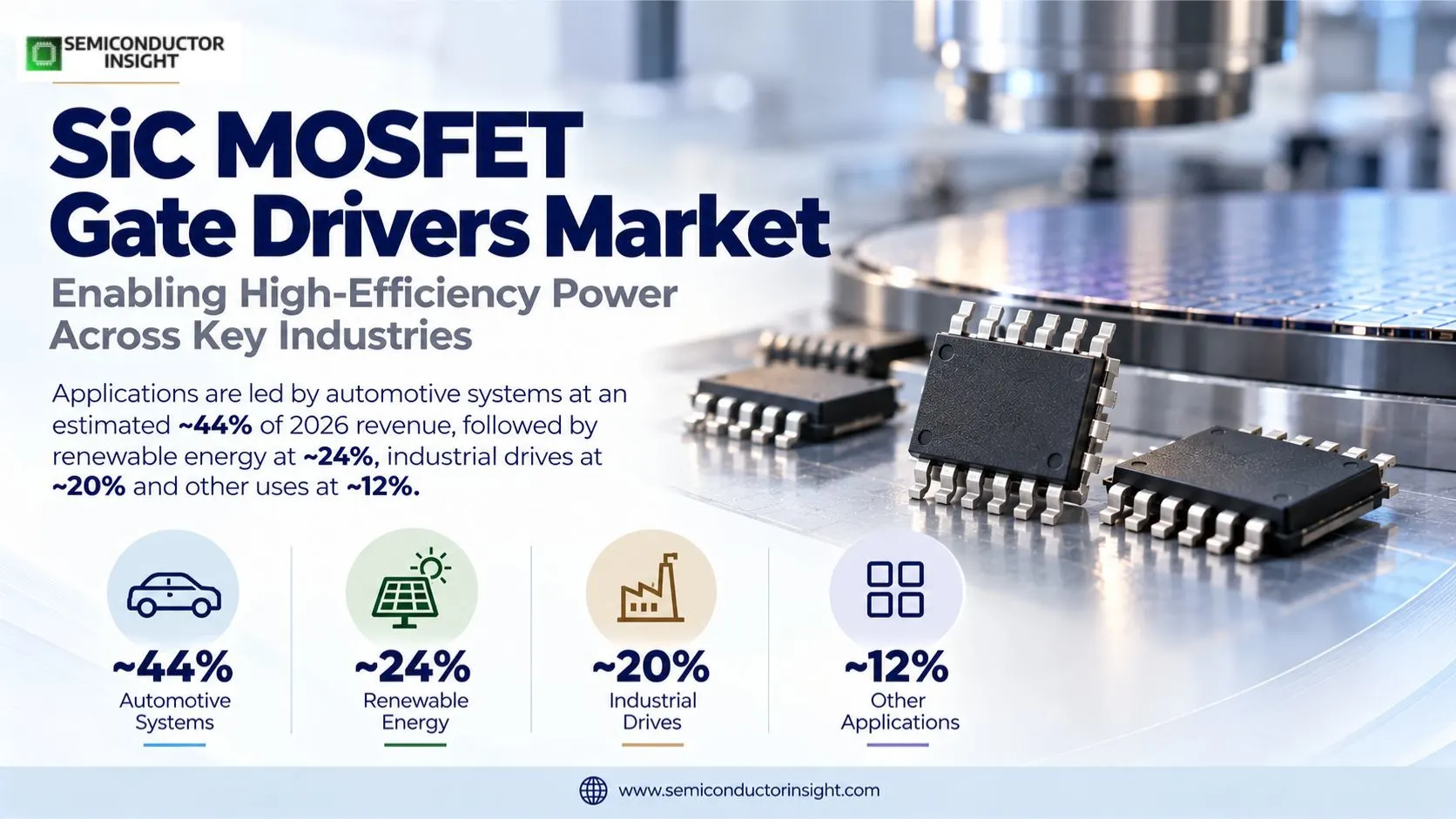
Applications are led by automotive systems at an estimated ~44% of 2026 revenue, followed by renewable energy at ~24%, industrial drives at ~20% and other uses at ~12%. These shares represent the commercial end use of gate-driver devices rather than the share of SiC MOSFET die or completed converter shipments. Each buyer class specifies distinct combinations of isolation, diagnostics, switching speed and thermal tolerance.
| Application | Demand characteristics |
|---|---|
| Automotive | Vehicle traction inverters, onboard chargers and high-voltage auxiliary converters demand gate drivers with fault response, isolation and timing repeatability. An 800V electric vehicle platform typically uses 1200V-class SiC MOSFETs and places high value on stable switching during rapid acceleration and regenerative braking. Automotive qualification and system safety validation create longer design cycles, but a successful platform nomination can generate repeat orders across several model years. The automotive application accounts for an estimated ~44% of the 2026 gate-driver revenue pool, making purchasing sensitive to the converter qualification cycle. |
| Renewable Energy | Solar inverters, storage power-conversion systems and grid-interface equipment use SiC switches to improve conversion efficiency at high operating frequencies. Gate drivers must handle variable loads, switching transients and long operating lives under outdoor or industrial temperature conditions. The procurement decision depends on inverter architecture and serviceability rather than installed photovoltaic megawatts alone; new solar installations provide an adjacent demand signal, not a direct driver-revenue measure. The renewable energy application accounts for an estimated ~24% of the 2026 gate-driver revenue pool, making purchasing sensitive to the converter qualification cycle. |
| Industrial Drives | Variable-speed motor drives, servo systems and factory power converters benefit from fast switching, efficient motor control and compact power stages. Gate-driver designers prioritize immunity to conducted noise, reliable short-circuit response and predictable dead time when motors accelerate or brake. An industrial buyer may accept a more expensive isolated driver if it reduces unplanned shutdowns and simplifies commissioning across multiple equipment variants. The industrial drives application accounts for an estimated ~20% of the 2026 gate-driver revenue pool, making purchasing sensitive to the converter qualification cycle. |
| Others | The remaining applications include charging infrastructure, rail traction, uninterruptible power supplies and specialist power-conversion systems. These uses differ in power rating and approval cycles, but share a need to protect fast-switching SiC devices against voltage overshoot and fault energy. A rail converter may value reinforced isolation and long service support, while a charger designer may prioritize compact layouts and integration with control firmware. The others application accounts for an estimated ~12% of the 2026 gate-driver revenue pool, making purchasing sensitive to the converter qualification cycle. |
End-user channels further divide the market between original equipment manufacturers at an estimated ~55%, original design manufacturers at ~27% and system integrators at ~18%. OEMs typically control component qualification and design ownership; ODMs may select catalog drivers for customer-specific boards; integrators buy modules and driver cores for installed systems. These purchasing channels overlap technologically but are allocated separately in the revenue model to avoid counting one gate-driver sale multiple times.
Regional Analysis
The regional allocation of SiC MOSFET gate-driver revenue reflects both converter design activity and semiconductor sourcing. North America leads at an estimated ~35% in 2026, Asia-Pacific follows at ~34%, Europe represents ~22%, the Middle East and Africa ~5%, and South America ~4%. These modeled shares describe sales value attributable to each market rather than semiconductor fabrication capacity, and every regional forecast is reconciled to the same global product boundary.
Which regions lead demand for SiC MOSFET gate drivers?
Regional growth is linked to different demand mechanisms. North American engineering teams influence automotive and industrial design wins; Asia-Pacific contains a dense base of converter assembly and electric-vehicle manufacturing; Europe emphasizes safety-critical power systems; the Middle East and Africa adopt imported solar and charging equipment; and South America develops renewable and industrial applications. This differentiation matters because design qualification can occur far from the location where a final inverter is assembled.
| Region | Position | Growth outlook | Demand profile | What decides supplier selection |
|---|---|---|---|---|
| North America | Largest (~35%) | ~21.2% CAGR | Engineering value and automotive design qualification are important contributors to North American gate-driver revenue. Customers tend to evaluate multiple device variants during inverter development and retain approved drivers after extensive testing. The region therefore carries a relatively high value per qualified design, even where board assembly and component packaging are located overseas. | Buyers emphasize isolation certificates, 1200V or 1700V switch compatibility, electromagnetic noise immunity and documented fault response. A supplier with accessible application engineers and long-term product support can win preference during a vehicle or industrial platform qualification. These requirements support a premium for advanced integrated drivers, but each nomination still depends on system testing. |
| Asia-Pacific | Second largest (~34%) | ~23.1% CAGR | Asia-Pacific combines high-volume converter production with a broad network of electronics manufacturers and design houses. China, Japan and South Korea serve different equipment programs, while India and Southeast Asia contribute assembly and new application development. Growth is supported by electric vehicles, renewable conversion and industrial automation, with the fastest opportunity in complex switching systems. | Customers compare driver capability at target switching frequencies, access to reference designs and delivery reliability. Local application support can shorten validation of 1200V SiC power stages and improve response to layout or electromagnetic interference issues. Pricing pressure is significant in high-volume converters, making integration and manufacturing yield important competitive levers for global and regional suppliers. |
| Europe | Established (~22%) | ~21.6% CAGR | Europe has a concentration of automotive inverter development, industrial automation and grid-power engineering that supports premium isolated gate-driver demand. Design teams often require evidence of functional safety and long component support periods. Local supplier engineering resources and qualification infrastructure strengthen the region even when final power electronics are assembled elsewhere. In Europe, engineers verify timing, isolation margins and fault recovery at the full converter operating voltage before approving repeat purchases. For Europe, consistent operation across thermal cycles reduces service exposure and helps preserve a stable converter bill of materials. | European buyers frequently specify documented isolation, robust temperature ratings, short-circuit response and electromagnetic compatibility. Suppliers with application laboratories and validated reference designs can reduce the time needed to qualify a SiC inverter. Component cost remains relevant, but predictable operation during repeated switching and system-level protection are decisive for safety-critical or high-uptime applications. |
| Middle East & Africa | Emerging (~5%) | ~23.5% CAGR | The Middle East and Africa represent a smaller but potentially fast-growing market driven by renewable power, charging infrastructure and industrial electrification. Most gate-driver content enters through imported converter equipment or internationally sourced boards. The region’s revenue opportunity is tied to the penetration of SiC-based inverter platforms, not to a local wafer-fabrication base. | Equipment suppliers prioritize heat tolerance, protection features and availability of qualified maintenance partners. A gate driver with strong noise immunity and reliable fault shutdown can be attractive in harsh power environments, provided the entire converter meets the project specification. Price sensitivity and long procurement cycles favor established equipment platforms over frequent component substitutions. |
| South America | Emerging (~4%) | ~22.7% CAGR | South America has a modest share of gate-driver revenue, with demand centered on renewable inverters and industrial power equipment. Brazil provides the broadest industrial electronics market, while Chile has a specialized solar integration opportunity. Adoption is sensitive to equipment imports and financing, so regional revenue can lag broader energy infrastructure announcements. In South America, engineers verify timing, isolation margins and fault recovery at the full converter operating voltage before approving repeat purchases. For South America, consistent operation across thermal cycles reduces service exposure and helps preserve a stable converter bill of materials. | Purchasing channels favor established inverter manufacturers and component distributors that can provide documentation, warranty support and reliable replacements. Gate-driver features such as controlled turn-off and fault reporting matter when electrical grids experience disturbances. Currency fluctuations and project procurement schedules affect orders, but they do not change the underlying need for compatible isolation and gate-voltage control. |
Competitive Landscape
Competition centers on the ability to deliver predictable high-speed switching, robust isolation and application-ready protection around SiC MOSFET power stages. Infineon, Texas Instruments, STMicroelectronics, Microchip and Analog Devices provide direct product evidence for gate-driver solutions, while the wider power-semiconductor ecosystem influences integration and channel strategy. A manufacturer’s broad SiC device revenue is not equivalent to its sales of dedicated gate-driver components.
Infineon competes with EiceDRIVER isolated families designed for automotive traction, industrial motor drives and renewable conversion. Its 2026 products illustrate a move from basic switching commands toward configurable slew-rate behavior and integrated protection. This can lower the number of external components in a power stage and create differentiation through engineering support. The commercial benefit depends on OEM qualification and the specific inverter platform, not simply on the company’s total semiconductor sales.
Texas Instruments emphasizes isolation ratings, active Miller clamping, fast short-circuit response and predictable channel timing in its UCC217 series. These features are important where 1200V or 1700V SiC MOSFETs switch rapidly in a noisy environment. The supplier’s extensive evaluation tools can reduce system-development effort for automotive and industrial teams. Pricing still competes with alternative ICs and discrete driver circuits, especially when the equipment does not require the highest protection specification.
Microchip positions programmable gate-driver cores alongside SiC modules and system reference designs. Its 3.3 kV plug-and-play driver announced in February 2024 demonstrates the value of preconfigured switching profiles, monitoring and isolation for higher-voltage equipment. The product strategy addresses customers who prefer a validated subassembly over building every driver function from discrete parts. Such integration can command a premium while also creating dependence on application-specific mechanical and electrical interfaces.
Analog Devices and STMicroelectronics offer isolated driver technologies that equipment manufacturers can integrate with their chosen SiC transistors. Additional semiconductor suppliers participate through complementary power-management portfolios, but not every named power-device producer independently sells a stand-alone SiC gate-driver IC. Competitive comparisons therefore emphasize verified driver products, engineering availability and approved design wins rather than treating all semiconductor revenue as part of this specialized component market.
Tier structure
| Tier | Companies | Basis of competition |
|---|---|---|
| Direct driver leaders | Infineon Technologies; Texas Instruments; Microchip Technology | These vendors publish SiC-compatible gate-driver ICs or programmable driver assemblies with documented isolation, fault management and switching-control specifications. Their portfolios support 1200V and higher-voltage applications and provide evaluation resources for converter engineers. Tier placement reflects product breadth and technical relevance rather than a verified global ranking by gate-driver revenue, which is generally not disclosed at this product granularity. |
| Specialized analog suppliers | STMicroelectronics; Analog Devices | These companies supply isolated gate drivers and related signal-chain technologies that can be designed into SiC switching stages. Customers compare drive current, isolation, channel configuration, propagation delay and fault-reporting behavior against their converter needs. Engineering support and access to proven evaluation boards influence design wins, while semiconductor purchasing teams also assess package availability and expected support over the equipment life cycle. |
| Adjacent ecosystem | ROHM Semiconductor; onsemi; Wolfspeed; Power Integrations; NXP Semiconductors | These companies are relevant to the surrounding power-electronics ecosystem through SiC devices, control components or converter architecture, but the group is not presented as a uniform list of independently verified stand-alone SiC gate-driver suppliers. Buyers may use their reference designs or complementary products when defining a power stage. Revenue attribution requires a separately identifiable gate-driver product rather than a bundled power-module or complete-system price. |
Key companies profiled
- Infineon Technologies
- Texas Instruments
- STMicroelectronics
- Microchip Technology
- Analog Devices
- ROHM Semiconductor
- onsemi
- Wolfspeed
- Power Integrations
- NXP Semiconductors
Production Capacity Analysis
Gate-driver capacity depends on mixed-signal semiconductor fabrication, isolation technology, packaging and test rather than on silicon-carbide crystal growth. Many gate-driver ICs are manufactured in conventional semiconductor processes while being specified to control SiC power devices. The ability to meet isolation, temperature and timing requirements at production yield is more relevant than the total number of SiC wafers manufactured worldwide.
Production workflows combine wafer fabrication, isolation structures, package assembly and final electrical test. Manufacturers must verify propagation delay, common-mode transient immunity, output-drive strength and fault signaling over specified temperature ranges. Reinforced isolated drivers can require specialized packages and additional reliability documentation. A supplier may scale usable capacity by improving test throughput and assembly yield without adding new SiC wafer crystal-growth equipment.
Automotive demand creates stringent traceability requirements because gate drivers are part of a safety-sensitive traction inverter. Buyers often require qualified manufacturing sites, stable process controls and notification before material or package changes. This favors established semiconductor suppliers that can support long programs and maintain consistent electrical characteristics across batches. Manufacturing concentration also makes second-source planning and component inventory important during sudden changes in converter demand.
Digital driver assemblies introduce additional capacity considerations beyond a bare IC. A programmable board may contain isolation components, bias supplies, control firmware and connectors that must be assembled and functionally tested as a unit. The number of finished boards is constrained by application-specific qualification and integration resources. This higher-content route can be attractive for medium-voltage industrial converters even when its production volumes are lower than those of catalog driver ICs.
Market Dynamics
The principal growth forces are vehicle inverter redesign, renewable power conversion and higher-value gate-control integration. The strongest restraints are isolation expense, qualification time and competition from simpler circuits. The modeled contribution table expresses each factor as percentage points of the forecast growth rate, with 2027–2029 representing near-term design conversion, 2030–2032 wider platform adoption and 2033–2036 a more mature replacement and integration cycle.
MARKET DRIVERS
Drivers Impact Analysis*
| Market Drivers | Impact Rank | CAGR Contribution (%) | 2027–2029 | 2030–2032 | 2033–2036 |
|---|---|---|---|---|---|
| Automotive traction inverter redesigns | High | +9.00% | High | High | High |
| Renewable and storage conversion growth | High | +7.00% | High | High | High |
| Active gate control and protection integration | Medium-High | +5.20% | Medium | High | High |
| Industrial drive electrification | Medium | +3.40% | Medium | High | High |
| High-voltage charging and rail converters | Low-Medium | +2.00% | Medium | Medium | High |
| Others (qualification reuse and replacement platforms) | Low | +1.00% | Low | Medium | Medium |
EV traction inverter platforms
Electric vehicles using 800V-class architectures can benefit from 1200V SiC MOSFET power stages, but the faster devices place greater demands on gate control. Integrated drivers with desaturation detection, active Miller clamping and controlled turn-off can reduce overshoot and protect costly power modules. Infineon’s June 2026 automotive family illustrates how switching-loss optimization and reduced component count can influence OEM design choices. Commercial adoption follows platform qualification and production schedules rather than vehicle registrations alone.
Solar and storage power conversion
Solar and battery-storage inverters increasingly use high-frequency power stages to improve efficiency and reduce passive-component size. The driver must maintain safe isolation and stable switching under changing load and temperature. The 2026 EiceDRIVER opto-emulator family offers an upgrade route for equipment designers that previously used optocoupler-based control, reducing the need to redesign the logic interface. Supplier revenue is driven by the number and complexity of approved driver channels in shipped converters.
Active switching control
SiC MOSFETs can switch rapidly enough that gate-resistor selection alone does not always balance efficiency and electromagnetic interference. Programmable or multi-level slew-rate control enables a power stage to use different turn-on and turn-off profiles under varying operating conditions. This creates additional semiconductor and firmware value per driver channel. OEMs can justify the higher cost when improved switching behavior reduces cooling, filtering or reliability expenses elsewhere in the inverter.
Industrial motor-drive upgrades
Industrial automation and high-efficiency motors create opportunities for SiC-based variable-frequency drives, especially where compact packaging or lower switching loss is valuable. Gate-driver requirements include short-circuit protection, immunity to long-cable noise and stable dead time across thermal cycles. Buyers often reuse qualified designs across several equipment ratings, so an accepted driver can generate sustained component demand without a new qualification for every drive sold.
High-voltage transport and charging
Charging equipment, rail converters and heavy-duty electrification can require drivers for higher-voltage SiC modules. Microchip’s 3.3 kV digital driver integrates protection and configurable switching profiles, illustrating the technical value of a validated driver subassembly. These applications involve smaller volumes than mass-market vehicle inverters but may support higher average prices because isolation, fault handling and service life are demanding. Project timing and engineering approvals govern order conversion.
MARKET RESTRAINTS
Restraints Impact Analysis*
| Market Restraints | Impact Rank | CAGR Contribution (%) | 2027–2029 | 2030–2032 | 2033–2036 |
|---|---|---|---|---|---|
| Isolation and certification expense | High | -2.10% | High | High | Medium |
| Converter redesign and test burden | Medium-High | -1.50% | High | Medium | Medium |
| Pricing pressure from simpler drivers | Medium | -1.20% | Medium | High | High |
| Others (supply disruption and integration delays) | Low | -0.70% | Medium | Low | Low |
Isolation and qualification cost
Reinforced isolation, high common-mode transient immunity and automotive reliability testing increase design and production costs for advanced gate drivers. Semiconductor suppliers must demonstrate electrical behavior across voltage, temperature and fault conditions, while OEMs must test the complete power stage. These requirements can slow adoption by smaller converter manufacturers, especially when a lower-voltage design can operate safely with simpler driver components and external protection circuits.
Switching-cell redesign effort
Replacing a silicon IGBT or MOSFET with a SiC device often changes gate bias, layout, switching speed and protection timing. The driver cannot be substituted independently of the power module, controller and electromagnetic filtering. Equipment makers may postpone redesign until the next platform refresh to avoid interrupting a qualified production line. This creates a delay between component availability and recurring sales even when the technical efficiency benefit is clear.
Price competition and integration tradeoffs
Basic gate buffers and discrete protection circuits can be less expensive than highly integrated isolated driver ICs in less demanding applications. Customers compare the full bill of materials rather than a single driver price, so a premium device must demonstrate savings in testing, passive components or reliability. Competitive pressure is strongest in standardized converter architectures where suppliers offer pin-compatible alternatives and the switching environment is well understood.
Supply-chain and lead-time uncertainty
Gate-driver availability depends on mixed-signal semiconductor capacity, isolation packaging and specialized electrical testing. A disruption in one device family can delay shipment of an otherwise complete inverter, encouraging buyers to maintain approved alternates and safety stocks. Second-source qualification remains difficult because propagation delay, fault thresholds and drive strength may differ. This can temporarily raise inventory costs and slow adoption of new driver technologies.
MARKET OPPORTUNITIES
Programmable gate profiles
Advanced drivers can adjust gate current or slew rate according to operating conditions, creating opportunities to improve both efficiency and electromagnetic compatibility. This capability is valuable in vehicle inverters that experience acceleration, cruising and regenerative braking rather than one fixed operating point. Suppliers can differentiate through evaluation software and application support, but they must demonstrate measurable system benefits to justify a higher component price.
Isolation-compatible retrofit designs
Opto-emulator input devices can allow equipment engineers to upgrade from older control interfaces to faster SiC-compatible switching without changing the entire controller architecture. Infineon’s February 2026 product family demonstrates this design strategy. A simpler migration path can accelerate component adoption in solar inverters and motor drives, especially where existing boards have already passed extensive environmental or safety testing.
Driver-plus-bias integration
Combining isolated gate control with bias generation, monitoring and fault management can reduce external components and simplify qualification of medium-voltage systems. Digital driver cores are especially relevant when the customer wants configurable switching behavior and a repeatable interface to a SiC module. Suppliers can capture more value per converter, while customers gain shorter engineering schedules and clearer accountability for protection performance.
Application engineering services
Power electronics manufacturers need support for double-pulse testing, switching waveform interpretation, gate-resistor selection and electromagnetic compatibility. A semiconductor supplier that provides reference boards and validated designs can shorten time to production and improve customer retention. The service itself is not counted as driver hardware revenue unless bundled within a defined driver product, but it can influence recurring IC and driver-assembly orders.
Supply Chain Analysis
The gate-driver supply chain starts with mixed-signal circuit design and semiconductor fabrication, then moves through isolation packaging, electrical test, distribution and integration into a SiC power stage. Unlike the SiC transistor itself, the driver is often made on silicon-based semiconductor processes. The commercial challenge is to deliver consistent timing and protection behavior while coordinating driver, bias supply and power-module specifications across multiple suppliers.
Upstream. Design houses select semiconductor processes and isolation structures according to the target voltage, package size and switching performance. Key inputs include silicon wafers, dielectric isolation materials and specialized packaging rather than SiC substrate wafers. A driver may need a separate isolated bias supply, which creates coordination between analog components and the wider power-management bill of materials. Material traceability matters when automotive customers require stable characteristics across production lots.
Manufacturing. After fabrication, driver ICs undergo packaging and electrical screening for timing, current capability, fault thresholds and isolation integrity. High-voltage devices may require reinforced packages with larger creepage distances, while multi-channel parts must control skew between outputs. Test yield can influence supply availability even when front-end wafer capacity is sufficient. Manufacturers invest in process controls and production diagnostics to reduce field failure rates and avoid costly inverter requalification.
Distribution. Most converter developers source catalog gate drivers through authorized semiconductor channels, while high-volume automotive programs negotiate directly with device manufacturers. Engineering teams use evaluation boards and reference designs before releasing an approved part number. The channel must support samples, application documentation and consistent supply through the equipment life. A shortage of one qualified driver can disrupt an entire converter shipment despite the component representing a small portion of system value.
End use. A gate driver is integrated with the SiC MOSFET, bias network, controller and fault-monitoring circuitry inside a converter. Automotive, solar and industrial customers require different switching profiles and reliability evidence, but all must validate behavior under abnormal loads. The supplier’s commercial success depends on achieving an approved design position and retaining it through production, not on the total revenue of the vehicles or electricity equipment that eventually contain the device.
Recent Developments in SiC MOSFET Gate Drivers
- 3 Jun 2026 Introduced
Infineon announced EiceDRIVER 1EDI3040AS and 1EDI3041AS reinforced isolated gate drivers for battery-electric traction inverters. The family adds multi-level slew-rate control and integrated protection for SiC MOSFET and IGBT power stages. It demonstrates how gate-drive electronics can improve inverter efficiency and reduce external parts, although the announcement does not disclose the number of automotive designs that will adopt the devices. Source - 5 Feb 2026 Introduced
Infineon launched the 1ED301xMC12I opto-emulator-input isolated gate-driver family for SiC-capable motor drives, solar inverters, charging and storage applications. The stated common-mode transient immunity exceeds 300 kV per microsecond, and the devices support up to 6.5A output current. Pin compatibility with existing optocoupler control schemes may reduce redesign effort, but customer production qualification remains necessary. Source - 7 Nov 2025 Documented
Infineon published version 1.0 of its EVAL-1ED3012MC12I-SiC evaluation-board guide, describing a half-bridge setup and the need for suitable external DC-link capacitance during double-pulse tests. The dated technical document provides a practical path for engineers to characterize a new isolated driver before using it in production. This is an evaluation documentation milestone rather than evidence of a separate commercial product launch. Source - 29 Oct 2025 Documented
Infineon issued version 1.0 of its EVAL-1ED3321MC12N-SiC evaluation-board guide, which explains the driver IC evaluation arrangement, decoupling and double-pulse testing considerations. The material illustrates the importance of test equipment and reference layouts when developing fast-switching SiC converters. It records publication of engineering documentation, not a claim that the gate driver first became commercially available on this date. Source - 24 Oct 2025 Documented
Infineon dated version 1.0 of its automotive functional-safety application note covering a battery-management system with AURIX controllers and a high-voltage SiC gate-driver example. The note discusses the 1EDI3033AS as a galvanically isolated driver for 1200V SiC MOSFETs. This technical milestone reinforces how isolation and system safety requirements shape design selection, without implying an October product launch. Source - 20 Feb 2024 Introduced
Microchip introduced the 3.3 kV XIFM plug-and-play mSiC digital gate driver with configurable switching profiles, integrated power supply and fiber-optic interface. The company described use cases in transport, grids and high-voltage industrial power modules. The announcement illustrates growing demand for driver assemblies that simplify qualification and protection at high voltage, rather than establishing a global gate-driver sales figure. Source - 8 Sep 2023 Documented
Texas Instruments dated the UCC21738-Q1 automotive isolated gate-driver datasheet revision on 8 September 2023, detailing reinforced isolation, active Miller clamping and short-circuit protection for SiC and IGBT applications. The technical documentation establishes an earlier stage in the protection-feature evolution now used in high-voltage converters. It should be read as a datasheet milestone, not as an independently verified product-launch announcement. Source
REPORT SCOPE & SEGMENTATION
| Attribute | Details |
|---|---|
| Study Period | 2021–2036 |
| Base Year | 2026 |
| Base-Year Market Size | USD 788 million |
| Estimated Year | 2027 |
| Estimated Market Size | USD 962 million |
| Forecast Year | 2036 |
| Forecast Market Size | USD 5,809 million |
| Forecast CAGR | 22.1% |
| Revenue Unit | USD million, worldwide supplier sales |
| Product Boundary | SiC-compatible isolated and non-isolated gate-driver ICs and dedicated programmable gate-driver assemblies; excludes SiC power devices, completed inverters and unrelated control electronics. |
| Historical Reference | 2021–2025 |
| By Type | Galvanically Isolated Gate Driver · Non-Isolated Gate Driver |
| By Application | Automotive · Renewable Energy · Industrial Drives · Others |
| By End User | OEMs · Original Design Manufacturers (ODMs) · System Integrators |
| By Gate Bias Scheme | Unipolar Gate Drive · Bipolar Gate Drive · Active Gate Control |
| By Channel | Single-Channel · Dual-Channel · Multi-Channel |
| By Region | 2026 modeled regional revenue allocation; country detail reflects equipment engineering, production and procurement channels. North AmericaUnited States · Canada · Mexico Asia-PacificChina · Japan · South Korea · India and Southeast Asia EuropeGermany · France · Italy Middle East & AfricaUnited Arab Emirates · Saudi Arabia · South Africa South AmericaBrazil · Chile · Argentina and Colombia |
| Key Companies Profiled | Infineon Technologies · Texas Instruments · STMicroelectronics · Microchip Technology · Analog Devices · ROHM Semiconductor · onsemi · Wolfspeed · Power Integrations · NXP Semiconductors |
| Customization Scope | Company and country-level sales, application-specific gate-driver content, isolation class, bias scheme, channel configuration, qualified automotive programs and 2027–2036 forecasts. |
Frequently Asked Questions
How large is the SiC MOSFET gate drivers market?
The global market is valued at USD 788 million in 2026 and is projected to reach USD 5,809 million in 2036, representing a CAGR of 22.1% over 2027–2036. The revenue boundary includes gate-driver integrated circuits and dedicated driver assemblies used with SiC MOSFET power stages. It does not include the SiC transistors, full inverter assemblies or vehicle sales. Demand is linked to converter designs requiring isolation and protection.
Which gate-driver type holds the largest share?
Galvanically isolated SiC-compatible gate drivers lead with an estimated ~66% of 2026 revenue, while non-isolated devices hold ~34%. High-voltage traction inverters, solar conversion and industrial motor drives often need reinforced separation between controller logic and power-switch nodes. The commercial premium comes from isolation, fault protection and engineering validation, not from the silicon-carbide material content of the driver IC itself.
Which application creates the most demand?
Automotive power electronics account for an estimated ~44% of 2026 gate-driver revenue, followed by renewable energy at ~24%, industrial drives at ~20% and other converter uses at ~12%. Traction inverters require stable switching across acceleration, braking and temperature changes. Solar and industrial applications use similar protection principles but differ in lifetime, duty cycle and certification requirements.
What is the largest regional market?
North America leads with an estimated ~35% of 2026 revenue, narrowly ahead of Asia-Pacific at ~34%. Europe contributes ~22%, the Middle East and Africa ~5%, and South America ~4%. These allocations reflect the commercial location of design, procurement and converter use, rather than only the geography of semiconductor assembly. The model projects the fastest regional expansion in the Middle East and Africa from a smaller starting base.
Why do SiC MOSFETs need specialized drivers?
Fast SiC switching can produce high voltage slew rates and electromagnetic interference, making control of gate current and turn-off behavior critical. Specialized drivers may integrate high common-mode transient immunity, DESAT short-circuit detection, negative gate bias, active Miller clamping and isolated fault reporting. Their value is measured in stable converter operation, lower switching loss and protection of expensive power modules.
How important is active gate control?
Active gate control represents an estimated ~45% of 2026 gate-bias scheme revenue, compared with ~35% for bipolar and ~20% for unipolar approaches. Programmable or multi-level control can adjust switching behavior under different loads and temperatures. This supports efficiency and electromagnetic compatibility targets, but the additional electronics must justify their cost through system-level testing and production qualification.
Which end users buy these products?
Original equipment manufacturers account for an estimated ~55% of 2026 revenue, original design manufacturers ~27%, and system integrators ~18%. OEMs usually define the approved power stage and long-term component specification, while ODMs and integrators implement customer designs or specialized equipment. These shares describe distinct procurement channels within the same driver revenue pool, not additional markets to be summed.
What channel configurations are most common?
Single-channel gate drivers hold an estimated ~44% of 2026 value, dual-channel products ~38%, and multi-channel solutions ~18%. A single-channel device provides independent control and fault response, while dual-channel components can simplify half-bridge layouts. More integrated channel arrangements may save board area, but isolation, timing matching and safety architecture determine the right choice for a given converter.
Which suppliers are active in this field?
Infineon, Texas Instruments, STMicroelectronics, Microchip and Analog Devices publish direct technical information for SiC-compatible gate-driver products. Their offerings differ in isolation technology, output current, fault response and digital configurability. Other power-semiconductor companies influence the surrounding ecosystem through MOSFET modules or controller platforms, but such adjacent activity does not by itself establish stand-alone gate-driver revenue.
What factors could slow adoption?
Reinforced isolation and extensive automotive or industrial qualification can raise component and engineering costs. Moving from silicon switching devices to SiC often requires redesign of the gate-bias network, protection thresholds and electromagnetic filtering. Buyers may therefore retain an existing driver architecture until a new inverter platform is approved. Price competition from simpler solutions is strongest in lower-voltage or less demanding applications.
Research Sources & Evidence Base

Get Sample Report PDF for Exclusive Insights
Report Sample Includes
- Table of Contents
- List of Tables & Figures
- Charts, Research Methodology, and more...
 Download Sample Report PDF