Industrial Grade Microcontrollers (MCU) Market Insights
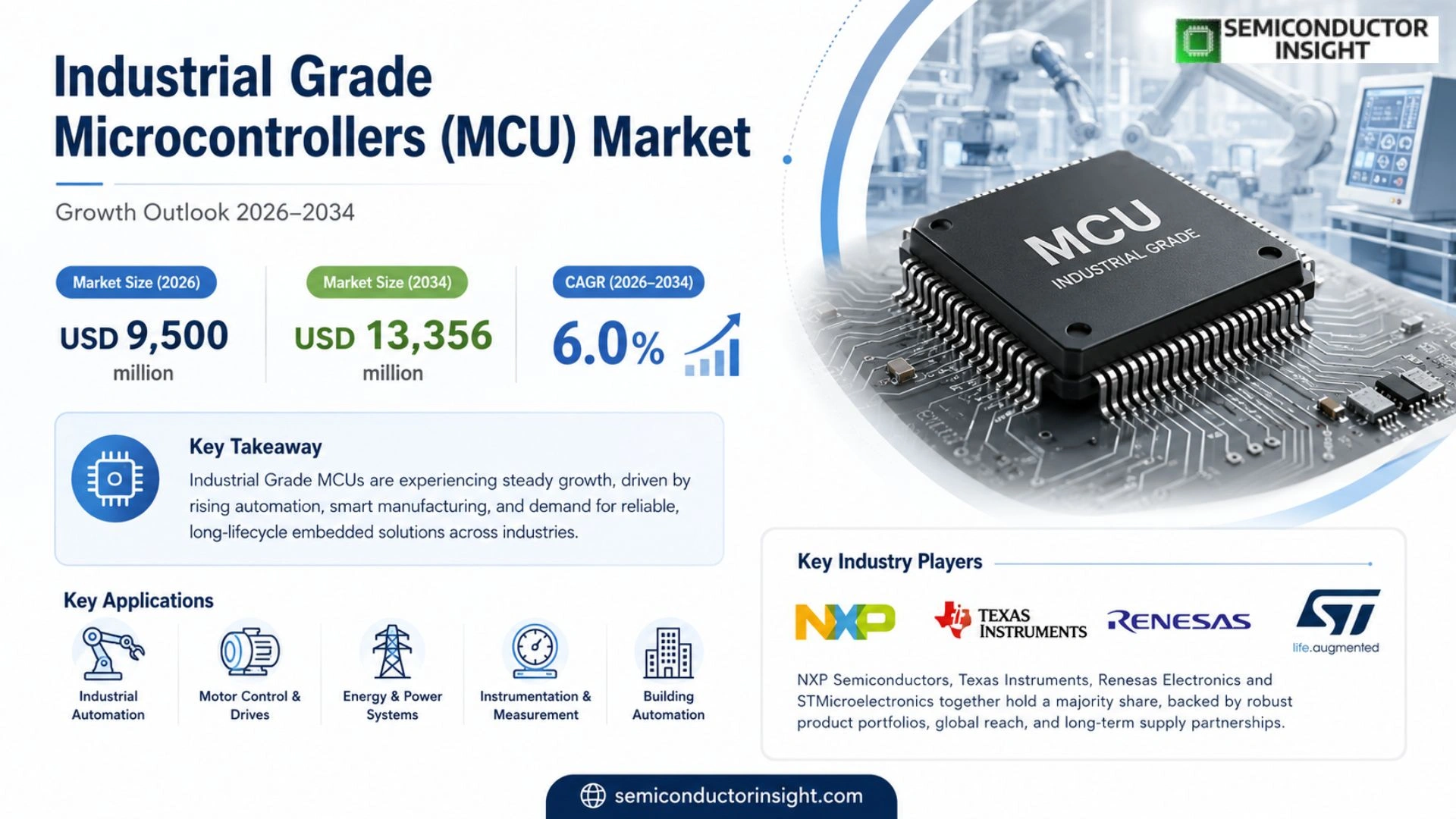
Global Industrial Grade Microcontrollers (MCU) market size was valued at USD 8,936 million in 2025. The market will expand from USD 9,500 million in 2026 to USD 13,356 million by 2032, reflecting a CAGR of 6.0% over the forecast horizon.
Industrial Grade Microcontrollers (MCU) are single‑chip controllers engineered for industrial control, instrumentation, motor drive, power electronics, industrial communication, building automation and IIoT applications. They integrate a CPU core, flash memory, SRAM, timers, ADC/DAC and PWM while often incorporating comparators, watchdogs, communication interfaces and secure encryption modules designed for wide‑temperature operation, EMI resistance and long‑term reliability.
The market is gaining momentum because manufacturers are upgrading automation lines, expanding energy‑management systems and adopting edge‑AI capabilities. Simultaneously customers place greater emphasis on real‑time response, low power consumption and robust certification; this shifts preference toward 32‑bit Arm Cortex‑M and RISC‑V architectures. As a result top IDM players with stable supply chains are consolidating their positions while domestic alternatives emerge for PLCs, servo drives and smart meters.
MARKET DRIVERS
Rising Automation in Manufacturing
The shift toward smart factories has compelled OEMs to adopt high‑performance control units capable of handling real‑time data streams. In 2024, more than 60 % of midsize manufacturers reported upgrading to industrial‑grade microcontroller solutions to reduce latency in production lines, a move that directly fuels demand for Industrial Grade Microcontrollers (MCU) Market.
Stringent Reliability Standards
Regulatory bodies across Europe and North America have tightened certification criteria for devices operating in harsh environments. Manufacturers seeking compliance are increasingly specifying microcontrollers with extended temperature ranges and error‑correction features, pushing the market toward premium pricing tiers.
➤ Edge‑centric designs are becoming a non‑negotiable attribute for next‑generation control architectures.
Concurrently, the proliferation of predictive maintenance platforms is creating a feedback loop: more data drives the need for processors that can execute analytics locally, reinforcing the growth trajectory of Industrial Grade Microcontrollers (MCU) Market.
MARKET CHALLENGES
Supply Chain Volatility
Global semiconductor shortages have extended lead times for critical components, forcing many buyers to hold larger safety stocks. This inventory pressure translates into higher upfront costs and can deter smaller firms from investing in advanced microcontroller platforms.
Other Challenges
Design Complexity
Engineers must balance power consumption, processing speed, and ruggedization within a single die, a trade‑off that lengthens development cycles and raises R&D expenditure.
MARKET RESTRAINTS
High Capital Outlay
The initial cost of integrating industrial‑grade MCU modules,often 30 % above standard consumer parts,acts as a barrier for cost‑sensitive sectors such as HVAC and agricultural equipment. This pricing premium can slow adoption in markets where margin compression is already intense.
Furthermore, many legacy systems rely on legacy architectures that are incompatible with newer microcontroller families. The requirement for extensive retrofitting adds another layer of expense that firms must evaluate before committing to a migration.
Finally, intellectual property constraints tied to proprietary core designs limit the ability of smaller players to source alternatives, reinforcing a concentration of supply among a handful of tier‑one vendors.
MARKET OPPORTUNITIES
Expansion into Renewable Energy Systems
Solar inverters and wind turbine controllers are increasingly reliant on microcontrollers that can operate under wide temperature swings while processing complex power‑conversion algorithms. This niche presents a sizable revenue avenue for suppliers that can certify their devices for IEC 61784‑2 standards.
In addition, the emergence of autonomous material handling robots creates demand for MCU architectures that support low‑power AI inference at the edge. Companies that embed neural‑network accelerators into their silicon can capture a share of the evolving logistics automation market.
Lastly, regional government incentives aimed at modernizing industrial infrastructure,particularly in Southeast Asia,are encouraging manufacturers to replace dated control units with robust microcontroller platforms, further widening the addressable market for Industrial Grade Microcontrollers (MCU) Market participants.
Industrial Grade Microcontrollers (MCU) Market Trends
Shift Toward Real‑Time Edge Control
The industrial sector is redefining control architecture by insisting on deterministic response times at the device edge. Customers are no longer satisfied with legacy MCUs that merely execute periodic tasks; they require processors capable of sub‑millisecond latency while maintaining low power draw. This shift reflects the broader move to decentralized automation, where each node must react autonomously to sensor inputs without relying on a central PLC. Manufacturers that embed high‑speed cores, hardware timers, and deterministic interrupt handling are gaining the confidence of OEMs seeking to reduce cycle times on motor drives and robotic axes. The consequence for the supply chain is a sharper focus on silicon architectures that balance throughput with thermal stability, prompting design houses to prioritize 32‑bit Cortex‑M and emerging RISC‑V families that offer predictable execution pipelines.
Other Trends
Security‑Centric MCU Designs
Industrial deployments now operate in environments where data integrity and device authentication are non‑negotiable. Recent incidents involving unauthorized firmware updates have forced vendors to embed cryptographic engines directly into the MCU silicon. By integrating secure boot, hardware‑based key storage, and tamper‑detect circuits, suppliers provide a trusted execution base that satisfies regulatory auditors and protects critical infrastructure. The ripple effect is evident in procurement specifications, where buyers rank security features alongside temperature range and lifecycle guarantees. Companies that can certify their MCUs against emerging industrial security standards are positioning themselves as preferred partners for edge‑AI gateways and smart‑meter networks.
Domestic Supply Chain Resilience
Lengthy import lead times and the strategic imperative to localize critical components have reshaped sourcing strategies across the globe. Nations are encouraging homegrown silicon initiatives, offering subsidies for wafer fabs and IP licensing that reduce dependency on overseas foundries. This policy environment encourages incumbent IDM players and new fabless entrants to develop domestically qualified MCU portfolios, especially for applications such as PLCs, servo drives, and energy‑storage controllers where long‑term availability is paramount. The business implication is a bifurcated market: multinational firms must negotiate dual‑track supply agreements, while regional manufacturers leverage proximity to end‑users to deliver faster design cycles and after‑sales support. As a result, product roadmaps increasingly feature modular firmware families that can be re‑targeted across multiple foundry processes without sacrificing certification continuity.
COMPETITIVE LANDSCAPE
Key Industry Players
Industrial Grade Microcontrollers (MCU) – Competitive Overview
The market is anchored by a handful of integrated device manufacturers (IDMs) that command the bulk of revenue through extensive product families, worldwide distribution networks, and long‑term supply contracts. NXP Semiconductors, Texas Instruments, Renesas Electronics and STMicroelectronics together account for more than half of global shipments, leveraging their deep analog and power‑management expertise to meet the stringent reliability criteria of industrial automation. Their breadth of 32‑bit Cortex‑M and RISC‑V offerings, combined with secure boot and encryption modules, creates a sticky ecosystem that discourages customers from switching platforms despite modest price differentials. Meanwhile, the midstream is populated by specialist design houses that partner with these IDMs to develop application‑specific MCU variants, reinforcing the concentration of power at the top of the value chain.
Beyond the dominant tier, a diverse set of regional and niche players is expanding the competitive set, often targeting cost‑sensitive segments or emerging applications such as edge‑AI sensing nodes. Companies such as GigaDevice, Sino Wealth Electronic, Shanghai Sinomcu and Shenzhen Chipsea have introduced MCUs with built‑in motor‑control peripherals and low‑power UART interfaces that appeal to domestic manufacturers looking to reduce import reliance. Meanwhile, firms like Holtek Semiconductor and Nuvoton focus on high‑integration 8‑bit and 16‑bit devices for legacy equipment upgrades, offering extended temperature ranges and guaranteed lifetime production runs. This bottom tier provides a counterbalance to the IDM dominance, fostering price competition and encouraging innovation in packaging and security features.
List of Key Industrial Grade Microcontrollers (MCU) Companies Profiled
- NXP Semiconductors
- Microchip Technology
- Renesas Electronics
- STMicroelectronics
- Infineon Technologies
- Texas Instruments
- Silicon Laboratories
- GigaDevice
- Sino Wealth Electronic
- Shanghai Sinomcu
- Shenzhen Chipsea
- Holtek Semiconductor
- Nuvoton
- Toshiba
- Qingdao Eastsoft
Segment Analysis:
| Segment Category | Sub-Segments | Key Insights |
| By Type |
|
32‑bit MCU is the dominant type due to its ability to handle complex algorithms and larger memory requirements.
|
| By Application |
|
PLC Controllers remain the core application driving MCU adoption in industrial settings.
|
| By End User |
|
Manufacturing Automation is the leading end‑user segment, shaping MCU feature priorities.
|
| By Architecture |
|
ARM Cortex‑M architecture dominates because of its extensive ecosystem and proven real‑time performance.
|
| By Functional Focus |
|
Real‑Time Control is the primary functional emphasis driving MCU differentiation.
|
Regional Analysis: Industrial Grade Microcontrollers (MCU) Market
North America
A dense network of research universities, venture capital, and niche fab facilities fuels continual MCU innovation. Collaborative programs between academia and defense contractors accelerate the integration of AI‑enabled safety cores, positioning North America to set industry benchmarks for reliability and intelligence.
Recent geopolitical shocks prompted firms to diversify wafer sources and stock critical substrates locally. Government‑backed incentives now subsidize on‑shoring of key process steps, mitigating lead‑time volatility for high‑specification industrial devices.
Stringent UL and IEC certifications are mandated for equipment used in aerospace and energy sectors. Compliance frameworks have been harmonized across states, reducing testing duplication and allowing faster market entry for compliant MCU families.
End users prioritize deterministic latency, extended temperature range, and integrated security. This focus drives vendors to embed hardware‑rooted encryption and watchdog timers, creating a value‑added proposition that justifies premium pricing structures.
Europe
European manufacturers leverage the region’s strong standards‑driven environment to adopt industrial‑grade MCUs that meet rigorous electromagnetic compatibility and functional safety directives. Automotive manufacturers, especially in Germany and France, seek devices that seamlessly integrate with over‑the‑air update mechanisms, enabling post‑deployment performance tuning. Energy utilities across the continent are modernizing substations, demanding MCUs with built‑in redundancy and fault‑tolerant architectures. While domestic fab capacity remains modest, strategic partnerships with Asian foundries ensure access to leading‑edge process nodes, allowing European firms to focus on system‑level differentiation rather than wafer production. The cumulative effect is a market that values certification compliance and long‑term component support over sheer cost advantage.
Asia‑Pacific
The Asia‑Pacific region exhibits a rapid shift from cost‑centric sourcing to quality‑centric adoption, driven by burgeoning investment in smart manufacturing hubs in China, South Korea, and Taiwan. OEMs in these economies increasingly require MCUs that can operate reliably in high‑humidity, dust‑laden factory floors while supporting localized AI inference for predictive maintenance. Government programs that promote “Industry 4.0” acceleration have paved the way for joint ventures between local designers and global semiconductor leaders, creating a hybrid supply chain that blends inexpensive silicon with advanced packaging. Though price pressure persists, the emphasis on durability and integrated connectivity is reshaping procurement criteria across the region.
South America
South American industrial sectors, notably mining and agribusiness, are upgrading legacy control systems to incorporate rugged MCUs capable of handling severe environmental stressors. Brazil’s recent infrastructure stimulus has spurred demand for automation solutions that can endure high temperatures and power fluctuations common in remote operations. Local distributors are prioritizing vendors that provide extended warranty and on‑site technical assistance, reflecting a market preference for reliability over minimal upfront cost. The growing focus on sustainability also drives interest in MCUs that support energy‑efficient motor control, aligning with regional carbon‑reduction targets.
Middle East & Africa
In the Middle East and Africa, oil‑and‑gas, as well as water‑treatment facilities, dominate the demand for industrial‑grade microcontrollers. Harsh desert climates and high salinity environments necessitate MCUs with superior corrosion resistance and temperature tolerance. Regional projects, especially in the United Arab Emirates and Saudi Arabia, are integrating IoT‑enabled MCUs to enable real‑time monitoring of pipeline integrity, a move that also satisfies escalating regulatory scrutiny on environmental impact. African markets, while smaller, are beginning to adopt modular MCU platforms that allow incremental upgrades, reflecting a cautious but forward‑looking approach to digital transformation.
Report Scope
This market research report provides a comprehensive analysis of the Industrial Grade Microcontrollers (MCU) Market , covering the forecast period 2026–2034. It offers detailed insights into market dynamics, technological advancements, competitive landscape, and key trends shaping the industry.
Key focus areas of the report include:
- Market Overview: The report begins with an overview outlining its current market scenario, key growth indicators, and industry transformation drivers. It discusses macroeconomic factors, demand–supply balance, regulatory landscape, and the strategic role of semiconductors in powering advancements across industries such as automotive, telecommunications, consumer electronics, and industrial automation.
- Market Size & Forecast: Historical data and future projections for revenue, unit shipments, and market value across major regions and segments.
- Segmentation Analysis: Detailed breakdown by product type, technology, application, and end-user industry to identify high-growth segments and investment opportunities.
- Regional Insights: Insights into market performance across North America, Europe, Asia-Pacific, Latin America, and the Middle East & Africa, including country-level analysis where relevant.
- Competitive Landscape: Profiles of leading market participants, including their product offerings, R&D focus, manufacturing capacity, pricing strategies, and recent developments such as mergers, acquisitions, and partnerships.
- Technology Trends & Innovation: Assessment of emerging technologies, integration of AI/IoT, semiconductor design trends, fabrication techniques, and evolving industry standards.
- Market Drivers & Restraints: Evaluation of factors driving market growth along with challenges, supply chain constraints, regulatory issues, and market-entry barriers.
- Stakeholder Insights: Insights for component suppliers, OEMs, system integrators, investors, and policymakers regarding the evolving ecosystem and strategic opportunities.
Primary and secondary research methods are employed, including interviews with industry experts, data from verified sources, and real-time market intelligence to ensure the accuracy and reliability of the insights presented.
FREQUENTLY ASKED QUESTIONS:
What is the current market size of Industrial Grade Microcontrollers (MCU) Market?
-> Industrial Grade Microcontrollers (MCU) Market was valued at USD 8,936 million in 2025 and is expected to reach USD 13,356 million by 2032, growing at a CAGR of 6.0% during the forecast period.
Which key companies operate in Industrial Grade Microcontrollers (MCU) Market?
-> Key players include NXP Semiconductors, Microchip Technology, Renesas Electronics, STMicroelectronics, Infineon Technologies, Texas Instruments, Cypress Semiconductor, Silicon Laboratories, Nuvoton, Toshiba, Holtek Semiconductor, Sino Wealth Electronic, GigaDevice, Sonix Technology, Qingdao Eastsoft, Shanghai Sinomcu, Shenzhen Chipsea, Shanghai MindMotion.
What are the key growth drivers?
-> Key growth drivers include industrial automation upgrades, energy management, intelligent manufacturing, industrial Internet of Things, domestic substitution, efficient motor control, and digital transformation of equipment.
Which region dominates the market?
-> Asia-Pacific holds a significant share of Industrial Grade Microcontrollers market, driven by extensive industrial manufacturing and strong demand for automation solutions.
What are the emerging trends?
-> Emerging trends include high‑performance real‑time control MCUs, low‑power sensing node MCUs, industrial communication MCUs, motor‑control dedicated MCUs, MCUs with secure encryption and edge‑AI capabilities, and domestically produced alternatives for PLCs, servos, energy‑storage and charging‑pile applications.
Get Sample Report PDF for Exclusive Insights
Report Sample Includes
- Table of Contents
- List of Tables & Figures
- Charts, Research Methodology, and more...
 Download Sample Report PDF