Peltier Electronic Cooler Market Insights
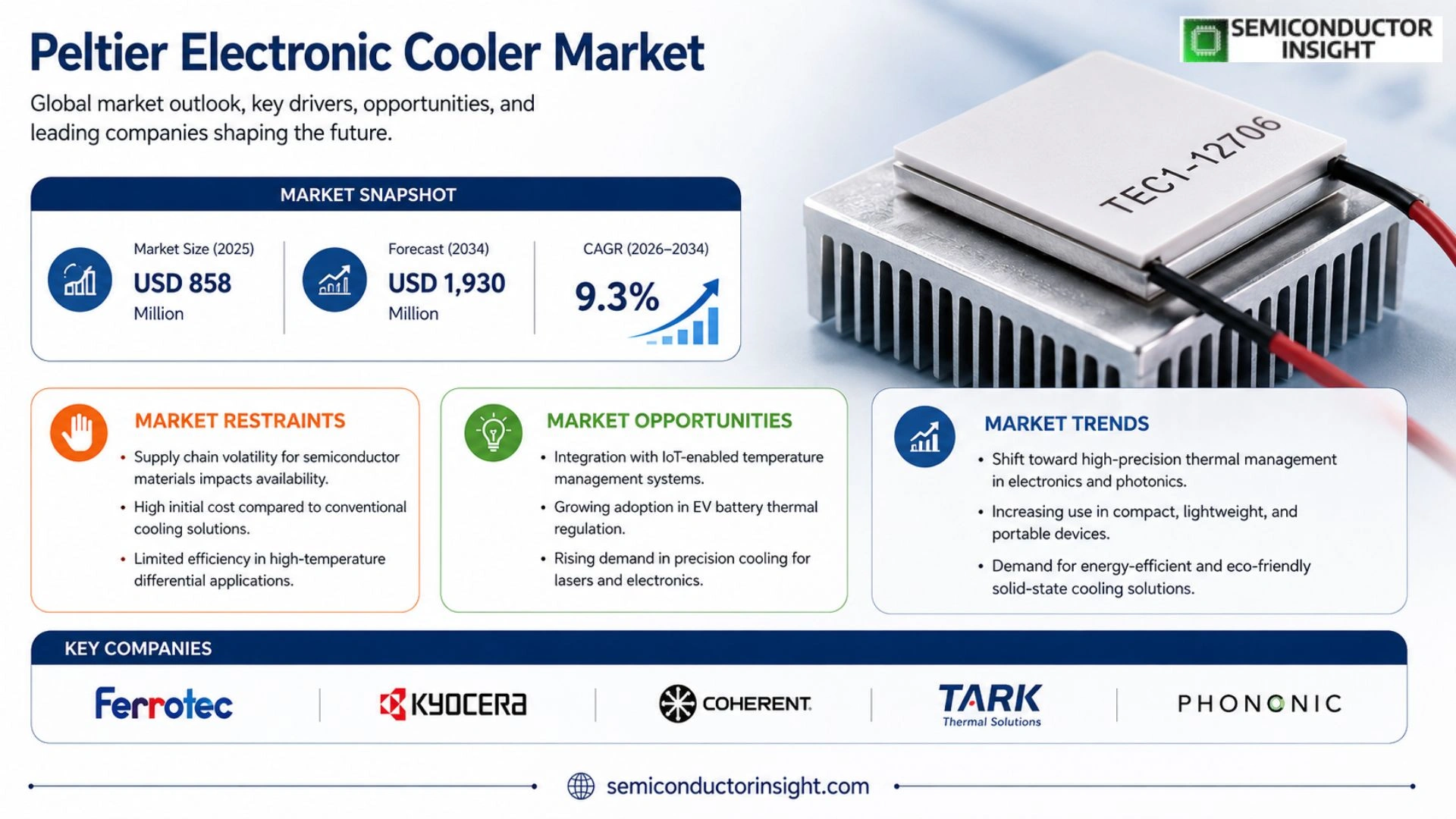
Global Peltier Electronic Cooler market was valued at USD 858 million in 2025. The market is forecasted to increase from USD 861 million in 2026 to USD 1 930 million by 2034, exhibiting a CAGR of approximately 9.3% during the forecast period.
A Peltier Electronic Cooler is a solid‑state thermal‑management device that exploits the Peltier effect to deliver active cooling and precise temperature control. It comprises alternating p‑type and n‑type semiconductor elements sandwiched between ceramic substrates together with electrodes and thermal interface materials; when direct current flows, one side absorbs heat while the opposite side rejects it, providing compact, fast‑response cooling without refrigerants that can be reversed simply by changing current direction.
This technology is employed in optical communication modules, high‑power lasers, semiconductor manufacturing equipment, medical laboratory instruments, automotive battery thermal management, consumer electronics, industrial sensors and aerospace/defence systems where localized temperature stability, low vibration and rapid cycling are essential.
MARKET DRIVERS
Thermal Efficiency Demands Across Industries
Peltier Electronic Cooler Market is being propelled by manufacturers that require precise thermal regulation for high‑performance electronics, medical devices, and aerospace components. As product miniaturisation intensifies, traditional refrigerants struggle to meet space constraints, prompting designers to adopt solid‑state cooling modules that deliver rapid temperature adjustments without moving parts. This shift translates into lower vibration levels and higher reliability for mission‑critical applications.
Cost Advantages of Solid‑State Cooling
Operating expenses are declining as the manufacturing yield of thermoelectric modules improves. Automation in semiconductor fabrication has trimmed per‑unit costs by an estimated 12% over the past three years, allowing end‑users to replace legacy compressor‑based systems without a prohibitive price premium. The resulting reduction in maintenance labour, coupled with the absence of refrigerant‑handling fees, creates a compelling total‑cost‑of‑ownership narrative for adopters.
➤ “Solid‑state cooling cuts preventive‑maintenance cycles by roughly one‑third, freeing up engineering resources for product innovation.”
These efficiency gains also reinforce sustainability agendas, as the elimination of ozone‑depleting gases aligns with stricter environmental regulations worldwide. Companies that integrate Peltier coolers can therefore present greener product portfolios while preserving performance benchmarks.
MARKET CHALLENGES
Reliability Concerns Under Extreme Conditions
Despite advances, Peltier Electronic Cooler Market still wrestles with durability issues when exposed to harsh temperature gradients. Thermal fatigue can degrade the junction integrity of bismuth‑telluride elements, leading to premature power loss. End users in automotive and outdoor equipment sectors demand rigorous qualification testing, which inflates development timelines and raises entry barriers for newer suppliers.
Other Challenges
Material Constraints
The scarcity of high‑purity tellurium and the geopolitical concentration of its mining operations impose supply‑risk premiums. Manufacturers that cannot secure stable raw‑material contracts face price volatility that erodes margin flexibility, particularly when competing against larger incumbents with diversified sourcing strategies.
MARKET RESTRAINTS
Supply Chain Volatility for Semiconductor Materials
The ability of Peltier Electronic Cooler Market to scale is constrained by periodic shortages in semiconductor wafers and thermoelectric alloys. Lead times for high‑efficiency chips have stretched from weeks to several months during recent global chip shortages, prompting OEMs to keep larger safety stocks. This inventory pressure translates into elevated working‑capital requirements and dampens aggressive rollout plans for new cooling solutions.
MARKET OPPORTUNITIES
Integration with IoT‑Enabled Temperature Management
Embedding Peltier coolers within connected devices unlocks adaptive thermal control driven by real‑time data analytics. As manufacturers deploy edge‑compute platforms, they can calibrate cooling power on demand, extending component lifespan and reducing overall energy draw. This convergence creates a niche for modular, software‑controlled cooler kits that appeal to smart‑factory and wearable‑technology makers.
Furthermore, emerging standards for low‑power refrigeration in electric‑vehicle battery packs present a sizable upside. By fine‑tuning cell temperatures through solid‑state modules, automotive firms can improve charge‑acceptance rates and mitigate thermal runaway risks, positioning Peltier Electronic Cooler Market as an enabler of next‑generation EV performance.
Peltier Electronic Cooler Market Trends
Shift Toward High‑Precision Thermal Management
The demand profile for Peltier Electronic Coolers is moving from generic consumer appliances toward applications that require tight temperature stability and rapid response. Optical‑communication modules, laser systems, and semiconductor test rigs now prioritize cycle life and heat‑flux density over sheer cooling capacity. This shift explains why manufacturers such as Kyocera and Coherent are launching products that increase maximum heat absorption by more than 20 % while guaranteeing 100,000 thermal cycles. The trend matters because customers in medical diagnostics and automotive battery thermal control are willing to pay premium prices for modules that combine compactness with reproducible performance, thereby expanding the overall value chain and pressuring low‑margin bulk suppliers.
Other Trends
Supply‑Side Realignment in Asia
Raw‑material sourcing continues to be dominated by Japanese and European providers of bismuth‑telluride and high‑purity copper laminates, yet Chinese manufacturers are scaling single‑line capacities to between 500,000 and 1 million units. The ability to offer 30‑40 % gross margins while maintaining stable batch delivery has drawn major OEMs such as Bosch and Huawei toward local suppliers. As domestic substitution accelerates, Chinese firms are also investing in extrusion and ceramic‑substrate technologies, reducing dependence on imported extruded aluminum. The result is a more competitive pricing environment that forces legacy players to differentiate through reliability testing and longer warranty cycles rather than cost alone.
Integration of Thermoelectric Modules into System‑Level Solutions
Beyond stand‑alone coolers, system integrators are embedding TECs into cold‑plate assemblies, liquid‑cooling loops, and closed‑loop temperature controllers. Phononic’s 2025 roadmap, which highlights deployments exceeding 25 million units in AI‑compute and data‑center infrastructure, illustrates how the module is becoming a building block rather than an end product. This integration drives a demand for standardized electrical interfaces and predictive‑maintenance analytics, creating opportunities for downstream software vendors. Companies that can bundle thermoelectric hardware with control electronics and service contracts are positioned to capture a larger share of the expanding high‑precision market while mitigating competition from traditional vapor‑compression solutions.
COMPETITIVE LANDSCAPE
Key Industry Players
Global Peltier Electronic Cooler Competitive Overview
Ferrotec, Kyocera and Coherent dominate the high‑reliability segment, where customers such as telecom equipment makers and aerospace integrators demand consistent cycle life and stringent quality assurance. These firms leverage long‑standing material sourcing agreements in Japan and Europe, allowing them to secure premium bismuth‑telluride grades and maintain tight process control. Their product portfolios span single‑stage, multi‑stage and custom‑geometry modules, each engineered to meet the thermal budget of optical networking and laser systems. Because the downstream buyers prioritize warranty performance and reproducibility, the premium pricing of these manufacturers is justified, and they retain a defensible share of the global revenue despite rising cost pressure from low‑cost alternatives.
Chinese manufacturers,including Guangdong Fuxin Technology, Zhejiang Wangu Semiconductor, and Hangzhou Aurin Cooling Device,have built extensive domestic supply chains for aluminium extrusions, copper laminates and bulk thermoelectric material. Their ability to scale single‑stage production to volumes of up to one million units per year has introduced competitive pricing in consumer electronics, automotive seat‑temperature control and mid‑range industrial sensors. Niche players such as ARCTIC TEC, Thermion Company and Same Sky provide specialized custom‑shaped or center‑hole designs that cater to emerging AI‑server cooling and high‑density photonic packages. This diversification creates a multi‑tiered market where cost‑sensitive segments are served by mass producers, while high‑performance niches remain the preserve of legacy brands.
List of Key Peltier Electronic Cooler Companies Profiled
- Ferrotec
- Kyocera
- Coherent Corp
- Tark Thermal Solutions
- Phononic
- Guangdong Fuxin Technology
- ARCTIC TEC
- KELK Ltd.
- Thermion Company
- Same Sky
- TEC Microsystems GmbH
- Peltron GmbH
- Zhejiang Wangu Semiconductor
- Hangzhou Aurin Cooling Device
- Thermo Fisher Scientific (as major end‑user)
Segment Analysis:
| Segment Category | Sub-Segments | Key Insights |
| By Type |
|
Multi‑stage Type
|
| By Application |
|
Communication
|
| By End User |
|
System Integrators
|
| By Materials |
|
Bismuth‑Telluride Alloys
|
| By Technology |
|
Micro TEC Devices
|
Regional Analysis: Peltier Electronic Cooler Market
North America
Device makers targeting wearables, ultra‑thin laptops, and VR headsets increasingly select Peltier coolers to meet aggressive thermal budgets without compromising form factor. The absence of moving parts dovetails with design aesthetics, enabling brands to market devices as both high‑performance and low‑maintenance.
Process‑control equipment in semiconductor fabs and laser machining stations relies on precise temperature regulation. Peltier modules afford rapid response to load variations, a characteristic prized by operators seeking to minimise cycle times and scrap rates.
Universities and private labs across the region experiment with nanostructured bismuth‑telluride alloys, propelling efficiency gains that could lower power consumption by double‑digit percentages, a compelling value proposition for battery‑dependent platforms.
Federal incentives for low‑energy components encourage system integrators to substitute conventional refrigerants with thermoelectric alternatives, aligning product roadmaps with broader carbon‑reduction targets.
Europe
European manufacturers leverage a dense network of specialized suppliers that focus on high‑precision Peltier assemblies for scientific instrumentation and automotive thermal management. The region’s emphasis on compliance with rigorous safety and electromagnetic standards forces vendors to adopt stricter quality controls, which, in turn, raises confidence among downstream adopters. Collaborative projects funded by the EU’s Horizon programme stimulate cross‑border research, yielding incremental performance improvements that feed directly into commercial offerings. Consequently, European firms often command premium pricing for modules that can demonstrate validated reliability over extended operational cycles.
Asia‑Pacific
The Asia‑Pacific arena is characterised by a rapid escalation in demand for consumer gadgets that incorporate solid‑state cooling, particularly in mobile devices and emerging IoT hardware. Local contract manufacturers benefit from cost‑effective production facilities, allowing them to scale volumes while keeping price points attractive for mass‑market brands. At the same time, national initiatives in China, South Korea, and Japan promote green technology adoption, nudging OEMs toward thermoelectric solutions that minimize refrigerant use. This policy backdrop, combined with a talent pool adept at high‑density packaging, fuels a competitive environment where speed to market often outweighs marginal efficiency gains.
South America
In South America, the adoption curve for Peltier electronic coolers is accelerating within niche sectors such as renewable‑energy storage and agricultural equipment. Companies operating in remote locations prize the reliability of solid‑state cooling, which reduces maintenance trips and downtime. Local distributors are beginning to stock a broader array of module sizes, reflecting an awareness that bespoke thermal solutions can unlock performance improvements in legacy machinery. Although overall market size remains modest, the region’s focus on rugged, low‑maintenance designs presents a fertile ground for targeted product introductions.
Middle East & Africa
The Middle East & Africa region exhibits growing interest in Peltier cooling for data‑center auxiliary systems and portable medical devices used in field clinics. Harsh ambient temperatures drive the need for compact, energy‑efficient cooling that does not rely on extensive HVAC infrastructure. Partnerships between regional engineering firms and overseas component providers have started to yield customized solutions that address both climatic challenges and cost sensitivities. As infrastructure projects expand across the Gulf and sub‑Saharan markets, the demand for reliable thermoelectric cooling is likely to translate into incremental but steady market participation.
Report Scope
This market research report provides a comprehensive analysis of the Peltier Electronic Cooler Market , covering the forecast period 2026–2034. It offers detailed insights into market dynamics, technological advancements, competitive landscape, and key trends shaping the industry.
Key focus areas of the report include:
- Market Overview: The report begins with an overview outlining its current market scenario, key growth indicators, and industry transformation drivers. It discusses macroeconomic factors, demand–supply balance, regulatory landscape, and the strategic role of semiconductors in powering advancements across industries such as automotive, telecommunications, consumer electronics, and industrial automation.
- Market Size & Forecast: Historical data and future projections for revenue, unit shipments, and market value across major regions and segments.
- Segmentation Analysis: Detailed breakdown by product type, technology, application, and end-user industry to identify high-growth segments and investment opportunities.
- Regional Insights: Insights into market performance across North America, Europe, Asia-Pacific, Latin America, and the Middle East & Africa, including country-level analysis where relevant.
- Competitive Landscape: Profiles of leading market participants, including their product offerings, R&D focus, manufacturing capacity, pricing strategies, and recent developments such as mergers, acquisitions, and partnerships.
- Technology Trends & Innovation: Assessment of emerging technologies, integration of AI/IoT, semiconductor design trends, fabrication techniques, and evolving industry standards.
- Market Drivers & Restraints: Evaluation of factors driving market growth along with challenges, supply chain constraints, regulatory issues, and market-entry barriers.
- Stakeholder Insights: Insights for component suppliers, OEMs, system integrators, investors, and policymakers regarding the evolving ecosystem and strategic opportunities.
Primary and secondary research methods are employed, including interviews with industry experts, data from verified sources, and real-time market intelligence to ensure the accuracy and reliability of the insights presented.
FREQUENTLY ASKED QUESTIONS:
What is the current market size of Peltier Electronic Cooler Market?
-> Global Peltier Electronic Cooler market is forecasted to increase from USD 861 million in 2026 to USD 1 930 million by 2034, exhibiting a CAGR of 9.3%
Which key companies operate in Peltier Electronic Cooler Market?
-> Key players include Ferrotec, KELK Ltd., Kyocera, Coherent Corp, Tark Thermal Solutions, Phononic, Guangdong Fuxin Technology, ARCTIC TEC, KJLP, Thermion Company, Z-MAX, Zhejiang Wangu Semiconductor, Xianghe Oriental Electronic, Thermonamic Electronics, TE Technology, P&N Technology, AISIN Corporation, Sensor Controls Co., Ltd., Wakefield Thermal, Same Sky, TEC Microsystems GmbH, Peltron GmbH, Kryotherm Industries, Crystal Ltd, Liaoning Lengxin Technology, Thermoelectric New Energy Technology, Jianju Technology, Bi Sheng Semiconductor, Henan Hongchang Electronic, Wei County Zhongtian Electron Stock Cooperative, Beijing Xinyu Kaimeng Electronic Technology, Beijing Huimao Refrigeration Equipment, Hangzhou Aurin Cooling Device, Henan Guanjing Semiconductor Technology, and Hubei Sagreon New Energy Technology.
What are the key growth drivers?
-> Key growth drivers include the shift toward high‑precision temperature control in optical modules, lasers, medical testing, and semiconductor equipment; expanding automotive thermal‑management applications such as battery and seat temperature control; rising power density in AI computing, 800G/1.6T optical networking, and data‑center servers; and increasing demand for compact, fast‑response solid‑state cooling solutions.
Which region dominates the market?
-> Asia‑Pacific dominates the market owing to large‑scale manufacturing capacity in China and strong demand from automotive and consumer electronics, while Japan and Europe retain leadership in high‑end material supply and reliability‑critical applications.
What are the emerging trends?
-> Emerging trends include development of high heat‑flux, low‑power TEC modules; integration of thermoelectric coolers with cold plates, liquid‑cooling loops, and intelligent temperature controllers; solid‑state thermal solutions for next‑generation AI servers and data‑center infrastructure; and enhanced cycle‑life reliability targeting over 100,000 thermal cycles.
Get Sample Report PDF for Exclusive Insights
Report Sample Includes
- Table of Contents
- List of Tables & Figures
- Charts, Research Methodology, and more...
 Download Sample Report PDF