Peltier Thermoelectric Cooler Market Insights
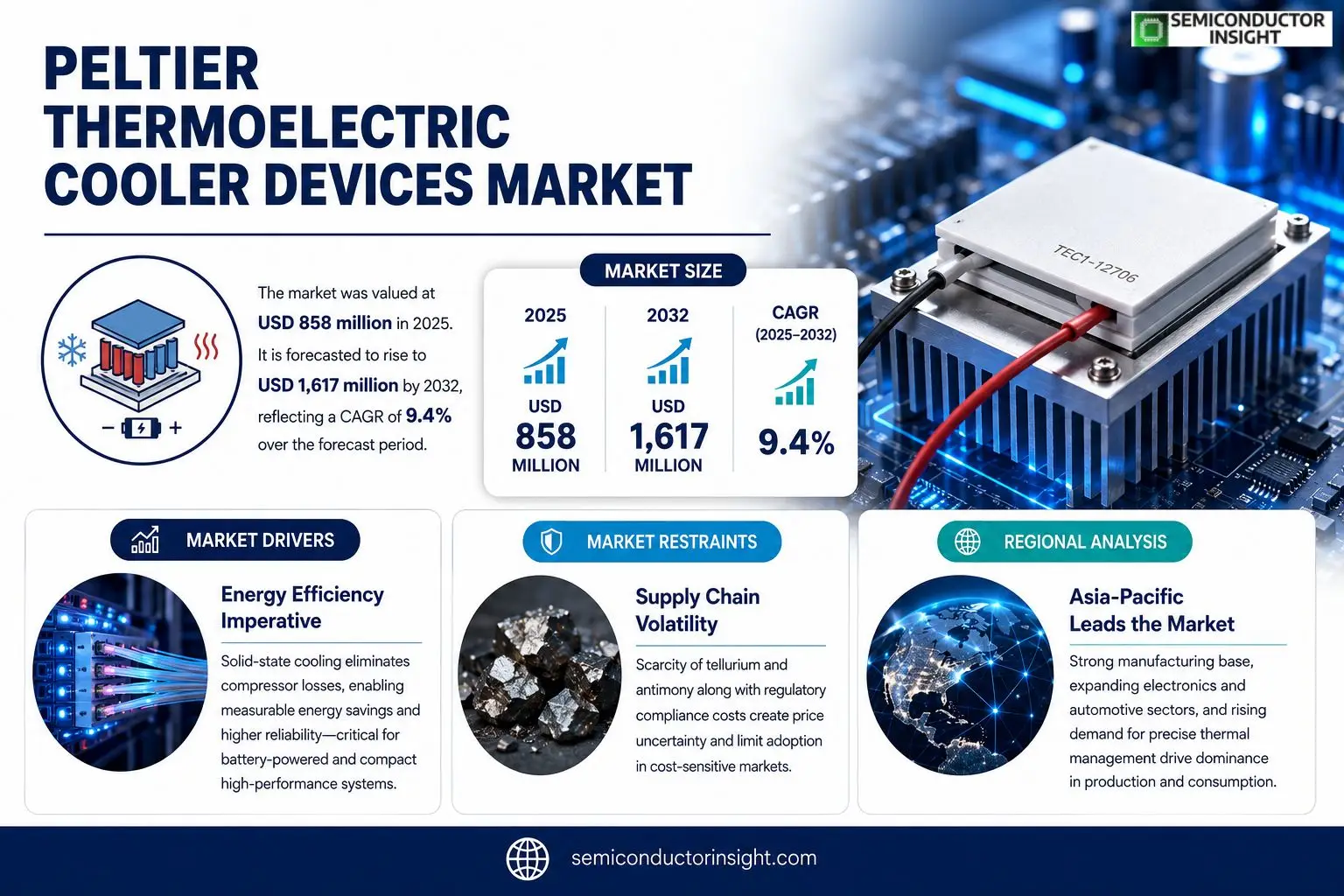
Peltier Thermoelectric Cooler market was valued at USD 858 million in 2026 and will rise to USD 1 ,617 million by 2034, delivering a compound annual growth rate of 9.4%.
Peltier Thermoelectric Cooler is a solid‑state thermal management device that exploits the Peltier effect to generate active cooling and precise temperature control. It consists of alternating p‑type and n‑type semiconductor elements sandwiched between ceramic substrates together with electrodes and thermal‑interface layers. When direct current passes through the module, one side absorbs heat while the opposite side rejects it, providing rapid response without moving parts or refrigerants. This architecture makes the technology attractive for optical communication modules, laser systems, semiconductor manufacturing equipment, medical instrumentation, automotive thermal management, consumer electronics, industrial sensors and aerospace/defense applications where localized cooling or tight temperature stability is required.
MARKET DRIVERS
Rising Demand for Compact Cooling Solutions
The surge in portable electronicsranging from wearables to handheld diagnosticshas forced manufacturers to seek cooling technologies that occupy minimal board space while delivering reliable temperature control. Peltier Thermoelectric Cooler Market participants are benefitting from this shift, as solid‑state modules replace bulky compressors in many designs.
Energy‑Efficiency Imperatives Across Industries
Regulatory pressure to reduce carbon footprints has accelerated adoption of low‑power thermal management. Companies that can demonstrate a 20‑30 % reduction in power draw compared with traditional vapor‑compression systems are securing contracts in automotive HVAC and data‑center auxiliary cooling.
➤ “Clients prioritize reliability and size over outright cooling capacity, giving solid‑state solutions a clear edge in niche markets.”
Beyond performance, the absence of moving parts translates into lower maintenance cycles, a factor that resonates strongly with OEMs seeking long‑term cost predictability.
MARKET CHALLENGES
High Unit Cost Relative to Conventional Systems
Despite their technical merits, thermoelectric modules remain priced 1.5‑2 times higher than comparable compressor‑based units. This premium limits penetration into price‑sensitive segments such as mass‑market consumer appliances.
Other Challenges
Thermal Performance Ceiling
The maximum temperature differential that a single Peltier element can sustain caps at roughly 70 °C, constraining its suitability for heavy‑duty industrial cooling without multi‑stage designs.Integration complexity also poses a hurdle; designers must manage heat‑sink geometry, electrical control loops, and vibration isolation simultaneously, which can extend development timelines.
MARKET RESTRAINTS
Material and Manufacturing Limitations
The scarcity of high‑purity bismuth‑telluride compounds drives lead times and pushes unit costs upward, creating supply‑chain bottlenecks for manufacturers aiming to scale volume.Heat‑dissipation efficiency remains a secondary concern; inadequate fin design or sub‑optimal airflow can negate the benefits of solid‑state cooling, resulting in customer dissatisfaction.Regulatory scrutiny around the use of telluriumclassified as a hazardous material in several jurisdictionsadds compliance overhead, especially for companies exporting to regions with strict environmental standards.
MARKET OPPORTUNITIES
Growth in Edge‑Computing and IoT Devices
Edge servers and rugged IoT gateways often operate in confined enclosures where traditional fans cannot be accommodated. Thermoelectric coolers, with their silent operation and modular form factor, present a compelling alternative, opening new revenue streams for niche players.The push toward renewable energy integration is another catalyst; solar‑powered off‑grid installations require low‑maintenance thermal management that can be powered directly from DC sources, aligning perfectly with the attributes of solid‑state cooling.Customization servicesincluding variable‑capacity modules and integrated heat‑pipe assembliesare emerging as differentiators, allowing suppliers to command premium pricing while addressing specific application constraints.
Peltier Thermoelectric Cooler Market Trends
Shift Toward Precision Thermal Management
The Peltier Thermoelectric Cooler Market recorded a revenue of roughly $858 million in 2026 and is forecasted to climb to about $1,617 million by 2034. Production volumes in 2026 reached 226,573 K units, with an average selling price near $4,149 per K units. This pricing level reflects the premium placed on the device’s solid‑state architecture, which eliminates moving parts and refrigerants while delivering rapid temperature modulation. Suppliers are achieving gross margins of 30‑40 %, supported by single‑line capacities that span 500,000 to 1 million pieces depending on the manufacturer’s scale and technology stack. The combination of rising unit price, healthy margins, and expanding capacity indicates a resilient commercial foundation for the sector.
Other Trends
Emergence of High‑Value Application Segments
Demand is migrating from generic consumer cooling to sectors that prize temperature steadiness and miniaturisation. Optical communication modules, laser systems, and semiconductor testing rigs now account for an increasing share of orders because they require tighter thermal tolerances than conventional small‑appliance cooling. Automotive battery packs and seat‑temperature control are gaining attention after recent launches, such as Kyocera’s 2024 module that lifted maximum heat absorption by 21 %. Simultaneously, AI‑driven data‑center servers and 800 Gb/s optical networking equipment are driving the need for compact, high‑efficiency heat‑flux solutions. These niches support higher price points and justify the development of customized geometry and multi‑stage designs, reinforcing the market’s tilt toward precision‑oriented deployments.
Competitive Landscape and Regional Dynamics
From a supply standpoint, Japanese and European firms continue to dominate the high‑end material supply chain, leveraging consistent bismuth‑telluride quality and long‑term reliability track records. Chinese manufacturers, meanwhile, have accelerated large‑scale output and are building domestic sourcing capabilities for extruded aluminium and copper‑clad laminates. This dual‑track structure creates a competitive tension: cost‑driven manufacturers can undercut prices in standard‑TEC categories, while legacy players retain market share in applications where cycle life and batch‑to‑batch stability are non‑negotiable. Over the medium term, the expanding Chinese capacity and local support infrastructure are likely to reshape pricing curves, prompting established vendors to emphasize advanced packaging, integrated cold‑plate solutions, and extended cycle‑life guarantees.
COMPETITIVE LANDSCAPEKey Industry Players
Competitive dynamics of the Peltier Thermoelectric Cooler market, 2026‑2034
The upper tier of the market is anchored by firms that combine high‑purity material sourcing with extensive reliability testing programs. Ferrotec, with its long history in bismuth‑telluride production, controls a sizeable share of the high‑end segment, supplying OEMs in optical communications and aerospace where cycle life and temperature stability are non‑negotiable. Kyocera’s recent module upgrade, which lifted heat‑absorption capacity by over 20%, reinforces its foothold in automotive thermal‑management and medical instrument applications, where precise temperature control drives premium pricing. Parallel to these, Coherent and Phononic have differentiated themselves through system‑level offerings that embed TEC modules into cold‑plate and controller assemblies, targeting data‑center AI servers and next‑generation photonic networks. This concentration of expertise creates a tiered supply chain in which Japanese and European players dominate the specification‑driven niche, while strategically positioned U.S. companies capture high‑margin integration projects.Beyond the leaders, a dense cluster of specialized manufacturers competes on volume, cost efficiency, and regional support. Chinese firms such as Guangdong Fuxin Technology, Zhejiang Wangu Semiconductor, and Xianghe Oriental Electronic have leveraged domestic raw‑material pipelines to rapidly scale standard‑TEC production, pressuring price points in consumer‑electronics and industrial sensor markets. KELK Ltd. (Komatsu) and Tark Thermal Solutions focus on ruggedized modules for automotive battery cooling and seat‑temperature systems, carving out mid‑range reliability niches. Emerging players including ARCTIC TEC, Thermion Company, and Z‑MAX are pursuing niche applicationshigh‑frequency laser equipment and portable medical diagnosticsby offering custom‑shaped packages and accelerated development cycles. The breadth of this ecosystem suggests that while brand‑centric firms retain the most lucrative contracts, the expanding base of cost‑competitive manufacturers widens market access and fuels incremental adoption across multiple sectors.
List of Key Peltier Thermoelectric Cooler Companies Profiled
- Ferrotec
- Kyocera
- Coherent Corp
- Phononic
- KELK Ltd. (Komatsu)
- Guangdong Fuxin Technology
- ARCTIC TEC
- Tark Thermal Solutions
- Thermion Company
- Z‑MAX
- Zhejiang Wangu Semiconductor
- Xianghe Oriental Electronic
- AISIN Corporation
- TEC Microsystems GmbH
- Peltron GmbH
Segment Analysis:
| Segment Category | Sub-Segments | Key Insights |
| By Type |
|
Single‑stage
|
| By Application |
|
Communication
|
| By End User |
|
OEMs
|
| By Material |
|
Bismuth Telluride
|
| By Integration Level |
|
Complete Thermoelectric Systems
|
Regional Analysis: Peltier Thermoelectric Cooler Market
North America
High‑mix, low‑volume fabs in the Midwest have adopted modular assembly lines that can be reconfigured for different thermoelectric plate configurations, reducing change‑over time and supporting bespoke client specifications.
Silicon‑valley incubators host multidisciplinary teams that blend semiconductor expertise with thermal management, producing next‑generation cooler architectures that push efficiency envelopes.
Regional sourcing of bismuth‑telluride alloys mitigates exposure to Asian export volatility, allowing manufacturers to maintain steady production schedules.
Harmonized UL and IEC standards simplify cross‑border certification, encouraging OEMs to integrate thermoelectric coolers into a broader range of consumer and industrial products.
Europe
European firms are capitalising on the region’s strong emphasis on sustainability, integrating Peltier cooling solutions into energy‑efficient refrigeration for the food‑service sector. Collaborative programs between German research institutes and French manufacturers accelerate material‑science breakthroughs that lower waste heat, aligning with the EU’s circular‑economy objectives. The regulatory environment, while rigorous, offers a clear roadmap for compliance, enabling faster market entry for devices targeting medical imaging equipment. Consequently, Europe is emerging as a strategic market for companies seeking to differentiate through eco‑friendly product portfolios.
Asia‑Pacific
Asia‑Pacific presents a paradox of rapid adoption and fragmented supply chains. Chinese manufacturers benefit from scale economies, yet face pressure to upgrade from legacy bulk‑cooling designs to high‑efficiency solid‑state modules demanded by smartphone and wearables producers in South Korea and Japan. Regional trade agreements are easing component movement, while government incentives for high‑tech exports stimulate R&D investment in novel thermoelectric materials. The confluence of cost advantage and rising consumer‑device expectations makes the region a hotbed for product diversification.
South America
In South America, burgeoning renewable‑energy projects are prompting utility operators to explore thermoelectric coolers for temperature‑stabilised battery storage systems. Brazil’s focus on localized production reduces reliance on imported modules, fostering a nascent ecosystem of small‑scale manufacturers. Market participants recognize that integrating Peltier technology can improve grid resilience, especially in remote regions where conventional cooling assets are impractical.
Middle East & Africa
The Middle East & Africa region is witnessing niche growth driven by data‑center expansion in Gulf states and telecom infrastructure upgrades across sub‑Saharan Africa. Operators value the compact footprint of Peltier coolers for dense server racks, where space constraints limit traditional refrigeration. Partnerships between UAE venture funds and emerging African startups are seeding local capabilities in thermoelectric module design, positioning the region for gradual yet steady market penetration.
Report Scope
This market research report provides a comprehensive analysis of the Peltier Thermoelectric Cooler Market , covering the forecast period 2026–2034. It offers detailed insights into market dynamics, technological advancements, competitive landscape, and key trends shaping the industry.
Key focus areas of the report include:
- Market Overview: The report begins with an overview outlining its current market scenario, key growth indicators, and industry transformation drivers. It discusses macroeconomic factors, demand–supply balance, regulatory landscape, and the strategic role of semiconductors in powering advancements across industries such as automotive, telecommunications, consumer electronics, and industrial automation.
- Market Size & Forecast: Historical data and future projections for revenue, unit shipments, and market value across major regions and segments.
- Segmentation Analysis: Detailed breakdown by product type, technology, application, and end-user industry to identify high-growth segments and investment opportunities.
- Regional Insights: Insights into market performance across North America, Europe, Asia-Pacific, Latin America, and the Middle East & Africa, including country-level analysis where relevant.
- Competitive Landscape: Profiles of leading market participants, including their product offerings, R&D focus, manufacturing capacity, pricing strategies, and recent developments such as mergers, acquisitions, and partnerships.
- Technology Trends & Innovation: Assessment of emerging technologies, integration of AI/IoT, semiconductor design trends, fabrication techniques, and evolving industry standards.
- Market Drivers & Restraints: Evaluation of factors driving market growth along with challenges, supply chain constraints, regulatory issues, and market-entry barriers.
- Stakeholder Insights: Insights for component suppliers, OEMs, system integrators, investors, and policymakers regarding the evolving ecosystem and strategic opportunities.
Primary and secondary research methods are employed, including interviews with industry experts, data from verified sources, and real-time market intelligence to ensure the accuracy and reliability of the insights presented.
FREQUENTLY ASKED QUESTIONS:
What is the current market size of Peltier Thermoelectric Cooler Market?
-> Peltier Thermoelectric Cooler Market was valued at USD 858 million in 2026 and is expected to reach USD 1617 million by 2034
Which key companies operate in Peltier Thermoelectric Cooler Market?
-> Key players include Ferrotec, KELK Ltd., Kyocera, Coherent Corp., Tark Thermal Solutions, Phononic, Guangdong Fuxin Technology, ARCTIC TEC, KJLP, Thermion Company, among others.
What are the key growth drivers?
-> Key growth drivers include the shift toward high‑precision temperature control in optical modules, lasers, medical testing, automotive battery and seat thermal management, and the rising heat‑density demands of AI servers and high‑speed optical networking.
Which region dominates the market?
-> Asia-Pacific dominates the market, driven by Japan’s high‑end material expertise and China’s large‑scale manufacturing capacity.
What are the emerging trends?
-> Emerging trends include integration of TECs with cold‑plates and liquid‑cooling systems, development of high‑heat‑flux low‑power devices, and expanding applications in AI computing, 800G/1.6T optical networking, and data‑center thermal management.
Get Sample Report PDF for Exclusive Insights
Report Sample Includes
- Table of Contents
- List of Tables & Figures
- Charts, Research Methodology, and more...
 Download Sample Report PDF