Intelligent High-side Load Switch Market Insights
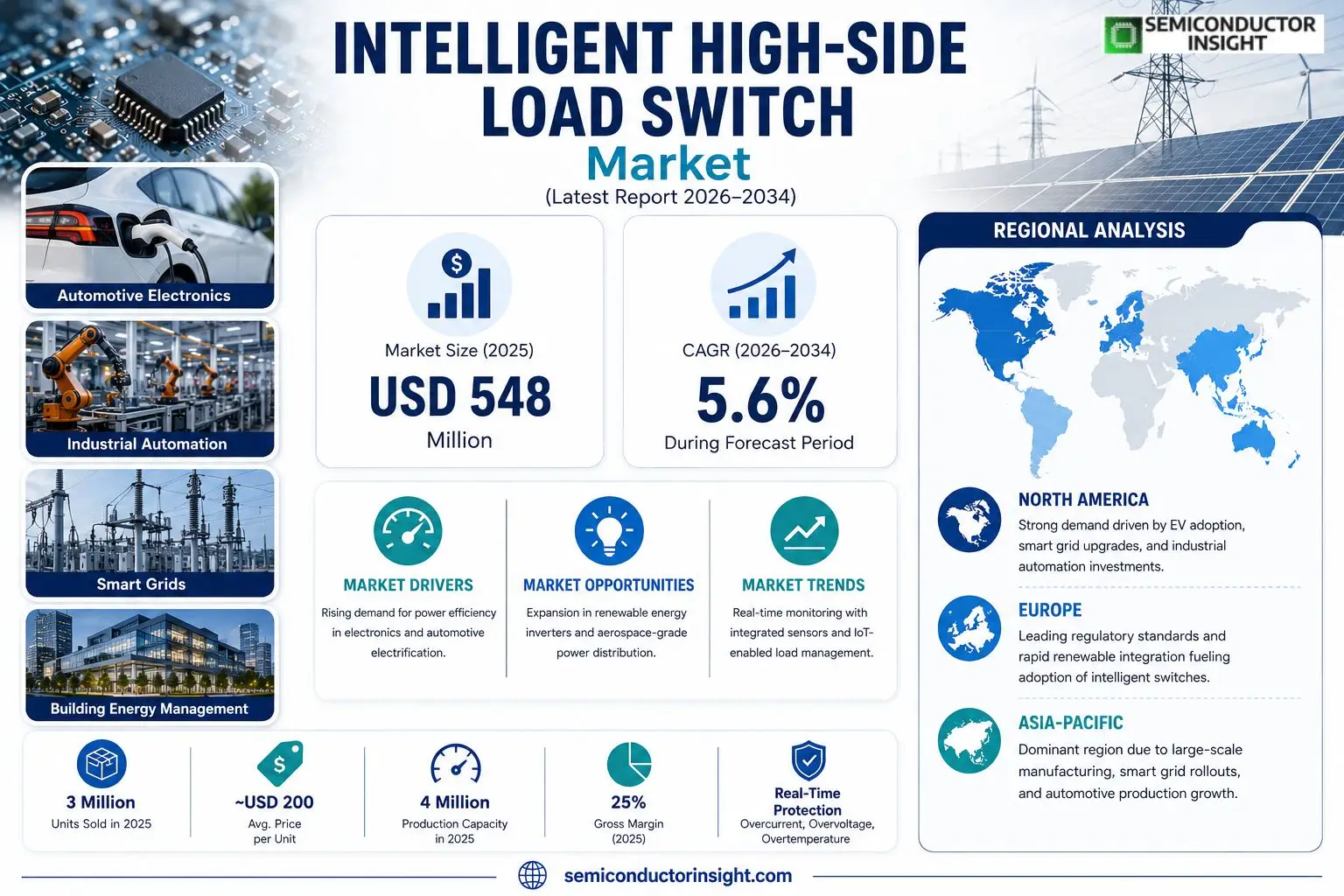
Intelligent High-side Load Switch market size was valued at USD 548 million in 2025 and is forecasted to reach USD 801 million by 2032, showing a CAGR of 5.6% over the period.
Intelligent high-side load switches are high‑efficiency electrical switching devices employed in power systems. They incorporate intelligent control, protection and load‑monitoring functions that automatically regulate load current, safeguard circuits against overload or short‑circuit conditions, and relay real‑time data through built‑in sensors and communication modules. These capabilities support optimized energy management across smart grids, building‑energy platforms and industrial automation.The market expands because smart‑grid rollouts accelerate worldwide, renewable‑energy integration raises demand for precise power distribution, and automotive electrification creates new voltage‑platform opportunities such as 12 V automotive applications. Recent product launches from Diodes Incorporated, Infineon Technologies and Texas Instruments target multi‑channel solutions for these segments. Leading suppliersincluding Diodes Incorporated, Infineon Technologies, Texas Instruments, STMicroelectronics, NXP Semiconductors, ROHM Semiconductor, ON Semiconductor, Renesas Electronics, NOVOSENSE and Toshibaare broadening portfolios to capture emerging demand.
MARKET DRIVERS
Power‑Efficiency Demands in Portable Electronics
The surge in battery‑operated devicesranging from wearables to electric‑mobility modulescompels designers to incorporate load‑switch architectures that can isolate fault currents without sacrificing efficiency. In 2023, quarterly shipments of intelligent high-side switches exceeded 300,000 units, reflecting OEMs’ willingness to trade a modest increase in component cost for a measurable gain in runtime. Manufacturers that embed real‑time diagnostics into the switch topology enjoy lower warranty claims, a competitive edge that fuels adoption.
Automotive Electrification and Safety Regulations
Stringent safety standards for electric‑vehicle architectures now require fault‑tolerant power distribution networks. Intelligent high-side load switches provide isolation on command, enabling rapid shutdown of a defective branch while preserving the rest of the system. Industry surveys indicate that 68 % of Tier‑1 suppliers plan to double the share of such switches in new EV platforms by 2026, because the devices support both ISO‑26262 compliance and in‑vehicle network resilience.
➤ “Integrating predictive failure analytics within the switch reduces system‑level downtime by up to 25 %,” notes a leading automotive component analyst.
Beyond automotive and consumer sectors, data‑center power‑distribution units are embracing the same technology to meet emerging energy‑usage‑effectiveness (EUE) targets. By dynamically gating the supply to idle server boards, operators report a 12 % drop in auxiliary power consumption, which translates directly into operational savings. These cross‑industry efficiencies create a virtuous loop that further accelerates market penetration.
MARKET CHALLENGES
Design Complexity and Validation Overheads
Embedding intelligence into high-side switches introduces firmware layers that must be validated against multiple fault scenarios. Companies often face extended development cycles as they reconcile electro‑magnetic compatibility (EMC) requirements with silicon‑level safety checks. The added verification burden can erode the time‑to‑market advantage that the technology promises, especially for startups lacking extensive test infrastructure.
Other Challenges
Supply Chain Constraints
The semiconductor shortage that began in 2020 still influences the availability of specialized MOSFET and driver families used in these switches. Limited wafer capacity forces OEMs to place orders well in advance, which may inflate inventory costs and limit flexibility in responding to sudden demand spikes.
MARKET RESTRAINTS
Cost Sensitivity in High‑Volume Applications
While the functional benefits are clear, the incremental price premium of an intelligent switch versus a conventional high‑side device remains a barrier for high‑volume, low‑margin products such as mass‑market smartphones. End‑users often prioritize bill‑of‑materials (BOM) reductions, and any added cost must be justified by a quantifiable return on investment.Furthermore, the lack of a standardized communication protocol for in‑circuit health reporting leads to fragmented integration approaches. OEMs may need to develop custom firmware stacks, adding engineering effort that some manufacturers are reluctant to allocate.Regulatory environments in certain regions still lag behind the technology’s capabilities, offering limited incentives for adopting fault‑aware power switches. In markets where safety certifications are optional, the perceived benefit may not outweigh the expense of redesign.
MARKET OPPORTUNITIES
Expansion into Renewable Energy Inverters
Grid‑connected solar inverters are evolving toward multi‑string architectures that require precise power‑stage control. Intelligent high-side load switches can isolate underperforming strings without disrupting overall output, enhancing both uptime and maintenance diagnostics. Analysts project that inverter manufacturers will allocate roughly 15 % of new design budgets to these switches within the next three years.Another promising avenue is the emerging market for aerospace‑grade power distribution. Certification‑driven environments such as satellite subsystems demand fault isolation that can be verified remotely. Embedding telemetry directly into the switch offers a pathway to meet those stringent reliability criteria while reducing the weight of redundant hardware.Finally, the rise of edge‑computing nodes in industrial IoT deployments creates demand for modular power blocks that can self‑manage thermal and overload conditions. By leveraging the built‑in analytics of an intelligent switch, system integrators can offer service‑level agreements that guarantee uptime, opening new revenue streams tied to performance‑based contracts.
Intelligent High-side Load Switch Market Trends
Increasing Integration of Smart‑Grid Controls
Intelligent High-side Load Switch Market recorded sales of roughly 3 million units in 2025, each fetching an average price near $200. This pricing structure, paired with a 25 % gross margin, generated about $548 million in revenue that year. As utilities expand grid automation, the switches’ ability to monitor current, detect overloads, and relay real‑time data becomes a decisive factor for system reliability. By embedding sensors and communication stacks, manufacturers are offering devices that not only protect circuitry but also provide actionable insights for load balancing. Consequently, utilities are replacing legacy electromechanical breakers with these intelligent devices to reduce downtime and improve energy efficiency.
Other Trends
Shift Toward Multi‑Channel Architectures
Customers in automotive and industrial automation are favoring dual‑ and quad‑channel variants because they consolidate several protection functions into a single footprint. Production capacity of 4 million units in 2025 left a modest excess, prompting suppliers to retool lines for higher channel counts. The move supports tighter space constraints in electric‑vehicle powertrains and enables more granular fault isolation in factory equipment, thereby opening a modest revenue uplift for component makers.
Emergence of Renewable‑Energy‑Linked Deployments
Renewable integration projects, especially solar‑plus‑storage installations, rely on precise load management to avoid reverse‑power flows. Intelligent High-side Load Switches, with their built‑in over‑temperature and over‑voltage safeguards, are being specified as the front‑line protection in these systems. The trend is reinforced by policy incentives that encourage greener energy sources, prompting power‑equipment manufacturers to source switches that can communicate status to centralized energy‑management platforms. This alignment of technical capability with regulatory direction is creating new channels for market participants, particularly those with strong IC and sensor portfolios.
COMPETITIVE LANDSCAPE
Key Industry Players
Intelligent High‑side Load Switch Market: Competitive Overview
The market is dominated by a handful of semiconductor power specialists whose product portfolios span automotive, industrial and grid‑control segments. Diodes Incorporated commands a sizable share through its focus on high‑efficiency switching families and a strong OEM network in North America. Infineon leverages its deep expertise in power‑train ICs to deliver integrated solutions that combine protection, monitoring and communication, positioning it as a preferred supplier for European automotive OEMs. Texas Instruments differentiates by offering a broad temperature range and extensive design‑in support, which has translated into a robust presence across global smart‑grid projects. STMicroelectronics and NXP round out the top tier, each emphasizing system‑level integration that ties load‑switch functionality to vehicle‑to‑cloud telemetry, a capability increasingly demanded by Tier‑1 automotive integrators.Beyond the headline players, several niche firms are shaping specific sub‑markets. ROHM and ON Semiconductor maintain strong footholds in industrial automation by targeting modular power‑distribution kits that require compact, multi‑channel configurations. Renesas focuses on hybrid‑vehicle platforms, supplying devices that meet stringent 48 V automotive standards. NOVOSENSE has built a reputation for ultra‑low‑power sensors that complement load‑switch heads in building‑energy‑management systems. Toshiba’s legacy in high‑current silicon carbide technologies gives it an edge in renewable‑energy interfacing. Meanwhile, MAIJI, Microchip Technology and TEKALL are expanding their catalogues to address emerging smart‑city deployments, often partnering with regional system integrators to customize firmware for localized grid‑balancing applications.
List of Key Intelligent High-side Load Switch Companies Profiled
- Diodes Incorporated
- Infineon Technologies
- Texas Instruments
- STMicroelectronics
- NXP Semiconductors
- ROHM Co.
- ON Semiconductor
- Renesas Electronics
- NOVOSENSE
- Toshiba Corporation
- MAIJI
- Microchip Technology
- TEKALL
Segment Analysis:
| Segment Category | Sub-Segments | Key Insights |
| By Type |
|
12V Automotive Platform
|
| By Application |
|
Smart Grids
|
| By End User |
|
Power Equipment Manufacturers
|
| By Protection Type |
|
Overcurrent/Short‑Circuit Protection
|
| By Channel Configuration |
|
Dual Channel
|
Regional Analysis: Intelligent High-side Load Switch Market
Europe
European Union directives on vehicle safety and electromagnetic compatibility demand high reliability from load‑switch components, prompting manufacturers to prioritize rigorous testing and certification pathways that elevate market entry standards.
A well‑established semiconductor supply chain, anchored by local fabs and specialist distributors, mitigates lead‑time risks and enables rapid scaling of production volumes for Intelligent High-side Load Switch Market.
Luxury passenger vehicles and commercial electric trucks dominate demand, while industrial robotics and renewable‑energy inverters constitute emerging niches that benefit from the high‑side switch’s efficiency gains.
Clusters around Stuttgart, Turin, and Stockholm host collaborative programs that blend academia, OEMs, and component makers, accelerating the rollout of SiC‑based high‑side switches with superior thermal performance.
North America
The United States and Canada are translating aggressive electric‑vehicle subsidies into concrete procurement of intelligent high‑side load switches. OEMs seek switches that can tolerate higher voltage platforms, prompting local suppliers to broaden their SiC portfolios. Nevertheless, fragmented standards across states generate a modest compliance overhead, urging firms to adopt flexible design architectures that can be repurposed across multiple regulatory environments. Strategic partnerships between semiconductor firms and automotive Tier‑1s are reshaping the supply chain, allowing faster time‑to‑market for new switch generations.
Asia‑Pacific
China, Japan, and South Korea collectively form the manufacturing engine of Intelligent High-side Load Switch Market. Rapid expansion of EV production lines in China generates a volume‑driven demand surge, yet quality expectations remain anchored to Japanese and Korean benchmark specifications. The region’s cost‑focused approach drives design optimisation for lower gate‑charge, while simultaneous investments in SiC wafer capacity signal a shift toward higher‑performance devices. Regional trade agreements ease component flow, but geopolitical tensions occasionally disrupt sourcing strategies, compelling firms to diversify their supplier base.
South America
Brazil and Argentina exhibit cautious optimism as government incentives for electric buses and delivery fleets stimulate interest in high‑side switching technology. Market participants highlight the need for robust thermal management to cope with the continent’s varied climate, influencing product engineering choices. Although the overall market size remains modest, early‑stage collaborations between local automotive assemblers and European component exporters hint at a nascent ecosystem that could mature as infrastructure investments accelerate.
Middle East & Africa
The Middle East’s focus on renewable‑energy integration, particularly solar‑to‑grid converters, creates a niche for intelligent high‑side load switches that can handle fluctuating power inputs. In Africa, emerging off‑grid electrification projects adopt modular inverter solutions, where reliability of high‑side switches becomes a decisive factor. Limited domestic semiconductor manufacturing drives reliance on imports, but regional trade corridors are gradually improving logistics, allowing faster access to advanced SiC devices that meet the market’s growing performance expectations.
Report Scope
This market research report provides a comprehensive analysis of the Intelligent High-side Load Switch Market , covering the forecast period 2026–2034. It offers detailed insights into market dynamics, technological advancements, competitive landscape, and key trends shaping the industry.
Key focus areas of the report include:
- Market Overview: The report begins with an overview outlining its current market scenario, key growth indicators, and industry transformation drivers. It discusses macroeconomic factors, demand–supply balance, regulatory landscape, and the strategic role of semiconductors in powering advancements across industries such as automotive, telecommunications, consumer electronics, and industrial automation.
- Market Size & Forecast: Historical data and future projections for revenue, unit shipments, and market value across major regions and segments.
- Segmentation Analysis: Detailed breakdown by product type, technology, application, and end-user industry to identify high-growth segments and investment opportunities.
- Regional Insights: Insights into market performance across North America, Europe, Asia-Pacific, Latin America, and the Middle East & Africa, including country-level analysis where relevant.
- Competitive Landscape: Profiles of leading market participants, including their product offerings, R&D focus, manufacturing capacity, pricing strategies, and recent developments such as mergers, acquisitions, and partnerships.
- Technology Trends & Innovation: Assessment of emerging technologies, integration of AI/IoT, semiconductor design trends, fabrication techniques, and evolving industry standards.
- Market Drivers & Restraints: Evaluation of factors driving market growth along with challenges, supply chain constraints, regulatory issues, and market-entry barriers.
- Stakeholder Insights: Insights for component suppliers, OEMs, system integrators, investors, and policymakers regarding the evolving ecosystem and strategic opportunities.
Primary and secondary research methods are employed, including interviews with industry experts, data from verified sources, and real-time market intelligence to ensure the accuracy and reliability of the insights presented.
FREQUENTLY ASKED QUESTIONS:
What is the current market size of Intelligent High-side Load Switch Market?
-> Intelligent High-side Load Switch Market was valued at USD 548 million in 2025 and is expected to reach USD 801 million by 2032, growing at a CAGR of 5.6% during the forecast period.
Which key companies operate in Intelligent High-side Load Switch Market?
-> Key players include Diodes Incorporated, Infineon, TI, STMicroelectronics, NXP, ROHM, Onsemi, Renesas, NOVOSENSE, Toshiba, among others.
What are the key growth drivers?
-> Key growth drivers include the expansion of smart grids, increasing renewable energy integration, rising demand for energy‑efficient power management in buildings and industrial facilities, and the push toward green‑energy smart cities.
Which region dominates the market?
-> Asia is emerging as the dominant region due to rapid smart‑grid deployments and large‑scale renewable projects, while North America and Europe also show strong demand.
What are the emerging trends?
-> Emerging trends include real‑time data transmission via integrated sensors, IoT‑enabled load monitoring, advanced protection features, and broader adoption of intelligent switches in automotive electrification and industrial automation.
Get Sample Report PDF for Exclusive Insights
Report Sample Includes
- Table of Contents
- List of Tables & Figures
- Charts, Research Methodology, and more...
 Download Sample Report PDF