1.6T High-speed Optical Module Market Insights
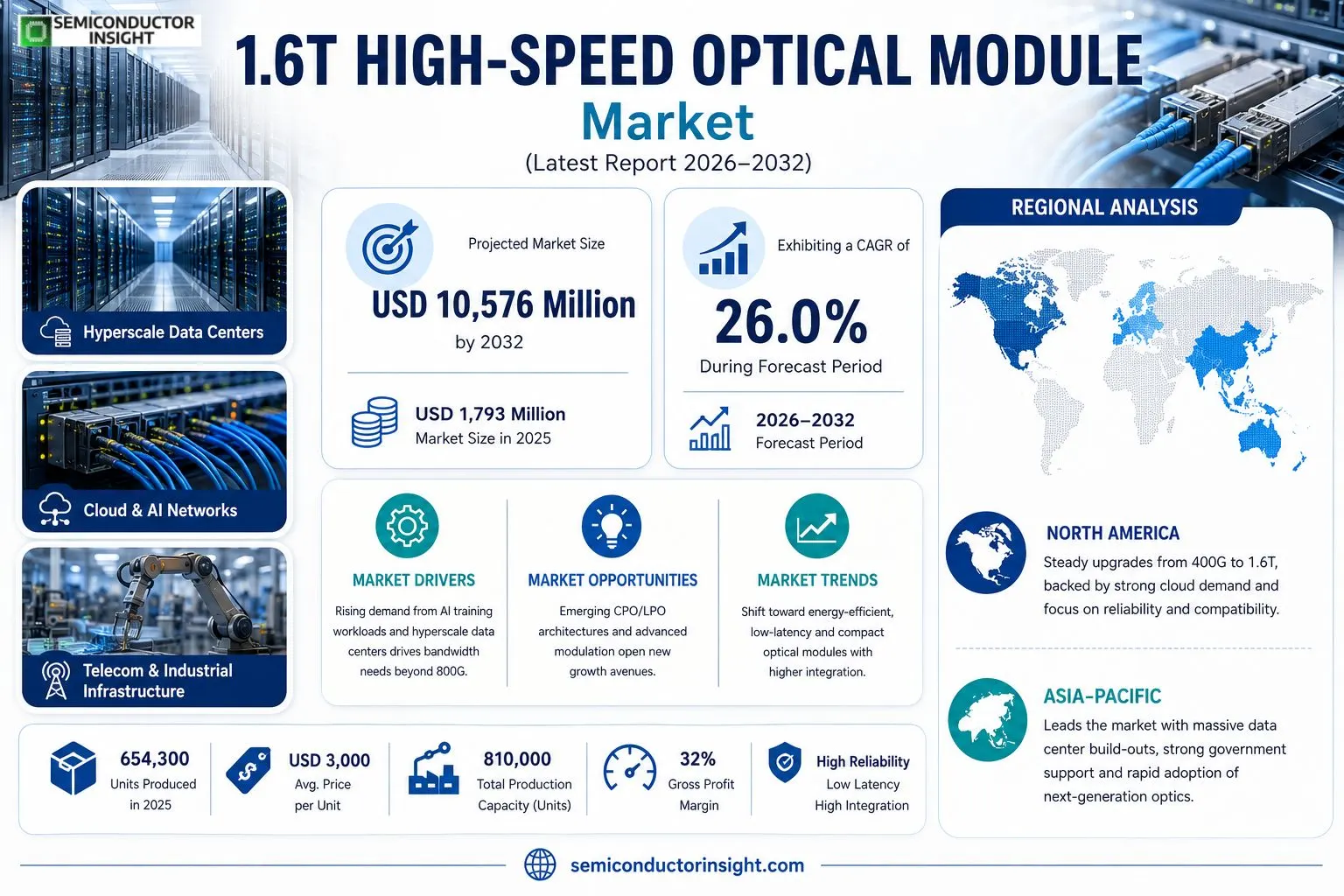
1.6T High-speed Optical Module market size was valued at USD 1793 million in 2025 and will grow to USD 10576 million by 2032, reflecting a CAGR of 26.0 % during the forecast period.
A 1.6T high‑speed optical module is an optical communication component capable of delivering a total transmission rate of 1.6 Tbps (1600 Gbps) across single or multiple channels. It enables ultra‑high‑speed photo‑electric conversion and data transfer among hyperscale data centers, cloud‑computing networks, and AI‑training clusters, typically employing high‑order modulation such as PAM4 within a multi‑channel parallel architecture.In 2025 the sector produced roughly 654,300 units at an average price of about USD 3,000 per unit, while total production capacity reached approximately 810,000 units and gross profit margins averaged 32 %. Growth is linked to expanding AI model training workloads that push bandwidth requirements beyond existing 400G/800G solutions, as well as emerging CPO and LPO architectures that aim to lower power consumption and latency.
MARKET DRIVERS
Scaling Bandwidth for Cloud‑Native Workloads
Enterprises migrating to distributed cloud‑native architectures demand transceivers that can sustain 400 Gbps per lane and aggregate to 1.6 Tbps. 1.6T High-speed Optical Module Market meets this requirement by offering a compact, power‑efficient solution that sidesteps the cabling complexity of parallel optics. Operators can therefore consolidate edge and core nodes without expanding rack footprints.
Advancements in Silicon Photonics Integration
Recent breakthroughs in silicon photonic foundries have lowered the cost per gigabit for 1.6 Tbps modules. By integrating driver ASICs directly on the optical chip, manufacturers reduce assembly steps and improve thermal performance. This technical edge translates into a more predictable total cost of ownership, encouraging data‑center owners to refresh aging inventories sooner.
➤ “The convergence of higher per‑lane rates and tighter power envelopes makes 1.6 Tbps modules the logical stepping stone before 2.5 Tbps becomes mainstream.”
The migration from 400 Gbps to 1.6 Tbps also unlocks new use cases such as real‑time AI model training across geographically dispersed clusters. Latency‑sensitive applications benefit from fewer electrical‑to‑optical conversions, and service providers can advertise differentiated SLAs that command premium pricing.
MARKET CHALLENGES
Manufacturing Yield Constraints
Achieving consistent performance at 1.6 Tbps pushes process windows to their limits. Even minor variations in waveguide geometry can cause eye‑diagram degradation, forcing manufacturers to scrap a sizable portion of wafers. The resulting yield pressure inflates unit costs and slows time‑to‑market for new product families.
Other Challenges
Supply‑Chain Dependence
Critical components such as high‑quality InP lasers and low‑loss polymer waveguides are sourced from a narrow supplier base. Geopolitical tensions or raw‑material shortages can therefore disrupt 1.6T High-speed Optical Module Market’s ability to meet demand spikes.In addition, the need for rigorous testing at multi‑terabit speeds lengthens validation cycles. Certification labs must invest in specialized test equipment, and the scarcity of qualified engineers adds another layer of delay for customers seeking rapid deployment.
MARKET RESTRAINTS
Capital Expenditure Sensitivity
Data‑center operators with tight CAPEX budgets often defer upgrades to multi‑terabit optics until existing equipment reaches end‑of‑life. The upfront investment required for 1.6 Tbps modulesparticularly when bundled with new switching chassiscan be a deterrent for cost‑conscious players, limiting short‑term adoption rates.
Compatibility with Legacy Infrastructure
Many incumbent networks rely on 100 Gbps or 400 Gbps optics that lack the electrical interfaces needed for 1.6 Tbps modules. Retrofits often demand firmware upgrades and re‑cabling, creating operational friction. Until a critical mass of compatible routers and switches is in place, the market will experience a gradual transition rather than an abrupt shift.
MARKET OPPORTUNITIES
Emerging Edge‑Compute Deployments
Edge data‑centers serving 5G fronthaul, autonomous‑vehicle telemetry, and mixed‑reality streaming are beginning to require bandwidths that exceed traditional 400 Gbps limits. 1.6T High-speed Optical Module Market is uniquely positioned to equip these sites with a compact, high‑density solution, opening a revenue stream that bypasses the slower‑moving core‑network segment.
Policy‑Driven Sustainability Initiatives
Regulatory pushes toward greener ICT infrastructure favor technologies that deliver more data per watt. By consolidating multiple 400 Gbps lanes into a single 1.6 Tbps module, operators can cut energy consumption and reduce carbon footprints, aligning with ESG objectives and potentially qualifying for incentive programs.
1.6T High-speed Optical Module Market Trends
AI‑Driven Bandwidth Surge Elevates 1.6T Module Adoption
The explosion of large‑scale AI model training has forced hyperscale data centers to rethink their interconnect strategy. When GPU clusters expand from tens of thousands to millions of devices, the internal traffic generated per rack can exceed several petabits per second. Operators therefore replace legacy 400G and 800G links with 1.6T High-speed Optical Module solutions to keep latency low and to avoid a bottleneck in back‑plane fabrics. This migration is not merely a capacity upgrade; it reshapes system economics by allowing fewer physical lanes, reducing cable management overhead, and consolidating power delivery. Vendors that can guarantee the tighter eye‑diagram margins required for 1.6T transmission become preferred partners, and the overall procurement cycle shortens as data center planners align network rollout with AI workload spikes.
Other Trends
Supply Chain Integration and Advanced Packaging
Beyond the silicon layer, the value chain for 1.6T modules is converging around a tightly coupled optics‑electronics‑packaging ecosystem. Optical chipslasers, modulators, and photodetectorsmust be co‑located with high‑speed DSPs, driver ASICs, and TIAs on a single substrate to preserve signal integrity at 1.6 Tbps. Advanced packaging techniques such as wafer‑level integration and fan‑out can deliver the necessary interconnect density while keeping the thermal envelope within manageable limits. As a result, manufacturers that own both the photonic and electronic design capabilities are better positioned to negotiate volume discounts with foundries and to accelerate time‑to‑market. The ripple effect is visible in the upstream market, where demand for high‑performance silicon photonics and high‑frequency electrical components is rising in tandem with module orders.
Emerging Modulation Techniques Reshape Cost Structure
Traditional NRZ signaling has given way to multi‑level formats such as PAM4, enabling each lane to carry twice the data without doubling the laser count. Recent research on probabilistic constellation shaping and coherent detection further pushes spectral efficiency, allowing manufacturers to achieve 1.6 Tbps with fewer optical sources. These advances translate into lower bill‑of‑materials for 1.6T High-speed Optical Module Market, even as performance margins tighten. Energy consumption per bit also drops, which is a decisive factor for operators concerned about data‑center PUE (Power Usage Effectiveness). Consequently, cost‑competitiveness is becoming a differentiator alongside raw speed, prompting incumbents to invest heavily in next‑generation modulation algorithms and silicon‑photonic integration platforms.
COMPETITIVE LANDSCAPEKey Industry Players
Competitive dynamics of the 1.6T Optical Module sector
The market is anchored by a handful of integrated manufacturers that control most of the value chain from silicon‑photonic chips to advanced packaging. Nokia Corporation leverages its deep foothold in transceiver silicon and a manufacturing network to command a material share of revenue, concentrating on hyperscale data‑center contracts that demand the highest bandwidth density. Its strategy of bundling DSP, driver, and photonic layers into a single OSFP‑XDX form factor gives it leverage over customers seeking to minimize power consumption while scaling to multi‑petabit interconnects. Parallel to Nokia, Samsung Electronics applies its massive semiconductor fabs to produce high‑volume laser and detector arrays, enabling price‑performance improvements that keep 1.6T modules financially viable for emerging AI clusters.Beyond the dominant duopoly, a diverse set of niche players enriches the ecosystem. Sont Technologies and Optech Technology specialize in custom‑tuned PAM4 driver ASICs, allowing system integrators to fine‑tune link budgets for long‑reach DCI scenarios. Cisco Systems, while traditionally a network equipment vendor, has doubled down on in‑house optical module design to secure supply‑chain resilience for its own switching platforms. A rising cadre of pure‑play photonics firmsincluding InnoLight Technology, Solis Optoelectronics, and OpenLight Photonicsfocus on silicon photonics foundry services that lower entry barriers for smaller OEMs. Meanwhile, Broadcom Inc., Marvell Technology, and Lumentum Holdings contribute critical DSP and laser engine IP, shaping the cost structure of downstream module assemblers. This multi‑tiered fabric ensures that innovation propagates from chip‑level breakthroughs to system‑level deployments, compelling all players to sharpen their R&D pipelines and strategic alliances.
List of Key Optical Module Companies Profiled
- Nokia Corporation
- Samsung Electronics
- Sont Technologies
- Cisco Systems
- Optech Technology
- Eoptolink Technology
- Accelink Technologies
- Broadcom Inc.
- Marvell Technology
- InnoLight Technology
- Solis Optoelectronics
- Lumentum Holdings
- Universal Scientific Industrial (USI)
- Jabil
- AOI
Segment Analysis:
| Segment Category | Sub-Segments | Key Insights |
| By Type |
|
Silicon Photonics
|
| By Application |
|
AI Training Clusters
|
| By End User |
|
Hyperscale Cloud Providers
|
| By Packaging Form |
|
OSFP‑XD
|
| By Transmission Distance |
|
LR4
|
Regional Analysis: 1.6T High-speed Optical Module Market
Asia-Pacific
Governments across the region earmark billions for fiber‑optic expansion, directly expanding the addressable market for high‑speed modules. Public‑private consortia accelerate deployment timelines, allowing manufacturers to scale production with predictable demand pipelines.
Operators consolidate fragmented sites into mega‑facilities, favoring dense optical solutions that maximize port count per rack. This drives a shift toward compact, high‑bandwidth modules that can service multiple chassis simultaneously.
Recent disruptions prompted vendors to diversify component sourcing within the region. Localized fabs reduce lead‑times, granting customers quicker access to the latest 1.6T specifications.
Early alignment with upcoming optical Ethernet standards positions Asia‑Pacific firms as testbeds, creating a feedback loop that shapes module features and accelerates market acceptance.
North America
The United States and Canada exhibit a mature market where incumbent telecom carriers are gradually migrating from 400 Gb/s to 1.6 Tb/s platforms. Enterprises prioritize reliability and backward compatibility, compelling vendors to offer hybrid modules that bridge legacy equipment. Regulatory scrutiny around spectrum allocation adds a layer of complexity, urging manufacturers to embed adaptive optics that can cope with evolving bandwidth allocations. While growth is steadier than in Asia‑Pacific, the emphasis on high‑value contracts and service‑level guarantees sustains a profitable niche for premium‑priced solutions.
Europe
European operators confront a fragmented landscape of national backbones, each governed by distinct compliance regimes. This environment rewards vendors who can tailor firmware to satisfy varied security mandates while preserving performance parity. Investment in green data centers amplifies interest in power‑efficient optical modules, prompting R&D focus on low‑heat designs. Cross‑border initiatives such as the Digital Europe Programme inject modest but consistent funds, ensuring that the continent remains a respectable consumer of 1.6T modules despite a more cautious upgrade cadence.
South America
In Brazil, Chile, and Argentina, burgeoning internet penetration fuels demand for bandwidth upgrades, yet capital scarcity tempers large‑scale rollout. Operators adopt a phased approach, first deploying 1.6T modules in metropolitan cores before extending to secondary cities. Partnerships with Asian manufacturers help bridge technology gaps, while local policy incentives aimed at reducing digital inequality accelerate selective deployments. The market’s trajectory hinges on the ability to balance cost constraints with the need for future‑proof infrastructure.
Middle East & Africa
The Gulf Cooperation Council states spearhead regional momentum by launching sovereign cloud platforms that require cutting‑edge optical interconnects. Meanwhile, Sub‑Saharan nations focus on building foundational fiber routes, often leveraging international financing. This dichotomy creates two distinct demand streams: high‑end, feature‑rich modules for flagship data hubs in the Middle East, and robust, cost‑effective solutions for emerging African networks. Vendors that can navigate geopolitical nuances and offer scalable product families stand to capture the most sustainable share of the continent’s nascent market.
Report Scope
This market research report provides a comprehensive analysis of the 1.6T High-speed Optical Module Market , covering the forecast period 2026–2034. It offers detailed insights into market dynamics, technological advancements, competitive landscape, and key trends shaping the industry.
Key focus areas of the report include:
- Market Overview: The report begins with an overview outlining its current market scenario, key growth indicators, and industry transformation drivers. It discusses macroeconomic factors, demand–supply balance, regulatory landscape, and the strategic role of semiconductors in powering advancements across industries such as automotive, telecommunications, consumer electronics, and industrial automation.
- Market Size & Forecast: Historical data and future projections for revenue, unit shipments, and market value across major regions and segments.
- Segmentation Analysis: Detailed breakdown by product type, technology, application, and end-user industry to identify high-growth segments and investment opportunities.
- Regional Insights: Insights into market performance across North America, Europe, Asia-Pacific, Latin America, and the Middle East & Africa, including country-level analysis where relevant.
- Competitive Landscape: Profiles of leading market participants, including their product offerings, R&D focus, manufacturing capacity, pricing strategies, and recent developments such as mergers, acquisitions, and partnerships.
- Technology Trends & Innovation: Assessment of emerging technologies, integration of AI/IoT, semiconductor design trends, fabrication techniques, and evolving industry standards.
- Market Drivers & Restraints: Evaluation of factors driving market growth along with challenges, supply chain constraints, regulatory issues, and market-entry barriers.
- Stakeholder Insights: Insights for component suppliers, OEMs, system integrators, investors, and policymakers regarding the evolving ecosystem and strategic opportunities.
Primary and secondary research methods are employed, including interviews with industry experts, data from verified sources, and real-time market intelligence to ensure the accuracy and reliability of the insights presented.
FREQUENTLY ASKED QUESTIONS:
What is the current market size of 1.6T High-speed Optical Module Market?
-> 1.6T High-speed Optical Module Market was valued at USD 1,793 million in 2025 and is expected to reach USD 10,576 million by 2032.
What is the compound annual growth rate (CAGR) for the market?
-> The market is projected to grow at a 26.0% CAGR over the forecast period.
How many units were produced and what was the total production capacity in 2025?
-> production reached approximately 654,300 units in 2025, while the total production capacity was about 810,000 units.
What is the average selling price per unit and the industry gross profit margin?
-> The average market price per unit was around USD 3,000 and the industry recorded an average gross profit margin of 32%.
Which key manufacturers operate in 1.6T High-speed Optical Module Market?
-> Key players include Nokia Corporation, Sont Technologies, Cisco Systems, Samsung Electronics, Optech Technology, Eoptolink Technology, Accelink Technologies, Universal Scientific Industrial (USI), Jabil, AOI, among others.
What are the primary market drivers?
-> The market is driven by explosive demand for AI large‑scale model training, rapid expansion of hyperscale cloud data centers, and emerging architectures such as CPO and LPO that improve power efficiency and latency.
Which applications dominate the demand for 1.6T modules?
-> Major downstream applications are hyperscale cloud data centers, AI training clusters, high‑performance computing (HPC) centers, and data center interconnect (DCI) networks.

Get Sample Report PDF for Exclusive Insights
Report Sample Includes
- Table of Contents
- List of Tables & Figures
- Charts, Research Methodology, and more...
 Download Sample Report PDF