Peltier Device Market Insights
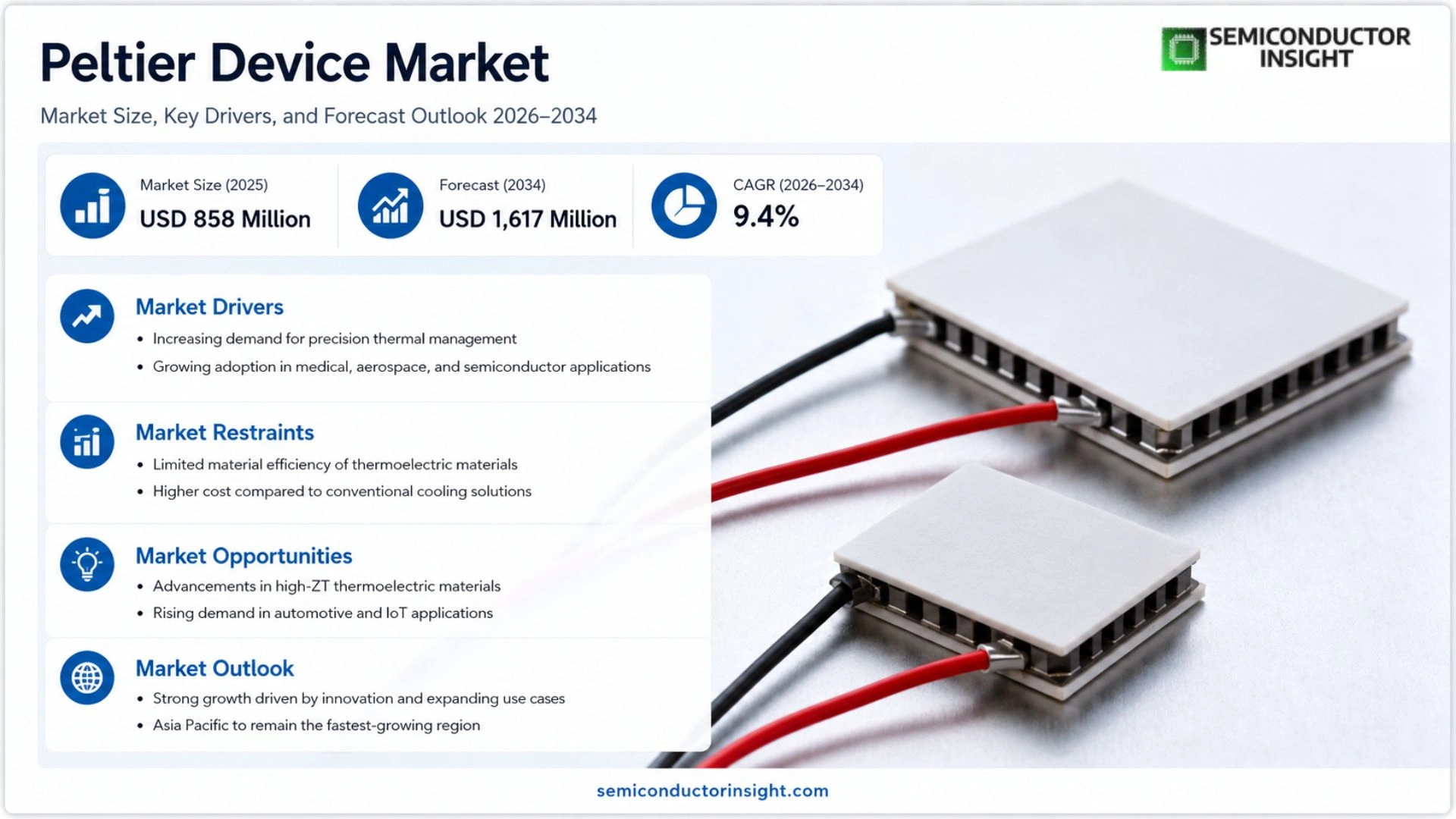
Peltier Device market size was valued at USD 858 million in 2025. The market is expected to expand to USD 1,617 million by 2034, reflecting an approximate CAGR of 9.4% over the forecast horizon.
A Peltier Device is a solid‑state thermal‑management component that utilizes Peltier effect to deliver active cooling or heating when direct current passes through paired P‑type and N‑type semiconductor elements. Its compact form, rapid response, absence of moving parts, and refrigerant‑free operation make it ideal for precise temperature control in optical communications, laser systems, semiconductor equipment, medical instruments, automotive thermal management, consumer electronics, industrial sensors, and aerospace/defense applications.
MARKET DRIVERS
Increasing Demand for Precision Thermal Management
Peltier Device Market is buoyed by a surge in applications that require tight temperature control, such as laser diodes, medical diagnostics, and aerospace instrumentation. Manufacturers are opting for solid‑state cooling because it eliminates refrigerants and offers rapid response times, which translates into lower lifecycle costs for end users.
Growth of Miniaturized Electronics
Compact smartphones, wearables, and edge‑computing modules increasingly embed thermoelectric modules to dissipate heat from high‑density processors. A recent shipment survey indicates a 7 % year‑over‑year rise in unit sales of modules under 10 mm², underscoring the relevance of size‑driven innovation.
➤ Industrial automation firms are integrating Peltier elements into robotic joints to maintain sensor accuracy in fluctuating ambient conditions.
Finally, government incentives for energy‑efficient technologies in Europe and North America have lowered capital barriers, prompting OEMs to replace traditional vapor‑compression systems with thermoelectric alternatives.
MARKET CHALLENGES
Cost Competitiveness with Conventional Cooling
While thermoelectric solutions excel in precision, the upfront price per watt of cooling remains higher than that of established compressor‑based units. This price gap narrows only slowly as silicon‑based leg efficiencies improve, leaving price‑sensitive segments hesitant to adopt.
Other Challenges
Thermal Interface Management
Effective heat‑spreading still demands high‑performance interface materials. Companies that cannot guarantee low thermal resistance across the junction risk reduced system reliability, which can stall broader market acceptance.
MARKET RESTRAINTS
Limited Material Efficiency
The figure‑of‑merit (ZT) of commercially available bismuth‑telluride alloys hovers around 1.2, constraining the maximum heat‑pumping capacity. Although research labs report ZT values above 2.0, scale‑up barriers keep those breakthroughs out of mass production, restraining overall market velocity.
MARKET OPPORTUNITIES
Emergence of High‑ZT Nanocomposites
Recent advances in nanostructuring have yielded materials that push ZT toward 2.5 while remaining compatible with existing manufacturing lines. Early adopters in the electric‑vehicle thermal‑management niche anticipate up to a 15 % reduction in battery cooling energy, opening a lucrative avenue for suppliers that can certify these next‑generation legs.
Integration with IoT‑Enabled Monitoring
Embedding temperature sensors and cloud‑based analytics within Peltier modules enables predictive maintenance and dynamic performance tuning. This value‑added service model is especially attractive to data‑center operators seeking to fine‑tune cooling loads in real time.
Peltier Device Market Trends
Shift Toward High‑Precision Thermal Management
Peltier Device market is moving away from generic cooling solutions for small appliances toward niche applications that demand tight temperature tolerance and rapid response. Optical communication modules, semiconductor test rigs, and automotive battery packs now prioritize stability at the millikelvin level, forcing manufacturers to engineer modules with higher heat‑flux density and longer cycle life. This shift is fueled by the rise of 800 G/1.6 T optical networking and the proliferation of AI‑driven inference engines, both of which generate dense heat pockets in confined footprints. Suppliers that can guarantee material consistency,especially bismuth‑telluride purity,and deliver reliable batch testing are capturing premium price points, while downstream OEMs benefit from reduced thermal shutdown incidents and extended product warranties.
Other Trends
Regional Competitive Realignment
Japan and Europe continue to dominate the high‑end segment, where performance verification and long‑term reliability are non‑negotiable. At the same time, Chinese manufacturers are scaling capacity for standard‑grade modules, leveraging lower labor costs and a domestic supply chain for copper‑clad laminates and extruded aluminum. The resulting price differential is encouraging automotive seat‑heating and consumer‑electronics players to source from China for volume‑driven lines, while still relying on Japanese or European vendors for mission‑critical medical and aerospace equipment. This bifurcated sourcing model is reshaping procurement strategies: firms negotiate multi‑sourcing contracts to balance cost efficiency with risk mitigation, and they increasingly demand localized technical support to accelerate time‑to‑market for customized thermal solutions.
Integration of System‑Level Cooling Architectures
Beyond stand‑alone modules, the industry is converging on integrated cold‑plate and liquid‑cooling hybrids. Recent product launches couple thermoelectric stacks with micro‑channel heat exchangers, enabling compact form factors that fit within laptop chassis or satellite payload bays. This approach reduces the dependence on traditional vapor‑chamber designs and aligns with green‑energy directives that favor refrigerant‑free technologies. Companies that can offer turnkey packages,including temperature controllers and monitoring software,are positioned to win contracts in data‑center upgrades and next‑generation laser systems, where total‑cost‑of‑ownership calculations increasingly factor in maintenance downtime and energy consumption.
COMPETITIVE LANDSCAPE
Key Industry Players
Competitive Landscape of Peltier Device Market
Ferrotec, Kyocera and Coherent dominate the high‑margin segment where reliability, cycle life and material consistency are paramount. Their portfolios combine advanced Bi2Te3‑based thermoelectric alloys with proprietary ceramic substrates, allowing them to serve optical‑communication giants, semiconductor‑equipment makers and aerospace‑defence contractors. These firms retain most of the premium pricing because customers in laser‑stabilisation and medical‑testing applications demand stringent thermal‑cycling guarantees that only long‑track record suppliers can meet. Meanwhile, Chinese manufacturers such as Guangdong Fuxin Technology and Zhejiang Wangu Semiconductor have leveraged substantial scale to flood the standard‑TEC market, driving unit costs down and prompting many volume‑oriented OEMs in consumer electronics and automotive seat‑heating to shift sourcing domestically. The resulting dual‑track structure,high‑end, low‑volume versus mass‑market, high‑volume,creates a strategic crossroads for newcomers: either invest heavily in material science to capture premium contracts or focus on cost‑effective production lines to win share in the commoditised tier.
Beyond the headline names, a host of niche specialists are reshaping particular sub‑segments. Phononic and Tark Thermal Solutions have positioned themselves around integrated thermal‑management modules that combine cold plates, power‑electronics drivers and advanced packaging, appealing to AI‑server and data‑center designers seeking compact heat‑flux solutions. ARCTIC TEC and KELK Ltd. focus on micro‑TEC devices for medical diagnostics and portable spectroscopy, where size and rapid response outweigh raw cooling capacity. Companies such as Sensor Controls Co., Ltd. and TE Technology are building ecosystem services,temperature‑control software, predictive reliability analytics, and on‑site spares logistics,that add value beyond the physical module. This diversification of service offerings indicates that competitive advantage will increasingly hinge on system‑level integration rather than sole reliance on semiconductor performance.
List of Key Peltier Device Companies Profiled
- Ferrotec
- Kyocera
- Coherent Corp
- Guangdong Fuxin Technology
- ARCTIC TEC
- Tark Thermal Solutions
- Phononic
- KELK Ltd.
- Z-MAX
- Zhejiang Wangu Semiconductor
- Xianghe Oriental Electronic
- Thermion Company
- TE Technology
- AISIN Corporation
- Sensor Controls Co., Ltd.
Segment Analysis:
| Segment Category | Sub-Segments | Key Insights |
| By Type |
|
Multi-Stage
|
| By Application |
|
Communication
|
| By End User |
|
OEM Manufacturers
|
| By Material |
|
Bismuth Telluride
|
| By Integration Approach |
|
System‑Level Thermoelectric Packages
|
Regional Analysis: Peltier Device Market
North America
The region hosts a dense network of fabs that deliver both bulk and customized Peltier modules. Integrated downstream services,including wafer testing, module assembly, and reliability validation,streamline time‑to‑market, granting domestic firms a logistical edge over overseas competitors.
Aerospace thermal control, point‑of‑care diagnostics, and high‑performance computing dominate demand, each requiring precise temperature gradients. The intricate specifications of these sectors drive continuous refinement of Peltier Device Market’s product portfolio.
Stringent certification processes for medical and aerospace applications impose high compliance thresholds. Companies that embed compliance early in development reap faster approval timelines, reinforcing their market foothold.
Research clusters in Silicon Valley and Boston translate academic breakthroughs into commercial Peltier solutions, fueling a pipeline of low‑loss, high‑efficiency modules that attract strategic partnerships.
Europe
European firms leverage a strong tradition of precision engineering to carve out niche segments within Peltier Device Market. Automotive thermal management, particularly in electric vehicle powertrain cooling, has prompted collaborations between component suppliers and chassis manufacturers. Simultaneously, the continent’s emphasis on energy‑efficiency standards pushes OEMs to integrate thermoelectric cooling in consumer appliances, where incremental power savings are prized. Cross‑border research initiatives funded by EU programs foster shared knowledge on novel semiconductor materials, positioning Europe as a source of differentiated technology rather than pure volume production. Companies that can translate these research outcomes into compliant, modular solutions stand to secure long‑term contracts with major appliance brands, reinforcing Europe’s role as a sophisticated, albeit smaller, market contributor.
Asia‑Pacific
The Asia‑Pacific region exhibits rapid expansion of electronics manufacturing capacity, creating a fertile backdrop for Peltier Device Market. Domestic producers in China, South Korea, and Taiwan benefit from proximity to large‑scale assembly lines for smartphones, wearables, and compact refrigeration units. While cost considerations dominate, rising consumer expectations for performance and durability have prompted manufacturers to adopt higher‑grade thermoelectric modules. Additionally, governmental incentives for green technology in countries such as India nurture startups focused on waste‑heat recovery, introducing new application scenarios. The challenge for market participants lies in harmonizing quality expectations with price sensitivity, a balance that determines long‑term adoption across the region’s diverse industrial landscape.
South America
South America’s contribution to Peltier Device Market remains modest but is gradually gaining relevance through targeted investments in renewable energy and remote sensing. Nations such as Brazil and Chile are exploring thermoelectric cooling for solar‑thermal power plants, where precise temperature regulation optimizes energy conversion efficiency. Moreover, the agricultural sector’s need for portable refrigeration in remote areas creates a niche demand for rugged Peltier modules. Local distributors are beginning to forge alliances with North American manufacturers, leveraging imported technology while adapting it to regional climatic conditions. These developments suggest a slow yet steady integration of thermoelectric solutions into South America’s emerging high‑tech applications.
Middle East & Africa
In the Middle East and Africa, Peltier Device Market is shaped by climate‑driven demands for efficient cooling in harsh environments. Oil‑field equipment, data‑center racks, and military communications gear increasingly incorporate thermoelectric modules to maintain operational stability under extreme heat. Regional procurement agencies prioritize suppliers that can guarantee reliability without extensive maintenance, a criterion that elevates the importance of solid‑state cooling solutions. Concurrently, growing interest in solar‑powered refrigeration for remote health clinics underscores the market’s potential in humanitarian contexts. Companies that can demonstrate durability and low power consumption are likely to secure the limited yet strategic contracts that define this segment.
Report Scope
This market research report provides a comprehensive analysis of the Peltier Device Market , covering the forecast period 2026–2034. It offers detailed insights into market dynamics, technological advancements, competitive landscape, and key trends shaping the industry.
Key focus areas of the report include:
- Market Overview: The report begins with an overview outlining its current market scenario, key growth indicators, and industry transformation drivers. It discusses macroeconomic factors, demand–supply balance, regulatory landscape, and the strategic role of semiconductors in powering advancements across industries such as automotive, telecommunications, consumer electronics, and industrial automation.
- Market Size & Forecast: Historical data and future projections for revenue, unit shipments, and market value across major regions and segments.
- Segmentation Analysis: Detailed breakdown by product type, technology, application, and end-user industry to identify high-growth segments and investment opportunities.
- Regional Insights: Insights into market performance across North America, Europe, Asia-Pacific, Latin America, and the Middle East & Africa, including country-level analysis where relevant.
- Competitive Landscape: Profiles of leading market participants, including their product offerings, R&D focus, manufacturing capacity, pricing strategies, and recent developments such as mergers, acquisitions, and partnerships.
- Technology Trends & Innovation: Assessment of emerging technologies, integration of AI/IoT, semiconductor design trends, fabrication techniques, and evolving industry standards.
- Market Drivers & Restraints: Evaluation of factors driving market growth along with challenges, supply chain constraints, regulatory issues, and market-entry barriers.
- Stakeholder Insights: Insights for component suppliers, OEMs, system integrators, investors, and policymakers regarding the evolving ecosystem and strategic opportunities.
Primary and secondary research methods are employed, including interviews with industry experts, data from verified sources, and real-time market intelligence to ensure the accuracy and reliability of the insights presented.
FREQUENTLY ASKED QUESTIONS:
What is the current market size of Peltier Device Market?
-> Peltier Device market size was valued at USD 858 million in 2025. The market is expected to expand to USD 1,617 million by 2034, an approximate CAGR of 9.4%
Which key companies operate in Peltier Device Market?
-> Key players include Ferrotec, KELK Ltd., Kyocera, Coherent Corp, Tark Thermal Solutions, Phononic, Guangdong Fuxin Technology, ARCTIC TEC, KJLP, Thermion Company, among others.
What are the key growth drivers?
-> Key growth drivers include increasing demand for precise temperature control in optical communication, lasers, medical testing, automotive battery and seat thermal management, and the rise of AI computing and high‑density data‑center cooling.
Which region dominates the market?
-> Asia (especially China) leads in volume manufacturing, while Japan and Europe dominate high‑end applications and material supply.
What are the emerging trends?
-> Emerging trends include integration of TECs with cold‑plate and liquid‑cooling systems, development of high‑heat‑flux modules for AI servers and data centers, and the shift toward solid‑state thermal solutions for automotive and aerospace applications.
Get Sample Report PDF for Exclusive Insights
Report Sample Includes
- Table of Contents
- List of Tables & Figures
- Charts, Research Methodology, and more...
 Download Sample Report PDF