DLP Splicing Display Unit Market Insights
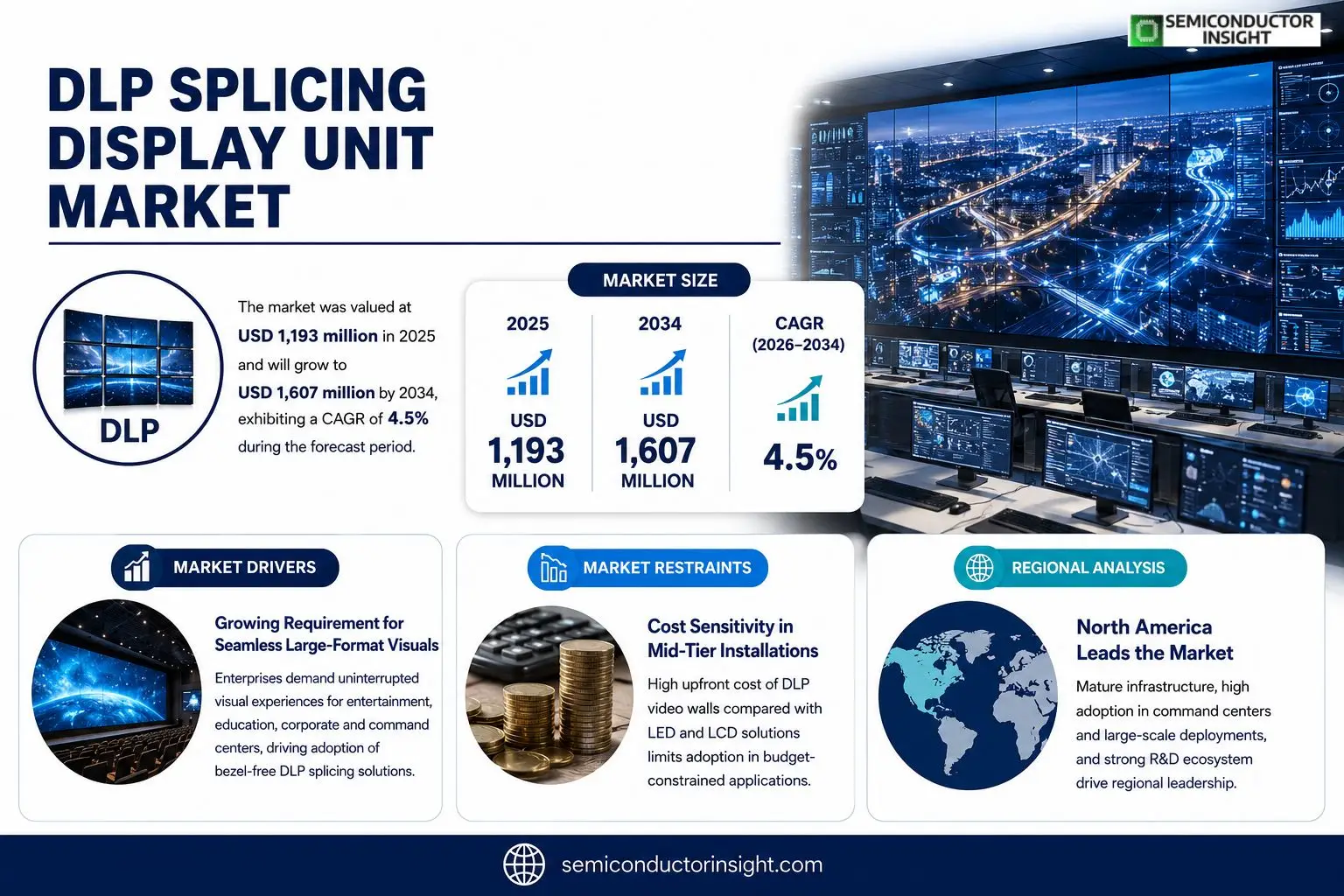
DLP Splicing Display Unit market size was valued at USD 1,193 million in 2025 and will grow to USD 1,607 million by 2034, exhibiting a CAGR of 4.5% during the forecast period.
A DLP video wall unit is a composite display system created by seamlessly joining multiple independent DLP (Digital Light Processing) modules through frameless integration or ultra‑narrow bezels, delivering a single large‑area screen. These units are commonly deployed where high resolution and brightness are criticalsuch as commercial signage, large conference rooms, sports arenas and command centers.Growth stems from rising demand for ultra‑high‑definition visuals together with the shift toward laser light sources and ultra‑thin designs. While fine‑pitch LED and narrow‑bezel LCD splicing erode DLP’s share in price‑sensitive segments, its minimal bezels, superior image quality and stability keep it dominant in high‑end professional applications like public security command centers, military dispatch operations and energy monitoring hubs.
MARKET DRIVERS
Growing Requirement for Seamless Large‑Format Visuals
Enterprises in entertainment, education, and corporate communications are upgrading from fragmented panels to continuous imagery. The shift is propelled by audiences that expect uninterrupted visual storytelling, prompting system integrators to adopt DLP splicing solutions that eliminate bezel artifacts. This transition enhances viewer engagement and supports premium pricing models.
Maturation of Light‑Engine Integration
Recent refinements in DLP chip architecture deliver higher luminous efficacy while retaining precise color rendition. Manufacturers now embed advanced thermal management within compact modules, allowing tighter pixel density without compromising reliability. These engineering gains reduce total ownership costs and make the technology attractive for long‑term deployments.
➤ DLP chip yields higher brightness while preserving color accuracy, enabling tighter pixel pitches and more flexible installation geometries.
The convergence of demand for flawless expanses and the availability of mature light‑engine components creates a feedback loop. System designers can now propose larger configurations with confidence, driving incremental sales across DLP Splicing Display Unit Market.
MARKET CHALLENGES
Cost Sensitivity in Mid‑Tier Installations
While high‑end venues readily absorb the premium of spliced DLP arrays, mid‑scale operators often balk at the upfront capital outlay. Budget constraints force them to compare traditional LCD or LED walls, which, although less seamless, present lower entry costs. This price pressure slows adoption in sectors such as regional education centers and community event spaces.
Other Challenges
Supply Chain Volatility
Component shortagesparticularly for high‑resolution DLP chipshave introduced lead‑time uncertainty. Installers face delayed project schedules, which can erode client confidence and elevate contingency budgets.Furthermore, the need for specialized calibration expertise adds operational complexity. Firms lacking in‑house talent must contract external specialists, inflating project expenses and extending rollout timelines.
MARKET RESTRAINTS
Limited Compatibility with Legacy Infrastructure
Many existing venues still rely on analog signal chains and older control protocols. Integrating a modern DLP splicing solution often requires a complete overhaul of distribution hardware, a prospect that can deter owners of older facilities.In addition, certification processes for fire safety and electromagnetic compliance differ across regions. Navigating these regulatory landscapes adds time and cost, especially for manufacturers targeting a rollout.
MARKET OPPORTUNITIES
Expansion into Immersive Experience Venues
Theme parks, simulation centers, and immersive museums are actively seeking display technologies that can wrap audiences in panoramic visuals. DLP splicing delivers the requisite seamlessness without the pixel‑spacing issues that plague conventional tiled systems, opening a high‑value niche for the market.Integrating edge‑computing platforms with DLP splicing hardware enables real‑time content rendering, a capability increasingly demanded by interactive installations. Providers that bundle processing power with display modules can command differentiated pricing and capture a larger share of project budgets.Finally, the convergence of augmented reality (AR) and large‑scale visualisation points to collaborative workspaces where multiple users engage with a shared high‑definition canvas. Supplying flexible, modular splicing units positions vendors to benefit from this emerging workflow paradigm.
DLP Splicing Display Unit Market Trends
High‑End Dominance Amidst Broad‑Screen Competition
DLP Splicing Display Unit Market continues to consolidate its lead in sectors where image fidelity and bezel‑free presentation are non‑negotiable. Command centers, military dispatch hubs, and financial data floors still favour DLP assemblies because the technology delivers sub‑pixel precision, consistent luminance, and a reliability record that newer fine‑pitch LEDs have yet to match. While the overall market sees a modest deceleration, the premium tier records margin expansion, with manufacturers leveraging laser light sources and ultra‑thin chassis to justify price premiums that exceed $4,000 per unit. This pricing power translates into a gross margin north of 24 %, reinforcing investment in R&D pipelines aimed at 4K resolution upgrades and tighter bezel tolerances. For suppliers, the implication is clear: focus on differentiated performance attributes and after‑sales service packages to protect high‑value contracts in public‑security and energy‑monitoring installations.
Other Trends
Mid‑to‑Low‑End Segment Pressures
The mid‑range segment of DLP Splicing Display Unit Market is losing ground to fine‑pitch LED and ultra‑narrow‑bezel LCD solutions. Price‑sensitive buyers in education, retail, and smaller conference rooms gravitate toward alternatives that offer comparable size at a lower total cost of ownership. Consequently, DLP’s share in the broader large‑screen splicing arena has contracted, prompting manufacturers to trim inventory and re‑evaluate production schedules that previously targeted 500,000 units annually. The business outcome is a strategic retreat from volume‑driven models toward a tighter focus on niche, high‑margin applications where DLP’s technical superiority remains decisive.
Technology Refresh and Consolidation
Recent product cycles reveal a pronounced shift toward laser‑based illumination and ultra‑thin panel designs, allowing DLP units to compete on depth and energy efficiency as well as visual quality. Simultaneously, the competitive landscape is edging toward brand consolidation; leading firms are fortifying their market positions through selective acquisitions and aggressive patent portfolios. For downstream integrators, this trend signals fewer but more capable sourcing options, pushing them to negotiate longer‑term service agreements and to co‑invest in lifecycle upgrades. The net effect is a market that, while modest in growth, offers clear pathways for revenue enhancement through high‑end specialization and collaborative innovation.
COMPETITIVE LANDSCAPE
Key Industry Players
Competitive dynamics of DLP Splicing Display Units, 2025‑2034
Barco and VTRON dominate the high‑end segment, where minimal bezels, laser light sources, and 4K resolution are non‑negotiable. Their ability to integrate ultra‑thin chassis with proprietary DMD chips sustains a gross margin near 25 % and secures the majority of contracts for command centers, financial data hubs, and military dispatch rooms. Both firms leverage extensive service networks, offering on‑site calibration and lifecycle support that smaller rivals cannot match, effectively locking in premium‑price contracts and reinforcing market concentration.Beyond the tier‑one manufacturers, a cluster of niche playersHikvision, Delta Electronics, Changhong, Innolux Corporation, and TCLaddresses price‑sensitive installations such as stadium videoboards and transport hubs. These companies compensate for lower resolution or bezel width with aggressive pricing, localized supply chains, and rapid rollout of LED‑backlit DLP modules. Their presence keeps the overall market diversified, permitting mid‑range adopters to benefit from DLP’s stability while still feeling pressure from fine‑pitch LED alternatives.
List of Key DLP Splicing Display Unit Companies Profiled
- Barco
- VTRON
- Innolux Corporation
- TCL
- Hikvision
- Delta Electronics
- Changhong
- DAHUA
- CQY
- HUARONGDIANZI
- SONCK
- COSTAR GROUP
- JINGSEE
- SAMPLEX
- TRIOLION
Segment Analysis:
| Segment Category | Sub-Segments | Key Insights |
| By Type |
|
High‑End Large‑Format solutions dominate the premium market segment.
|
| By Application |
|
Public‑Security & Command Centers drive demand for DLP splicing solutions.
|
| By End User |
|
Mission‑Critical Operations favor DLP technology for its reliability.
|
| By Light Source Type |
|
Laser‑Based Units are emerging as the preferred architecture for premium deployments.
|
| By Bezel Width |
|
Narrow Bezel Solutions drive the premium segment.
|
Regional Analysis: DLP Splicing Display Unit Market
North America
Large corporations are standardising on DLP splicing to achieve seamless wall‑to‑wall imaging, reducing the need for multiple hardware refresh cycles and simplifying maintenance contracts.
Integration of AI‑driven calibration tools is enhancing image uniformity, a factor that distinguishes leading North American suppliers from regional competitors.
Proximity to component manufacturers enables faster response to component shortages, reinforcing the region’s capacity to meet tight project timelines.
Stringent safety and electromagnetic compatibility standards compel vendors to adopt best‑practice designs, elevating overall market quality.
Europe
European adopters are prioritising sustainability, prompting manufacturers to develop low‑power DLP splicing modules that meet the EU’s eco‑design directives. The region’s strong emphasis on immersive public displays, especially in transport hubs and museums, fuels demand for modular solutions that can be reconfigured with minimal downtime. German engineering firms are pioneering hybrid optical‑electronic control boards, a move that could set new benchmarks for image fidelity across the continent. Meanwhile, the United Kingdom’s post‑Brexit trade arrangements have motivated local distributors to seek diversified supplier portfolios, encouraging a broader range of product offerings. Collectively, these factors create a market environment where compliance, environmental stewardship, and flexibility drive purchasing decisions.
Asia‑Pacific
In Asia‑Pacific, rapid urbanisation and a burgeoning entertainment sector are the primary catalysts for DLP splicing deployment. Nations such as China, India, and South Korea are investing heavily in large‑scale digital signage and stadium screens, where seamless image stitching is a prerequisite for audience engagement. Local manufacturers are capitalising on lower labour costs to produce cost‑effective chassis, while simultaneously collaborating with international OEMs to integrate advanced cooling solutions. The region’s talent pool, increasingly skilled in photonics and precision engineering, supports a steady pipeline of innovation that could reshape the cost structure of the market. However, fragmented standards across jurisdictions pose challenges that vendors must navigate through flexible certification strategies.
South America
South American markets are experiencing a modest uptick in demand, driven largely by government‑backed smart‑city initiatives and the expansion of multiplex cinema chains. Brazil’s investment in digital public‑space projects creates a need for robust, weather‑resistant DLP splicing units capable of operating under diverse climatic conditions. Argentina’s emerging focus on virtual training environments for the oil and gas sector is also encouraging the uptake of high‑resolution display walls. While economic volatility remains a concern, the region’s growing appetite for cost‑efficient visual solutions positions it as a frontier for value‑oriented manufacturers willing to tailor warranty and financing models to local buyers.
Middle East & Africa
The Middle East & Africa region is distinguished by its concentration of flagship architectural installations, where luxury hospitality venues and mega‑event arenas demand ultra‑high definition display walls. United Arab Emirates developers are integrating DLP splicing into iconic tourism attractions, leveraging the technology’s ability to deliver seamless panoramic visuals. In Africa, nascent adoption is observable in education hubs that are upgrading classroom environments with modular display solutions. Energy‑intensive installations are prompting a focus on efficient thermal management, prompting suppliers to innovate in heat‑sink designs suitable for hot, arid climates. Although the overall market size remains modest, the premium nature of projects delivers higher average contract values, attracting niche players seeking differentiated opportunities.
Report Scope
This market research report provides a comprehensive analysis of the DLP Splicing Display Unit Market , covering the forecast period 2026–2034. It offers detailed insights into market dynamics, technological advancements, competitive landscape, and key trends shaping the industry.
Key focus areas of the report include:
- Market Overview: The report begins with an overview outlining its current market scenario, key growth indicators, and industry transformation drivers. It discusses macroeconomic factors, demand–supply balance, regulatory landscape, and the strategic role of semiconductors in powering advancements across industries such as automotive, telecommunications, consumer electronics, and industrial automation.
- Market Size & Forecast: Historical data and future projections for revenue, unit shipments, and market value across major regions and segments.
- Segmentation Analysis: Detailed breakdown by product type, technology, application, and end-user industry to identify high-growth segments and investment opportunities.
- Regional Insights: Insights into market performance across North America, Europe, Asia-Pacific, Latin America, and the Middle East & Africa, including country-level analysis where relevant.
- Competitive Landscape: Profiles of leading market participants, including their product offerings, R&D focus, manufacturing capacity, pricing strategies, and recent developments such as mergers, acquisitions, and partnerships.
- Technology Trends & Innovation: Assessment of emerging technologies, integration of AI/IoT, semiconductor design trends, fabrication techniques, and evolving industry standards.
- Market Drivers & Restraints: Evaluation of factors driving market growth along with challenges, supply chain constraints, regulatory issues, and market-entry barriers.
- Stakeholder Insights: Insights for component suppliers, OEMs, system integrators, investors, and policymakers regarding the evolving ecosystem and strategic opportunities.
Primary and secondary research methods are employed, including interviews with industry experts, data from verified sources, and real-time market intelligence to ensure the accuracy and reliability of the insights presented.
FREQUENTLY ASKED QUESTIONS:
What is the current market size of DLP Splicing Display Unit Market?
-> DLP Splicing Display Unit Market was valued at USD 1193 million in 2025 and is expected to reach USD 1607 million by 2034.
Which key companies operate in DLP Splicing Display Unit Market?
-> Key players include VTRON, Vitron, Innolux Corporation, TCL, Hikvision, Changhong, BARCO, DAHUA, DELTA, CQY, HUARONGDIANZI, SONCK, COSTAR GROUP, JINGSEE, SAMPLEX, TRIOLION, Tsingshow Intelligent, BIAVT, SALI Electronics.
What are the key growth drivers?
-> Key growth drivers include strong demand for high‑resolution, high‑brightness displays in high‑end professional sectors such as command centers, military dispatch, energy monitoring and financial data centers, coupled with technological upgrades like laser light sources, ultra‑thin designs and 4K resolution support.
Which region dominates the market?
-> The available information does not identify a single dominant region; growth is driven by high‑end professional applications worldwide.
What are the emerging trends?
-> Emerging trends include adoption of laser light sources, ultra‑thin form factors, 4K resolution capability, and ongoing brand consolidation that emphasizes technological innovation and differentiated services.
Get Sample Report PDF for Exclusive Insights
Report Sample Includes
- Table of Contents
- List of Tables & Figures
- Charts, Research Methodology, and more...
 Download Sample Report PDF