USB to Ethernet IC Market Insights
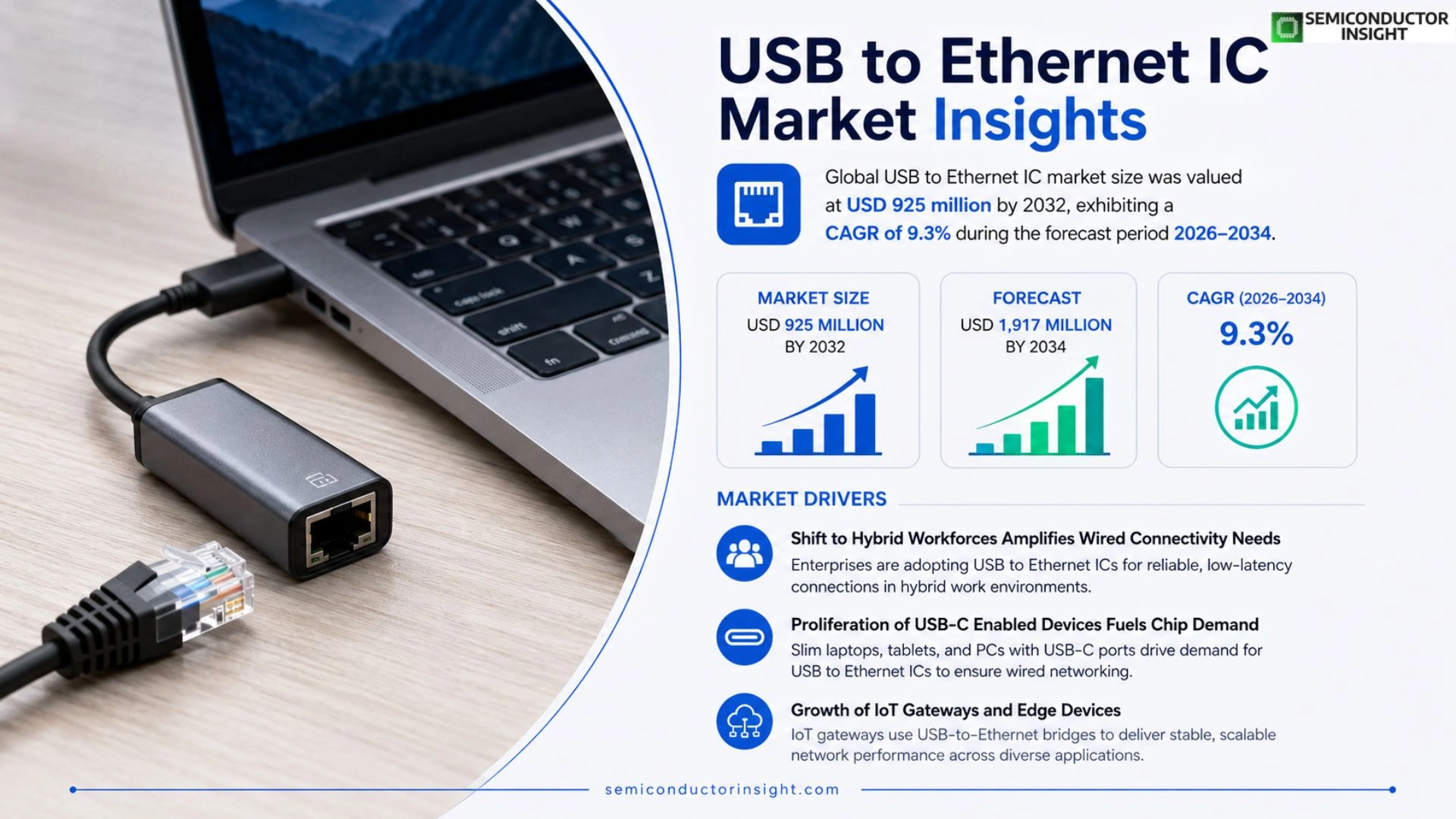
Global USB to Ethernet IC market size was valued at USD 505 million in 2025. The market is projected to grow from USD 505 million in 2025 to USD 925 million by 2032, exhibiting a CAGR of 9.3% during the forecast period.
USB‑to‑Ethernet chip refers to a bridging‑type integrated circuit that converts signals between a USB interface and an Ethernet protocol, allowing devices lacking an RJ45 port,such as ultra‑thin laptops, tablets, embedded modules and industrial terminals,to attach securely to wired networks via USB. By 2025, annual shipments are expected around 205 million units with an average selling price of roughly USD 2.7 per piece; capacity utilization hovers near 84% while gross margins sit close to 33%. Upstream activities encompass semiconductor wafer fabrication, analog/digital design houses, foundries and packaging/testing services; midstream players focus on network‑communication chip design and module assembly; downstream demand originates from consumer‑electronics OEMs, computer‑server manufacturers, industrial‑automation firms and network‑equipment integrators.
MARKET DRIVERS
Shift to Hybrid Workforces Amplifies Wired Connectivity Needs
Enterprises that have embraced hybrid work models are mandating reliable, low‑latency links for video conferencing and cloud‑based applications. USB to Ethernet ICs deliver plug‑and‑play performance that sidesteps the variability of Wi‑Fi, making them attractive for desk‑side adapters and docking stations. The result is a noticeable uptick in procurement orders from corporate IT departments seeking to standardize network access across diverse device portfolios.
Proliferation of USB‑C Enabled Devices Fuels Chip Demand
Manufacturers are rolling out slim laptops, tablets, and ultrathin PCs that rely exclusively on USB‑C ports. Because many of these devices lack native Ethernet controllers, OEMs integrate USB to Ethernet ICs to preserve wired‑network capability without compromising form factor. This trend is particularly evident in the education and government sectors, where legacy network infrastructure remains dominant.
➤ “The convergence of USB‑C adoption and the need for deterministic networking is reshaping the component landscape, prompting suppliers to accelerate ASIC development.”
Another catalyst is the expansion of Internet‑of‑Things (IoT) gateways that must relay sensor data over stable links. By embedding USB‑to‑Ethernet bridges, vendors can offer modular solutions that accommodate varying Ethernet speeds while keeping BOM costs in check. The cumulative effect of these drivers is a clear upward trajectory for USB to Ethernet IC market.
MARKET CHALLENGES
Escalating Price Competition Among Semiconductor Vendors
As the market widens, numerous fabless companies introduce low‑cost alternatives that erode pricing power for established players. Buyers, especially large‑scale distributors, negotiate aggressively, pressing manufacturers to achieve sub‑$0.30 per unit cost for mid‑range chips. This pressure forces firms to streamline design cycles and seek volume discounts, often at the expense of margin stability.
Other Challenges
Regulatory Compliance Burden
Achieving certification for electromagnetic compatibility (EMC) and meeting regional safety standards adds layers of testing and documentation. Small and medium‑sized suppliers, in particular, struggle to allocate resources for repeated compliance cycles, which can delay product launches and limit market penetration.
MARKET RESTRAINTS
Power Efficiency Constraints Limit Adoption in Battery‑Operated Devices
USB to Ethernet converters typically consume more power than integrated Wi‑Fi modules, a drawback for handheld gadgets that prioritize battery longevity. Designers seeking to meet stringent runtime targets often bypass Ethernet entirely, opting for wireless solutions despite occasional reliability concerns.
Complex Validation Requirements for High‑Speed USB Standards
Transitioning from USB 2.0 to USB 3.2 and USB4 demands rigorous signal‑integrity testing and firmware updates. Companies lacking mature validation infrastructure incur additional development time, discouraging them from incorporating advanced USB‑to‑Ethernet ICs into next‑generation products.
Intense Competition from Alternative Connectivity Technologies
Emerging standards such as Wi‑Fi 6E and 5G NR mini‑cells deliver comparable throughput with greater flexibility, drawing attention away from wired solutions. For manufacturers, this shift translates into a narrower addressable market for Ethernet adapters, especially in consumer electronics where wireless convenience dominates.
MARKET OPPORTUNITIES
Industrial Automation and Edge Computing Expand Demand
Factories upgrading to Industry 4.0 architectures require deterministic connections for robotic controllers and vision systems. USB to Ethernet ICs enable rapid retro‑fitting of legacy equipment, offering a cost‑effective bridge between legacy interfaces and modern Ethernet networks. This niche presents a fertile ground for component suppliers willing to provide ruggedized, temperature‑tolerant parts.
Automotive Ethernet Integration Accelerates Growth
Advanced driver‑assistance systems (ADAS) and infotainment platforms increasingly rely on Ethernet backbones to handle high‑bandwidth data streams. Integrating USB‑to‑Ethernet bridges into diagnostic tools and OTA‑update modules allows car manufacturers to maintain a unified connectivity strategy across multiple vehicle generations, opening a steady revenue stream for IC producers.
USB4 Ecosystem Generates New Use‑Cases
The emergence of USB4, with its 40 Gbps capacity, invites designers to pair it with high‑speed Ethernet interfaces for data‑center interconnects and professional workstations. Companies that can deliver tightly integrated USB‑to‑Ethernet solutions optimized for USB4’s power‑delivery and tunnel‑mode capabilities stand to capture early‑adopter contracts in the high‑performance computing segment.
USB to Ethernet IC Market Trends
Rising Demand for Wire‑Based Connectivity in Thin Devices
USB to Ethernet IC Market is feeling the impact of a sustained shift toward ultra‑slim form factors. Laptop manufacturers have increasingly omitted built‑in RJ45 ports to save chassis height, forcing end‑users to adopt external adapters. This design choice creates a predictable need for conversion chips that translate USB signals into Ethernet frames. As a result, sales volumes are projected to approach 205 million units by 2025, reflecting a clear alignment between product engineering trends and component demand. The price pressure generated by high utilization rates,around 84 % of capacity,means suppliers are optimizing wafer yields while preserving a gross margin near 33 %. Companies that can balance cost efficiency with performance will capture the lion’s share of this expanding demand.
Other Trends
Integration and Speed Enhancements
Manufacturers are consolidating MAC, PHY, and power‑management functions onto single die, a move that reduces board‑level complexity and improves power budgets. The migration from legacy 100 Mbps interfaces to gigabit and 2.5 G solutions is no longer a niche upgrade; it is becoming the baseline for new product introductions. By embedding higher‑speed PHYs, vendors meet the expectations of both consumer electronics and industrial controllers that require lower latency without sacrificing energy efficiency. The cost composition shows that wafer and chip fabrication accounts for roughly half of total expenses, underscoring the importance of advanced process nodes in delivering these integrated, high‑speed parts.
Industrial IoT Adoption Accelerates
Beyond the consumer arena, the industrial Internet of Things is fueling a separate growth vector for USB to Ethernet IC Market. Factories and automation lines still rely on deterministic wired links for reliability and deterministic latency, especially where safety‑critical signals travel. Policy incentives aimed at expanding digital infrastructure have amplified procurement budgets for network‑enabled machinery. Consequently, downstream customers,including industrial automation equipment manufacturers and network equipment integrators,are specifying chips that meet rigorous environmental and electromagnetic compatibility standards. The combination of higher integration density and extended temperature ranges makes the latest generation of devices attractive for rugged deployments, positioning them as essential building blocks for the next wave of smart‑factory installations.
COMPETITIVE LANDSCAPE
Key Industry Players
USB to Ethernet IC Market Competitive Overview
The segment is dominated by a handful of firms that have leveraged deep IP portfolios and advanced packaging capabilities to secure the bulk of revenue. Realtek, Microchip and ASIX each command double‑digit market shares, thanks to their early investments in gigabit and 2.5 G PHY integration, which enabled single‑chip solutions that fit ultra‑thin laptops and industrial gateways. Infineon and Texas Instruments complement the tier‑one cluster by supplying high‑reliability MAC/PHY blocks to OEMs that require automotive‑grade temperature ranges. Their ability to bundle power‑management IP with Ethernet functions reduces bill‑of‑materials cost and shortens time‑to‑market, reinforcing their position as preferred silicon partners for large‑scale consumer‑electronics manufacturers.
Beyond the core, a diverse set of niche innovators expands the ecosystem. NXP and Marvell target the data‑center edge, offering multi‑protocol controllers that support USB 3.x and 2.5 G Ethernet in a compact die. MaxLinear and ASMedia focus on cost‑sensitive multimedia devices, embedding USB‑to‑Ethernet bridges within broader audio‑video SoCs. Smaller Asian players such as JMicron, Davicom, WIZnet, Nanjing Qinheng, Motorcomm, Shenzhen CoreChips, Kawasaki Microelectronics and Ratoc provide specialized variants for embedded automation, smart‑home hubs, and legacy equipment retrofits. Their agility in customizing firmware stacks and supporting regional certifications creates pockets of competitive advantage that larger rivals often overlook.
List of Key USB to Ethernet IC Companies Profiled
- Realtek Semiconductor Corp.
- Microchip Technology Inc.
- ASIX Electronics Corp.
- Infineon Technologies AG
- Texas Instruments Inc.
- NXP Semiconductors N.V.
- Marvell Technology Inc.
- MaxLinear Inc.
- ASMedia Technology Inc.
- JMicron Technology Corp.
- Davicom Semiconductor Inc.
- WIZnet Co., Ltd.
- Nanjing Qinheng Microelectronics Co., Ltd.
- Motorcomm Electronic Technology Co., Ltd.
- Shenzhen CoreChips Technology Co., Ltd.
- Kawasaki Microelectronics Inc.
- Ratoc Systems Inc.
Segment Analysis:
| Segment Category | Sub-Segments | Key Insights |
| By Type |
|
USB 3.x → 2.5 Gbps Ethernet ICs
|
| By Application |
|
Industrial IoT Gateways
|
| By End User |
|
Enterprise IT Departments
|
| By [Segment Category 3]] |
|
Leading Segment description with qualitative insights only [Pointers preferred in bullets atleast 2-3]. |
| By [Segment Category 4]] |
|
Leading Segment description with qualitative insights only [Pointers preferred in bullets atleast 2-3]. |
Regional Analysis: USB to Ethernet IC Market
North America
Large corporations prioritize wired redundancy to safeguard data integrity, prompting a steady infusion of USB to Ethernet ICs into workstation docking stations and secure kiosks. The strategic shift toward zero‑trust networking amplifies demand for hardware‑level isolation that these chips provide.
Leading notebook and tablet manufacturers embed compact Ethernet controllers to address bandwidth‑intensive applications without sacrificing form factor. This design choice is reinforced by consumer expectations for plug‑and‑play reliability in conference‑room environments.
FCC and industry certifications demand rigorous electromagnetic compatibility, steering chip suppliers toward solutions that meet high‑grade compliance. Meeting these standards becomes a market differentiator for suppliers courting enterprise clients.
Proximity to semiconductor fabs and mature logistics networks afford North American firms a resilience advantage, allowing rapid replenishment cycles for USB to Ethernet IC inventories amid fluctuating demand patterns.
Europe
European manufacturers exhibit a nuanced approach, coupling stringent data‑privacy regulations with a strong push for interoperability across legacy and next‑generation devices. The region’s automotive and industrial automation sectors increasingly embed USB to Ethernet ICs to bridge legacy equipment with modern Ethernet backbones, fostering smoother migration paths. Additionally, the EU’s emphasis on energy‑efficient design influences chip makers to prioritize low‑power operation, aligning with sustainability targets set by numerous member states. These dynamics collectively shape a market that values compliance, efficiency, and cross‑industry synergy.
Asia‑Pacific
Asia‑Pacific’s rapid digital transformation fuels a surge in demand for compact connectivity solutions, especially in emerging economies where cost‑sensitive OEMs dominate. Manufacturers in China, South Korea, and Taiwan leverage localized design houses to accelerate time‑to‑market for USB to Ethernet ICs, often tailoring features for high‑density consumer electronics. The region’s expansive manufacturing base also drives a competitive pricing environment, compelling global vendors to adjust their value propositions. While price pressures are evident, the appetite for higher data rates and robust security features remains a decisive factor for market participants.
South America
In South America, market growth is anchored by expanding broadband infrastructure and a gradual shift from legacy serial interfaces to Ethernet‑centric architectures. Companies across Brazil and Argentina are retrofitting industrial equipment with USB to Ethernet adapters to meet rising productivity expectations. Though economic volatility introduces cautious investment behavior, the region’s increasing focus on smart‑factory initiatives provides a tangible catalyst for adoption, particularly among mid‑size manufacturers seeking scalable connectivity options.
Middle East & Africa
The Middle East & Africa region reflects a blend of high‑value projects in Gulf states and foundational network upgrades across Sub‑Saharan markets. Government‑led smart‑city programs and oil‑and‑gas digitization efforts demand ruggedized USB to Ethernet ICs capable of operating under harsh conditions. Meanwhile, African enterprises prioritize affordable, reliable connectivity to support expanding e‑commerce and fintech platforms. This duality creates a market where durability and cost efficiency are equally prized, influencing vendor strategies toward versatile product portfolios.
Report Scope
This market research report provides a comprehensive analysis of the USB to Ethernet IC Market , covering the forecast period 2026–2034. It offers detailed insights into market dynamics, technological advancements, competitive landscape, and key trends shaping the industry.
Key focus areas of the report include:
- Market Overview: The report begins with an overview outlining its current market scenario, key growth indicators, and industry transformation drivers. It discusses macroeconomic factors, demand–supply balance, regulatory landscape, and the strategic role of semiconductors in powering advancements across industries such as automotive, telecommunications, consumer electronics, and industrial automation.
- Market Size & Forecast: Historical data and future projections for revenue, unit shipments, and market value across major regions and segments.
- Segmentation Analysis: Detailed breakdown by product type, technology, application, and end-user industry to identify high-growth segments and investment opportunities.
- Regional Insights: Insights into market performance across North America, Europe, Asia-Pacific, Latin America, and the Middle East & Africa, including country-level analysis where relevant.
- Competitive Landscape: Profiles of leading market participants, including their product offerings, R&D focus, manufacturing capacity, pricing strategies, and recent developments such as mergers, acquisitions, and partnerships.
- Technology Trends & Innovation: Assessment of emerging technologies, integration of AI/IoT, semiconductor design trends, fabrication techniques, and evolving industry standards.
- Market Drivers & Restraints: Evaluation of factors driving market growth along with challenges, supply chain constraints, regulatory issues, and market-entry barriers.
- Stakeholder Insights: Insights for component suppliers, OEMs, system integrators, investors, and policymakers regarding the evolving ecosystem and strategic opportunities.
Primary and secondary research methods are employed, including interviews with industry experts, data from verified sources, and real-time market intelligence to ensure the accuracy and reliability of the insights presented.
FREQUENTLY ASKED QUESTIONS:
What is the current market size of USB to Ethernet IC Market?
-> USB to Ethernet IC Market was valued at USD 505 million in 2025 and is expected to reach USD 925 million by 2032 with a CAGR of 9.3% during the forecast period.
Which key companies operate in USB to Ethernet IC Market?
-> Key players include Realtek Semiconductor Corp., Microchip Technology Inc., ASIX Electronics Corp., Infineon Technologies AG, Texas Instruments Inc., among others.
What are the key growth drivers?
-> Key growth drivers include digital infrastructure construction, industrial IoT expansion, high‑speed USB 3.x and 2.5G Ethernet adoption, low‑power and multifunctional chip integration.
Which region dominates the market?
-> Asia is the fastest‑growing region, while North America remains a major market.
What are the emerging trends?
-> Emerging trends include higher transmission rates (gigabit & 2.5G), integration of MAC/PHY/power management in single‑chip solutions, and increased adoption in industrial IoT and AI computing devices.

Get Sample Report PDF for Exclusive Insights
Report Sample Includes
- Table of Contents
- List of Tables & Figures
- Charts, Research Methodology, and more...
 Download Sample Report PDF