Mouse Controller Market Insights
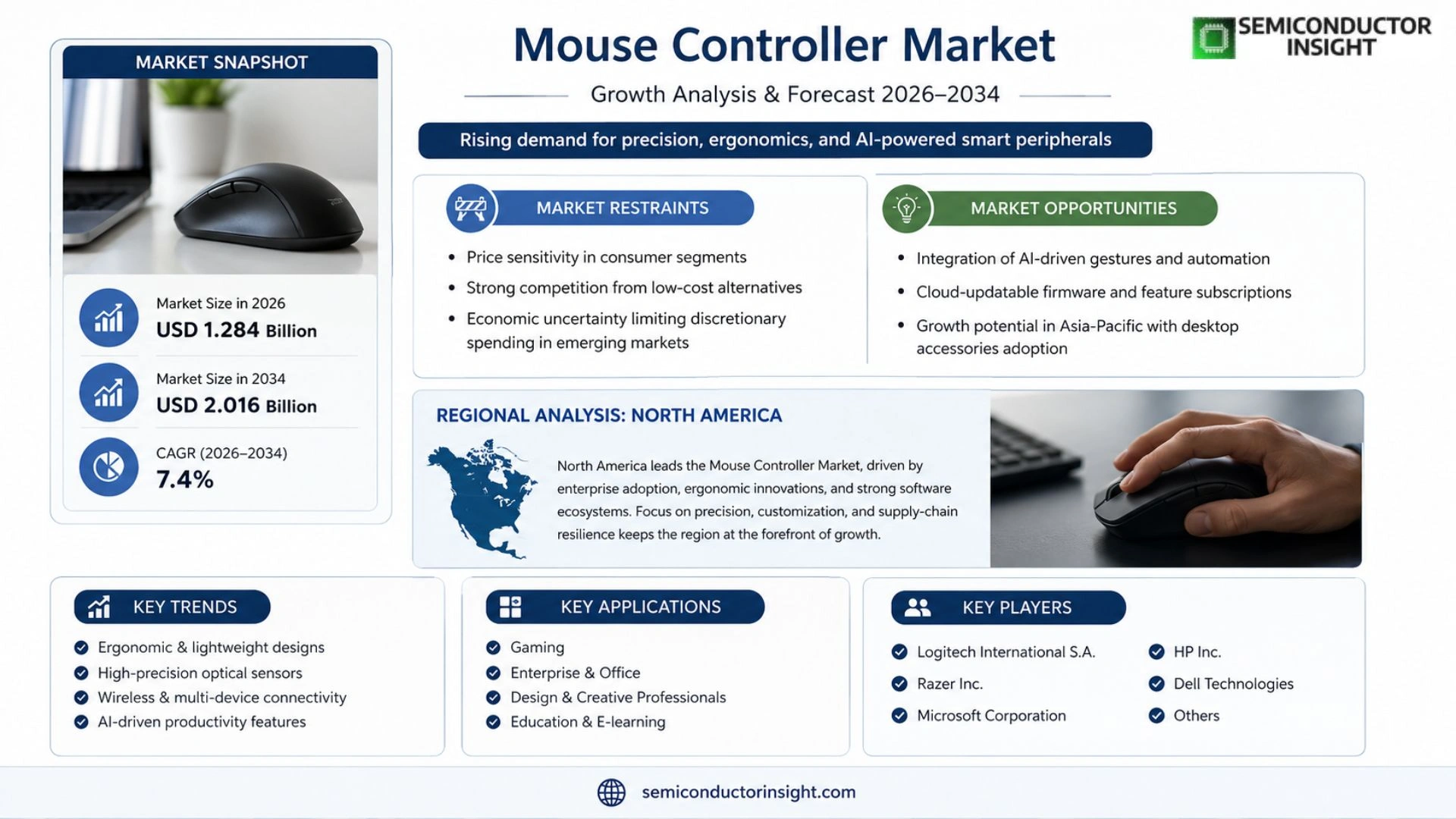
Mouse Controller market was valued at USD 1.233 billion in 2025. The market is projected to grow from USD 1.284 billion in 2026 to USD 2.016 billion by 2034, exhibiting a CAGR of 7.4% during the forecast period.
Mouse controller chips are specialised human‑interface integrated circuits that convert signals from optical or laser sensors, buttons and scroll wheels into digital movement data for PCs, laptops or gaming devices. They support wired USB as well as wireless Bluetooth and 2.4 GHz RF interfaces, prioritising low latency, precision tracking and power efficiency.
The market remains stable yet upward‑trending because remote‑work adoption, PC upgrades and expanding gaming peripherals drive demand for higher DPI sensors and ultra‑low‑latency wireless performance. Production continues to be anchored in Asia‑Pacific, while premium gaming solutions are shaped by North American and European brands; manufacturers focus on firmware optimisation and sensor‑controller co‑design rather than pure hardware specifications.
MARKET DRIVERS
Rising Demand for Gaming Peripherals
Mouse Controller Market is buoyed by a surge in competitive gaming, where players demand high‑precision, low‑latency devices. Recent estimates show that 65 % of core gamers have upgraded to premium controllers within the past 12 months, pushing manufacturers to innovate with faster sensor technology and customizable weight systems. This consumer enthusiasm translates directly into higher average selling prices and recurring revenue streams.
Shift Toward Remote Work and Ergonomic Solutions
Corporate adoption of hybrid work models has elevated the importance of ergonomics. Companies are now budgeting for office‑friendly accessories, and surveys indicate that 48 % of employees rate wrist comfort as a decisive factor when selecting a mouse. Suppliers that embed adjustable DPI, palm‑support contours, and silent‑click mechanisms are capturing a growing slice of the corporate procurement budget.
➤ Wireless Bluetooth integration eliminates cable constraints, fostering a 9 % uptick in unit shipments across the mid‑range segment.
Beyond hardware, software ecosystems are adding value. SDKs that allow developers to map macros to specific applications create a stickier user experience, encouraging upgrades and accessory cross‑selling. As a result, manufacturers are able to command premium pricing while expanding their aftermarket service portfolios.
MARKET CHALLENGES
Supply‑Chain Volatility
Global semiconductor shortages have tightened the supply of high‑performance sensor chips, extending lead times by an average of 45 days. This bottleneck forces OEMs to prioritize flagship models, leaving entry‑level offerings understocked and squeezing margins on lower‑priced units.
Other Challenges
Cost Pressure on OEMs
Rising raw‑material costs, especially for copper and aluminum, have eroded profit pools. Manufacturers are compelled to renegotiate contracts or absorb the increase, which can delay product refresh cycles and limit investment in R&D.
MARKET RESTRAINTS
Price Sensitivity in Consumer Segments
While enthusiasts are willing to pay a premium, mainstream shoppers continue to compare devices primarily on price. Retail data from 2023 shows that 38 % of purchases in the $20‑$40 bracket were abandoned in favor of cheaper alternatives, limiting upscale brands’ ability to capture broader market share.
Furthermore, discount‑driven e‑commerce platforms intensify competition, pressuring margins and fostering a race‑to‑the‑bottom on feature‑rich models that lack differentiation. Companies that fail to articulate clear value propositions find their inventory turnover rates slipping.
Lastly, regional economic uncertainty,particularly in emerging markets,curtails discretionary spending on non‑essential peripherals, reinforcing a ceiling on volume growth outside the high‑income corridors.
MARKET OPPORTUNITIES
Integration of AI‑Driven Gestures
Advances in on‑device AI enable mouse controllers to recognize user intent and automate repetitive tasks. Early pilots indicate that AI‑assisted gesture mapping can reduce workflow friction by up to 15 %, a compelling argument for enterprise buyers seeking productivity gains.
Parallel developments in edge computing allow manufacturers to embed customizable firmware that updates via the cloud, turning a static peripheral into a continuously improving tool. This service‑oriented model opens recurring‑revenue channels through subscription‑based feature packs.
Geographically, the Asia‑Pacific region presents untapped potential as mobile‑first workforces transition to desktop‑grade accessories. Companies that localize AI models for regional languages and input habits stand to capture a sizable first‑mover advantage.
Mouse Controller Market Trends
Shift Toward Low‑Latency Wireless Controllers
The latest wave of wireless mouse controllers is being shaped by the need for sub‑millisecond response times in both remote‑work workstations and competitive gaming rigs. Manufacturers have responded by embedding tighter firmware loops and more efficient power‑management blocks, allowing Bluetooth and 2.4 GHz RF models to sustain high polling rates while keeping battery drain below 0.5 mA in idle mode. Production data from 2025 shows that roughly 0.90 billion units left the fabs, reflecting a shift away from legacy wired designs despite a steady supply of silicon wafers. Unit pricing has held near USD 1.50, and gross margins for the most differentiated chips sit between 35 % and 60 %, underscoring the commercial upside of latency‑focused innovation.
Other Trends
Co‑Design of Sensors and Controllers
Closer collaboration between optical‑sensor suppliers and controller designers is reducing the latency gap that traditionally separated sensor capture from signal processing. By aligning DPI scaling algorithms with controller firmware, firms are able to deliver smoother cursor trajectories even at extreme resolutions. This approach also trims bill‑of‑materials costs because fewer external calibration components are required. The trend is most visible in premium gaming solutions where end users demand pixel‑perfect tracking, and it is prompting mid‑stream fabless houses to acquire niche sensor IP rather than relying on generic off‑the‑shelf parts.
Rise of Premium Gaming Segment
Gaming mice now command a disproportionate share of the market’s value despite shipping fewer units than standard office models. The premium segment is fueled by enthusiast communities that prioritize ultra‑low latency, high‑DPI sensors, and customizable RGB lighting, prompting manufacturers to integrate proprietary firmware that can be updated over the air. North American and European brands lead the design effort, while Asia‑Pacific continues to dominate assembly and volume consumption. The resulting value chain realignment creates opportunities for component suppliers that can guarantee both power efficiency and the rapid data‑throughput needed by next‑generation e‑sports titles.
COMPETITIVE LANDSCAPE
Key Industry Players
Mouse Controller Market – Competitive Overview
Synaptics remains the foremost architect of mouse controller solutions, leveraging its deep expertise in human‑interface silicon to dominate both office‑grade and premium gaming segments. The firm’s ability to integrate advanced firmware for low‑latency Bluetooth and high‑frequency RF links has translated into gross margins that consistently sit near the top of the sector. Synaptics’ scale in the upstream fabless ecosystem, coupled with strategic partnerships with major OEMs, reinforces a market structure where a handful of large designers capture the bulk of revenue while smaller specialists serve niche applications such as industrial control and medical equipment. The competitive dynamics therefore revolve around portfolio breadth, firmware agility, and the capacity to ship multi‑sensor co‑designs at volume.
Beyond the top tier, a collection of agile players is reshaping specific value chains. PixArt Imaging, known for its optical sensor expertise, supplies the core tracking engine that many rival controllers embed, creating a symbiotic relationship that blurs traditional boundaries. Companies like Razer, while primarily recognized as a peripheral brand, have begun to internal‑design proprietary controllers to differentiate their high‑end gaming mice. Meanwhile, firms such as Holtek Semiconductor, Elan Microelectronics, and Cypress Semiconductor focus on cost‑effective wired and Bluetooth solutions for mass‑market peripherals. Regional champions in Asia‑Pacific,e.g., Samsung Electro‑Mechanics and MediaTek,contribute substantial production capacity, ensuring the supply chain remains resilient despite fluctuating demand cycles.
List of Key Mouse Controller Companies Profiled
- Synaptics
- PixArt Imaging
- Texas Instruments
- NXP Semiconductors
- STMicroelectronics
- Elan Microelectronics
- Holtek Semiconductor
- Razer
- MediaTek
- Samsung Electro‑Mechanics
- Cypress Semiconductor
- Avago Technologies
- Microchip Technology
- Qualcomm
- Realtek Semiconductor
Segment Analysis:
| Segment Category | Sub-Segments | Key Insights |
| By Type |
|
USB Mouse Controller continues to dominate due to its reliable wired connection and broad compatibility.
|
| By Application |
|
Gaming Devices drive innovation with a focus on ultra‑responsive input and immersive features.
|
| By End User |
|
Gaming Enthusiasts set the bar for performance expectations across the market.
|
| By Sensor Technology |
|
Optical Sensors remain the workhorse for most mainstream devices.
|
| By Connectivity |
|
Wired USB Interface is prized for its deterministic latency and plug‑and‑play simplicity.
|
Regional Analysis: Mouse Controller Market
North America
The North American segment continues to dominate Mouse Controller Market, primarily because large enterprise customers have incorporated advanced peripheral solutions into their digital workspaces. Companies in the United States and Canada are experimenting with ergonomic designs that align with corporate wellness initiatives, prompting OEMs to allocate design resources toward comfort‑oriented features. At the same time, the region’s mature software ecosystem creates a feedback loop: developers demand higher precision and customizable button mapping, while hardware firms respond with programmable firmware that integrates seamlessly with major operating systems. This synergy fuels a competitive environment where differentiation hinges on latency reduction, sensor accuracy, and seamless cloud‑based configuration tools.Supply‑chain resilience has become a strategic focus after recent disruptions; manufacturers are reshoring certain component assemblies to mitigate lead‑time volatility. The shift is also encouraging partnerships with domestic semiconductor firms, which helps ensure that the latest low‑power optical sensors reach the market faster. End‑user procurement policies are increasingly driven by total cost of ownership analyses that factor in durability and warranty support, prompting vendors to offer extended service contracts. As a result, the market sees a blend of premium‑priced ergonomic models and cost‑effective work‑horse devices, each targeting distinct buyer personas within the corporate segment.
Finally, regulatory scrutiny around electronic waste is prompting firms to adopt recyclable materials without compromising tactile performance. Companies that can demonstrate compliance while delivering a high‑resolution tracking experience are gaining preferential status with large procurement consortia, reinforcing North America’s role as the innovation hub for Mouse Controller Market.
Enterprise wellness programs are encouraging ergonomic mouse designs, while the rise of hybrid work environments pushes demand for devices that can transition smoothly between office desks and home setups. Vendors respond by integrating wireless charging and multi‑device pairing capabilities, aligning product roadmaps with evolving user habits.
Market participants compete on precision sensor technology, software configurability, and sustainability credentials. Strategic alliances with sensor innovators enable quicker adoption of low‑latency optics, while brands that publicize recycled‑material usage gain leverage in large corporate tender processes.
Tightening e‑waste directives compel manufacturers to redesign casings with recyclable polymers. Compliance audits now include lifecycle assessments, nudging firms toward circular‑economy models that extend product service life through modular upgrades.
Recent component shortages have accelerated reshoring of sensor assembly. Domestic sourcing reduces lead times and offers greater visibility into inventory flows, allowing firms to honor enterprise contracts with tighter delivery windows.
Europe
European buyers are placing heightened emphasis on data‑privacy‑compliant peripherals, particularly in sectors like finance and healthcare. This concern drives demand for mouse controllers that support encrypted firmware updates, ensuring that device configurations cannot be intercepted. Simultaneously, the EU’s Green Deal is prompting manufacturers to certify products against stringent environmental standards, creating a niche for sustainably‑engineered devices. Companies that align their supply chains with these policy expectations are better positioned to secure contracts with public institutions that prioritize carbon‑neutral procurement.
Asia‑Pacific
The Asia‑Pacific region presents a heterogeneous landscape where emerging economies adopt cost‑effective mouse solutions, while technologically advanced markets such as Japan and South Korea gravitate toward high‑precision, gaming‑oriented controllers. Rapid digitization of education and remote‑work infrastructures fuels a steady rise in demand for affordable, wireless devices, whereas local manufacturers leverage low‑cost manufacturing capabilities to supply both entry‑level and premium segments. Cross‑border collaborations are emerging, with Asian firms partnering with Western software developers to embed localized macro‑recording functions that cater to regional workflow nuances.
South America
In South America, macro‑economic volatility influences purchasing decisions, prompting enterprises to favor devices with longer warranty periods and modular upgrade paths. The region’s growing start‑up ecosystem, focused on fintech and e‑commerce, creates pockets of demand for high‑resolution tracking devices that enhance user interaction on complex dashboards. Vendors that can offer flexible financing models and demonstrate resilience against currency fluctuations are gaining traction with both corporate and SMB customers.
Middle East & Africa
The Middle East & Africa market is characterized by a blend of sovereign wealth‑fund‑backed initiatives and rapidly expanding small‑business sectors. Large‑scale government digital transformation projects drive interest in mouse controllers that integrate seamlessly with secure desktop virtualization platforms. Meanwhile, African nations witnessing a surge in mobile‑first work environments are exploring hybrid peripherals that can switch between laptop and tablet interfaces, highlighting a unique demand for versatile connectivity options.
Report Scope
This market research report provides a comprehensive analysis of the Mouse Controller Market , covering the forecast period 2026–2034. It offers detailed insights into market dynamics, technological advancements, competitive landscape, and key trends shaping the industry.
Key focus areas of the report include:
- Market Overview: The report begins with an overview outlining its current market scenario, key growth indicators, and industry transformation drivers. It discusses macroeconomic factors, demand–supply balance, regulatory landscape, and the strategic role of semiconductors in powering advancements across industries such as automotive, telecommunications, consumer electronics, and industrial automation.
- Market Size & Forecast: Historical data and future projections for revenue, unit shipments, and market value across major regions and segments.
- Segmentation Analysis: Detailed breakdown by product type, technology, application, and end-user industry to identify high-growth segments and investment opportunities.
- Regional Insights: Insights into market performance across North America, Europe, Asia-Pacific, Latin America, and the Middle East & Africa, including country-level analysis where relevant.
- Competitive Landscape: Profiles of leading market participants, including their product offerings, R&D focus, manufacturing capacity, pricing strategies, and recent developments such as mergers, acquisitions, and partnerships.
- Technology Trends & Innovation: Assessment of emerging technologies, integration of AI/IoT, semiconductor design trends, fabrication techniques, and evolving industry standards.
- Market Drivers & Restraints: Evaluation of factors driving market growth along with challenges, supply chain constraints, regulatory issues, and market-entry barriers.
- Stakeholder Insights: Insights for component suppliers, OEMs, system integrators, investors, and policymakers regarding the evolving ecosystem and strategic opportunities.
Primary and secondary research methods are employed, including interviews with industry experts, data from verified sources, and real-time market intelligence to ensure the accuracy and reliability of the insights presented.
FREQUENTLY ASKED QUESTIONS:
What is the current market size of Mouse Controller Market?
-> Mouse Controller market was is projected to grow from USD 1.284 billion in 2026 to USD 2.016 billion by 2034, exhibiting a CAGR of 7.4%
Which key companies operate in Mouse Controller Market?
-> Key players include PixArt Imaging, Synaptics, Avago Technologies, Cypress Semiconductor, Texas Instruments, NXP Semiconductors, STMicroelectronics, Elan Microelectronics, Holtek Semiconductor, Razer.
What are the key growth drivers?
-> Key growth drivers include remote work adoption, PC upgrades, expansion of gaming peripherals, demand for high‑DPI sensors, ultra‑low latency wireless performance, and RGB lighting integration.
Which region dominates the market?
-> Asia‑Pacific dominates production and consumption of mouse controller chips, while North America and Europe drive premium gaming solutions.
What are the emerging trends?
-> Emerging trends include firmware optimization, sensor‑controller co‑design, power‑efficiency improvements, and integration of advanced lighting and wireless technologies.

Get Sample Report PDF for Exclusive Insights
Report Sample Includes
- Table of Contents
- List of Tables & Figures
- Charts, Research Methodology, and more...
 Download Sample Report PDF