Human Interface Device Controller Chips Market Insights
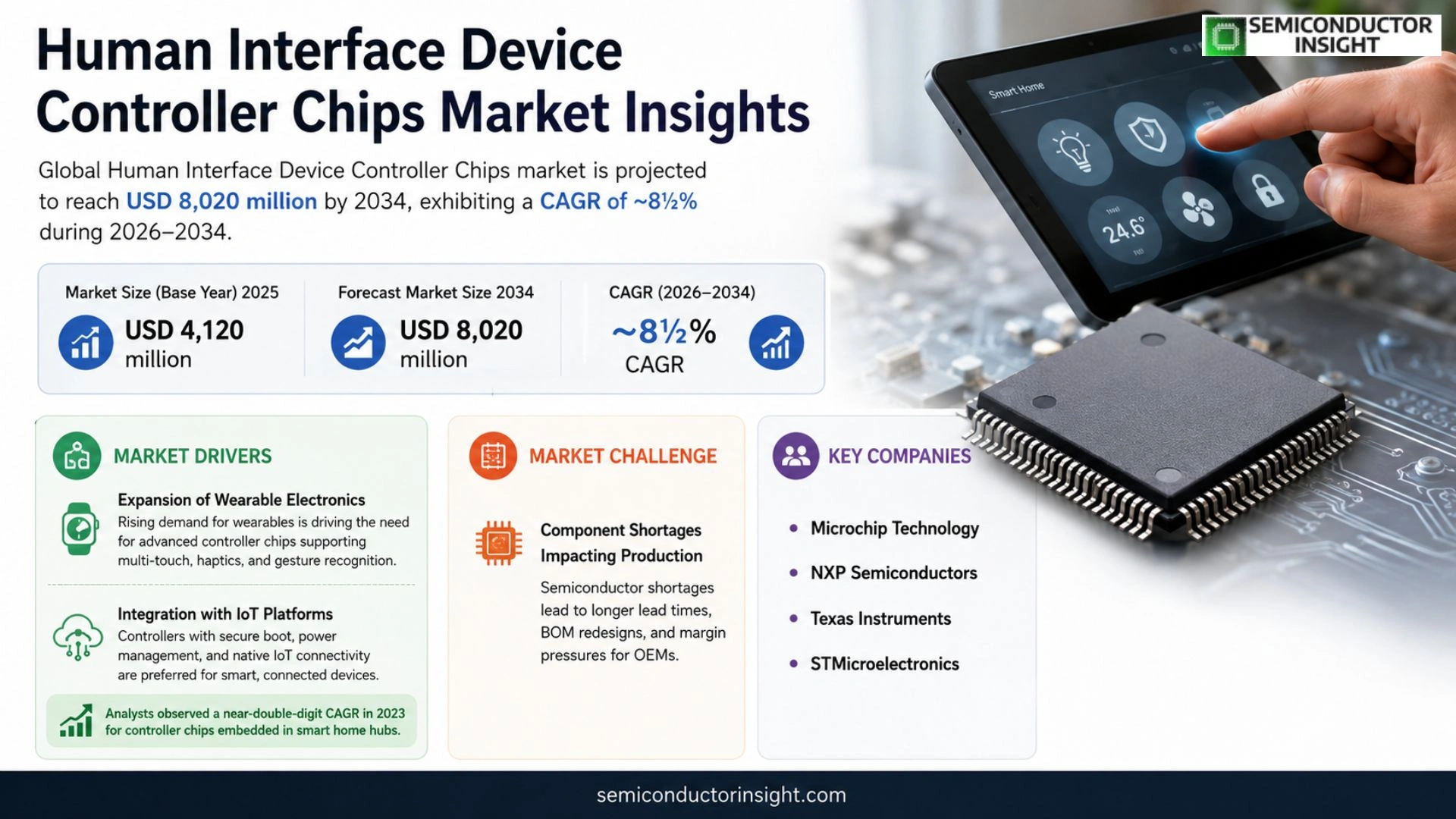
Global Human Interface Device Controller Chips market size was valued at USD 3.835 billion in 2025. The market is projected to reach USD 6.819 billion by 2032, exhibiting a CAGR of 8.7% during the forecast period.
Human interface controller chips are specialized integrated circuits that manage data input from human interface devices such as keyboards, mice, touchscreens, and game controllers. They handle signal processing, communication protocols, power management, and interface control, ensuring accurate, fast, and reliable user input.
The expansion reflects rising demand for high‑performance input processing across PCs, smartphones, gaming consoles and industrial automation. Recent collaborations,such as Microchip Technology’s partnership with major OEMs on low‑latency designs,show how manufacturers are tackling latency and power‑efficiency challenges while widening application scope.
MARKET DRIVERS
Expansion of Wearable Electronics
The surge in consumer‑focused wearables has forced OEMs to embed richer user interfaces. Human Interface Device Controller Chips that support multi‑touch, haptic feedback, and low‑latency gesture recognition are becoming mandatory components. This shift is less about incremental upgrades and more about redefining how devices interpret human input, which drives immediate demand for higher‑integration controller families.
Integration with IoT Platforms
Edge devices that connect to cloud services require controller chips capable of handling protocol stacks while still delivering responsive touch or button interfaces. Manufacturers that bundle secure boot, power‑management, and native IoT connectivity into a single silicon die are gaining a competitive edge, prompting system designers to favor those solutions over discrete components.
➤ Analysts observed a near‑double‑digit compound annual growth rate in 2023 for controller chips embedded in smart home hubs.
Because end‑users now expect seamless interaction across multiple devices, Human Interface Device Controller Chips Market is being reshaped by ecosystem pressure rather than isolated product launches. Companies that can align chip roadmaps with evolving UI standards are positioned to capture the bulk of forthcoming design cycles.
MARKET CHALLENGES
Component Shortages Impacting Production
Global semiconductor supply constraints have not spared specialized controller families. Allocation policies favor high‑volume memory and logic chips, leaving niche interface controllers with longer lead times. This bottleneck forces OEMs to redesign bill‑of‑materials, undermining cost forecasts and eroding margins.
Other Challenges
Regulatory Compliance
Stringent electromagnetic compatibility (EMC) and safety standards in medical and automotive sectors compel chip vendors to certify each product variant. The certification cycle adds months to time‑to‑market, discouraging rapid iteration and raising entry barriers for smaller players.
MARKET RESTRAINTS
High Power Consumption in Legacy Designs
Older controller architectures still dominate legacy equipment, and their inefficient power profiles limit battery longevity. When designers must prioritize endurance,particularly in medical wearables,they often bypass legacy chips, constraining market volume for those entrenched products.
Limited Standardization Across Brands
The absence of a unified interface‑controller specification means each OEM negotiates bespoke firmware and validation cycles. This fragmentation inflates development costs and slows adoption, especially for companies attempting to support a broad device portfolio.
MARKET OPPORTUNITIES
Emergence of Edge AI Devices
Edge AI processors increasingly embed on‑chip inference engines that require real‑time tactile feedback. Controllers equipped with built‑in neural‑network accelerators enable richer user experiences without offloading to external processors, opening a niche for differentiated chip offerings within Human Interface Device Controller Chips Market.
Customized Low‑Power Architectures
Design houses are collaborating with silicon vendors to create ultra‑low‑power controller families tailored for ultra‑compact wearables and medical implants. By leveraging sub‑threshold operation and advanced power‑gating techniques, these chips promise months‑long battery life, a proposition that directly addresses the most pressing restraint identified earlier.
Human Interface Device Controller Chips Market Trends
Rising Demand for Low‑Power, Multi‑Input Controllers
Human Interface Device Controller Chips Market is reacting to a surge in devices that require both minimal power draw and the ability to process several input modalities simultaneously. Touch‑based smartphones, gesture‑enabled tablets, and hybrid gaming accessories have all shifted design specifications toward chips that can sustain high‑frequency polling while staying under a watt of consumption. Manufacturers are therefore allocating silicon area to integrated power‑management blocks and to firmware that can switch between USB‑HID, I²C, and Bluetooth protocols on‑the‑fly. This trend matters because lower energy bills translate into longer battery life for end‑users, which in turn bolsters product appeal and accelerates adoption cycles. The resulting pressure on component pricing has pushed vendors to adopt advanced FinFET processes, trimming unit cost by roughly 12 % over the last two years without compromising the 30‑55 % gross margin band observed across the sector.
Other Trends
AI‑Assisted Adaptive Input Processing
Recent development cycles show that chip designers are embedding lightweight neural inference engines directly within controller silicon. By analysing keystroke dynamics, touch pressure patterns, or joystick movement, the AI layer can predict and pre‑empt user actions, shaving latency by up to 18 ms in benchmarked gaming controllers. The significance of this capability lies in the growing consumer expectation for instantaneous response, especially in competitive e‑sports and immersive VR environments. Companies that succeed in delivering a seamless AI‑enhanced experience are likely to capture premium market segments, while those that linger with purely deterministic logic risk losing relevance as developers embed more sophisticated input schemes into their software stacks.
Geographic Concentration of Production Capacity
Production data from 2025 reveal that the bulk of manufacturing output,approximately 2.3 billion units,remains anchored in regions equipped with mature semiconductor fabs, such as East Asia and parts of Western Europe. This concentration reflects the high capital intensity of wafer fabrication and the need for tightly controlled testing environments. For downstream customers, the geographic clustering translates into shorter lead times for high‑volume orders but also creates exposure to regional supply‑chain shocks, as demonstrated by recent logistics disruptions in East Asian ports. Firms are therefore diversifying their sourcing strategies, either by establishing secondary assembly lines in emerging fabs or by entering long‑term agreements with foundries that can guarantee capacity under fluctuating demand scenarios. The strategic implication for market participants is clear: flexibility in the supply chain will become a decisive factor in maintaining service levels and price stability as the overall market expands toward the forecasted $6.8 billion valuation by 2032.
COMPETITIVE LANDSCAPE
Key Industry Players
Competitive Overview of Human Interface Device Controller Chips Market
The segment is dominated by a handful of semiconductor powerhouses that combine deep‑packet design capabilities with extensive fabrication capacity. Microchip Technology leverages its legacy in embedded controllers to capture a sizable share of keyboard and mouse IC sales, while NXP Semiconductors relies on its broad automotive and IoT portfolio to cross‑sell touchscreen controllers. Texas Instruments distinguishes itself through aggressive integration of analog front‑ends with digital processing, allowing it to serve both consumer‑grade and industrial‑grade applications. STMicroelectronics and Renesas Electronics round out the core quartet, each offering differentiated low‑power families that address the latency‑sensitive demands of gaming consoles and wearable devices. The concentration of design talent and access to advanced packaging facilities in East Asia reinforces this top‑tier structure, creating high entry barriers for new entrants.
Beyond the leaders, a vibrant set of niche innovators adds depth to the ecosystem. Cypress Semiconductor (now part of Infineon) continues to specialize in Bluetooth‑enabled HID solutions for smart‑home products, whereas Analog Devices focuses on high‑precision signal‑conditioning chips for medical‑grade input devices. Broadcom supplies integrated USB‑HID controllers that benefit from its massive scale in networking silicon. NVIDIA, although primarily known for graphics, has entered the market with AI‑augmented input processors aimed at next‑generation AR/VR headsets. ROHM Semiconductor, Prolific Technology, Synaptics, Bridgetek Pte Ltd., Wincom, and several regional firms such as MediaTek and SiFive provide targeted offerings ranging from low‑cost game‑controller ASICs to customizable firmware‑driven platforms. Their agility enables rapid response to emerging form factors, positioning them as strategic partners for OEMs seeking differentiated user‑experience features.
List of Key Human Interface Device Controller Chips Companies Profiled
- Microchip Technology
- NXP Semiconductors
- Texas Instruments
- STMicroelectronics
- Renesas Electronics
- Cypress Semiconductor
- Analog Devices
- Broadcom
- NVIDIA
- ROHM Semiconductor
- Prolific Technology Inc.
- Synaptics
- Bridgetek Pte Ltd.
- Wincom
Segment Analysis:
| Segment Category | Sub-Segments | Key Insights |
| By Type |
|
Touchscreen Controller Chips are emerging as the dominant type because they enable fluid gesture interaction across smartphones, tablets and emerging automotive infotainment platforms. • Manufacturers are integrating low‑power AI engines to enhance touch accuracy and reduce latency. • Robust signal‑processing architectures are being adopted to support multi‑touch and pressure‑sensing capabilities. • Ecosystem support, including driver and firmware tools, accelerates adoption in consumer and industrial touch‑enabled devices. |
| By Application |
|
Gaming Consoles & VR/AR Devices drive intensive demand for high‑performance controllers that can process rapid input streams with minimal latency. • The convergence of haptic feedback and motion tracking requires chips with advanced sensor fusion capabilities. • Energy‑efficiency is critical as developers aim to extend battery life of untethered VR headsets. • Tight integration with graphics pipelines enables seamless user experiences, positioning this segment as a technology showcase. |
| By End User |
|
Consumer Electronics remains the largest end‑user group, propelled by ubiquitous keyboards, mice and touch interfaces in PCs, smartphones and tablets. • Continuous innovation in ergonomic design pushes manufacturers to develop chips with ultra‑low power draw. • Compatibility with multiple operating systems and standard HID protocols simplifies integration for OEMs. • Strong after‑sales support ecosystems, including driver updates and calibration services, reinforce market adoption. |
| By Interface Type |
|
USB HID Controller Chips dominate because of their universal compatibility and straightforward integration across legacy and modern devices. • Robust plug‑and‑play support reduces development time for system integrators. • High data‑transfer rates enable responsive input for gaming peripherals and professional keyboards. • Ongoing enhancements in power‑management allow USB‑C implementations to achieve lower standby consumption. |
| By Deployment Region |
|
Asia exhibits the fastest momentum, driven by a concentration of advanced semiconductor fabs and a massive consumer base. • Regional OEMs are co‑designing chips to meet specific device form‑factors for smartphones and wearables. • Government incentives for semiconductor R&D accelerate innovation cycles. • Strong supply‑chain integration ensures rapid time‑to‑market for emerging IoT and industrial automation solutions. |
Regional Analysis: Human Interface Device Controller Chips Market
North America
The proliferation of high‑resolution touchscreens in smartphones, tablets and laptops fuels a steady need for advanced controller chips. Manufacturers prioritize chips that deliver low latency and consistent tactile feedback, prompting several North American firms to tailor ASICs for flagship devices.
As autonomous driving platforms adopt haptic steering wheels and multi‑modal dashboards, automotive suppliers turn to robust controller chips that can survive harsh thermal cycles, positioning the region’s chipmakers as preferred partners for OEMs.
Data‑center peripherals and secure workstations increasingly embed encrypted HID communication. North American designers respond with chips that embed hardware‑level encryption, creating a competitive moat in security‑sensitive verticals.
Start‑ups targeting health monitoring and AR glasses demand ultra‑low‑power controllers. The region’s venture‑backed innovators deliver silicon that balances power envelope with rich sensor fusion, catalyzing new product categories.
Europe
European markets exhibit a deliberate shift toward sustainable device design, prompting chipmakers to emphasize recyclable materials and energy‑efficient operation. Regulatory frameworks such as the EU Ecodesign Directive encourage manufacturers to embed power‑saving logic directly into controller firmware. This policy pressure, coupled with a mature automotive sector that values precise haptic feedback for driver‑assistance systems, nudges European suppliers toward higher integration levels. Concurrently, the region’s strong design community fuels collaborative standards development, ensuring interoperability across a fragmented vendor landscape.
Asia‑Pacific
Asia‑Pacific remains the manufacturing powerhouse for consumer hardware, translating into a massive downstream demand for interface controller chips. While cost competitiveness drives volume, local OEMs are increasingly seeking differentiated experiences,such as localized gesture vocabularies,to capture market share in highly price‑sensitive segments. The rise of 5G‑enabled devices also accelerates the need for more responsive touch and stylus interfaces, prompting regional fabless firms to invest in mixed‑signal expertise. Strategic partnerships between chip designers and major smartphone assemblers are reshaping supply dynamics, allowing quicker roll‑out of next‑generation controllers.
South America
In South America, growth is anchored by expanding mobile penetration and a budding market for affordable wearables. Local distributors favor controller solutions that can be integrated into multi‑function chips, reducing bill‑of‑materials for cost‑conscious device makers. Government incentives for domestic technology parks encourage joint R&D projects, especially in Brazil, where universities collaborate with chip firms to prototype low‑power HID modules for IoT gateways. These initiatives gradually lower entry barriers and diversify the regional supplier base.
Middle East & Africa
The Middle East & Africa region is witnessing incremental adoption of smart‑home appliances and industrial automation equipment that rely on precise human‑machine interfaces. Investment in digital infrastructure, particularly in United Arab Emirates and South Africa, drives demand for controllers capable of operating across varied temperature ranges. Moreover, defense and aerospace contracts in the Gulf states often stipulate hardened interface chips, prompting niche players to tailor ruggedized solutions. Although volume remains modest, the willingness to pay a premium for reliability creates a niche that attracts specialized silicon providers.
Report Scope
This market research report provides a comprehensive analysis of the Human Interface Device Controller Chips Market , covering the forecast period 2026–2034. It offers detailed insights into market dynamics, technological advancements, competitive landscape, and key trends shaping the industry.
Key focus areas of the report include:
- Market Overview: The report begins with an overview outlining its current market scenario, key growth indicators, and industry transformation drivers. It discusses macroeconomic factors, demand–supply balance, regulatory landscape, and the strategic role of semiconductors in powering advancements across industries such as automotive, telecommunications, consumer electronics, and industrial automation.
- Market Size & Forecast: Historical data and future projections for revenue, unit shipments, and market value across major regions and segments.
- Segmentation Analysis: Detailed breakdown by product type, technology, application, and end-user industry to identify high-growth segments and investment opportunities.
- Regional Insights: Insights into market performance across North America, Europe, Asia-Pacific, Latin America, and the Middle East & Africa, including country-level analysis where relevant.
- Competitive Landscape: Profiles of leading market participants, including their product offerings, R&D focus, manufacturing capacity, pricing strategies, and recent developments such as mergers, acquisitions, and partnerships.
- Technology Trends & Innovation: Assessment of emerging technologies, integration of AI/IoT, semiconductor design trends, fabrication techniques, and evolving industry standards.
- Market Drivers & Restraints: Evaluation of factors driving market growth along with challenges, supply chain constraints, regulatory issues, and market-entry barriers.
- Stakeholder Insights: Insights for component suppliers, OEMs, system integrators, investors, and policymakers regarding the evolving ecosystem and strategic opportunities.
Primary and secondary research methods are employed, including interviews with industry experts, data from verified sources, and real-time market intelligence to ensure the accuracy and reliability of the insights presented.
FREQUENTLY ASKED QUESTIONS:
What is the current market size of Human Interface Device Controller Chips Market?
-> Human Interface Device Controller Chips Market was valued at USD 3835 million in 2025 and is expected to reach USD 6819 million by 2032 with a CAGR of 8.7% during the forecast period.
Which key companies operate in Human Interface Device Controller Chips Market?
-> Key players include Microchip Technology, NXP Semiconductors, Texas Instruments, STMicroelectronics, Renesas Electronics, Cypress Semiconductor, Analog Devices, Broadcom, NVIDIA, ROHM Semiconductor, Prolific Technology Inc., Synaptics, Bridgetek Pte Ltd., Wincom.
What are the key growth drivers?
-> Key growth drivers include rising demand for faster, more reliable and energy‑efficient input processing in consumer electronics, industrial automation and gaming devices; increasing adoption of touch‑based and gesture‑controlled interfaces; and the need for multi‑input and AI‑assisted processing capabilities.
Which region dominates the market?
-> Asia dominates the market, driven by advanced semiconductor fabrication, packaging and testing capabilities in countries such as China, Japan and South Korea, while North America and Europe remain significant secondary markets.
What are the emerging trends?
-> Emerging trends include integration of low‑power management and AI‑assisted input processing, multi‑device connectivity, and the convergence of HID controllers with IoT and edge‑computing platforms.
Get Sample Report PDF for Exclusive Insights
Report Sample Includes
- Table of Contents
- List of Tables & Figures
- Charts, Research Methodology, and more...
 Download Sample Report PDF