AI Server MOSFET Market Insights
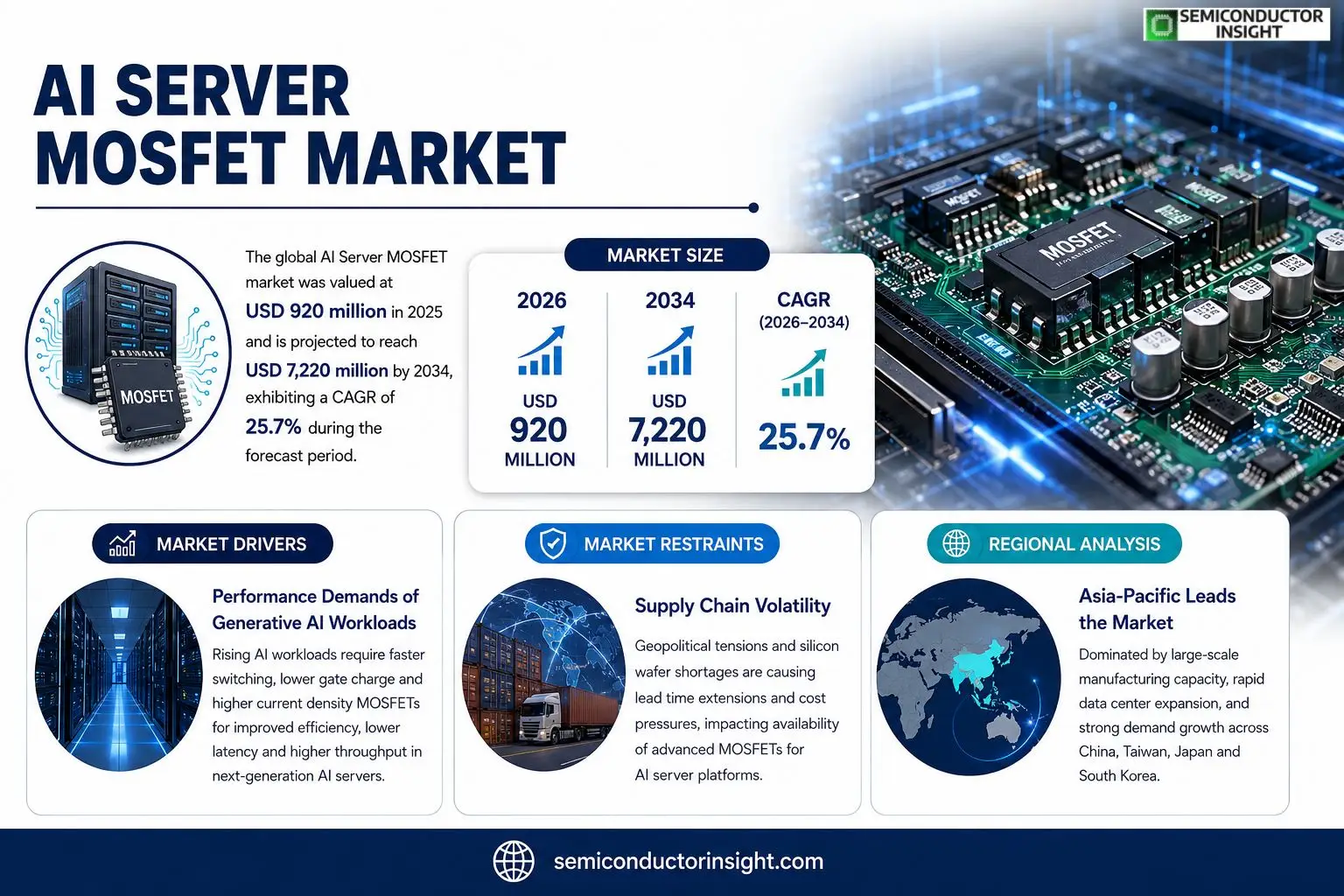
AI Server MOSFET market size was valued at USD 920 million in 2025 and is projected to reach USD 7,220 million by 2034, exhibiting a CAGR of approximately 25.7% during the forecast period.
AI Server MOSFET refers to power semiconductor devices employed in AI servers for power conversion, distribution, and load management. Their core function is to enable high‑frequency switching and improve overall system efficiency. Key application points include power‑supply units, battery‑backup modules, 48‑V distribution networks, hot‑swap/or‑ing protection circuits, intermediate bus conversion stages, and voltage‑regulation modules serving CPUs, GPUs, ASICs and high‑bandwidth memory rails. By form factor, they are categorized into discrete MOSFETs, DRMOS packages and smart power stages; by material composition silicon dominates while SiC and GaN are gaining traction in high‑voltage or ultra‑efficient scenarios.
MARKET DRIVERS
Performance Demands of Generative AI Workloads
The surge in generative‑AI applications forces data‑center architects to prioritize transistors that can switch faster while dissipating less heat. AI Server MOSFET Market participants are therefore channeling R&D funds into low‑gate‑charge devices that sustain high current densities, a shift that directly improves inference latency and training throughput.
Power‑Efficiency Targets in Hyper‑Scale Facilities
Operators of hyperscale clouds are under pressure to curb electricity bills and meet sustainability goals. Modern MOSFET architectures that combine silicon‑carbide channels with advanced trench structures deliver up to 30% lower conduction losses, allowing facilities to pack more servers per rack without exceeding power budgets.
➤ Increasing rack density compels OEMs to select MOSFETs that balance high voltage tolerance with minimal on‑resistance, reshaping the component mix in AI‑focused servers.
These technical imperatives create a feedback loop: as AI models become more demanding, manufacturers refine device physics, and data‑center designers reap efficiency gains that justify further investment in cutting‑edge MOSFETs.
MARKET CHALLENGES
Supply‑Chain Volatility
Geopolitical tensions and the shortage of high‑purity silicon substrates have stretched lead times for advanced MOSFETs. Companies that cannot secure reliable wafer capacity face production bottlenecks, which in turn inflate component costs for AI‑oriented servers.
Other Challenges
Thermal Management Constraints
The transition to higher power densities elevates junction temperatures, demanding sophisticated cooling solutions that add capital expense and limit the feasibility of retrofitting older data‑center assets.
MARKET RESTRAINTS
Regulatory Energy‑Efficiency Standards
Emerging regional mandates on data‑center power usage effectiveness (PUE) require manufacturers to certify that their MOSFET offerings meet stringent efficiency thresholds. Compliance testing adds a layer of complexity that can delay time‑to‑market for new AI‑grade devices.
MARKET OPPORTUNITIES
Emergence of Edge AI Infrastructures
Deployments of AI workloads at the edgesuch as autonomous‑vehicle controllers and real‑time video analyticsrequire MOSFETs capable of operating under constrained power envelopes yet delivering high switching speeds. Companies that can engineer compact, low‑gate‑leakage solutions stand to capture a nascent segment of the AI Server MOSFET Market, diversifying revenue beyond traditional data‑center channels.
AI Server MOSFET Market Trends
Accelerating Demand for High‑Efficiency Power Switching
The AI Server MOSFET Market posted revenue of roughly US$920 million in 2025, a level that reflects the surge in AI‑driven compute workloads. A forecast indicates the market will ascend to about US$4.66 billion by 2032, driven by the need to power increasingly dense accelerator boards. Production in 2025 crossed the 991 million‑unit threshold, with an average transaction price hovering near US$1.01 per device. These figures underscore that MOSFETs have moved from peripheral components to essential enablers of server‑level power conversion, compelling OEMs to reevaluate bill‑of‑materials and thermal budgets.
Other Trends
Material Innovation and Device Architecture
Silicon continues to dominate the AI Server MOSFET Market, yet silicon‑carbide (SiC) and gallium‑nitride (GaN) are carving out niche roles where voltage stress and efficiency margins tighten. SiC devices deliver lower conduction loss in 48 V server architectures, while GaN excels in ultra‑high‑frequency regimes required for next‑generation VRM stages. This material diversification is prompting design houses to adopt mixed‑technology power stages, integrating discrete MOSFETs with DrMOS blocks to balance cost and performance. The shift encourages closer collaboration between wafer fabs, OSAT partners, and system integrators, as package parasitics and thermal paths become decisive cost factors.
Regional Supply‑Chain Realignments
North America retains a strategic advantage in high‑end design and IP creation, fueling early‑adopter deployments among cloud service giants. Meanwhile, Asia‑Pacificparticularly Taiwan and mainland Chinaremains the manufacturing hub, supplying the bulk of wafer capacity and meeting the rapid expansion of data‑center construction. Europe’s niche lies in safety‑critical and automotive‑grade power modules, where stringent reliability standards drive bespoke MOSFET configurations. Companies that can synchronize upstream material sourcing with downstream power‑module integration stand to capture incremental margin, whereas those reliant on single‑source suppliers may confront supply volatility as demand spikes across all regions.
COMPETITIVE LANDSCAPE
Key Industry Players
Competitive Positioning in the AI Server MOSFET Segment
Infineon Technologies continues to anchor the high‑power AI server MOSFET market through a blend of silicon‑based and SiC product families that address both 48 V distribution and high‑voltage bus conversion. Its vertically integrated modelspanning wafer fab, design, and advanced packagingdelivers consistent RDS(on) performance and enables customers to meet the stringent transient response specifications of modern AI accelerators. The company’s emphasis on bundled power stages, such as DR‑MOS solutions, has locked in a sizable share of the North‑American and European OEM supply chains, where reliability and thermal management are paramount. As data‑center builders prioritize efficiency, Infineon’s ability to ship calibrated modules at scale creates a barrier for new entrants that lack similar manufacturing depth.Beyond the dominant IDM, a constellation of specialist firms strengthens the competitive fabric. onsemi and Wolfspeed have leveraged their SiC capabilities to capture niche high‑voltage applications, while Vishay and ROHM focus on low‑loss silicon MOSFETs for VRM rails. Alpha & Omega Semiconductor and Nexperia, operating as fabless designers, rely on outsourced foundries to deliver cost‑effective discrete devices for mid‑range servers. Asian manufacturersChina Resources Microelectronics, Wuxi NCE Power, and Suzhou Oriental Semiconductorexploit regional wafer capacity and aggressive pricing to serve the rapidly expanding data‑center construction in China and Southeast Asia. Smaller players such as JoulWatt, Navitas, and PANJIT International round out the ecosystem, offering custom smart power stages that appeal to OEMs seeking differentiated thermal solutions.
List of Key AI Server MOSFET Companies Profiled
- Infineon Technologies
- onsemi
- Vishay Intertechnology
- Alpha & Omega Semiconductor
- Nexperia
- STMicroelectronics
- Wolfspeed
- Monolithic Power Systems
- China Resources Microelectronics Limited
- Wuxi NCE Power Co., Ltd
- Advanced Power Electronics Co., Ltd.
- Texas Instruments
- ROHM Semiconductor
- JoulWatt
- Navitas
Segment Analysis:
| Segment Category | Sub-Segments | Key Insights |
| By Type |
|
Discrete MOSFET remains the workhorse for AI server power architectures, offering:
|
| By Application |
|
Power Supply Units drive the core platform strategy because they:
|
| By End User |
|
Cloud Data Centers shape market direction through:
|
| By Material |
|
Silicon continues to dominate because it:
|
| By Voltage |
|
Low‑Voltage segments gain traction due to:
|
Regional Analysis: AI Server MOSFET Market
North America
Silicon Valley and Austin host ecosystems where MOSFET designers collaborate closely with AI server architects. This proximity accelerates prototype cycles, allowing novel device topologies to enter pilot programs within months rather than years.
Regional investments in wafer‑fab capacity and domestic material sourcing mitigate disruptions, ensuring that high‑volume AI server manufacturers can maintain steady component flows despite volatility.
Energy‑efficiency regulations in the United States and Canada incentivize the adoption of low‑loss MOSFETs, reinforcing market momentum for designs that meet stringent Power Usage Effectiveness benchmarks.
Cloud providers seeking to expand AI‑training clusters are negotiating long‑term MOSFET supply contracts, leveraging bulk pricing to offset the higher cost of next‑generation device architectures.
Europe
European data‑center operators are aligning their rollout strategies with the continent’s carbon‑neutral objectives. Consequently, server OEMs are evaluating MOSFETs that deliver superior thermal performance, as reduced cooling translates directly into lower emissions. The region’s diversified manufacturing basefrom Germany’s precision fabs to France’s emerging design housesenables a collaborative environment where power‑device engineers adapt to the specific voltage tolerances required by European AI workloads. Moreover, the EU’s focus on strategic autonomy in semiconductors creates funding pathways for specialized MOSFET projects, fostering a pipeline that could narrow the gap with North America over the next few years.
Asia‑Pacific
Asia‑Pacific’s AI Server MOSFET Market is characterized by rapid scale‑up of cloud infrastructure, especially in China, Japan, and South Korea. While the region historically emphasized cost‑lead solutions, the shift toward high‑density AI inference is prompting a reevaluation of power efficiency. Local foundries are accelerating the adoption of advanced lithography to deliver MOSFETs with lower on‑resistance, addressing the power‑budget constraints of compact server chassis. Strategic partnerships between regional chip designers and AI chipset vendors are also emerging, allowing co‑development of tailored power stages that match the unique thermal envelopes of emerging AI accelerators.
South America
In South America, the AI Server MOSFET Market remains nascent but is gaining traction as multinational cloud providers extend edge‑computing footprints. Countries such as Brazil and Chile are investing in data‑center clusters that serve growing AI‑driven applications in agriculture and finance. The primary challenge lies in balancing device cost with performance, prompting operators to favor MOSFETs that provide a pragmatic mix of reliability and efficiency. Local distributors are beginning to stock a broader portfolio of AI‑grade MOSFETs, reducing lead times and encouraging early experimentation among regional system integrators.
Middle East & Africa
The Middle East & Africa region is witnessing a measured entry into AI‑intensive workloads, driven by sovereign wealth funds allocating capital to digital infrastructure. Server deployments in the United Arab Emirates and South Africa increasingly call for MOSFETs that can operate under high ambient temperatures without compromising reliability. Energy‑cost considerations are paramount, leading operators to prioritize devices with low leakage currents. As regional telecom operators diversify into cloud services, the demand for AI‑ready server power solutions is expected to evolve from pilot projects to more sustained procurement cycles.
Report Scope
This market research report provides a comprehensive analysis of the AI Server MOSFET Market , covering the forecast period 2026–2034. It offers detailed insights into market dynamics, technological advancements, competitive landscape, and key trends shaping the industry.
Key focus areas of the report include:
- Market Overview: ✅ The report begins with an overview outlining its current market scenario, key growth indicators, and industry transformation drivers. It discusses macroeconomic factors, demand–supply balance, regulatory landscape, and the strategic role of semiconductors in powering advancements across industries such as automotive, telecommunications, consumer electronics, and industrial automation.
- ✅ Market Size & Forecast: Historical data and future projections for revenue, unit shipments, and market value across major regions and segments.
- ✅ Segmentation Analysis: Detailed breakdown by product type, technology, application, and end-user industry to identify high-growth segments and investment opportunities.
- ✅ Regional Insights: Insights into market performance across North America, Europe, Asia-Pacific, Latin America, and the Middle East & Africa, including country-level analysis where relevant.
- ✅ Competitive Landscape: Profiles of leading market participants, including their product offerings, R&D focus, manufacturing capacity, pricing strategies, and recent developments such as mergers, acquisitions, and partnerships.
- ✅ Technology Trends & Innovation: Assessment of emerging technologies, integration of AI/IoT, semiconductor design trends, fabrication techniques, and evolving industry standards.
- ✅ Market Drivers & Restraints: Evaluation of factors driving market growth along with challenges, supply chain constraints, regulatory issues, and market-entry barriers.
- ✅ Stakeholder Insights: Insights for component suppliers, OEMs, system integrators, investors, and policymakers regarding the evolving ecosystem and strategic opportunities.
Primary and secondary research methods are employed, including interviews with industry experts, data from verified sources, and real-time market intelligence to ensure the accuracy and reliability of the insights presented.
FREQUENTLY ASKED QUESTIONS:
What is the current market size of AI Server MOSFET Market?
-> AI Server MOSFET Market was valued at USD 920 million in 2025 and is expected to reach USD 4664 million by 2032 with a CAGR of 24.4% during the forecast period.
Which key companies operate in AI Server MOSFET Market?
-> Key players include Infineon Technologies, onsemi, Vishay, Alpha & Omega Semiconductor, Nexperia, STMicroelectronics, Wolfspeed, Monolithic Power Systems, China Resources Microelectronics Limited, Wuxi NCE Power Co., Ltd, Advanced Power Electronics Co., Ltd., TI, JoulWatt, ROHM, Yangjie Electronic Technology Co., Ltd., Navitas, PANJIT International Inc, Suzhou Oriental Semiconductor Company Limited.
What are the key growth drivers?
-> Key growth drivers include investment in AI computing power, deployment of high‑performance computing clusters, large‑scale model training demand, and expanding edge inference applications, which drive the need for ultra‑high switching frequency, low conduction loss, and superior thermal performance MOSFETs.
Which region dominates the market?
-> Asia‑Pacific dominates the market due to its leading semiconductor manufacturing capacity, massive data‑center construction, and strong demand growth, while North America remains a hub for technological innovation.
What are the emerging trends?
-> Emerging trends include gradual adoption of SiC and GaN MOSFETs for high‑voltage/high‑efficiency scenarios, integration of smart power stages, open‑source ecosystem collaboration, and increasing focus on thermal management and package‑level consistency in AI servers.
Get Sample Report PDF for Exclusive Insights
Report Sample Includes
- Table of Contents
- List of Tables & Figures
- Charts, Research Methodology, and more...
 Download Sample Report PDF