Chip for AI Smart Glasses Market Insights
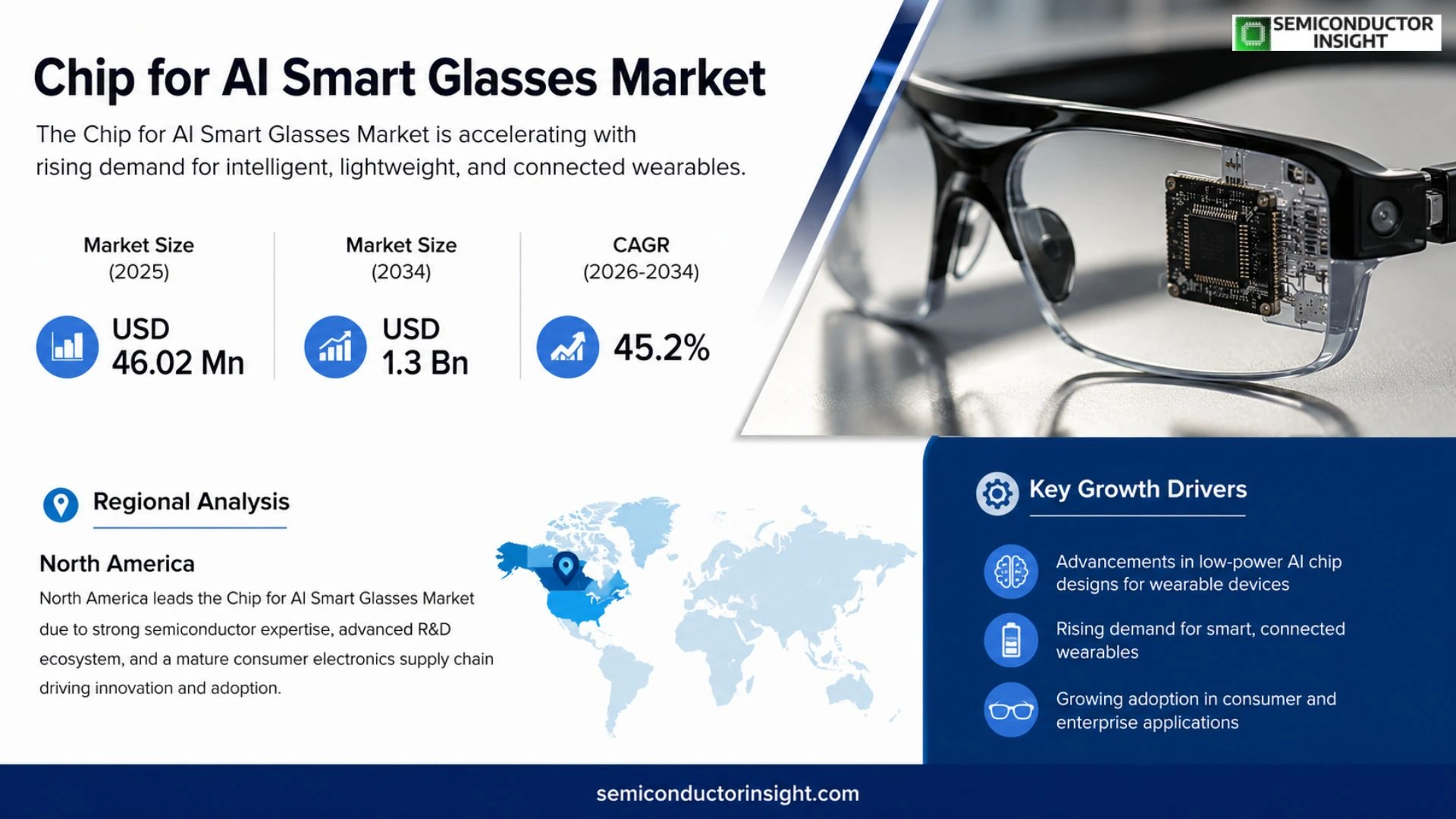
Global Chip for AI Smart Glasses market size was valued at USD 46.02 million in 2025 and is forecasted to climb to approximately USD 803 million by 2032, reflecting an implied CAGR of roughly 45 percent. Extending this growth path points toward a valuation close to USD 1.3 billion by 2034.
A Chip for AI Smart Glasses typically denotes a highly integrated system‑on‑chip (SoC) engineered for wearable eyewear that runs artificial‑intelligence workloads on‑device. It merges a general‑purpose CPU, neural‑processing unit (NPU), graphics/image engine, display driver, audio codec, memory interfaces, sensor‑fusion logic and wireless radios into a single die whose power envelope stays within tight battery limits while delivering real‑time inference for computer‑vision, voice commands and spatial awareness.
The sector shipped about 840 k units worldwide in 2025 at an average price of roughly USD 60 per unit. Production capacity hovered near 960 k units, supporting an industry‐wide gross margin of around 40 percent. The supply chain spans silicon wafer fabs such as
MARKET DRIVERS
Technological Advancements Accelerate Adoption
Recent breakthroughs in low‑power AI inference have lowered the energy envelope of processing units, making it feasible to embed sophisticated vision algorithms directly into eyewear. This shift enables manufacturers to differentiate products through on‑device intelligence rather than relying on cloud latency, thereby strengthening the overall Chip for AI Smart Glasses Market proposition.
Enterprise Use Cases Expand Demand
Large‑scale logistics operators are piloting smart glasses to overlay real‑time routing data, which hinges on compact chips capable of handling computer‑vision workloads without external hardware. The operational savings reported in early trials,up to 15% reduction in handling time,signal a clear business case that is prompting other verticals to explore similar deployments.
➤ Manufacturers that secure early access to next‑generation AI silicon are likely to capture premium market share as enterprise buyers prioritize integrated solutions over modular add‑ons.
In addition, consumer interest in immersive mixed‑reality experiences is nudging fashion brands toward collaborations with chipset designers. The resulting cross‑industry momentum is creating a feedback loop where design aesthetics and processing capability evolve together, further propelling growth.
MARKET CHALLENGES
Cost and Power Constraints
While performance per watt continues to improve, the price premium attached to cutting‑edge AI chips remains a barrier for price‑sensitive segments. Companies that cannot achieve economies of scale risk pricing themselves out of the mid‑tier market, where the bulk of adoption is expected to occur.
Other Challenges
Supply Chain Bottlenecks
The reliance on advanced semiconductor fabs in limited geographic locations introduces lead‑time volatility. Any disruption,whether geopolitical or capacity‑related,directly impacts the availability of key components for smart‑glass manufacturers.
MARKET RESTRAINTS
Regulatory Hurdles Limit Rollout
Data‑capture capabilities inherent to AI‑enabled eyewear trigger scrutiny from privacy regulators, especially in regions with stringent biometric legislation. Compliance requirements often demand additional secure‑enclave hardware, inflating design complexity and cost.
Furthermore, certification processes for medical‑grade smart glasses can extend time‑to‑market by several quarters, discouraging smaller innovators from entering Chip for AI Smart Glasses Market arena.
MARKET OPPORTUNITIES
Emerging Applications in Healthcare
Clinical trials leveraging AI‑powered visual assistance are demonstrating tangible improvements in surgical precision. Chips that can process high‑resolution imaging in real time enable surgeons to overlay anatomical guides without external monitors, creating a niche where premium pricing is defensible.
Beyond the operating room, remote diagnostics for tele‑medicine rely on lightweight wearables capable of on‑device inference, suggesting a parallel growth path for Chip for AI Smart Glasses Market as healthcare providers seek scalable, privacy‑preserving solutions.
Chip for AI Smart Glasses Market Trends
Growing Preference for Ultra‑Low‑Power SoCs
In 2025 the market delivered roughly 840 000 units, each priced near US $60, generating a gross margin of about 40 %. The combination of a modest unit price and strong profitability signals that OEMs are able to embed sophisticated AI functions without inflating retail costs. Designers are converging on system‑on‑chip architectures that fuse a CPU, neural‑processing unit, graphics engine and sensor interfaces on a single die. This integration curtails board‑level complexity, reduces power draw, and satisfies the stringent thermal envelope of eyewear. Consequently, customers experience seamless voice commands, real‑time object recognition, and spatial awareness, all while maintaining a battery life that supports a full workday.
Other Trends
Supply‑Chain Consolidation
The upstream ecosystem is coalescing around a handful of wafer fabs, memory suppliers and advanced‑packaging houses. Leading foundries such as TSMC provide the sub‑5 nm processes that enable higher transistor density without proportionate power penalties. Memory partners,including Samsung and SK hynix,have tailored low‑latency LPDDR solutions to match the on‑device inference requirements. Meanwhile, test and packaging specialists like ASE and Amkor are standardising wafer‑level fan‑out techniques that improve thermal performance. This concentration reduces lead‑time variability, giving manufacturers a more predictable path from silicon to shipped product.
Shift Toward Sub‑5nm Process Nodes
By 2032 the 4‑5 nm segment is slated to dominate Chip for AI Smart Glasses Market, driven by the need for higher compute per watt. Designers adopting these nodes report up to a 30 % boost in NPU throughput while keeping the power envelope under 200 mW. The migration forces smaller players to partner with larger fabs or to outsource design services, reshaping the competitive hierarchy. Enterprises that can secure early access to sub‑5nm silicon gain a clear advantage in delivering richer augmented‑reality experiences, prompting a wave of strategic alliances between chipset vendors and smart‑glass manufacturers.
COMPETITIVE LANDSCAPE
Key Industry Players
Competitive Overview of Chip for AI Smart Glasses Market
Qualcomm dominates the upper tier of the ecosystem, leveraging its Snapdragon XR platform to supply system‑on‑chip solutions that marry high‑throughput neural processing with the power budget demanded by eyewear form factors. The firm’s early partnerships with leading smart‑glasses OEMs have cemented a de‑facto standard around unified driver stacks and over‑the‑air update capabilities, giving it leverage in pricing negotiations and in shaping downstream product roadmaps. Beyond Qualcomm, NXP and MediaTek occupy the mid‑range segment, each offering differentiated IP blocks,NXP with its low‑latency sensor‑fusion hub and MediaTek with a modular AI accelerator that can be scaled across 4 nm to 12 nm processes. This tier exhibits a blend of volume‑driven cost efficiencies and the flexibility to customise peripheral interfaces, allowing manufacturers to target both consumer wearables and enterprise‑grade devices without the expense of full custom silicon.
Several niche innovators are reshaping the value chain by concentrating on ultra‑low‑power footprints or specialized connectivity. Ambiq’s sub‑threshold architecture enables chips that run for days on small coin‑cell batteries, a compelling proposition for outdoor or medical applications. Nordic Semiconductor’s radio‑centric designs provide seamless BLE and Thread support, crucial for edge‑device ecosystems. Chinese players such as Fullhan Microelectronics, StarFive Technology, and SigmaStar focus on cost‑effective mass production, often partnering with regional foundries to capture price‑sensitive market share. Meanwhile, companies like Bestechnic, Unisoc, and Actions Semiconductor add depth with audio‑signal‑processing expertise and integrated MCU+ISP combos, expanding the functional envelope of smart‑glasses beyond vision‑only use cases.
List of Key Chip for AI Smart Glasses Companies Profiled
- Qualcomm
- MediaTek
- NXP Semiconductors
- Ambiq
- Nordic Semiconductor
- Bestechnic
- Unisoc
- Fullhan Microelectronics
- StarFive Technology
- SigmaStar
- Actions Semiconductor
- Rockchip
- Espressif
- Ingenic Semiconductor
- Allwinner Technology
Segment Analysis:
| Segment Category | Sub-Segments | Key Insights |
| By Type |
|
4nm‑5nm
|
| By Application |
|
Consumer
|
| By End User |
|
Individual Users
|
| By Integration Level |
|
Full SoC
|
| By Power Consumption |
|
Ultra‑Low
|
Regional Analysis: Chip for AI Smart Glasses Market
The convergence of edge‑AI demand and the push for hands‑free interfaces creates a fertile environment for chip makers, while corporate procurement teams prioritize devices that blend compute power with ergonomic design, accelerating product rollouts.
Established semiconductor firms, several fabless startups, and optical lens specialists are forming joint ventures, allowing each to contribute core competencies and capture more of the value chain.
Federal guidelines on electromagnetic emissions and privacy‑by‑design principles shape product specifications, prompting manufacturers to embed compliance checks early in the chip design process.
Near‑term capacity expansions at leading foundries and strategic stockpiling of key materials assure manufacturers of a reliable pipeline for high‑volume smart‑glass chip production.
Europe
Europe’s approach to Chip for AI Smart Glasses Market hinges on stringent data‑security standards and a strong emphasis on modular design. Major optical firms in Germany are collaborating with chip designers in Sweden to produce processors that can be swapped without replacing the entire frame, a model that appeals to enterprise buyers seeking longevity. The region also benefits from EU‑wide funding programs that earmark resources for wearable‑tech research, encouraging cross‑border consortia to tackle challenges such as power budgeting and thermal management. While the market share remains modest compared with North America, the depth of engineering talent and a culture of standards‑first development position Europe as a credible source of differentiated, regulation‑ready solutions.
Asia‑Pacific
In Asia‑Pacific, rapid consumer adoption of AR eyewear fuels interest in locally produced AI chips, yet the market narrative is shaped by cost‑sensitivity and scale. Manufacturers in Taiwan and South Korea leverage highly efficient fab operations to deliver silicon that balances performance with a low price point, making smart‑glass devices viable for mass‑market applications like education and tourism. Simultaneously, Chinese conglomerates are exploring vertical integration, acquiring chip firms to lock in supply and accelerate time‑to‑market. The region’s expansive manufacturing base, combined with aggressive government incentives for advanced electronics, creates a competitive environment where price and volume drive strategic decisions.
South America
South America remains an emerging frontier for Chip for AI Smart Glasses Market, with adoption largely driven by niche use cases in agriculture and mining. Companies operating in Brazil and Chile are trialing AI‑enabled glasses to provide workers with real‑time terrain data, reducing reliance on handheld devices. Limited local semiconductor capacity forces firms to import chips, but partnerships with North American distributors mitigate lead‑time concerns. The market’s growth trajectory is contingent on infrastructure improvements and the development of regional testing facilities that can certify devices for harsh outdoor conditions.
Middle East & Africa
The Middle East & Africa region shows selective enthusiasm for AI‑powered smart glasses, particularly in sectors such as oil‑field inspection and security. Investments from sovereign wealth funds have enabled pilot programs that integrate locally sourced chips with globally sourced optics, aiming to reduce dependence on external supply chains. Regulatory environments vary widely, compelling vendors to adopt flexible design architectures that can be customized for differing compliance regimes. Although the overall market size is modest, the willingness to experiment with high‑value use cases suggests a steady, if measured, expansion of Chip for AI Smart Glasses Market in these economies.
Report Scope
This market research report provides a comprehensive analysis of the Chip for AI Smart Glasses Market , covering the forecast period 2026–2034. It offers detailed insights into market dynamics, technological advancements, competitive landscape, and key trends shaping the industry.
Key focus areas of the report include:
- Market Overview: The report begins with an overview outlining its current market scenario, key growth indicators, and industry transformation drivers. It discusses macroeconomic factors, demand–supply balance, regulatory landscape, and the strategic role of semiconductors in powering advancements across industries such as automotive, telecommunications, consumer electronics, and industrial automation.
- Market Size & Forecast: Historical data and future projections for revenue, unit shipments, and market value across major regions and segments.
- Segmentation Analysis: Detailed breakdown by product type, technology, application, and end-user industry to identify high-growth segments and investment opportunities.
- Regional Insights: Insights into market performance across North America, Europe, Asia-Pacific, Latin America, and the Middle East & Africa, including country-level analysis where relevant.
- Competitive Landscape: Profiles of leading market participants, including their product offerings, R&D focus, manufacturing capacity, pricing strategies, and recent developments such as mergers, acquisitions, and partnerships.
- Technology Trends & Innovation: Assessment of emerging technologies, integration of AI/IoT, semiconductor design trends, fabrication techniques, and evolving industry standards.
- Market Drivers & Restraints: Evaluation of factors driving market growth along with challenges, supply chain constraints, regulatory issues, and market-entry barriers.
- Stakeholder Insights: Insights for component suppliers, OEMs, system integrators, investors, and policymakers regarding the evolving ecosystem and strategic opportunities.
Primary and secondary research methods are employed, including interviews with industry experts, data from verified sources, and real-time market intelligence to ensure the accuracy and reliability of the insights presented.
FREQUENTLY ASKED QUESTIONS:
What is the current market size of Chip for AI Smart Glasses Market?
-> Chip for AI Smart Glasses Market was valued at USD 46.02 million in 2025 and is expected to reach USD 803 million by 2034, growing at a CAGR of 45.2% over the forecast period.
Which key companies operate in Chip for AI Smart Glasses Market?
-> Key players include Qualcomm, NXP, MediaTek, Ambiq, Nordic Semiconductor, Bestechnic, Unisoc, Fullhan Microelectronics, StarFive Technology, SigmaStar, Actions, Rockchip, Espressif, Ingenic Semiconductor, Allwinner, Hunan Goke.
What are the key growth drivers?
-> Key growth drivers include rapid adoption of AI‑powered wearables, demand for ultra‑low‑power and compact SoCs, expanding consumer and enterprise smart‑glasses deployments, and advances in semiconductor process technologies that enable higher integration and energy efficiency.
Which region dominates the market?
-> North America (United States) and Asia (China) are the dominant regions, contributing the largest revenue shares in the global Chip for AI Smart Glasses market.
What are the emerging trends?
-> Emerging trends include migration to advanced nodes such as 4nm‑5nm, greater integration of AI accelerators within SoCs, and the development of combined solutions (SoC+MCU, SoC+MCU+ISP) to support diversified smart‑glasses applications.
Get Sample Report PDF for Exclusive Insights
Report Sample Includes
- Table of Contents
- List of Tables & Figures
- Charts, Research Methodology, and more...
 Download Sample Report PDF