SerDes (GMSL, FPD-Link) for Automotive Camera Market Insights
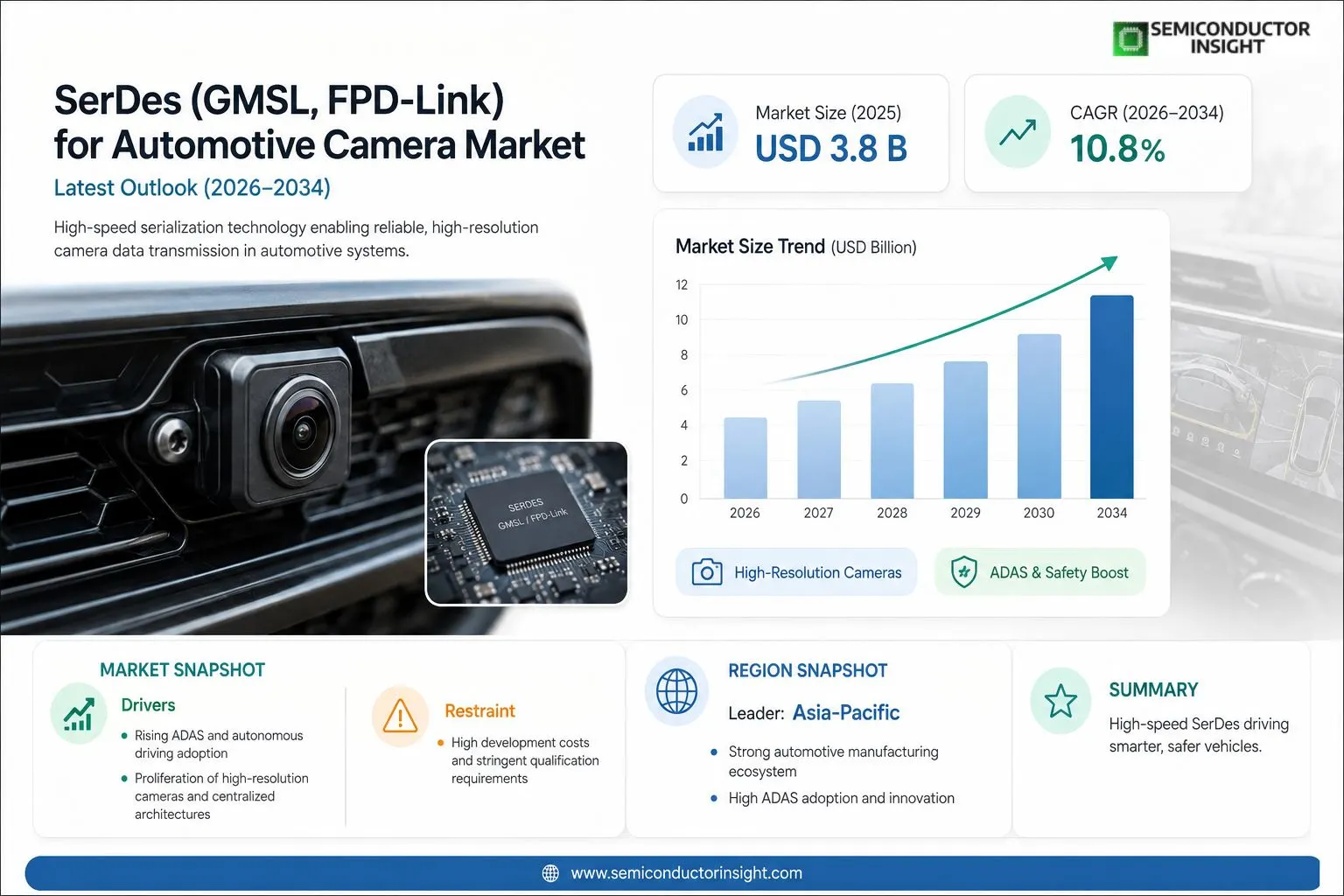
Global SerDes (GMSL, FPD-Link) for Automotive Camera Market size was valued at USD 3.8 billion in 2025. The market is projected to grow from USD 3.8 billion in 2025 to USD 9.6 billion by 2034, exhibiting a CAGR of 10.8% during the forecast period.
SerDes, or Serializer/Deserializer technology, serves as a critical enabler for high-speed data transmission in automotive camera systems. Solutions like GMSL (Gigabit Multimedia Serial Link) and FPD-Link facilitate the efficient transfer of uncompressed high-resolution video from cameras to electronic control units (ECUs) and processors over a single coaxial or shielded twisted-pair cable. These interfaces support essential features including power delivery, bidirectional control channels, and robust EMI performance, making them ideal for demanding automotive environments.
The market is experiencing robust growth due to several factors, including the rapid adoption of advanced driver assistance systems (ADAS), increasing integration of surround-view and high-resolution cameras, and the shift toward software-defined vehicles with centralized architectures. Rising safety regulations mandating multi-camera setups, coupled with consumer demand for enhanced features such as 360-degree vision and in-cabin monitoring, further accelerate expansion. Moreover, advancements in SerDes chipsets capable of supporting multi-gigabit data rates for 4K and higher resolution imaging are contributing significantly to market momentum. Key players such as Texas Instruments with its FPD-Link solutions and Analog Devices with GMSL platforms lead the ecosystem, delivering qualified, high-performance components that meet stringent automotive standards like AEC-Q100 and ISO 26262.
MARKET DRIVERS
Rising ADAS and Autonomous Driving Adoption
The integration of advanced driver assistance systems (ADAS) and the push toward higher levels of vehicle autonomy have significantly boosted demand for high-resolution automotive cameras. SerDes technologies such as GMSL and FPD-Link enable reliable high-bandwidth data transmission over long distances using cost-effective coaxial or shielded twisted pair cables, supporting multiple camera feeds essential for surround-view, forward-facing, and rear-view systems. As vehicles incorporate 8+ megapixel cameras, these SerDes solutions provide the necessary throughput for real-time video processing.
Proliferation of High-Resolution Cameras and Centralized Architectures
Software-defined vehicles and zonal architectures require efficient, low-latency connectivity between distributed cameras and central computing units. GMSL (from Analog Devices) and FPD-Link (from Texas Instruments) dominate due to their proven performance in supporting data rates up to 6 Gbps and beyond, along with Power over Coax capabilities that simplify wiring harnesses. This supports the transition to higher resolution imaging while maintaining electromagnetic compatibility in harsh automotive environments.
➤ Market projections indicate strong growth for automotive SerDes chipsets, driven by increasing camera content per vehicle and the need for robust high-speed interfaces in ADAS applications.
Electrification trends further amplify these drivers, as electric vehicles demand optimized E/E architectures where efficient SerDes solutions reduce weight and complexity while enhancing functional safety compliance.
MARKET CHALLENGES
EMI/EMC Compliance and Signal Integrity
Maintaining signal integrity over extended cable runs in noisy automotive environments poses significant engineering hurdles for SerDes implementations like GMSL and FPD-Link in camera systems. Designers must address electromagnetic interference while ensuring low latency for safety-critical vision data.
Other Challenges
Interoperability Across Ecosystems
Competition between proprietary standards from different vendors creates integration complexities for Tier-1 suppliers and OEMs selecting between GMSL and FPD-Link solutions for multi-camera platforms.
Thermal Management in Harsh Conditions
Automotive-grade components must operate reliably across wide temperature ranges and vibrations, increasing design validation efforts for high-speed SerDes camera links.
MARKET RESTRAINTS
High Development Costs and Qualification Requirements
Stringent functional safety standards (ISO 26262) and AEC-Q100 qualification processes add substantial costs and time to the deployment of GMSL and FPD-Link SerDes in automotive camera applications. These requirements can slow adoption in cost-sensitive vehicle segments despite performance advantages. Additionally, the complexity of system integration with varying processor interfaces and the need for extensive testing in centralized computing setups restrain faster market expansion for these technologies.
MARKET OPPORTUNITIES
Next-Generation Higher Bandwidth Solutions
Advancements toward GMSL3, FPD-Link IV, and multi-gigabit SerDes open opportunities for supporting 4K and higher resolution cameras in next-generation ADAS and autonomous systems. These evolutions enable uncompressed high-frame-rate video transmission critical for advanced perception algorithms.The ongoing shift to software-defined vehicles and increasing camera counts per vehicle create substantial growth potential for optimized SerDes (GMSL, FPD-Link) solutions that reduce cabling weight and enhance power efficiency in electric and premium vehicles.
SerDes (GMSL, FPD-Link) for Automotive Camera Market Trends
Rising Demand for High-Speed Data Transmission in Advanced Automotive Camera Systems
SerDes technology, particularly GMSL and FPD-Link solutions, plays a pivotal role in enabling high-speed data transmission for automotive camera systems. These interfaces efficiently transfer uncompressed high-resolution video from cameras to electronic control units and processors using a single coaxial or shielded twisted-pair cable. Their ability to support power delivery, bidirectional control channels, and strong electromagnetic interference performance makes them well-suited for the harsh conditions of automotive environments.
Other Trends
Expansion of Multi-Camera Configurations in ADAS
The proliferation of advanced driver assistance systems has driven wider integration of surround-view and high-resolution cameras across vehicle platforms. SerDes (GMSL, FPD-Link) solutions facilitate reliable connectivity for these multi-camera setups, meeting stringent requirements for real-time video processing and system reliability. Safety regulations promoting enhanced visibility features, including 360-degree vision and in-cabin monitoring, continue to support broader adoption of these technologies.
Support for Software-Defined Vehicles and Centralized Architectures
As the automotive industry shifts toward software-defined vehicles, centralized computing architectures require robust high-bandwidth links between distributed cameras and central processors. GMSL and FPD-Link interfaces provide the necessary performance for seamless data flow, enabling more sophisticated processing of camera feeds while maintaining signal integrity over longer distances within the vehicle chassis.
Technological Advancements in Multi-Gigabit SerDes Chipsets
Continuous innovation in SerDes chipsets is allowing support for higher data rates essential for 4K and beyond imaging capabilities in next-generation automotive cameras. Leading providers such as Texas Instruments with its FPD-Link portfolio and Analog Devices with GMSL platforms deliver components that comply with rigorous automotive qualifications including AEC-Q100 and functional safety standards like ISO 26262. These developments ensure that SerDes (GMSL, FPD-Link) solutions remain at the forefront of enabling clearer, more detailed visual data for safety-critical applications.
COMPETITIVE LANDSCAPE
Key Industry Players
Leading SerDes Providers Powering High-Resolution Automotive Camera Systems
SerDes (GMSL, FPD-Link) Market for automotive cameras is dominated by a concentrated group of semiconductor leaders specializing in high-speed serializer/deserializer solutions. Texas Instruments stands out as a primary force with its widely adopted FPD-Link technology, offering robust support for uncompressed high-resolution video transmission, power-over-cable, and bidirectional control critical for ADAS and surround-view systems. Analog Devices, through its GMSL platform (acquired via Maxim Integrated), commands significant market share with proven gigabit-level performance and extensive OEM deployments, establishing a duopoly-like structure focused on AEC-Q100 qualified components that ensure EMI resilience and functional safety compliance under ISO 26262.
Beyond the market leaders, several niche and emerging players contribute specialized solutions, including camera-specific integrations and next-generation multi-gigabit chipsets. Companies such as ON Semiconductor, Sony Semiconductor Solutions, and NXP Semiconductors enhance the ecosystem with complementary sensor and processing technologies, while participants in the Automotive SerDes Alliance (ASA) drive standardization efforts for broader interoperability. This competitive dynamic fosters innovation in 4K+ imaging support and centralized vehicle architectures amid rising demand for advanced safety features.
List of Key SerDes (GMSL, FPD-Link) Companies Profiled
- Texas Instruments
- Analog Devices (GMSL)
- Texas Instruments (FPD-Link)
- ON Semiconductor
- NXP Semiconductors
- Sony Semiconductor Solutions
- OmniVision Technologies
- STMicroelectronics
- ROHM Semiconductor
- Valens Semiconductor
- Microchip Technology (VSI)
- Leopard Imaging
- e-con Systems
- Broadcom Inc.
Segment Analysis:
| Segment Category | Sub-Segments | Key Insights |
| By Type |
|
GMSL stands out for its exceptional performance in high-speed data transmission over long distances with superior electromagnetic interference resilience. It enables seamless integration of multiple high-resolution cameras while supporting power-over-cable and bidirectional communication. This makes it particularly valued in complex automotive setups where signal integrity is paramount, offering robust reliability under harsh operating conditions and facilitating advanced video processing workflows. |
| By Application |
|
Advanced Driver Assistance Systems (ADAS) represents the dominant application area where SerDes technology delivers critical real-time video feeds essential for object detection, lane keeping, and collision avoidance. Its ability to maintain low-latency transmission of uncompressed high-definition imagery allows for rapid decision-making by central processing units. This segment benefits from continuous innovation in multi-camera synchronization and enhanced data bandwidth, driving more sophisticated safety features and improving overall vehicle responsiveness in dynamic environments. |
| By End User |
|
Passenger Vehicle Manufacturers lead adoption as they prioritize enhanced safety, comfort, and premium features across mass-market and luxury models. SerDes solutions enable the smooth integration of extensive camera networks that support 360-degree awareness and driver monitoring systems. This user base values the technology’s scalability for evolving vehicle architectures, allowing seamless upgrades to higher resolution sensors while maintaining compliance with rigorous automotive quality and functional safety standards. |
| By Vehicle Type |
|
Electric Vehicles drive strong demand due to their centralized computing architectures and emphasis on software-defined functionalities. SerDes interfaces like GMSL and FPD-Link support the high data throughput needed for comprehensive camera arrays that enhance range estimation, battery management visibility, and user experience features. The technology’s efficiency in power delivery and compact design aligns perfectly with EV constraints, enabling lighter wiring harnesses and improved thermal management while supporting future-proof scalability for increasingly intelligent mobility solutions. |
| By Resolution Support |
|
4K and Ultra-High Resolution is gaining prominence as automotive camera systems evolve to capture finer details for improved machine vision algorithms and enhanced driver displays. SerDes technologies excel here by providing the necessary bandwidth for lossless transmission of rich visual data over single cables. This capability supports more accurate environmental perception and contributes to superior image quality in challenging lighting conditions, fostering innovation in both safety-critical and comfort-oriented applications across modern vehicle platforms. |
Regional Analysis: SerDes (GMSL, FPD-Link) for Automotive Camera Market
Asia-Pacific
Asia-Pacific excels in pioneering SerDes advancements tailored for automotive cameras, with GMSL and FPD-Link solutions optimized for ultra-low latency and high-bandwidth video streaming. Local ecosystems nurture continuous improvements in electromagnetic compatibility and thermal resilience, enabling reliable performance across diverse driving conditions.
The region’s vertically integrated supply chains allow for swift customization of SerDes components, facilitating just-in-time delivery to major assembly plants. Strategic partnerships between camera module producers and interface technology providers streamline development, supporting agile responses to emerging vehicle platform requirements.
Leading automakers in the region are embedding SerDes (GMSL, FPD-Link) solutions deeply into their ADAS roadmaps, prioritizing seamless multi-camera synchronization. Business approaches focus on co-development programs that align interface technologies with evolving safety and infotainment architectures.
Forward-looking initiatives target next-generation SerDes enhancements for higher resolution sensors and AI-driven processing, ensuring the region maintains its competitive edge. Collaborative ecosystems are shaping standards that will define automotive camera connectivity well into the next decade.
North America
North America demonstrates strong momentum in adopting SerDes (GMSL, FPD-Link) technologies for automotive cameras, fueled by stringent safety regulations and consumer demand for premium ADAS features. The United States and Canada host innovative tech firms specializing in high-speed interfaces that enhance camera data integrity and system reliability. Business strategies revolve around partnerships between domestic automakers and global semiconductor suppliers to localize advanced camera system production. This approach supports the integration of sophisticated vision systems in electric and autonomous vehicles, with emphasis on cybersecurity measures to protect high-bandwidth data streams. The region’s focus on software-defined vehicles further amplifies the role of flexible SerDes solutions in enabling over-the-air updates for camera functionalities.
Europe
Europe maintains a sophisticated position in SerDes (GMSL, FPD-Link) for Automotive Camera Market, characterized by its leadership in safety-centric vehicle design and regulatory compliance. German, French, and other European manufacturers integrate these high-speed serialization technologies to achieve exceptional image quality and real-time processing in advanced driver monitoring systems. Regional strategies highlight sustainability and innovation, driving developments in energy-efficient interfaces suitable for next-generation electric platforms. Collaborative research initiatives among industry players accelerate the refinement of GMSL and FPD-Link protocols to meet rigorous functional safety standards. This environment nurtures premium applications where camera systems play pivotal roles in autonomous navigation and passenger comfort features.
South America
South America is gradually expanding its footprint in SerDes-enabled automotive camera applications, primarily through increasing vehicle localization efforts and technology transfer programs. Brazil and other key markets are witnessing growing interest from global automakers establishing regional production hubs that incorporate modern camera interfaces for safety enhancements. Business tactics focus on adapting established GMSL and FPD-Link solutions to local manufacturing capabilities and cost-sensitive vehicle segments. While infrastructure development remains a priority, rising awareness of advanced driver assistance benefits is encouraging the phased rollout of these technologies. The region presents opportunities for suppliers to build foundational ecosystems that support future growth in connected and electrified mobility solutions.
Middle East & Africa
The Middle East and Africa region shows emerging potential for SerDes (GMSL, FPD-Link) in automotive cameras, supported by investments in smart mobility and luxury vehicle imports. Gulf countries are particularly active in piloting advanced transportation projects that leverage high-performance camera systems for enhanced situational awareness. Market strategies involve technology localization partnerships aimed at building domestic expertise in high-speed data interfaces. Although adoption remains selective, focus areas include commercial fleets and premium SUVs where reliability in extreme climates is crucial. Long-term business planning centers on developing resilient supply networks and training programs to prepare for broader integration of these critical connectivity technologies across diverse vehicle categories.
Report Scope
This market research report provides a comprehensive analysis of the SerDes (GMSL, FPD-Link) for Automotive Camera Market , covering the forecast period 2026–2034. It offers detailed insights into market dynamics, technological advancements, competitive landscape, and key trends shaping the industry.
Key focus areas of the report include:
- Market Overview: The report begins with an overview outlining its current market scenario, key growth indicators, and industry transformation drivers. It discusses macroeconomic factors, demand–supply balance, regulatory landscape, and the strategic role of semiconductors in powering advancements across industries such as automotive, telecommunications, consumer electronics, and industrial automation.
- Market Size & Forecast: Historical data and future projections for revenue, unit shipments, and market value across major regions and segments.
- Segmentation Analysis: Detailed breakdown by product type, technology, application, and end-user industry to identify high-growth segments and investment opportunities.
- Regional Insights: Insights into market performance across North America, Europe, Asia-Pacific, Latin America, and the Middle East & Africa, including country-level analysis where relevant.
- Competitive Landscape: Profiles of leading market participants, including their product offerings, R&D focus, manufacturing capacity, pricing strategies, and recent developments such as mergers, acquisitions, and partnerships.
- Technology Trends & Innovation: Assessment of emerging technologies, integration of AI/IoT, semiconductor design trends, fabrication techniques, and evolving industry standards.
- Market Drivers & Restraints: Evaluation of factors driving market growth along with challenges, supply chain constraints, regulatory issues, and market-entry barriers.
- Stakeholder Insights: Insights for component suppliers, OEMs, system integrators, investors, and policymakers regarding the evolving ecosystem and strategic opportunities.
Primary and secondary research methods are employed, including interviews with industry experts, data from verified sources, and real-time market intelligence to ensure the accuracy and reliability of the insights presented.
FREQUENTLY ASKED QUESTIONS:
What is the current market size of SerDes (GMSL, FPD-Link) for Automotive Camera Market?
-> SerDes (GMSL, FPD-Link) for Automotive Camera Market was valued at USD 3.8 billion in 2025 and is expected to reach USD 9.6 billion by 2034.
Which key companies operate in SerDes (GMSL, FPD-Link) for Automotive Camera Market?
-> Key players include Texas Instruments, Analog Devices, among others.
What are the key growth drivers?
-> Key growth drivers include rapid adoption of ADAS, increasing integration of surround-view and high-resolution cameras, and the shift toward software-defined vehicles.
Which region dominates the market?
-> Asia-Pacific is the fastest-growing region, while North America remains a dominant market.
What are the emerging trends?
-> Emerging trends include multi-gigabit SerDes chipsets, support for 4K and higher resolution imaging, and robust EMI performance solutions.

Get Sample Report PDF for Exclusive Insights
Report Sample Includes
- Table of Contents
- List of Tables & Figures
- Charts, Research Methodology, and more...
 Download Sample Report PDF