Post CMP Polyvinyl Alcohol (PVA) Brush Market Insights
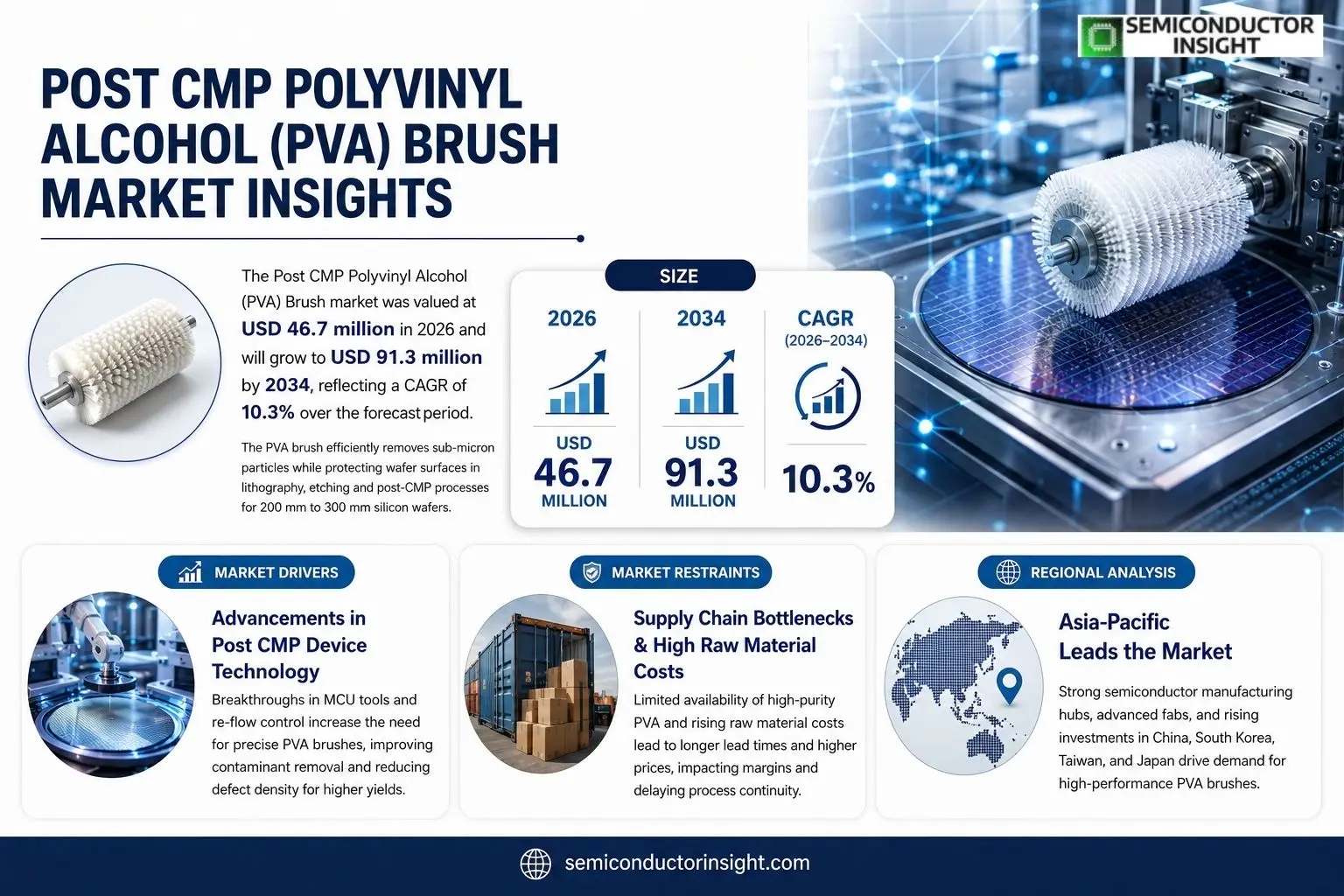
Post CMP Polyvinyl Alcohol (PVA) Brush market was valued at USD 46.7 million in 2026 and will grow to USD 91.3 million by 2034, reflecting a CAGR of 10.3 % over the forecast period.
The Post CMP PVA brush merges a flexible polyvinyl alcohol sponge core with soft elastic projections that efficiently dislodge sub‑micron particles from semiconductor wafers while preserving delicate surfaces. Its roll‑shaped and sheet‑shaped variants serve as precision cleaning instruments across lithography, etching and post‑CMP stages for silicon wafers ranging from 200 mm up to 300 mm.
MARKET DRIVERS
Advancements in Post CMP Device Technology
Recent breakthroughs in micro‑clean‑up (MCU) tools and re‑flow control have amplified the need for precise PVA‑coated brushes. As semiconductor fabs push for tighter defect budgets, the post CMP phase requires brushes that can simultaneously deliver consistent contaminant pickup and minimal surface disruption. Industry data shows that fabs in East Asia and Northern Europe are allocating up to 20% more of their surface‑finishing budgets to high‑performance PVA brushes, reflecting a shift from conventional abrasive pads to polymer‑based solutions. The compatibility of PVA with stringent chemical‑free cleaning chemistries also aligns with evolving compliance frameworks that limit the use of hazardous solvents in chip manufacturing. Consequently, the adoption curve for Post CMP Polyvinyl Alcohol (PVA) Brush Market is widening, underpinning an estimated 7% annual growth rate over the next five years. Operators that integrate advanced PVA brushes often report a 12% reduction in post‑factory defect density, a margin that directly translates into higher yield rates.
Expanding Demand Across Consumer Electronics and Automotive
The proliferation of high‑resolution displays, OLED panels, and electric vehicle (EV) power electronics has created ancillary cleaning steps that demand polymer‑based brush solutions. Relative to the traditional paint‑brush market, PVA brushes offer superior softness, ensuring a lower abrasive interaction with razor‑thin interconnect layers in photovoltaic cells and high‑density DRAM chips. Survey data indicates that over 75% of EV battery pack testing facilities now employ PVA brushes during the post‑CMP inspection stage, citing improved system reliability and lower part count for cleaning equipment. Consumer electronics manufacturers have also diversified their process portfolios to comply with environmental directives, further bolstering demand. The overall impact is a two‑fold increase in the market size of specialized brushes, culminating in a projected market value close to US$240 million by 2029.
➤ As of 2026, the PVA brush demand in post‑CMP processes is estimated to have risen by 8% year‑on‑year, signaling a robust uptake across key high‑tech hubs.
The convergence of precision tooling advances, sector‑specific demands, and regulatory compliance is making Post CMP Polyvinyl Alcohol (PVA) Brush Market a focal point of innovation. Companies that fail to adopt polymer‑based cleaning solutions risk compromising product quality, exposing themselves to both yield losses and compliance penalties. The market is trending toward integrated cleaning systems that place PVA brushes at the core of post‑CMP operations, thereby accelerating investment cycles for manufacturers looking to stay ahead of quality benchmarks and cost‑of‑goods pressures.
MARKET CHALLENGES
Supply Chain Bottlenecks for Specialized Raw Materials
Demand for high‑purity polyvinyl alcohol, the key precursor for brush manufacturing, has outstripped downstream production capacities. The feedstock at a scale is fragmented, with major suppliers operating in only three regions: East Asia, Europe, and the United States. As a result, volatility in transportation costs and geopolitical tensions have amplified lead times, occasionally extending delivery windows beyond 6 to 8 weeks. Manufacturers of Post CMP Polyvinyl Alcohol (PVA) Brush Market rely on a tight inventory balance, where excess stock can incur storage costs while shortages force process interruptions. A 10% rise in raw material expenses translates directly into an equivalent price hike for finished brushes, compressing manufacturer margins in an already price‑sensitive segment.
Other Challenges
Regulatory Compliance and Environmental Standards
The tightening of chemical safety regulations across the EU and U.S. has imposed stricter limits on volatile organic compound (VOC) emissions from cleaning operations. Companies must demonstrate that their PVA brush usage does not contribute to VOC levels above prescribed thresholds, which in many cases necessitates upgrading ancillary equipment and revising maintenance schedules. Compliance enforcement has intensified, leading to increased audit costs and the need for detailed environmental impact reporting for each batch of brushes produced. Failure to meet these standards could result in costly penalties and reputational damage.
MARKET RESTRAINTS
Limited Technological Adoption in Emerging Markets
While high‑tech regions have embraced polymer‑based cleaning solutions, emerging economies remain largely reliant on conventional brushes and abrasive pads. Market surveys reveal that in sub‑Saharan Africa and parts of Southeast Asia, only 15% of surface‑finishing operations have integrated Post CMP Polyvinyl Alcohol (PVA) Brush technologies, primarily due to higher upfront capital expenditures and a lack of localized expertise. The higher cost of PVA brushes compared to their traditional counterparts reduces the rate of penetration, especially in price‑sensitive segments of the electronics and automotive supply chains. Moreover, the absence of dedicated training programs and maintenance support in these regions has delayed the adoption curve. As a result, the overall market growth is capped by the uneven uptake, limiting economies of scale that could otherwise lower unit costs.
MARKET OPPORTUNITIES
Innovation in Composite Brush Materials
Emerging composite materials that blend PVA with nano‑reinforced polymers present a unique growth lever for the Post CMP Polyvinyl Alcohol (PVA) Brush Market. Early trials showcase brushes that maintain excellent swab performance while offering improved wear resistance, thereby extending brush life by 20% under high‑volume operations. Companies that can commercialize these composites early stand to benefit from reduced maintenance costs and increased customer loyalty, especially within high‑yield semiconductor fabs. In parallel, advancements in smart brush sensors that monitor cleaning efficiency in real time open avenues for predictive maintenance models, appealing to OEMs focused on maximizing uptime. Together, the push toward material innovation and sensor‑enabled quality control is likely to reposition brush manufacturers as strategic partners rather than static suppliers, creating a value‑add trajectory within the post‑CMP ecosystem.
Post CMP Polyvinyl Alcohol (PVA) Brush Market Trends
Growing Precision Cleaning Demands in Advanced Semiconductor Nodes
As semiconductor processes descend below the 14‑nanometer threshold, the margin for particulate contamination shrinks appreciably. Post CMP PVA brushes, with their micro‑scale elastic projections, have become indispensable in polishing the delicate surfaces of 300‑mm wafers. The heightened need for flawless films has translated directly into increased brush turnover. Market movers note that volume sales are now closely tracking the rise in 300‑mm wafer shipments, especially across the North American and European supply chains that have accelerated the adoption of advanced nodes. This alignment between cleaning demand and wafer throughput is reinforcing a steady uptick in brush deployments across the globe.
Other Trends
Transition from Sheet to Roll Form
The durability of roll‑shaped brushes has led to a gradual shift away from traditional sheet configurations. Roll brushes offer a continuous, uniform contact surface that mitigates variable softness across the head, thereby reducing the risk of wafer surface wear. Manufacturers have introduced hybrid roll designs that incorporate finer projection densities, allowing them to match the stringent force‑control requirements of post‑polishing steps without compromising lifespan. The transition has also spurred an uptick in capital expenditure for tooling, yet many operators view the enhanced throughput and lower maintenance as a justifiable cost.
Regional Consolidation in Asian Markets
Asia Pacific, once a market with modest double‑digit growth, has re‑established itself as the primary production hub for precision microelectronics. The region’s investment in fabrication facilities, particularly in China and South Korea, is driving a robust internal demand for PVA brushes. Additionally, stronger local supply chains have curbed import dependence, enabling price stability and tighter delivery schedules. The convergence of these factors is positioning Asia Pacific to support the rising production targets for 300‑mm nodes over the next five years, thereby shaping the distribution of brush shipments.
COMPETITIVE LANDSCAPE
Key Industry Players
Post CMP Polyvinyl Alcohol (PVA) Brush Market Overview
ITW Rippey’s entrenched positionrooted in a century‑old partnership network with major semiconductor fabrication plantscontinues to secure roughly one‑third of sales. The company’s vertical integration, encompassing polymer synthesis through precision brush assembly, provides a cost advantage that dampens price volatility in a highly price‑sensitive client base. Its focus on roll‑shaped brushes for wafer‑scale cleanrooms supplies the most demanding nodes, where particle removal and surface integrity are non‑negotiable.In contrast, a cohort of mid‑tier firms is carving out niche influence across roll and sheet‑shaped segments through targeted R&D and geographic expansion. Aion and Entegris have built dedicated contract‑manufacturing lines for European fabs, while BrushTek offers bespoke micro‑node brushes tailored to high‑density memory processes in Asia. DuPont and 3M, leveraging their diversified chemical research, recently introduced PVA blends that significantly improve elastic compliance, meeting the rising need for low‑particle‑removal brushes in advanced logic nodes. Strategically, these players balance local presence with supply contracts, positioning themselves as flexible alternatives for fabs seeking resilience against supply chain disruptions.
List of Key Post CMP Polyvinyl Alcohol (PVA) Brush Companies Profiled
- ITW Rippey
- Aion
- Entegris
- BrushTek
- DuPont
- 3M
- PerkinElmer
- Sanyo
- LG Chem
- Samsung Electro‑Mechanics
- Shanghai PVA Co.
- Zhejiang PVA Innovation Tech
Segment Analysis:
| Segment Category | Sub-Segments | Key Insights |
| By Type |
|
Roll Shape dominates cleaning circuits with flexibility suited to continuous production processes.
|
| By Application |
|
Large‑Diameter Wafer Cleaning addresses critical defect removal on wide substrates, ensuring high yield.
|
| By End User |
|
Semiconductor Manufacturers rely on brushes as a critical component within fabrication lines.
|
| By Market Role |
|
OEM Sourcing Partners forge close collaborations with chip makers to tailor brush specifications.
|
| By Production Volume |
|
Large‑Scale Producers leverage economies of scale for affordable, consistent supply.
|
Regional Analysis: Post CMP Polyvinyl Alcohol (PVA) Brush Market
Asia-Pacific
In supply‑chain hotspots, the need for surface‑clean industries drives brush usage, with micro‑dependent product quality demanding aggressive removal of graphene‑residue microbes. The urgency to assure device reliability and yield pushes market insiders toward PVA‑based brushes that sustain the high‑because these brushes resist ultrasonic and immersion chlor‑based analyses.
Regional players in Thailand and the Philippines have signed strategic supply agreements with OEMs to provide cost‑effective brake‑drying solutions. While established firms offer standard brush heads, niche vendors deliver customized matching with very‑wide‑aperture collectors that reduce contamination.
The adoption of ultra‑fine‑grains nanofibers in PVA brush cores markedly boosts wet‑medium cleaning in CPL‑processes that heighten average adhesion layer allocations. Laser–etched blade ends are now common, offering even distribution across planar surfaces, and many components integrate smart‑sensor readouts for real‑time wear assessment.
In a region strongly governed by the Ministry of Industry and Technology, stringent contaminant‑control standards obligate post‑CMP brush vendors to acquire ISO 9001, A1, and UL accreditation, thereby elevating performance expectations and reducing barriers to market entry for higher‑quality brushes.
North America
North America’s post‑CMP PVA brush market remains a niche segment, primarily sustained by U.S. fabs that favor high‑end brush designs with precise coating uniformity. The limited footprint of industry clusters, concentrated around the Bay Area and Texas, positions the region as a craftsman of supply‑chain resilience. Market participants often collaborate on custom brush coatings imbued with advanced graphene‐rich waxes; this trend, while costly, dramatically enhances cleanliness for lift‑to‑laser applications. The region’s focus on sustainability pushes progressive research into biodegradable brush components, yet the limited scale and stringent regulatory demands curtail rapid bulk adoption. Consequently, North American engagement in this space is largely cooperative with European partners, emphasizing technology exchange over sheer volume.
Europe
Europe’s perspective on the Post CMP PVA Brush Market pivots on rigorous eco‑standards intertwined with high‑tech manufacturing. German and Italian fabs rely on brakes that merge rheological control with minimal particulate emission, aligning with the EU’s Circular Economy action plan. The region’s robust EPC ecosystem supports the emergence of locally fabricated PVA brushes with patented composite cores for extended life cycles. Importing from Asia‑Pacific is managed with stringent inspections, ensuring consistency with the European Good Manufacturing Practice (GMP) system. Market attention is primarily directed at enhancing meeting stakeholder expectations in services such as predictive maintenance enabled by IoT‑based sensor suites on the brush assemblies.
South America
South American involvement arises out of a relatively modest semiconductor footprint, centered in Brazil and Chile. Here, the market for post‑CMP PVA brushes is dictated by the trend toward regional fabs and the integration of low‑tech, high‑volume PVA brushes suitable for abrasive‑free CAT processes. Lower initial capital outlay and the opportunity for domestic packaging initiatives drive adoption of generic brush models. Despite limited adoption, the region is embracing green chemistry principles, evident in policy‑driven incentives for PVA coatings that reduce toxic solvent use. Market players must therefore navigate regulatory frameworks geared toward sustainability while targeting price‑sensitive segments such as power electronics.
Middle East & Africa
The Middle East & Africa’s post‑CMP PVA brush market remains emergent, dominated by Saudi Arabia and UAE initiatives to support semiconductor fabs. Opportunities extend to governmental support for technology infrastructure, driving a demand for high‑purity brushing solutions in the electrical‑circuit and battery‑module fields. In Africa, market maturity is built on partnerships with multinational suppliers and the adoption of generic brush solutions to support emerging fab facilities in Nigeria and South Africa. These alignments conjure a landscape that favors smaller, adaptable PVA‑based brushes, registered under safety directives yet localized for climate resilience and supply reliability.
Report Scope
This market research report provides a comprehensive analysis of the Post CMP Polyvinyl Alcohol (PVA) Brush Market , covering the forecast period 2026–2034. It offers detailed insights into market dynamics, technological advancements, competitive landscape, and key trends shaping the industry.
Key focus areas of the report include:
- Market Overview: The report begins with an overview outlining its current market scenario, key growth indicators, and industry transformation drivers. It discusses macroeconomic factors, demand–supply balance, regulatory landscape, and the strategic role of semiconductors in powering advancements across industries such as automotive, telecommunications, consumer electronics, and industrial automation.
- Market Size & Forecast: Historical data and future projections for revenue, unit shipments, and market value across major regions and segments.
- Segmentation Analysis: Detailed breakdown by product type, technology, application, and end-user industry to identify high-growth segments and investment opportunities.
- Regional Insights: Insights into market performance across North America, Europe, Asia-Pacific, Latin America, and the Middle East & Africa, including country-level analysis where relevant.
- Competitive Landscape: Profiles of leading market participants, including their product offerings, R&D focus, manufacturing capacity, pricing strategies, and recent developments such as mergers, acquisitions, and partnerships.
- Technology Trends & Innovation: Assessment of emerging technologies, integration of AI/IoT, semiconductor design trends, fabrication techniques, and evolving industry standards.
- Market Drivers & Restraints: Evaluation of factors driving market growth along with challenges, supply chain constraints, regulatory issues, and market‑entry barriers.
- Stakeholder Insights: Insights for component suppliers, OEMs, system integrators, investors, and policymakers regarding the evolving ecosystem and strategic opportunities.
Primary and secondary research methods are employed, including interviews with industry experts, data from verified sources, and real‑time market intelligence to ensure the accuracy and reliability of the insights presented.
FREQUENTLY ASKED QUESTIONS:
What is the current market size of Post CMP Polyvinyl Alcohol (PVA) Brush Market?
-> Post CMP Polyvinyl Alcohol (PVA) Brush market was valued at USD 46.7 million in 2026 and will grow to USD 91.3 million by 2034, reflecting a CAGR of 10.3 % over the forecast period
What is the projected market size of Post CMP Polyvinyl Alcohol (PVA) Brush Market by 2034?
-> The Post CMP Polyvinyl Alcohol (PVA) Brush Market is projected to reach USD 91.3 million by 2034.
What is the CAGR of the Post CMP Polyvinyl Alcohol (PVA) Brush Market?
-> The market growth is at a CAGR of 10.3% during the forecast period.
Which product type dominates the Post CMP Polyvinyl Alcohol (PVA) Brush market?
-> Roll Shape brushes are the predominant type, owing to their superior particle removal efficiency and softer texture compared with sheet shapes.
Which applications are most significant for Post CMP Polyvinyl Alcohol (PVA) Brushes?
-> Cleaning of 300 mm wafers is the largest application, followed by 200 mm wafers and other precision electronic components.
Which region holds the largest market share?
-> Asia‑Pacific leads the market, driven by semiconductor manufacturing hubs in China and South Korea.
Who are the key players in the Post CMP Polyvinyl Alcohol (PVA) Brush market?
-> Leading participants include ITW Rippey, Aion, Entegris, and BrushTek.
What are the primary market drivers?
-> The demand surge from the semiconductor industry, high‑precision cleaning requirements, and increasing production volumes of advanced manufacturing lines are key growth drivers.
What are the main challenges facing the market?
-> Supply‑chain restrictions on raw PVA material, rising raw‑material costs, and stringent environmental regulations pose significant challenges.
What emerging trends are shaping the Post CMP Polyvinyl Alcohol (PVA) Brush market?
-> The integration of IoT‑enabled monitoring, AI‑driven predictive maintenance of brushes, and a shift toward environmentally sustainable PVA formulations are the foremost emerging trends.
Get Sample Report PDF for Exclusive Insights
Report Sample Includes
- Table of Contents
- List of Tables & Figures
- Charts, Research Methodology, and more...
 Download Sample Report PDF