Phased Array Antenna (Beamforming) IC for Satcom Market Insights
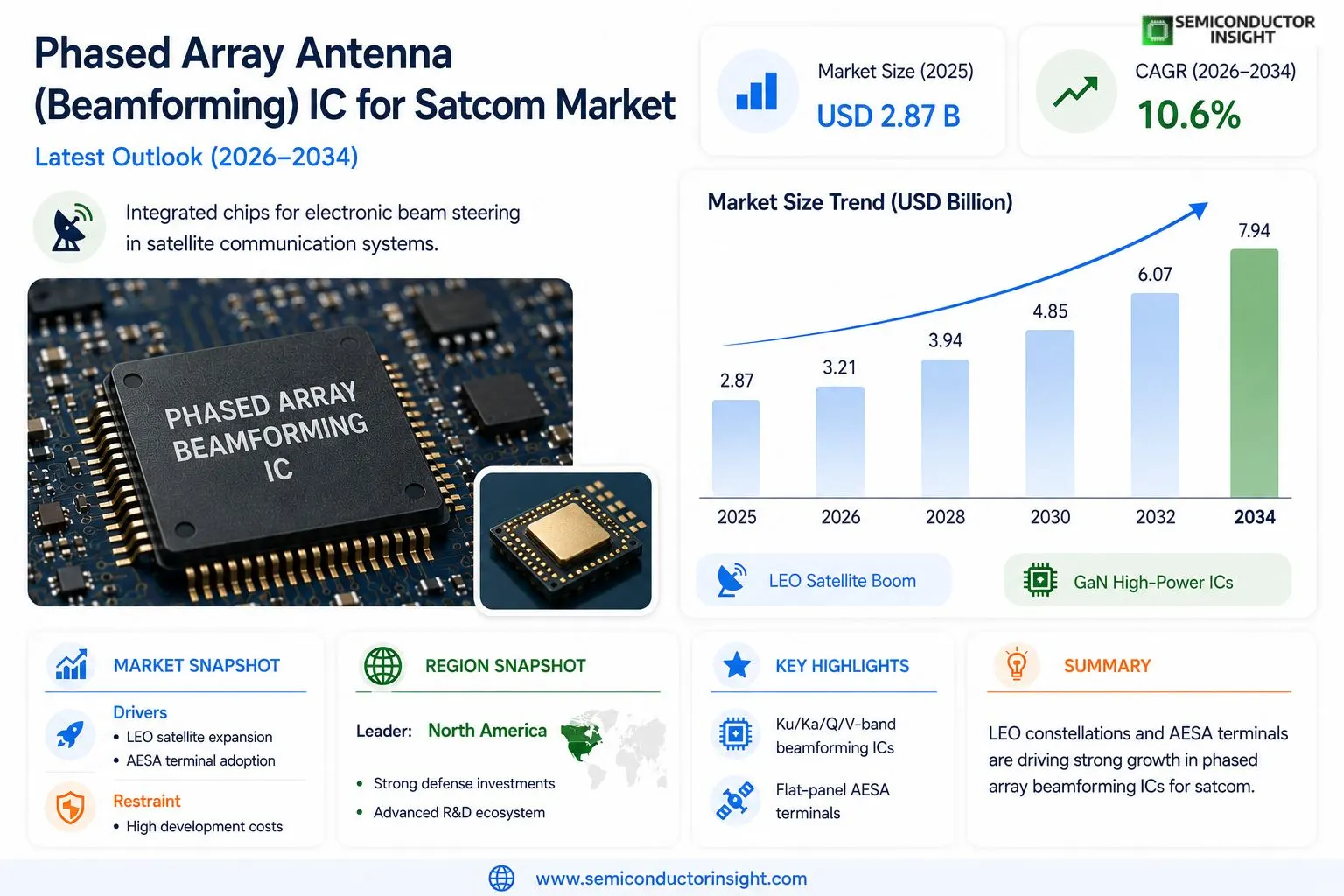
Global Phased Array Antenna (Beamforming) IC for Satcom Market size was valued at USD 2.87 billion in 2025. The market is projected to grow from USD 3.21 billion in 2026 to USD 7.94 billion by 2034, exhibiting a CAGR of 10.6% during the forecast period.
Phased array antenna beamforming ICs are highly integrated semiconductor devices engineered to electronically steer antenna beams without requiring mechanical movement, enabling precise, high-speed signal transmission and reception in satellite communications systems. These ICs incorporate key functional blocks such as phase shifters, variable gain amplifiers, transmit/receive switches, power amplifiers, and digital control interfaces within a single chip or chipset. Operating across frequency bands including Ku-, Ka-, and Q/V-band, they serve both geostationary (GEO) and non-geostationary (NGSO) satellite constellations, supporting low earth orbit (LEO) and medium earth orbit (MEO) broadband connectivity platforms.
The market is experiencing robust momentum driven by the rapid proliferation of LEO satellite constellations, surging demand for high-throughput broadband connectivity, and accelerating adoption of flat-panel active electronically scanned array (AESA) terminals across commercial, defense, and government segments. Furthermore, the ongoing rollout of programs such as SpaceX Starlink, Amazon Project Kuiper, and OneWeb has created significant downstream demand for cost-effective, high-performance beamforming ICs. Strategic initiatives among key industry participants are further reinforcing growth , for instance, Analog Devices, Inc., Renesas Electronics, and Anokiwave continue to expand their satcom-grade beamforming IC portfolios targeting next-generation user terminals. Lockheed Martin, Northrop Grumman, and Raytheon Technologies also remain prominent players leveraging advanced beamforming semiconductor solutions for military satellite communication applications.
MARKET DRIVERS
Surging Demand for Low Earth Orbit (LEO) Satellite Broadband Connectivity
The rapid expansion of LEO satellite constellations by operators such as SpaceX Starlink, Amazon Project Kuiper, and OneWeb has emerged as a primary driver for Phased Array Antenna (Beamforming) IC for Satcom Market. These mega-constellations require ground terminals and user equipment capable of electronically steering beams without mechanical components, making beamforming ICs indispensable. The transition from geostationary (GEO) to LEO architectures demands high-speed beam tracking, a capability only phased array technology can reliably deliver at scale. As subscriber terminals must continuously reacquire satellite links during orbital passes, beamforming IC performance directly determines system quality and user experience.
Military and Government Adoption of Electronically Steered Antenna Systems
Defense agencies and government satellite programs worldwide are accelerating procurement of electronically steered antenna (ESA) systems that integrate phased array beamforming ICs. Secure, jam-resistant, and low-probability-of-intercept satellite communications for airborne, naval, and ground platforms rely heavily on advanced beamforming IC architectures operating across Ka-, Ku-, and X-band frequencies. Government-funded modernization programs in North America, Europe, and the Asia-Pacific region are committing substantial budgets to upgrade legacy parabolic dish terminals with flat-panel phased array solutions. This institutional demand provides a stable, long-cycle revenue base for IC developers and foundry partners focused on Phased Array Antenna (Beamforming) IC for Satcom Market.
➤ The convergence of commercial LEO broadband deployment and defense satcom modernization is creating a dual-demand environment that is structurally elevating investment in phased array beamforming IC development, manufacturing scale-up, and system integration across Global satcom value chain.
Advances in semiconductor process nodes, particularly the maturation of silicon-germanium (SiGe) BiCMOS and bulk CMOS processes at millimeter-wave frequencies, have significantly reduced the cost and power consumption of beamforming ICs. This democratization of RF front-end integration allows merchant IC suppliers to address both high-volume consumer terminals and performance-sensitive defense applications from a common technology platform, broadening the total addressable market for Phased Array Antenna (Beamforming) IC for Satcom solutions.
MARKET CHALLENGES
Thermal Management and Power Efficiency Constraints in High-Channel-Count Arrays
One of the most technically demanding challenges facing Phased Array Antenna (Beamforming) IC for Satcom Market is the management of heat dissipation in dense, multi-element arrays. As channel counts increase to achieve higher antenna gain and finer beam resolution, the aggregate power consumption of the beamforming IC layer grows substantially. In flat-panel terminal designs, available volume and surface area for thermal spreading are inherently limited, creating a fundamental tension between electrical performance and thermal reliability. Sustained operation in elevated ambient environments , including automotive, aviation, and maritime satcom platforms , further exacerbates junction temperature budgets and long-term device reliability.
Other Challenges
Supply Chain Concentration and Foundry Capacity Constraints
Phased Array Antenna (Beamforming) IC for Satcom Market is exposed to supply chain risk stemming from concentration of advanced SiGe and GaAs foundry capacity among a limited number of qualified fabs. Lead times for wafer starts at specialty RF process nodes can extend significantly during periods of elevated demand, constraining the ability of terminal manufacturers to scale production in response to satellite operator rollout schedules. Diversification of qualified foundry sources and investment in domestic semiconductor manufacturing capacity are active strategic priorities for leading IC suppliers but remain multi-year undertakings.
Cost Reduction Pressure vs. Performance Requirements
Consumer-facing LEO terminal programs impose aggressive unit cost targets on beamforming IC content, while simultaneously demanding high equivalent isotropically radiated power (EIRP) and receive figure-of-merit (G/T) performance to meet link budgets. Reconciling these competing requirements demands continuous architectural innovation in IC design, including higher levels of per-chip integration, reduced external component counts, and tighter co-design between the IC and antenna aperture. Achieving cost structures compatible with mass-market consumer terminals without sacrificing compliance to spectrum regulatory requirements represents an ongoing engineering and business challenge across the market.
MARKET RESTRAINTS
Regulatory Complexity and Spectrum Coordination Across Global Satcom Bands
Phased Array Antenna (Beamforming) IC for Satcom Market faces a meaningful restraint in the form of evolving and regionally fragmented spectrum regulations governing Ka- and Ku-band satellite terminals. Regulatory bodies including the FCC, ITU, and ETSI impose specific requirements on out-of-band emissions, equivalent power flux density (EPFD) limits, and terminal type approvals that influence allowable beamforming IC output power levels and sidelobe suppression specifications. Compliance with these requirements across multiple regional regulatory regimes increases design complexity and certification timelines for IC and terminal vendors, acting as a barrier to rapid commercialization of new beamforming IC generations.
High Non-Recurring Engineering Costs and Extended Development Cycles
Developing a production-ready phased array beamforming IC for satcom applications requires substantial non-recurring engineering (NRE) investment, encompassing multi-pass silicon prototyping, antenna co-design, and extensive environmental qualification testing. For smaller IC design companies and new entrants, securing the capital necessary to complete a full product development cycle through to foundry qualification and customer qualification testing represents a significant financial restraint. This dynamic tends to concentrate development activity among well-capitalized incumbents and venture-backed startups with patient capital structures, limiting competitive diversity within Phased Array Antenna (Beamforming) IC for Satcom Market in the near term.
MARKET OPPORTUNITIES
Emergence of Direct-to-Device and Non-Terrestrial Network (NTN) Satcom Applications
The integration of satellite connectivity directly into smartphones and IoT devices under 3GPP Non-Terrestrial Network (NTN) standards represents a nascent but structurally significant opportunity for Phased Array Antenna (Beamforming) IC for Satcom Market. As standards bodies finalize NTN specifications and satellite operators license spectrum for direct-to-device services, demand will emerge for highly integrated, ultra-low-power beamforming IC solutions capable of fitting within the form factor and power envelope of consumer handheld devices. IC vendors capable of bridging RF front-end expertise with CMOS digital baseband integration are well positioned to capture early design wins in this rapidly evolving application segment.
Aero and Maritime In-Motion Satcom Terminal Proliferation
Commercial aviation and maritime industries represent high-value vertical markets creating durable demand for phased array beamforming ICs optimized for in-motion satcom applications. Electronically steered flat-panel terminals offer significant size, weight, and aerodynamic advantages over mechanically gimbaled dish antennas for aircraft and vessel installations, accelerating the replacement cycle for legacy antenna systems. Regulatory approvals for low-profile ESA terminals across major aviation authorities are progressively expanding the certified installation base, providing IC suppliers with a growing pipeline of design opportunities. Phased Array Antenna (Beamforming) IC for Satcom Market stands to benefit materially as airline and maritime operators prioritize passenger connectivity as a revenue-generating service differentiator.
Advanced Packaging and Chiplet Architectures Enabling Next-Generation Integration
Progress in advanced semiconductor packaging technologies , including antenna-in-package (AiP), 2.5D interposer integration, and chiplet-based disaggregated architectures , is opening new design opportunities for phased array beamforming IC developers targeting satcom terminals. These packaging innovations enable tighter co-integration of the RF beamforming IC with digital beamforming processors, power management units, and antenna elements, reducing system-level insertion loss and improving overall aperture efficiency. As packaging ecosystem maturity increases and costs decline along the learning curve, advanced integration approaches will become accessible to a broader range of terminal manufacturers, expanding the served market for specialized phased array beamforming IC products and stimulating innovation across Phased Array Antenna (Beamforming) IC for Satcom Market value chain.
Trend
Rapid Proliferation of LEO Satellite Constellations Driving Beamforming IC Demand
Phased Array Antenna (Beamforming) IC for Satcom Market is witnessing a significant transformation driven by the accelerating deployment of low earth orbit (LEO) satellite constellations globally. Programs such as SpaceX Starlink, Amazon Project Kuiper, and OneWeb have generated substantial downstream demand for high-performance, cost-effective beamforming integrated circuits. These constellations require large volumes of flat-panel active electronically scanned array (AESA) user terminals, each relying on phased array beamforming ICs to deliver seamless, high-throughput broadband connectivity. As satellite operators scale their constellation deployments, demand for semiconductor solutions capable of operating across Ku-, Ka-, and Q/V-band frequencies continues to intensify, making beamforming IC development a central priority across the satcom supply chain.
Other Trends
Expansion of Flat-Panel AESA Terminal Adoption Across Commercial and Defense Segments
One of the most prominent trends shaping Phased Array Antenna (Beamforming) IC for Satcom Market is the broad adoption of flat-panel AESA terminals across commercial aviation, maritime, government, and defense verticals. Unlike traditional mechanically steered dishes, AESA terminals leverage beamforming ICs to electronically steer antenna beams with precision and speed, eliminating moving parts and enabling compact, low-profile form factors. Defense organizations including those served by Lockheed Martin, Northrop Grumman, and Raytheon Technologies are increasingly deploying advanced beamforming semiconductor solutions in military satellite communication platforms, reflecting the growing strategic importance of reliable, high-bandwidth satcom connectivity in modern defense operations.
Integration of Key Functional Blocks Within Single-Chip Architectures
Semiconductor manufacturers are advancing chip-level integration by consolidating phase shifters, variable gain amplifiers, transmit/receive switches, power amplifiers, and digital control interfaces within a single beamforming IC or chipset. This trend is reducing system complexity, lowering bill-of-materials costs, and enabling smaller terminal designs suitable for mass-market deployment. Leading companies such as Analog Devices, Inc., Renesas Electronics, and Anokiwave are actively expanding their satcom-grade beamforming IC portfolios targeting next-generation user terminals that must support both geostationary (GEO) and non-geostationary (NGSO) satellite constellations, including LEO and medium earth orbit (MEO) broadband platforms.
Multi-Band Frequency Capability Emerging as a Competitive Differentiator
As satellite operators transition toward higher frequency bands to meet growing bandwidth demands, Phased Array Antenna (Beamforming) IC for Satcom Market is seeing increased emphasis on multi-band capable beamforming solutions. ICs engineered to operate seamlessly across Ku-, Ka-, and Q/V-band frequencies offer operators greater flexibility in satellite network design and terminal interoperability. This capability is becoming a key differentiator among IC developers, encouraging sustained research and development investment and reinforcing the long-term growth trajectory of the phased array antenna beamforming IC segment within the broader satellite communications ecosystem.
COMPETITIVE LANDSCAPE
Key Industry Players
Phased Array Antenna (Beamforming) IC for Satcom Market , Global Competitive Dynamics and Leading Innovators
Global Phased Array Antenna (Beamforming) IC for Satcom market, valued at USD 2.87 billion in 2025 and projected to reach USD 7.94 billion by 2034 at a CAGR of 10.6%, is characterized by intense competition among a select group of highly specialized semiconductor and defense electronics companies. Analog Devices, Inc. (ADI) commands a prominent position in this space, offering a comprehensive portfolio of satcom-grade beamforming ICs operating across Ku-, Ka-, and Q/V-band frequencies for both GEO and NGSO satellite constellations. ADI’s highly integrated chipsets , incorporating phase shifters, variable gain amplifiers, and digital control interfaces , have been widely adopted in flat-panel active electronically scanned array (AESA) terminals serving commercial and government broadband connectivity platforms. Anokiwave has similarly established itself as a critical innovator, delivering silicon-based beamforming ICs purpose-built for LEO satcom user terminals, capitalizing on downstream demand from programs such as SpaceX Starlink and Amazon Project Kuiper. Renesas Electronics has further strengthened its satcom beamforming IC portfolio through targeted acquisitions and organic R&D investments aimed at next-generation user terminal applications.
Beyond the leading players, the competitive landscape encompasses a broad set of niche and emerging participants addressing specific frequency bands, integration levels, and end-use verticals. Lockheed Martin, Northrop Grumman, and Raytheon Technologies remain dominant in the defense and military satellite communication segment, leveraging advanced beamforming semiconductor solutions for secure, high-reliability MILSATCOM applications. Integrated Device Technology (IDT, now part of Renesas), Crane Aerospace & Electronics, and Mynaric are also active contributors to the market ecosystem. On the commercial satcom terminal side, companies such as Viasat, Ball Aerospace (now part of BAE Systems), and SiBeam have developed proprietary beamforming IC solutions supporting high-throughput broadband terminals. Startups and fabless design houses including Epiq Solutions, Mixed-Mode Technology, and Arralis are gaining traction by targeting cost-optimized, high-volume beamforming chipsets for emerging LEO and MEO constellation ground segment deployments, further intensifying competition across the value chain.
List of Key Phased Array Antenna (Beamforming) IC for Satcom Companies Profiled
- Analog Devices, Inc. (ADI)
- Anokiwave
- Renesas Electronics Corporation
- Lockheed Martin Corporation
- Northrop Grumman Corporation
- Raytheon Technologies (RTX)
- Viasat, Inc.
- BAE Systems (Ball Aerospace)
- Crane Aerospace & Electronics
- Mynaric AG
- SiBeam, Inc.
- Epiq Solutions
- Arralis
- Mixed-Mode Technology
- Integrated Device Technology (IDT)
Segment Analysis:
| Segment Category | Sub-Segments | Key Insights |
| By Type |
|
Ka-Band Beamforming ICs represent the leading segment within the type classification, underpinned by several compelling market dynamics:
|
| By Application |
|
Satellite User Terminals (Flat-Panel AESA) dominate the application landscape, driven by a convergence of technological and commercial forces:
|
| By End User |
|
Commercial End Users represent the dominant and fastest-evolving category in this market, characterized by the following key dynamics:
|
| By Orbit Type |
|
Low Earth Orbit (LEO) has emerged as the preeminent orbit type driving beamforming IC demand, with several structural factors reinforcing its leadership:
|
| By Technology |
|
Silicon (Si) CMOS-Based ICs have established leadership within the technology segment, supported by a distinct set of competitive advantages:
|
Regional Analysis: Phased Array Antenna (Beamforming) IC for Satcom Market
North America
The United States defense establishment remains a primary demand driver for phased array antenna beamforming ICs in the satcom segment. Military satcom programs prioritizing secure, jam-resistant, and highly agile connectivity are spurring procurement of advanced beamforming chipsets. Government-funded R&D programs continue to push performance boundaries, ensuring that North American vendors maintain a significant technological advantage in mission-critical satcom applications.
Commercial satellite ventures headquartered across North America are scaling LEO mega-constellations at an unprecedented pace, creating sustained demand for high-performance beamforming ICs. These constellations require compact, power-efficient phased array antenna chips capable of dynamic beam steering to maintain continuous broadband connectivity. This commercial momentum is reshaping the supply chain and spurring substantial investment in beamforming IC design and manufacturing capacity within the region.
North America hosts a concentration of world-class semiconductor design firms, foundries, and EDA tool providers that collectively accelerate the development cycle for phased array antenna beamforming ICs. This robust ecosystem enables rapid prototyping, system-level integration, and volume production of satcom-grade chipsets. Strategic partnerships between fabless IC designers and advanced packaging specialists further enhance the region’s capacity to deliver differentiated beamforming solutions to Global satcom market.
A well-developed regulatory environment administered by the FCC and allied agencies provides North American satcom operators with relatively streamlined licensing pathways for deploying phased array antenna systems. Proactive spectrum allocation policies for Ka-, Ku-, and V-band frequencies support the broader adoption of beamforming IC-enabled satcom terminals across both government and commercial verticals, reinforcing the region’s market leadership and attracting continued foreign investment in satcom infrastructure.
Europe
Europe represents the second most significant regional market for Phased Array Antenna (Beamforming) IC for Satcom Market, shaped by a combination of institutional satellite programs, growing defense modernization initiatives, and the expanding role of the European Space Agency (ESA) in fostering next-generation satcom technologies. Nations such as Germany, France, the United Kingdom, and Italy are investing considerably in sovereign satellite communication capabilities, creating consistent demand for advanced beamforming IC solutions. The European Union’s emphasis on digital sovereignty and secure connectivity is accelerating the adoption of phased array antenna systems across both government and enterprise satcom segments. Additionally, Europe’s well-established aerospace and defense industrial base provides a fertile environment for the integration of beamforming ICs into military and dual-use satcom platforms. Growing interest in LEO connectivity services and in-flight broadband applications further stimulates regional demand, positioning Europe as a critical growth market through 2034.
Asia-Pacific
The Asia-Pacific region is emerging as one of the fastest-evolving markets for Phased Array Antenna (Beamforming) IC for Satcom Market, propelled by the ambitious satellite programs of China, Japan, India, South Korea, and Australia. China’s state-driven push to develop indigenous LEO constellations and advanced satcom infrastructure is generating significant domestic demand for beamforming ICs, while simultaneously encouraging local semiconductor development to reduce import dependency. Japan and South Korea contribute through their world-class electronics manufacturing capabilities and growing commercial satcom ventures. India’s expanding space economy, catalyzed by regulatory liberalization under the Indian Space Policy framework, is opening new avenues for phased array antenna beamforming IC adoption across commercial and defense satcom applications. The region’s large population base and increasing demand for broadband connectivity in remote and underserved areas further underpin long-term market growth, making Asia-Pacific a pivotal arena for satcom beamforming IC developers seeking global scale.
South America
South America occupies a developing but strategically relevant position in Global Phased Array Antenna (Beamforming) IC for Satcom Market. Brazil remains the region’s anchor market, driven by its vast geographic expanse and the critical need for satellite-based connectivity in remote and rural territories where terrestrial infrastructure remains limited. Government-backed satellite programs and growing interest from private operators in deploying LEO-based broadband services are creating nascent demand for phased array antenna beamforming ICs. Argentina and Colombia are also emerging as markets of interest as their respective space agencies and telecommunications regulators explore advanced satcom solutions. While budgetary constraints and import dependencies present challenges to rapid market penetration, South America’s structural need for ubiquitous connectivity ensures that phased array antenna beamforming IC adoption will accelerate progressively over the forecast period as LEO service costs decline and regional satellite partnerships mature.
Middle East & Africa
The Middle East and Africa region presents a long-term growth opportunity for Phased Array Antenna (Beamforming) IC for Satcom Market, anchored by divergent but complementary demand drivers. In the Middle East, sovereign wealth-backed investments in advanced satellite communication infrastructure and defense modernization programs are creating meaningful demand for high-performance beamforming IC-enabled satcom systems. Nations such as the UAE and Saudi Arabia are actively developing national satellite capabilities as part of broader digital transformation and Vision-aligned technology agendas. In Africa, the primary demand catalyst is the pressing need for broadband connectivity across vast underserved and unserved regions, where LEO satellite services powered by phased array antenna beamforming technology offer a viable alternative to costly terrestrial rollouts. As global LEO operators expand service coverage across Africa and as regional governments prioritize digital inclusion, the adoption of phased array antenna beamforming ICs within satcom terminals and ground equipment is expected to gain meaningful traction through 2034.
Report Scope
This market research report provides a comprehensive analysis of the Phased Array Antenna (Beamforming) IC for Satcom Market , covering the forecast period 2026–2034. It offers detailed insights into market dynamics, technological advancements, competitive landscape, and key trends shaping the industry.
Key focus areas of the report include:
- Market Overview: The report begins with an overview outlining its current market scenario, key growth indicators, and industry transformation drivers. It discusses macroeconomic factors, demand–supply balance, regulatory landscape, and the strategic role of semiconductors in powering advancements across industries such as automotive, telecommunications, consumer electronics, and industrial automation.
- Market Size & Forecast: Historical data and future projections for revenue, unit shipments, and market value across major regions and segments.
- Segmentation Analysis: Detailed breakdown by product type, technology, application, and end-user industry to identify high-growth segments and investment opportunities.
- Regional Insights: Insights into market performance across North America, Europe, Asia-Pacific, Latin America, and the Middle East & Africa, including country-level analysis where relevant.
- Competitive Landscape: Profiles of leading market participants, including their product offerings, R&D focus, manufacturing capacity, pricing strategies, and recent developments such as mergers, acquisitions, and partnerships.
- Technology Trends & Innovation: Assessment of emerging technologies, integration of AI/IoT, semiconductor design trends, fabrication techniques, and evolving industry standards.
- Market Drivers & Restraints: Evaluation of factors driving market growth along with challenges, supply chain constraints, regulatory issues, and market-entry barriers.
- Stakeholder Insights: Insights for component suppliers, OEMs, system integrators, investors, and policymakers regarding the evolving ecosystem and strategic opportunities.
Primary and secondary research methods are employed, including interviews with industry experts, data from verified sources, and real-time market intelligence to ensure the accuracy and reliability of the insights presented.
FREQUENTLY ASKED QUESTIONS:
What is the current market size of Phased Array Antenna (Beamforming) IC for Satcom Market?
-> Global Phased Array Antenna (Beamforming) IC for Satcom Market size was valued at USD 2.87 billion in 2025 and is projected to grow from USD 3.21 billion in 2026 to USD 7.94 billion by 2034, exhibiting a CAGR of 10.6% during the forecast period.
Which key companies operate in Phased Array Antenna (Beamforming) IC for Satcom Market?
-> Key players include Analog Devices, Inc., Renesas Electronics, Anokiwave, Lockheed Martin, Northrop Grumman, and Raytheon Technologies, among others.
What are the key growth drivers?
-> Key growth drivers include the rapid proliferation of LEO satellite constellations, surging demand for high-throughput broadband connectivity, and accelerating adoption of flat-panel active electronically scanned array (AESA) terminals across commercial, defense, and government segments. The ongoing rollout of programs such as SpaceX Starlink, Amazon Project Kuiper, and OneWeb has also created significant downstream demand for cost-effective, high-performance beamforming ICs.
Which region dominates the market?
-> North America remains a dominant market driven by strong defense and government satellite communication investments, while Asia-Pacific is among the fastest-growing regions owing to expanding broadband satellite infrastructure and rising demand for next-generation user terminals.
What are the emerging trends?
-> Emerging trends include electronically steered flat-panel AESA terminals, multi-band beamforming IC integration across Ku-, Ka-, and Q/V-band frequencies, and growing adoption of beamforming semiconductors for both geostationary (GEO) and non-geostationary (NGSO) satellite constellations supporting LEO and MEO broadband connectivity platforms.

Get Sample Report PDF for Exclusive Insights
Report Sample Includes
- Table of Contents
- List of Tables & Figures
- Charts, Research Methodology, and more...
 Download Sample Report PDF