MARKET INSIGHTS
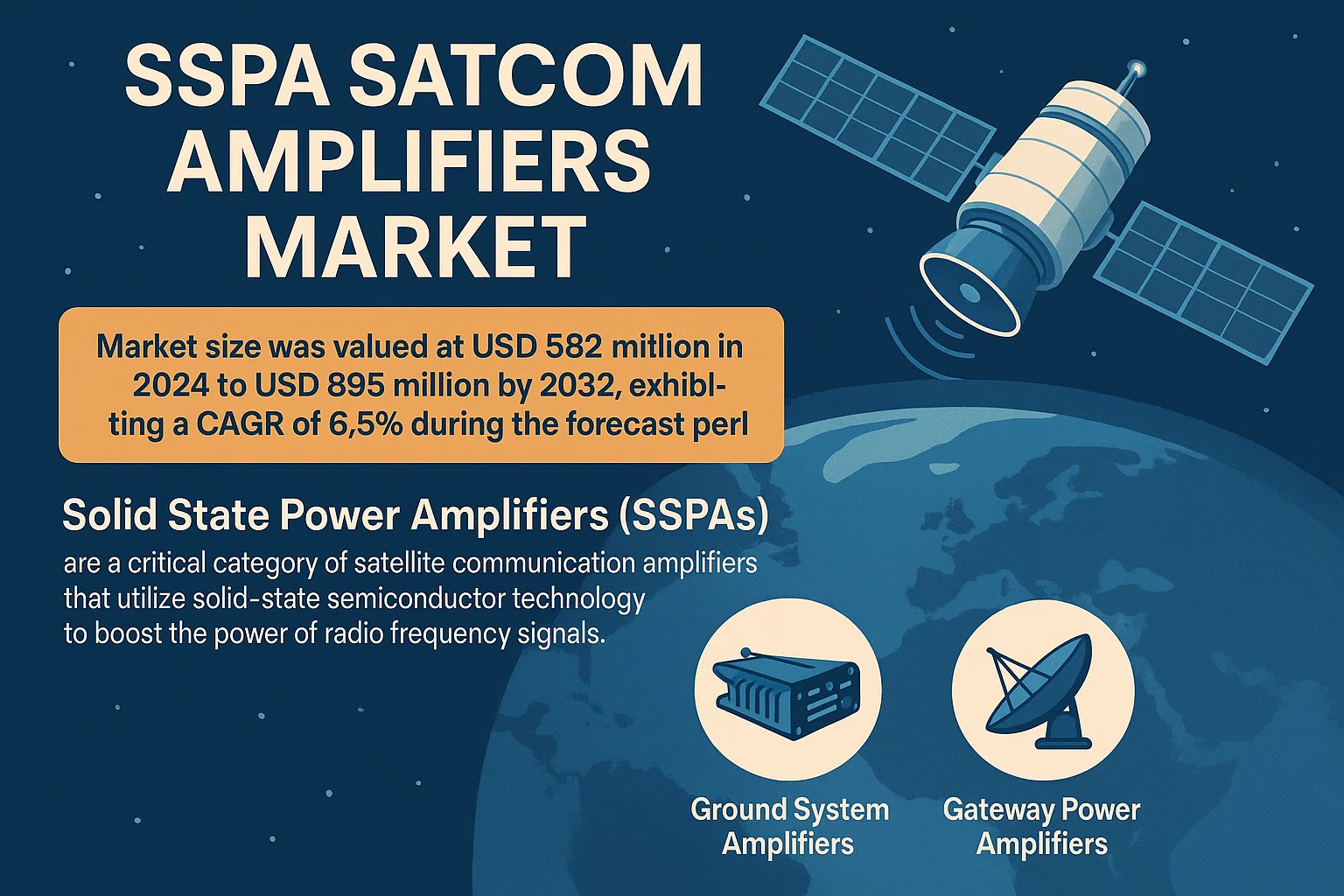
Global SSPA Satcom Amplifiers Market size was valued at USD 582 million in 2024 to USD 895 million by 2032, exhibiting a CAGR of 6.5% during the forecast period.
Solid State Power Amplifiers (SSPAs) are a critical category of satellite communication amplifiers that utilize solid-state semiconductor technology to boost the power of radio frequency signals. These devices are fundamental components in both ground-based and space-based communication systems, providing the necessary gain to ensure signal integrity over vast distances. SSPAs are engineered for high reliability and efficiency, encompassing various types such as Ground System amplifiers, In-Flight Connectivity (IFC) Power Amplifiers, and Gateway Power Amplifiers.
The market growth is primarily driven by the escalating global demand for high-throughput satellite services, increased government and defense spending on secure communication networks, and the rapid expansion of commercial satellite constellations for broadband internet. However, the market faces challenges such as complex regulatory environments and high initial development costs. North America dominates the market, holding approximately 50% of the global share, because of its advanced technological infrastructure and significant investments in defense and aerospace sectors. Key players leading the market include Communications & Power Industries (CPI), Comtech, and L3Harris Narda-MITEQ, who continue to innovate with more efficient and compact amplifier designs.
MARKET DRIVERS
Increasing Demand for High-Throughput Satellites (HTS)
The global push for high-speed internet connectivity in remote and underserved regions is driving demand for advanced satellite communication systems. High-throughput satellites require highly efficient and reliable SSPAs to handle increased data throughput, making them essential for modern satellite internet providers.
Adoption of Advanced Materials Like GaN
Gallium Nitride (GaN) technology offers superior power density and thermal performance compared to traditional materials, enabling smaller, more efficient amplifiers. This is particularly crucial for space-constrained applications in satellite payloads where every gram counts.
➤ “The shift to higher frequency bands like Ka-band and Q/V-band for greater bandwidth is pushing amplifier technology forward. SSPAs capable of operating at these frequencies with high efficiency are in high demand,”
Military and defense applications also contribute significantly, as they require robust and secure communication systems that depend on high-performance SSPAs for strategic communications and drone operations.
MARKET CHALLENGES
High Development and Production Costs
Developing and manufacturing SSPAs that meet the stringent requirements of space and defense applications involves significant investment in R&D, advanced materials, and precision engineering. These costs are often passed on to customers, making high-performance amplifiers a significant investment.
Other Challenges
Thermal Management in High-Power Applications
As power levels increase, dissipating heat becomes a critical challenge. Without effective thermal management, performance degrades and component lifespan decreases rapidly. Current materials and heat sink technologies are reaching their limits.
MARKET RESTRAINTS
High Initial Investment and R&D Costs
Developing a new SSPA product line capable of meeting modern requirements can require investments exceeding $20 million per product family. This includes costs associated with semiconductor fabrication, amplifier design, and rigorous testing under space-like conditions.
MARKET OPPORTUNITIES
Expansion of Satellite Internet Constellations
The rapid deployment of low-earth orbit (LEO) satellite constellations by companies like SpaceX, Amazon, and OneWeb requires thousands of satellites, each requiring multiple high-performance SSPAs. This creates a sustained demand curve projected to last through 2040.
Adoption in Emerging 5G Networks
As 5G networks expand, the need for backhaul solutions that can handle increased data loads is growing. Many providers are turning to satellite solutions integrated with terrestrial networks, creating new opportunities for high-frequency SSPAs in ground station equipment.
SSPA Satcom Amplifiers Market Trends
Increasing Demand for High-Throughput Satellites Drives Market Growth
The global SSPA Satcom Amplifiers market is experiencing significant growth, primarily driven by the increasing deployment of high-throughput satellites (HTS) that require advanced amplification systems. With major satellite operators like SpaceX, OneWeb, and Amazon’s Project Kuiper expanding their constellations, there is a corresponding increase in demand for high-performance SSPAs that can handle the increased data throughput. The market is projected to grow from $582 million in 2024 to $895 million by 2032, with a CAGR of 6.5%. This growth is supported by substantial investments in satellite internet infrastructure globally.
North America remains the largest market, accounting for approximately 50% of global demand, followed by Europe and Asia-Pacific. The growth in North America is primarily driven by government initiatives in defense and space exploration, coupled with commercial satellite internet services expanding their coverage. Major manufacturers are focusing on developing more efficient and compact SSPAs to meet the evolving requirements of next-generation satellite networks.
Other Trends
Shift Towards Higher Frequency Bands
The industry is witnessing a gradual shift towards higher frequency bands, particularly Ka-band and Q/V-band, to address spectrum congestion in traditional frequency bands. This transition requires SSPA amplifiers with higher performance specifications, creating opportunities for manufacturers to develop next-generation products. Companies like CPI and Comtech are investing in R&D to capitalize on this trend, focusing on improving power efficiency and thermal management in their new product lines.
Growing Demand for Portable and Mobile Solutions
There is increasing demand for portable and mobile satellite communication solutions, particularly in defense, emergency response, and remote operations. This trend is driving development of more compact, lightweight SSPA amplifiers without compromising performance. Manufacturers are focusing on improving power density and reducing weight while maintaining reliability. The market for portable satellite terminals with integrated SSPAs is expected to grow significantly in the coming years, especially in regions with limited terrestrial infrastructure.
Supply Chain Adaptation and Regional Manufacturing
The COVID-19 pandemic exposed vulnerabilities in global supply chains, particularly for critical components like SSPA amplifiers used in defense and critical infrastructure. In response, there is a trend toward regionalizing production, with North American and European manufacturers establishing additional manufacturing facilities to ensure supply chain resilience. This trend is expected to continue as geopolitical factors continue to influence supply chain decisions in the aerospace and defense sectors.
COMPETITIVE LANDSCAPE
Key Industry Players
SSPA Satcom Amplifiers Market Leaders
The global SSPA Satcom Amplifiers market is dominated by established players with extensive experience in aerospace and defense communications. Communications & Power Industries (CPI) leads the market with its comprehensive portfolio of high-power amplifiers for satellite communications, followed closely by Comtech Telecommunications with its advanced satcom solutions. L3Harris Narda-MITEQ maintains strong market presence through its specialized microwave technology offerings.
Beyond the market leaders, several companies have established significant positions in niche segments. General Dynamics SATCOM Technologies focuses on integrated solutions for government and military applications. Gilat Satellite Networks offers specialized solutions for mobility and enterprise markets. Kratos Defense focuses on secure communications for defense applications. Norsat (now Hytera) provides cost-effective solutions for emerging markets. Amplus and Advantech Wireless (Baylin) offer competitive solutions for commercial satellite operators.
List of Key SSPA Satcom Amplifiers Companies
- Communications & Power Industries (CPI)
- Comtech Telecommunications Corp.
- L3Harris Narda-MITEQ
- General Dynamics SATCOM Technologies
- Kratos Defense & Security Solutions
- Gilat Satellite Networks
- Norsat International (Hytera)
- Amplus Communication Solutions
- Advantech Wireless (Baylin)
- Agilis (ST Electronics)
- Mission Microwave Technologies
- Comtech Xicom Technology
- CPI Canada
- Teledyne Technologies
- Qorvo Inc.
Segment Analysis:
| Segment Category | Sub-Segments | Key Insights |
| By Type |
|
GaN HEMT based amplifiers are gaining significant traction due to their higher power density and efficiency, making them particularly suitable for high-frequency satellite communications where thermal management and power efficiency are critical factors. |
| By Application |
|
The commercial satellite communications segment drives the largest market share due to the growing demand for in-flight connectivity, maritime communications, and remote area internet services, while military applications prioritize reliability and security over cost considerations in their amplifier selection. |
| By End User |
|
Satellite service providers represent the most significant segment as they directly deploy and maintain the amplifier systems in operational environments, while government agencies focus more on specialized, secure communications for defense applications that require higher durability and security standards. |
| By Frequency Band |
|
Ku-band amplifiers currently dominate the market due to their widespread use in commercial satellite communications and VSAT applications, while Ka-band is growing rapidly for high-throughput satellites. Military and defense applications predominantly utilize X-band amplifiers for their established infrastructure and interference resistance capabilities. |
| By Component |
|
Power amplifiers represent the largest and most critical segment as they handle the final amplification stage with highest power requirements. The growing demand for integrated amplifier subsystems is driving innovation in multi-function modules that combine amplification with filtering and frequency conversion in compact form factors. |
Regional Analysis: SSPA Satcom Amplifiers Market
The accelerated deployment of low-earth orbit satellite constellations across North America has become the primary catalyst for SSPA amplifier demand. Internet service providers are investing heavily in next-generation amplifiers that can handle higher frequency bands and provide greater reliability for consumer and enterprise satellite internet services. This expansion is driving both volume production and technological innovation in the regional market.
North American defense budgets continue to prioritize satellite communications for both strategic and tactical applications. This has resulted in sustained investment in advanced SSPA amplifiers with enhanced security features, radiation hardening, and interoperability with existing defense networks. The region’s defense contractors are driving innovation in ruggedized amplifiers capable of operating in extreme environments while maintaining signal integrity.
The integration of satellite networks with terrestrial 5G and upcoming 6G infrastructure is most advanced in North America. This creates demand for amplifiers that can seamlessly interface between different network types while maintaining signal quality. The region’s technology companies are leading in developing smart amplifiers with built-in monitoring, predictive maintenance, and network optimization capabilities.
North America benefits from having major satellite and defense manufacturers within the region, creating shorter and more resilient supply chains for critical components. This proximity allows for closer collaboration between amplifier manufacturers and end-users, resulting in products that better address specific market needs. The region also maintains advanced semiconductor fabrication capabilities essential for high-frequency amplifier production.
Europe
Europe represents a mature but steadily growing market for SSPA Satcom Amplifiers, characterized by its strong regulatory framework and emphasis on interoperability. The European Space Agency and various national space programs continue to invest in satellite communications, particularly for scientific and defense applications. The region shows strength in developing energy-efficient and environmentally sustainable amplifier technologies, aligning with broader EU technology initiatives. European manufacturers maintain strong positions in specialized, high-performance amplifiers for niche applications, while also benefiting from the continent’s extensive terrestrial fiber networks that complement satellite networks.
Asia-Pacific
The Asia-Pacific region demonstrates the most rapid growth in SSPA Satcom Amplifier adoption, driven by massive investments in satellite internet infrastructure across developing nations. Countries like India, Indonesia, and Vietnam are rapidly expanding their satellite communication capabilities both for consumer internet access and for governmental applications. The region benefits from lower manufacturing costs and increasing technical expertise, enabling both consumption and production of advanced amplifier technologies. China’s Belt and Road Initiative has also driven infrastructure development that includes satellite communication components across participating countries.
South America
South America’s market is characterized by selective but strategic adoption of SSPA amplifier technologies. The region shows strongest growth in areas with limited terrestrial infrastructure, where satellite internet provides the most viable solution. Brazil, Argentina, and Chile lead in adopting advanced satellite communication technologies, often focusing on applications in resource extraction, environmental monitoring, and disaster response. The market remains price-sensitive but demonstrates willingness to invest in higher-quality components for critical applications.
Middle East & Africa
The Middle East demonstrates strong demand for SSPA amplifiers primarily driven by government investments in satellite technology for both communication and observation purposes. Gulf states with smaller populations but significant financial resources invest in the most advanced available technologies. Across Africa, the market is more fragmented with adoption concentrated in nations with active space programs (such as Egypt, Nigeria, and South Africa) and regions with limited terrestrial infrastructure. The market shows gradual but steady growth as satellite internet becomes more accessible across the continent.
Report Scope
This market research report provides a comprehensive analysis of the SSPA Satcom Amplifiers Market, covering the forecast period 2025-2032. It offers detailed insights into market dynamics, technological advancements, competitive landscape, and key trends shaping the industry.
Key focus areas of the report include:
- Market Overview: The report begins with an overview outlining its current market scenario, key growth indicators, and industry transformation drivers. It discusses macroeconomic factors, demand-supply balance, regulatory landscape, and the strategic role of semiconductors in powering advancements across industries such as aerospace, defense, telecommunications, and industrial automation.
- Market Size & Forecast: Historical data and future projections for revenue, unit shipments, and market value across major regions and segments.
- Segmentation Analysis: Detailed breakdown by product type, technology, application, and end-user industry to identify high-growth segments and investment opportunities.
- Regional Insights: Insights into market performance across North America, Europe, Asia-Pacific, Latin America, and the Middle East & Africa, including country-level analysis where relevant.
- Competitive Landscape: Profiles of leading market participants, including their product offerings, R&D focus, manufacturing capacity, pricing strategies, and recent developments such as mergers, acquisitions, and partnerships.
- Technology Trends & Innovation: Assessment of emerging technologies, integration of AI/IoT, semiconductor design trends, fabrication techniques, and evolving industry standards.
- Market Drivers & Restraints: Evaluation of factors driving market growth along with challenges, supply chain constraints, regulatory issues, and market-entry barriers.
- Stakeholder Insights: Insights for component suppliers, OEMs, system integrators, investors, and policymakers regarding the evolving ecosystem and strategic opportunities.
Primary and secondary research methods are employed, including interviews with industry experts, data from verified sources, and real-time market intelligence to ensure the accuracy and reliability of the insights presented.
FREQUENTLY ASKED QUESTIONS:
What is the current market size of SSPA Satcom Amplifiers Market?
-> The SSPA Satcom Amplifiers Market was valued at US$ 582 million in 2024 and is projected to reach US$ 895 million by 2032.
What is the growth rate of SSPA Satcom Amplifiers Market?
-> The market is expected to grow at a CAGR of 6.5% during the forecast period 2024-2032.
Which region dominates the SSPA Satcom Amplifiers Market?
-> North America is the largest market, accounting for about 50% of the global market share.
Who are the key players in SSPA Satcom Amplifiers Market?
-> Key players include Communications & Power Industries (CPI), Comtech, L3Harris Narda-MITEQ, General Dynamics SATCOM Technologies, Kratos, Gilat, Norsat (Hytera), Amplus, Advantech Wireless (Baylin), Agilis (ST Electronics), Mission Microwave and others.
What are the key applications of SSPA Satcom Amplifiers?
-> Key applications include military & defense, satellite communications, commercial telecommunications, and government infrastructure.

Get Sample Report PDF for Exclusive Insights
Report Sample Includes
- Table of Contents
- List of Tables & Figures
- Charts, Research Methodology, and more...
 Download Sample Report PDF