LEO satellite laser communication terminal for 100 Gbps feeder link Market Insights
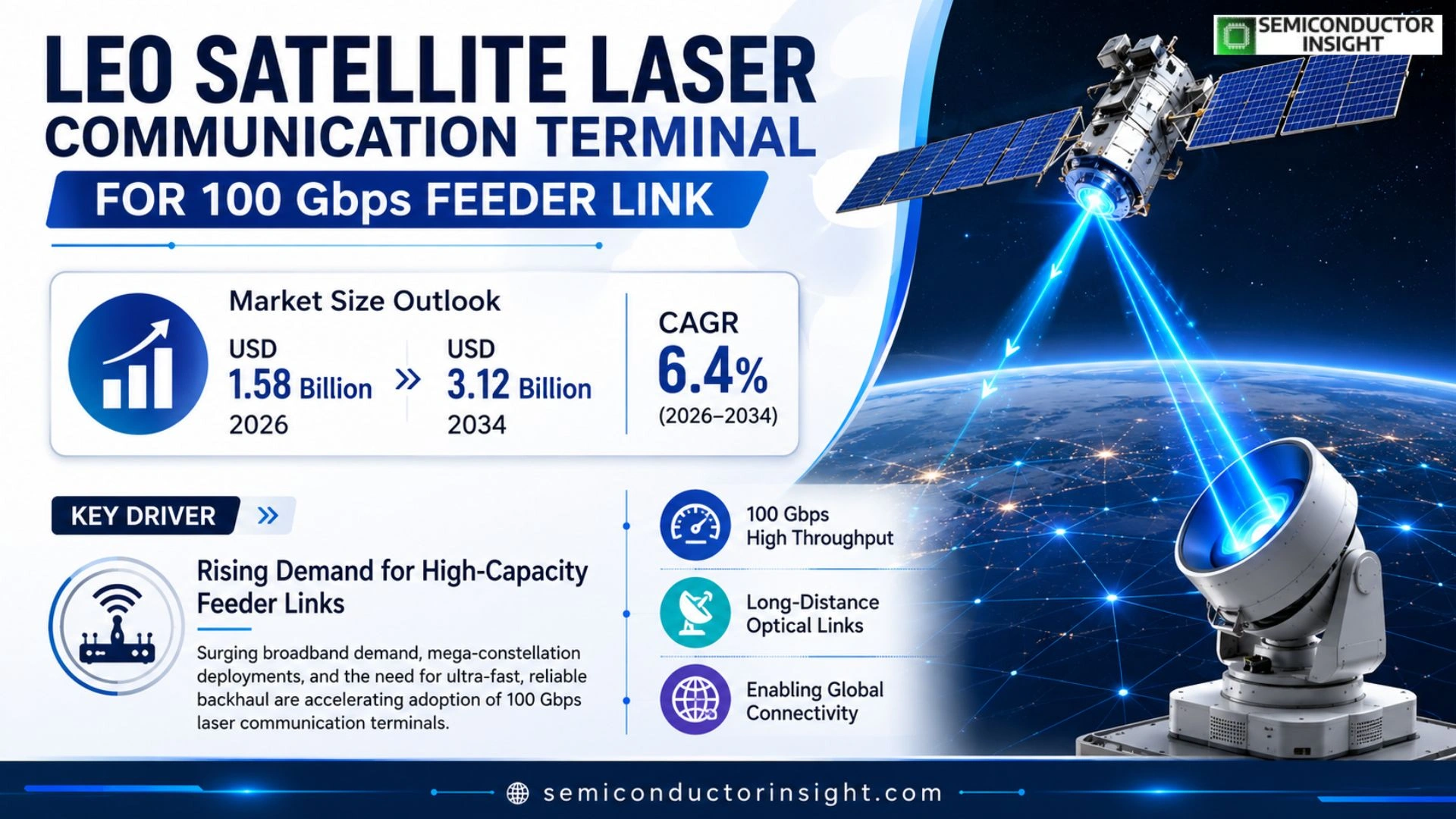
Global LEO satellite laser communication terminal market size was valued at USD 1.48 billion in 2025. The market is projected to grow from USD 1.58 billion in 2026 to USD 3.12 billion by 2034, exhibiting a CAGR of 6.4% during the forecast period.
LEO satellite laser communication terminals for a 100 Gbps feeder link are high‑capacity optical transceivers that enable ultra‑fast data transfer between low‑Earth‑orbit satellites and ground stations using coherent laser beams. These terminals integrate adaptive optics, precision pointing mechanisms, and advanced modulation formats to sustain reliable gigabit‑per‑second links over thousands of kilometers.
The market is experiencing rapid growth because of escalating demand for broadband connectivity in remote regions, rising traffic from video streaming and cloud services, and increasing investment in mega‑constellation projects such as Starlink and OneWeb. Furthermore, advancements in photonic integration and reductions in component costs are driving adoption across defense and commercial sectors. Key players,including SpaceX, Airbus Defence and Space, Mynaric, Tesat‑Spacecom, and Lumentum,are expanding their portfolios through strategic partnerships and technology rollouts.
MARKET DRIVERS
Growing Demand for High‑Capacity Feeder Links
LEO satellite laser communication terminal for 100 Gbps feeder link Market is being propelled by the rapid adoption of broadband services in underserved regions. Operators seek to backhaul multi‑gigabit traffic from ground stations to space, and laser terminals provide the required bandwidth while reducing spectrum congestion.
Advancements in Laser Terminal Technology
Recent breakthroughs in adaptive optics and high‑efficiency photodetectors have improved link reliability under atmospheric turbulence. These innovations allow terminals to maintain 100 Gbps data rates over distances exceeding 2,000 km, making them attractive for next‑generation constellations.
➤ Industry analysts forecast a compound annual growth rate of roughly 30 % for laser terminal shipments between 2024 and 2030.
Combined with decreasing component costs, the technology is shifting from niche defense applications to commercial broadband, positioning the market for sustained expansion.
MARKET CHALLENGES
Technical Integration Barriers
Integrating laser terminals with existing RF‑based ground stations requires precise alignment and sophisticated control algorithms. Operators often face limited expertise in optical‑phase tracking, which can delay deployment and increase engineering overhead.
Other Challenges
Regulatory Hurdles
The need for coordinated international laser safety standards adds complexity. While many jurisdictions have begun drafting guidelines, the lack of a unified framework can impede cross‑border satellite launches.
MARKET RESTRAINTS
High Capital Expenditure
Deploying a full constellation of 100 Gbps laser terminals demands substantial upfront investment. The cost of precision‑manufactured optics and ruggedized space‑qualified components often exceeds $2 million per unit, limiting participation to well‑capitalized players.
Additionally, the need for ground‑segment upgrades,such as high‑speed fiber backbones and advanced tracking stations,adds further financial pressure, especially for emerging market entrants.
Consequently, financing strategies and partnership models become critical determinants of market entry speed.
MARKET OPPORTUNITIES
Emerging 5G and Beyond Backhaul
The rollout of 5G networks and the upcoming 6G vision require backhaul solutions capable of supporting ultra‑high data rates. Laser communication terminals offer a low‑latency, high‑capacity alternative to microwave links, creating a sizable opportunity for vendors.
Furthermore, verticals such as autonomous vehicle networks, remote industrial IoT, and cloud‑gaming services are seeking reliable, high‑throughput connections that laser terminals can uniquely deliver.
Strategic collaborations between satellite operators, ground‑infrastructure providers, and technology firms are likely to accelerate market penetration and generate new revenue streams.
LEO satellite laser communication terminal for 100 Gbps feeder link Market Trends
Rising Demand for High‑Capacity Feeder Links
LEO satellite laser communication terminal for 100 Gbps feeder link Market is being reshaped by a surge in broadband connectivity projects targeting remote and underserved regions. Growing consumption of video streaming, cloud‑based applications, and edge‑computing services is creating persistent pressure for ultra‑fast, reliable backhaul solutions. Mega‑constellation operators such as Starlink and OneWeb are deploying large numbers of low‑Earth‑orbit platforms, which in turn require optical transceivers capable of sustaining gigabit‑per‑second links over thousands of kilometres. This confluence of user demand and satellite density drives a clear upward trajectory for high‑throughput laser terminals across both commercial and governmental networks.
Other Trends
Advancements in Photonic Integration
Recent progress in photonic integration has markedly improved the performance envelope of LEO satellite laser communication terminals. Adaptive optics now deliver finer beam pointing accuracy, while precision steering mechanisms reduce jitter during rapid satellite passes. Advanced modulation formats such as DP‑QPSK and OFDM enable higher spectral efficiency, allowing the same optical hardware to transport more data without expanding the physical footprint. At the same time, economies of scale in semiconductor laser manufacturing have lowered component costs, making the technology attractive for defense contracts and commercial broadband initiatives alike. These technical refinements collectively strengthen the value proposition of 100 Gbps feeder links.
Strategic Partnerships Driving Portfolio Expansion
Key industry players,including SpaceX, Airbus Defence and Space, Mynaric, Tesat‑Spacecom, and Lumentum,are accelerating growth through joint ventures, supply‑chain collaborations, and co‑development programs. Partnerships with ground‑station providers and network operators enable end‑to‑end service offerings that integrate optical terminals with terrestrial fiber backbones. Collaborative R&D efforts focus on next‑generation coherent laser sources and compact packaging, which promise to further reduce launch mass and power consumption. As these alliances mature, the market is likely to see a broader adoption curve, faster technology refresh cycles, and an increasingly competitive landscape that benefits both service providers and end users.
COMPETITIVE LANDSCAPE
Key Industry Players
LEO Satellite Laser Communication Terminal – 100 Gbps Feeder Link Market Overview
LEO satellite laser communication terminal market is anchored by a handful of vertically integrated manufacturers that control both the optical payload and the high‑precision pointing subsystems required for 100 Gbps feeder links. SpaceX, through its Starlink constellation, leads the commercial rollout and has partnered with multiple optical component suppliers to field the first large‑scale coherent laser terminals. Airbus Defence and Space complements this by offering end‑to‑end ground‑segment solutions, while Mynaric and Tesat‑Spacecom specialize in high‑power laser transceivers and adaptive‑optics modules that enable reliable gigabit‑per‑second links over thousands of kilometres. Lumentum provides the silicon‑photonic integration platforms that reduce component cost and power consumption, driving broader adoption across both defense and civilian mega‑constellations. Together these players shape a market structure that combines deep‑tech R&D with aggressive volume manufacturing, supporting the projected CAGR of 6.4 % through 2034.
Beyond the dominant tier, a diverse set of niche innovators contributes critical sub‑systems and application‑specific expertise. Thales Alenia Space and Rheinmetall focus on ruggedised terminals for defense and governmental payloads, whereas Telesat and OneWeb integrate laser back‑haul into their own satellite fleets. Boeing and Lockheed Martin bring heritage in space‑qualified optics, while smaller firms such as NeoPhotonics, InnoLight and Finisar supply high‑performance photonic chips that underpin the modulation formats used in 100 Gbps links. Raytheon’s precision pointing assemblies and Nokia’s networking software complete the ecosystem, ensuring that end‑to‑end latency and reliability meet the stringent requirements of broadband connectivity in remote regions.
List of Key LEO Satellite Laser Communication Terminal Companies Profiled
- SpaceX
- Airbus Defence and Space
- Mynaric
- Tesat‑Spacecom
- Lumentum
- Thales Alenia Space
- Rheinmetall
- Telesat
- OneWeb
- Boeing
- Lockheed Martin
- Raytheon Technologies
- Nokia
- NeoPhotonics
- InnoLight
Segment Analysis:
| Segment Category | Sub-Segments | Key Insights |
| By Type |
|
High‑capacity Optical Transceiver drives market momentum by delivering ultra‑fast data rates and robust link stability.
|
| By Application |
|
Broadband Internet Connectivity is the leading application, propelling adoption across remote and underserved regions.
|
| By End User |
|
Satellite Operators dominate the end‑user landscape, seeking to expand capacity and coverage.
|
| By Technology |
|
Coherent Laser Modulation underpins the terminal’s performance, delivering unmatched spectral efficiency.
|
| By Deployment Scenario |
|
Fixed Ground Stations remain the cornerstone of deployment, providing stable anchoring points for the feeder link network.
|
Regional Analysis: North America
Government support and funding for satellite internet projects are significantly boosting the market in North America. Initiatives aimed at expanding broadband access to underserved areas are creating strong demand for high-capacity feeder links.
The aerospace and defense sector represents a substantial portion of the North American market. The need for secure and high-speed communication for military and intelligence operations is driving investment in advanced laser communication terminals.
Continuous advancements in laser communication technology, including increased data rates and improved reliability, are key factors driving market growth in North America. Research and development efforts are focused on enhancing the performance and reducing the cost of these systems.
The growing demand for high-bandwidth applications like 5G, IoT, and cloud services is creating a significant market opportunity for LEO satellite laser communication terminals in North America.
Europe
Europe presents a dynamic market for LEO satellite laser communication terminals. The region’s strong emphasis on technological innovation and its commitment to expanding broadband access are key drivers. Several European countries are actively investing in satellite internet constellations and are exploring the potential of laser communication for enhanced data transfer. The European Union’s initiatives to promote digital connectivity and its focus on space-based services are creating a supportive environment for market growth. While the adoption rate might be slightly behind North America, the long-term outlook for Europe remains positive, with significant potential in government, enterprise, and research sectors. The integration of laser communication with existing satellite infrastructure is a key trend in the European market.
Asia-Pacific
Asia-Pacific is poised to be one of the fastest-growing markets for LEO satellite laser communication terminals. The region’s rapid economic expansion, increasing internet penetration, and growing demand for high-bandwidth applications are fueling market dynamics. Several countries in Asia-Pacific, including China, India, and Japan, are making significant investments in satellite communication infrastructure. The development of domestic satellite constellations and the increasing focus on digital transformation are key drivers. The government support for space technology and the growing enterprise sector are also contributing to market growth. The Asia-Pacific region presents a significant opportunity for players in LEO satellite laser communication terminal market.
South America
South America represents an emerging market with considerable potential for LEO satellite laser communication terminals. The region’s increasing need for improved broadband connectivity, particularly in remote and underserved areas, is driving market interest. Government initiatives aimed at expanding digital infrastructure and the growing demand for data-intensive applications are key factors. While the market is currently smaller compared to North America and Asia-Pacific, the long-term growth prospects are promising, with opportunities in government, telecommunications, and enterprise sectors. The deployment of LEO satellite constellations is expected to significantly enhance connectivity in the region.
Middle East & Africa
The Middle East and Africa market for LEO satellite laser communication terminals is characterized by growing demand and significant opportunities. The region’s increasing investments in telecommunications infrastructure, coupled with a rising need for high-bandwidth connectivity, is driving market growth. Government initiatives focused on digital transformation and the expansion of broadband access are key factors. The development of regional satellite constellations and the growing demand for data-intensive applications are further fueling market dynamics. The Middle East and Africa present a promising long-term market for LEO satellite laser communication terminals, with considerable potential for growth in the coming years.
Report Scope
This market research report provides a comprehensive analysis of the LEO satellite laser communication terminal for 100 Gbps feeder link Market , covering the forecast period 2026–2034. It offers detailed insights into market dynamics, technological advancements, competitive landscape, and key trends shaping the industry.
Key focus areas of the report include:
- Market Overview: The report begins with an overview outlining its current market scenario, key growth indicators, and industry transformation drivers. It discusses macroeconomic factors, demand–supply balance, regulatory landscape, and the strategic role of semiconductors in powering advancements across industries such as automotive, telecommunications, consumer electronics, and industrial automation.
- Market Size & Forecast: Historical data and future projections for revenue, unit shipments, and market value across major regions and segments.
- Segmentation Analysis: Detailed breakdown by product type, technology, application, and end-user industry to identify high-growth segments and investment opportunities.
- Regional Insights: Insights into market performance across North America, Europe, Asia-Pacific, Latin America, and the Middle East & Africa, including country-level analysis where relevant.
- Competitive Landscape: Profiles of leading market participants, including their product offerings, R&D focus, manufacturing capacity, pricing strategies, and recent developments such as mergers, acquisitions, and partnerships.
- Technology Trends & Innovation: Assessment of emerging technologies, integration of AI/IoT, semiconductor design trends, fabrication techniques, and evolving industry standards.
- Market Drivers & Restraints: Evaluation of factors driving market growth along with challenges, supply chain constraints, regulatory issues, and market-entry barriers.
- Stakeholder Insights: Insights for component suppliers, OEMs, system integrators, investors, and policymakers regarding the evolving ecosystem and strategic opportunities.
Primary and secondary research methods are employed, including interviews with industry experts, data from verified sources, and real-time market intelligence to ensure the accuracy and reliability of the insights presented.
FREQUENTLY ASKED QUESTIONS:
What is the current market size of LEO satellite laser communication terminal for 100 Gbps feeder link Market?
-> LEO satellite laser communication terminal for 100 Gbps feeder link Market was valued at USD 1.48 billion in 2025 and is expected to reach USD 3.12 billion by 2034.
Which key companies operate in LEO satellite laser communication terminal for 100 Gbps feeder link Market?
-> Key players include SpaceX, Airbus Defence and Space, Mynaric, Tesat‑Spacecom, and Lumentum.
What are the key growth drivers?
-> Key growth drivers include escalating demand for broadband connectivity in remote regions, rising video streaming and cloud service traffic, and investment in mega‑constellation projects such as Starlink and OneWeb.
Which region dominates the market?
-> The reference does not specify a dominant region for the market.
What are the emerging trends?
-> Emerging trends include advancements in photonic integration, reductions in component costs, and growing adoption across defense and commercial sectors.
Get Sample Report PDF for Exclusive Insights
Report Sample Includes
- Table of Contents
- List of Tables & Figures
- Charts, Research Methodology, and more...
 Download Sample Report PDF