
MARKET INSIGHTS
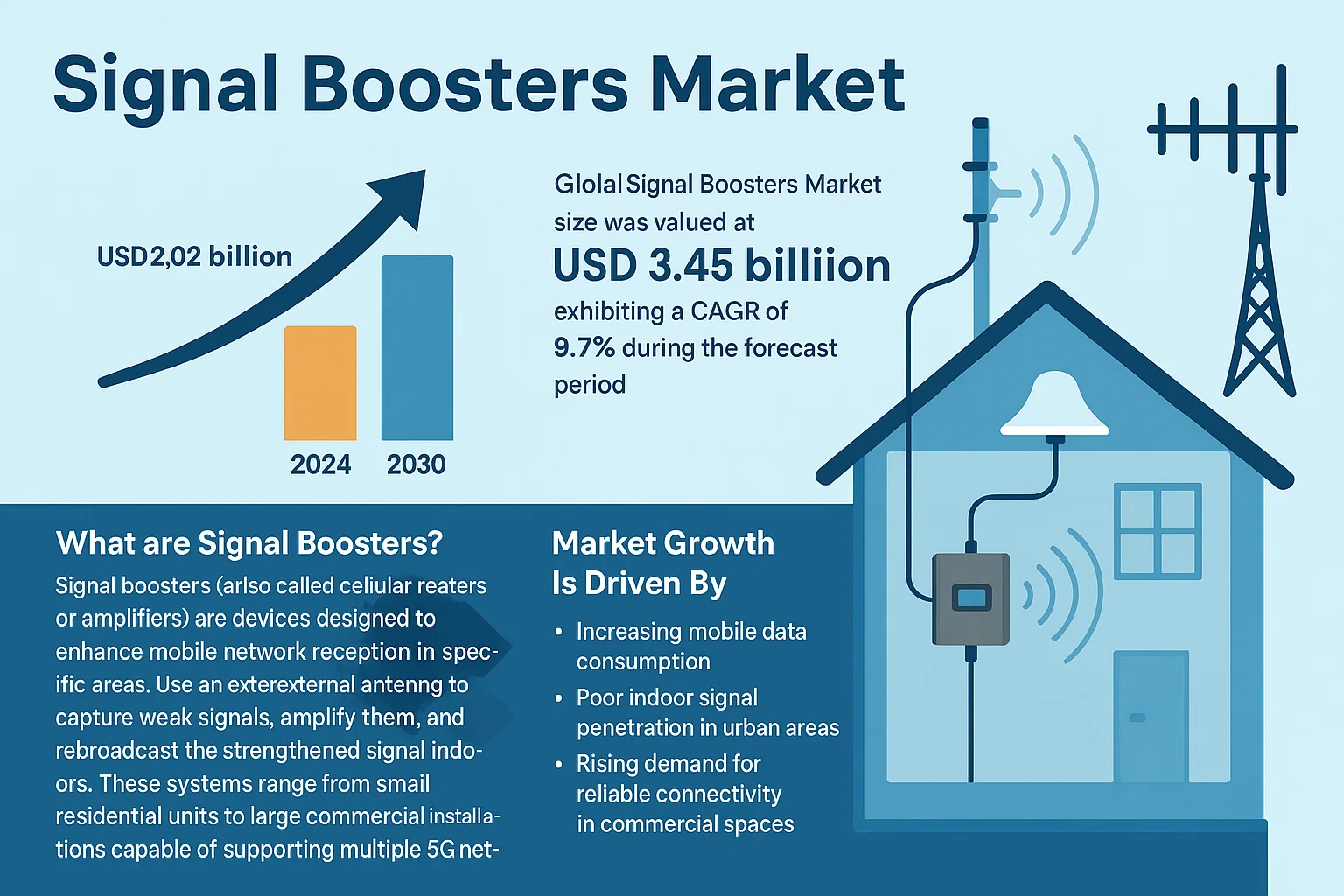
Global Signal Boosters Market size was valued at USD 2.02 billion in 2024 to USD 3.45 billion by 2030, exhibiting a CAGR of 9.7% during the forecast period.
Signal boosters (also called cellular repeaters or amplifiers) are devices designed to enhance mobile network reception in specific areas by using an external antenna to capture weak signals, amplifying them, and rebroadcasting the strengthened signal indoors. These systems range from small residential units to large commercial installations capable of supporting multiple simultaneous connections across various frequency bands including 4G LTE and emerging 5G networks.
The market growth is driven by increasing mobile data consumption, poor indoor signal penetration in urban areas, and rising demand for reliable connectivity in commercial spaces. While North America currently dominates due to stringent cellular coverage regulations, Asia-Pacific is witnessing rapid adoption because of expanding telecom infrastructure. Recent technological advancements like smart signal boosters with automatic gain control and IoT integration are creating new growth opportunities, particularly in smart building applications.
MARKET DYNAMICS
MARKET DRIVERS
Proliferation of 5G Networks and IoT Devices to Accelerate Market Expansion
The global rollout of 5G infrastructure is creating unprecedented demand for signal boosting solutions. With over 1.5 billion 5G connections projected worldwide by 2024, network operators and enterprises require reliable indoor coverage to deliver promised speeds and low latency. The Internet of Things ecosystem, expected to surpass 29 billion connected devices globally, further intensifies the need for consistent signal strength in smart buildings, industrial facilities, and urban environments. Signal boosters have evolved from basic consumer devices to sophisticated systems supporting multiple frequency bands and carrier aggregation, making them essential infrastructure components for ensuring seamless connectivity in the 5G era.
Growing Remote Work Culture and Digital Transformation Initiatives to Fuel Demand
The permanent shift toward hybrid work models has fundamentally changed connectivity requirements across residential and commercial spaces. Approximately 70% of organizations worldwide have adopted hybrid work arrangements, creating massive demand for reliable cellular coverage in home offices and corporate buildings. Simultaneously, digital transformation across industries requires robust connectivity for cloud-based applications, video conferencing, and real-time data transfer. Enterprises investing in smart building technologies are incorporating signal boosters as critical infrastructure, with the commercial segment experiencing over 15% annual growth in signal booster deployments. This trend is particularly evident in North America and Europe, where enterprises prioritize connectivity reliability for business continuity.
Regulatory Support and Standardization Efforts to Stimulate Market Growth
Government initiatives worldwide are facilitating signal booster adoption through improved regulatory frameworks and spectrum allocation policies. Many countries have established certification programs ensuring consumer-grade boosters don’t interfere with carrier networks, creating confidence in both residential and commercial markets. The Federal Communications Commission’s enhanced signal booster rules have resulted in over 2 million certified units deployed across the United States alone. Similar regulatory advancements in the European Union, Asia-Pacific, and Middle East regions are creating standardized markets where consumers and businesses can confidently deploy signal enhancement solutions. These regulatory developments, combined with carrier partnerships, are removing adoption barriers and creating predictable growth pathways for manufacturers and installers.
MARKET RESTRAINTS
Technical Complexity and Installation Challenges to Hinder Market Penetration
Despite growing demand, signal booster adoption faces significant technical hurdles that limit market penetration. The complexity of modern cellular networks, with multiple frequency bands and technologies coexisting, requires sophisticated equipment that can dynamically manage signal amplification without causing interference. Professional installation remains necessary for many commercial systems, adding substantial costs that deter small and medium enterprises. The variability in building materials and architectural designs further complicates deployment, as signal propagation characteristics differ dramatically between concrete structures, glass facades, and traditional construction. These technical challenges necessitate specialized expertise that remains in short supply, particularly in emerging markets where cellular infrastructure is rapidly expanding but technical support ecosystems are underdeveloped.
Regulatory Compliance and Spectrum Management Issues to Constrain Market Expansion
Stringent regulatory requirements across different jurisdictions create substantial barriers to market entry and product development. Each country maintains unique spectrum allocation policies and technical standards, forcing manufacturers to develop region-specific products that increase R&D costs and limit economies of scale. The certification process for signal boosters typically involves extensive testing and documentation, with approval timelines ranging from several months to over a year in some markets. These regulatory complexities are particularly challenging for smaller manufacturers seeking global expansion, as compliance costs can represent a significant portion of their operating expenses. Additionally, ongoing spectrum reallocation for 5G and future technologies requires constant product updates and recertification, creating sustained compliance burdens throughout product lifecycles.
Carrier Network Evolution and Small Cell Deployment to Impact Traditional Booster Demand
The rapid deployment of carrier-operated small cells and distributed antenna systems presents a fundamental challenge to the traditional signal booster market. Mobile network operators are investing heavily in their own in-building coverage solutions, with global small cell deployments expected to exceed 10 million units by 2025. These carrier-grade solutions often provide superior performance and integration with macro networks, potentially reducing the need for consumer and enterprise signal boosters in high-value locations. While signal boosters remain essential for cost-effective coverage in residential and small business settings, the competitive landscape is shifting as carriers increasingly view indoor coverage as a strategic differentiator rather than a problem for customers to solve independently.
MARKET OPPORTUNITIES
Emerging Smart City Infrastructure and Public Safety Networks to Create New Revenue Streams
The global smart city initiative represents a substantial growth opportunity for signal booster manufacturers and integrators. Municipalities worldwide are deploying intelligent transportation systems, public safety networks, and IoT infrastructure that require reliable cellular connectivity across urban environments. First responder communication systems, particularly those operating on dedicated frequency bands, increasingly incorporate signal boosting technology to ensure coverage in underground facilities, high-rise buildings, and remote areas. This public sector market segment is growing at approximately 12% annually as cities prioritize connectivity for emergency services and municipal operations. The convergence of cellular and public safety communications creates opportunities for specialized boosters that support both commercial and mission-critical frequencies, opening new markets beyond traditional consumer and enterprise segments.
Advanced Manufacturing and Industrial IoT Applications to Drive Premium Product Demand
Industry 4.0 transformation is creating unprecedented demand for reliable connectivity in manufacturing facilities, warehouses, and industrial campuses. The industrial IoT market, projected to reach $100 billion globally, requires robust cellular coverage for automation systems, autonomous guided vehicles, and real-time monitoring equipment. Unlike office environments, industrial settings present unique challenges including electromagnetic interference, harsh physical conditions, and complex layout configurations. Signal booster manufacturers are developing ruggedized, industrial-grade solutions that can withstand extreme temperatures, vibrations, and chemical exposures while providing reliable coverage for critical operations. This vertical-specific approach allows manufacturers to command premium pricing and establish long-term relationships with industrial clients who view connectivity as essential infrastructure rather than convenience.
Integration with Enterprise Network Management Systems to Enable Value-Added Services
The convergence of cellular and enterprise IT infrastructure creates opportunities for signal booster manufacturers to transition from hardware providers to solution integrators. Modern enterprises seek unified network management platforms that incorporate Wi-Fi, cellular, and IoT connectivity into a single dashboard. Signal booster manufacturers that develop API interfaces and management software can integrate their solutions into broader enterprise infrastructure, creating recurring revenue streams through software subscriptions and managed services. This approach is particularly valuable in the corporate real estate market, where facility managers require centralized visibility and control over connectivity assets across multiple locations. By embracing software-defined capabilities and cloud management, manufacturers can differentiate their offerings and capture higher-margin business while building barriers to entry for competitors focused solely on hardware production.
GLOBAL SIGNAL BOOSTERS MARKET TRENDS
5G Network Rollouts and IoT Proliferation Driving Market Expansion
The global deployment of 5G infrastructure represents a primary catalyst for the signal booster market, creating both opportunities and technical challenges that require advanced amplification solutions. While 5G offers significantly higher data speeds and reduced latency, its higher frequency bands—particularly millimeter wave (mmWave)—suffer from poorer penetration through buildings and physical obstructions. This inherent technical limitation has created a substantial addressable market for signal boosters capable of capturing, amplifying, and redistributing these fragile signals indoors. The global number of 5G connections is projected to exceed 1.9 billion by the end of 2024, underscoring the massive scale of this infrastructure transition. Furthermore, the proliferation of Internet of Things (IoT) devices, which are forecast to number over 29 billion globally by 2027, necessitates reliable indoor connectivity for smart home systems, industrial sensors, and healthcare monitors. This convergence of next-generation network requirements and ubiquitous connectivity demands is fundamentally reshaping product development strategies for leading manufacturers, who are now prioritizing multi-band amplifiers that support both legacy 4G LTE and new 5G frequencies.
Other Trends
Rising Demand for In-Building Coverage Solutions
Enterprise and commercial applications are emerging as a high-growth segment, driven by the critical need for uninterrupted cellular coverage in large buildings, underground facilities, and remote offices. Businesses increasingly recognize that poor cell signal directly impacts productivity, operational efficiency, and safety compliance. In healthcare facilities, for instance, reliable communication is vital for emergency response and patient care coordination, while in corporate offices, it supports the seamless operation of VoIP systems and mobile-dependent workflows. The commercial segment’s compound annual growth rate is notably higher than the consumer segment, reflecting this increased investment. Additionally, modern building materials such as low-emissivity glass and energy-efficient insulated concrete often block external radio frequencies, inadvertently creating dead zones that require technical solutions. This has led to sophisticated distributed antenna system (DAS) integrations, where signal boosters act as cost-effective alternatives to complex carrier-installed systems, particularly for small to medium-sized enterprises.
Technological Advancements and Regulatory Standardization
Product innovation continues to accelerate, with manufacturers developing smarter, more efficient, and user-friendly signal boosters. Modern units now incorporate automatic gain control, oscillation prevention circuitry, and real-time signal monitoring to ensure compliance with strict regulatory standards and avoid interference with carrier networks. The Federal Communications Commission (FCC) in the United States and equivalent bodies worldwide have established clearer guidelines for consumer and commercial signal booster use, which has legitimized the market and reduced consumer apprehension about device legality. This regulatory clarity has been instrumental in market growth. Moreover, the integration of smartphone apps for installation guidance and performance monitoring represents a significant usability advancement, reducing the need for professional installation and broadening the addressable consumer base. These technological improvements, coupled with a more favorable regulatory environment, have effectively expanded the market beyond early adopters to mainstream consumers and businesses seeking to resolve persistent connectivity issues.
COMPETITIVE LANDSCAPE
Key Industry Players
Strategic Product Innovation and Geographic Expansion Drive Market Competition
The global signal boosters market exhibits a fragmented yet dynamic competitive structure, characterized by the presence of numerous established players alongside emerging regional specialists. While the market is accessible to new entrants due to relatively moderate technological barriers, sustaining a competitive position requires significant investment in research and development, robust distribution networks, and adherence to stringent regulatory standards across different regions. The competitive intensity is further amplified by the continuous evolution of cellular network technologies, such as the ongoing global rollout of 5G infrastructure, which compels manufacturers to constantly upgrade their product portfolios.
Wilson Electronics (a WilsonPro brand) is widely recognized as a market leader, particularly in the North American region. Their dominance is attributed to a comprehensive product portfolio that spans consumer, enterprise, and industrial applications, coupled with strong brand recognition and a direct sales force. The company has consistently focused on obtaining regulatory certifications, such as those from the FCC in the U.S. and ISED in Canada, which acts as a significant barrier for lesser-known brands and solidifies their market position. Their recent initiatives have heavily focused on developing 5G-capable boosters to capitalize on the next generation of network upgrades.
Similarly, SureCall maintains a formidable presence, competing closely through aggressive marketing and a strong focus on the do-it-yourself (DIY) installation market. Their strategy often involves offering products across a wide price spectrum, making signal boosting technology accessible to a broader consumer base. The growth of these two U.S.-based leaders is largely driven by their deep understanding of domestic regulatory frameworks and their ability to forge partnerships with mobile network operators and major retail chains.
Beyond North America, other players leverage regional strengths. Stella Doradus in the UK and Comba Telecom in Asia-Pacific have carved out significant market shares within their respective geographic strongholds. Stella Doradus, for instance, has capitalized on the specific cellular frequency bands used across Europe, while Comba’s extensive experience in wireless infrastructure provides a technological edge. These companies are strengthening their positions through strategic investments in R&D for multi-band and multi-operator systems, which are crucial for commercial applications where a single booster must serve users on different carrier networks.
Meanwhile, companies like GrenTech and Huaptec are focusing on cost-competitive manufacturing and expanding their footprint in emerging markets across Asia, Latin America, and the Middle East and Africa. Their growth is often fueled by addressing the critical need for improved signal strength in rapidly developing urban and semi-urban areas where network infrastructure is still being built out. The overall competitive landscape is therefore defined by a mix of global innovation leaders and regional specialists, all striving to enhance their product offerings and geographic reach to capture a larger portion of this growing market.
List of Key Signal Booster Companies Profiled
- Wilson Electronics (U.S.)
- SureCall (U.S.)
- Stella Doradus (UK)
- SmoothTalker (U.S.)
- Comba Telecom Systems Holdings Ltd. (China)
- Phonetone (China)
- GrenTech (China)
- SANWAVE (China)
- BoomSense (China)
- Huaptec (China)
Segment Analysis:
By Type
Smart Signal Booster Segment Leads Due to Increasing Demand for Automated Connectivity Solutions
The market is segmented based on type into:
- Analog Signal Booster
- Subtypes: Wideband, Selective, and others
- Smart Signal Booster
- Hybrid Signal Booster
- Commercial-grade Boosters
- Subtypes: Multi-carrier, Single-carrier
- Consumer-grade Boosters
By Application
Mobilephone Segment Dominates with Growing Smartphone Penetration and Network Dependency
The market is segmented based on application into:
- TV Signal Enhancement
- Mobilephone Connectivity
- Radio Transmission
- Automotive Communication Systems
- Others
By End User
Residential Segment Expands Rapidly Due to Home Connectivity Needs
The market is segmented based on end user into:
- Residential
- Commercial
- Subtypes: Offices, Retail Spaces, Healthcare Facilities
- Industrial
- Governmental and Military
By Technology
4G/LTE Technology Maintains Strong Presence While 5G Adoption Accelerates
The market is segmented based on technology into:
- 3G
- 4G/LTE
- 5G
- Multi-band Systems
Regional Analysis: Global Signal Boosters Market
North America
North America represents a mature and technologically advanced market for signal boosters, characterized by high consumer awareness and stringent regulatory frameworks. The Federal Communications Commission (FCC) mandates strict certification (FCC Part 20 and Part 90) to ensure devices do not interfere with carrier networks, creating a high barrier to entry that favors established, compliant manufacturers like Wilson Electronics and SureCall. The market is primarily driven by the need to mitigate poor indoor coverage in both residential and commercial settings, particularly in suburban and rural areas where network infrastructure can be sparse. The proliferation of 5G network rollouts and the increasing reliance on seamless connectivity for remote work are significant growth catalysts. The region shows a strong preference for smart, multi-carrier boosters capable of supporting the latest cellular technologies.
Europe
Europe’s signal booster market is shaped by a diverse regulatory landscape across the EU, with a general trend towards harmonized standards to ensure device quality and network safety. The region exhibits strong demand stemming from its historic architecture, where thick building materials often impede cellular signals, and from the high value placed on reliable connectivity in both business and personal contexts. The market is highly competitive, with a mix of international brands and regional players. Growth is further supported by the ongoing expansion of 5G infrastructure and the European Union’s digital single market strategy, which aims to improve connectivity across member states. Consumer awareness regarding legal and certified products is increasing, steering the market away from non-compliant, low-quality amplifiers.
Asia-Pacific
The Asia-Pacific region is the largest and fastest-growing market for signal boosters globally, propelled by massive mobile subscriber bases, rapid urbanization, and significant infrastructure development, particularly in China and India. The market is volume-driven, with a higher penetration of cost-effective analog boosters, though demand for smart boosters is rising in metropolitan and commercial sectors. A key challenge is the prevalence of uncertified and non-standard devices, which can cause network interference. However, governments and mobile network operators are increasingly promoting the use of authorized boosters to enhance customer experience and network efficiency. The immense scale of new commercial construction and public infrastructure projects presents substantial opportunities for B2B sales of high-capacity booster systems.
South America
The South American market for signal boosters is developing, with growth potential tied to improving mobile network coverage and rising smartphone penetration. Economic volatility in several countries can constrain consumer spending on non-essential electronics, making the market somewhat price-sensitive. Demand is primarily concentrated in urban centers where building density causes signal attenuation, as well as in remote mining, agricultural, and industrial sites where reliable communication is critical. Regulatory frameworks are evolving but are generally less stringent than in North America or Europe, which can lead to a varied market with both certified and non-compliant products. Brazil and Argentina are the most active markets within the region.
Middle East & Africa
This region presents an emerging market with significant long-term potential, driven by ambitious national visions for digital transformation, such as Saudi Arabia’s Vision 2030 and the UAE’s Smart Dubai initiative. Demand is concentrated in key economic hubs and is largely fueled by the construction of new commercial towers, hospitality venues, and large-scale residential complexes that require robust indoor coverage. The extreme geography, including vast deserts and mountainous terrain, also creates natural coverage gaps that boosters can address. However, market growth is tempered by economic disparities, limited consumer awareness in some areas, and varying levels of regulatory development across different countries. The market is poised for growth as telecommunications infrastructure continues to expand.
Report Scope
This market research report provides a comprehensive analysis of the Global Signal Boosters Market, covering the forecast period 2025–2032. It offers detailed insights into market dynamics, technological advancements, competitive landscape, and key trends shaping the industry.
Key focus areas of the report include:
- Market Size & Forecast: Historical data and future projections for revenue, unit shipments, and market value across major regions and segments. The Global Signal Boosters Market was valued at USD 1.2 billion in 2023 and is projected to reach USD 2.8 billion by 2030, growing at a CAGR of 8.7%.
- Segmentation Analysis: Detailed breakdown by product type (analog and smart signal boosters), application (TV, mobilephone, radio, auto, others), and end-user industries to identify high-growth segments.
- Regional Outlook: Insights into market performance across North America, Europe, Asia-Pacific, Latin America, and Middle East & Africa, with country-level analysis of key markets like US, China, Germany, and India.
- Competitive Landscape: Profiles of leading players including Wilson Electronics, SureCall, Stella Doradus, Comba, and Phonetone, covering their product portfolios, market share (Wilson leads with 18% share), and strategic initiatives.
- Technology Trends: Analysis of 5G-compatible boosters, IoT integration, AI-powered signal optimization, and miniaturization trends in booster technology.
- Market Drivers & Restraints: Evaluation of growth drivers like increasing mobile penetration (global smartphone users reached 6.9 billion in 2023) and restraints such as regulatory challenges in certain regions.
- Stakeholder Analysis: Strategic insights for telecom operators, booster manufacturers, infrastructure providers, and investors regarding emerging opportunities in enterprise and residential segments.
The research methodology combines primary interviews with industry experts and analysis of data from regulatory bodies, company filings, and trade associations to ensure accuracy and reliability.
FREQUENTLY ASKED QUESTIONS:
What is the current market size of Global Signal Boosters Market?
-> Global Signal Boosters Market size was valued at USD 2.02 billion in 2024 to USD 3.45 billion by 2030, exhibiting a CAGR of 9.7% during the forecast period.
Which key companies operate in Global Signal Boosters Market?
-> Key players include Wilson Electronics, SureCall, Stella Doradus, Comba, Phonetone, GrenTech, and Huaptec, with Wilson Electronics holding the largest market share.
What are the key growth drivers?
-> Primary growth drivers include rising mobile data consumption (projected to reach 77.5 exabytes/month by 2025), increasing smart home adoption, and 5G network expansion.
Which region dominates the market?
-> North America currently leads the market (38% share), while Asia-Pacific is expected to grow fastest (CAGR 11.2%) during the forecast period.
What are the emerging trends?
-> Emerging trends include vehicle-integrated boosters, multi-carrier compatible devices, and AI-driven automatic gain control systems in signal boosters.

Get Sample Report PDF for Exclusive Insights
Report Sample Includes
- Table of Contents
- List of Tables & Figures
- Charts, Research Methodology, and more...
 Download Sample Report PDF


