Beamforming IC Market Insights
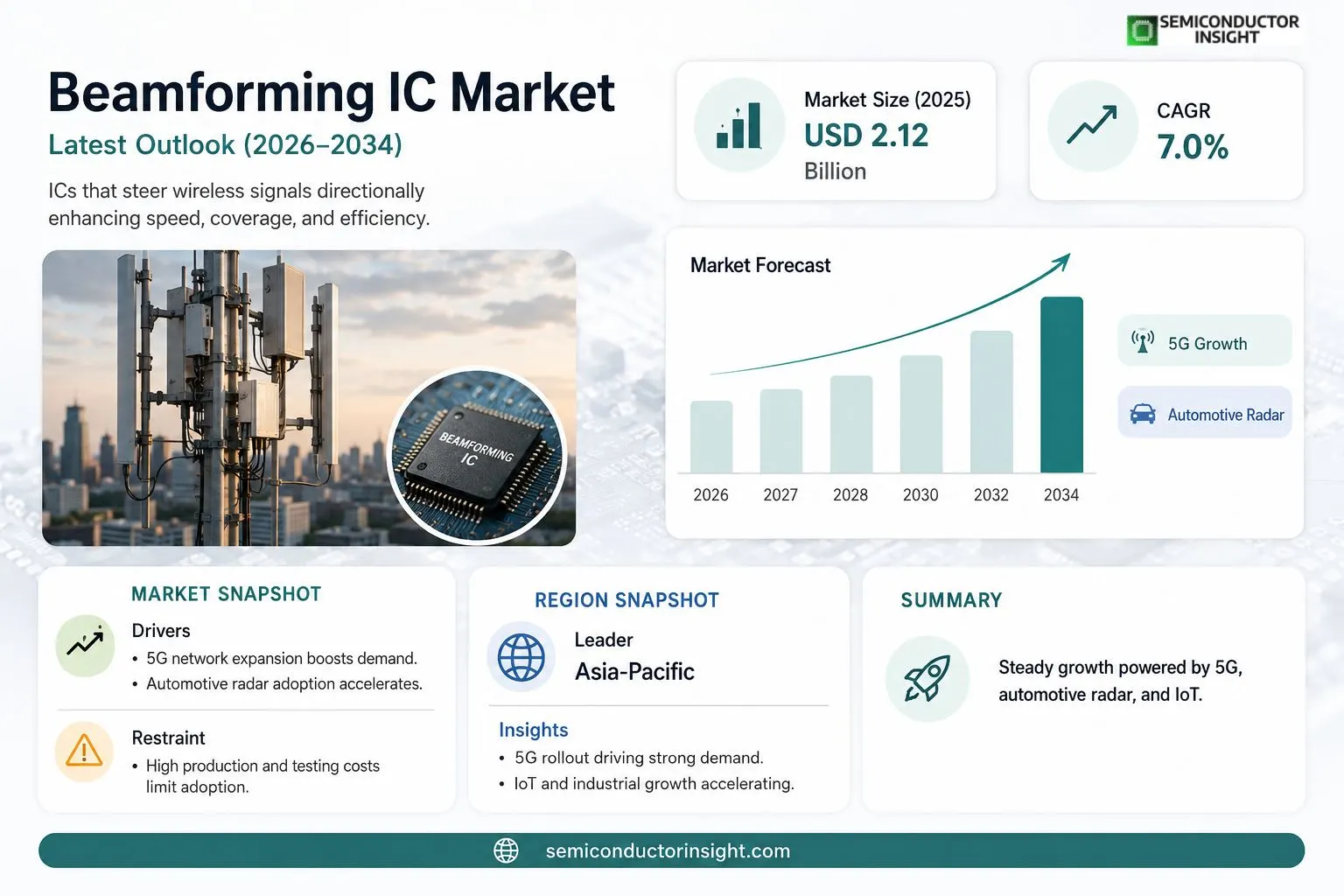
Global Beamforming IC market is projected to grow from USD 2.34 billion in 2026 to USD 4.79 billion by 2034, exhibiting a CAGR of 7.0% during the forecast period.
Beamforming integrated circuits are semiconductor components that enable directional signal transmission and reception by dynamically adjusting phase and amplitude across antenna arrays. These ICs are essential for advanced wireless standards such as 5G NR, Wi‑Fi 6/6E, automotive radar, and satellite communications, delivering higher throughput, reduced interference, and improved energy efficiency.The market is accelerating because telecom operators are expanding dense‑deployment networks, automotive manufacturers are integrating radar‑based driver‑assist systems, and consumer devices demand higher data rates with lower power consumption. Furthermore, ongoing R&D investments by leading silicon vendors,such as Qualcomm, NXP Semiconductors, and Skyworks,are driving cost reductions and integration of multi‑function beamforming solutions, which together fuel robust growth of Beamforming IC Market.
MARKET DRIVERS
Growing Demand for 5G Infrastructure
The rollout of 5G networks worldwide is accelerating the need for high‑precision antenna arrays, which rely on sophisticated beamforming integrated circuits. Operators are targeting latency below 1 ms and peak data rates exceeding 10 Gbps, driving manufacturers to adopt advanced Beamforming IC Market solutions that can dynamically steer beams in real time. This trend is especially pronounced in urban dense‑populations where capacity constraints demand efficient spectrum utilization.
Advancements in Automotive Radar Systems
Automakers are integrating radar‑based driver‑assistance features such as adaptive cruise control and blind‑spot detection. Modern radar modules require multi‑beam capability, which is enabled by low‑power, high‑frequency beamforming chips. Regulatory pushes for autonomous‑vehicle safety standards are pushing volume production, creating a robust demand pipeline for specialized ICs in this segment.
➤ “The convergence of 5G and automotive radar is projected to lift overall chip shipments by double‑digits over the next five years.”
Beyond communications and automotive, consumer‑grade Wi‑Fi 6E and upcoming Wi‑Fi 7 devices benefit from beamforming ICs that increase signal quality in congested indoor environments. Manufacturers are therefore expanding design‑win portfolios to capture market share, positioning Beamforming IC Market for sustained growth across multiple verticals.
MARKET CHALLENGES
Integration Complexity
Designers must co‑locate beamforming ICs with antenna arrays, RF front‑ends, and digital baseband processors on increasingly compact PCBs. The need to manage signal integrity, thermal dissipation, and power budgeting simultaneously introduces a steep learning curve, often extending development cycles and increasing R&D expenditures.
Other Challenges
Supply Chain Vulnerabilities
The semiconductor supply chain remains sensitive to geopolitical tensions and raw‑material shortages. Limited fab capacity for advanced SiGe and CMOS processes can cause lead‑time extensions, making it difficult for OEMs to align production schedules with market demand peaks.In addition, qualification of beamforming ICs for automotive safety standards such as ISO‑26262 demands extensive testing, further constraining time‑to‑market for new products.
MARKET RESTRAINTS
High Production Costs
The fabrication of high‑frequency, low‑noise beamforming chips requires specialized process nodes and meticulous calibration steps, driving unit costs well above those of conventional RF components. This price premium can deter adoption in cost‑sensitive applications such as low‑end consumer electronics.Moreover, testing equipment for multi‑beam verification is expensive and not widely available, limiting the number of firms capable of delivering fully qualified solutions.Finally, the need for software‑defined control adds another layer of development overhead, as manufacturers must provide robust firmware and driver stacks to enable real‑time beam steering, further stretching budgets.
MARKET OPPORTUNITIES
Emerging IoT Applications
Smart‑city deployments, including connected street lights and public‑safety cameras, are beginning to demand directional communication to reduce interference and improve energy efficiency. Beamforming ICs offer the precision needed for these point‑to‑point links, opening a new revenue stream for chipmakers.Edge‑AI devices that process data locally also benefit from on‑board beamforming to maintain reliable connectivity in cluttered environments. As AI inference workloads grow at the edge, the market for integrated solutions that combine AI accelerators with beamforming capabilities is expected to expand.Additionally, the satellite‑constellation sector is exploring ground‑station antennas that can dynamically track low‑Earth orbit satellites. Advanced beamforming chips capable of rapid beam‑switching are critical for maintaining continuous coverage, representing a high‑margin niche for early entrants.
Beamforming IC Market Trends
Rising Adoption of Beamforming ICs in 5G Deployments
The ongoing rollout of 5G New Radio is prompting telecom operators to densify antenna arrays across urban and suburban zones. Beamforming integrated circuits enable precise phase and amplitude control, allowing each cell site to direct energy toward active users while minimizing interference. This capability improves spectral efficiency and reduces the power budget of base stations, which in turn accelerates capital investment in advanced antenna modules. As operators prioritize network reliability and capacity, demand for highly integrated beamforming solutions continues to climb, positioning Beamforming IC Market for sustained expansion.
Other Trends
Automotive Radar Integration
Automotive manufacturers are embedding radar‑based driver‑assist systems into new vehicle platforms to meet safety regulations and consumer expectations. Beamforming ICs provide the necessary beam steering and high‑resolution detection required for adaptive cruise control, blind‑spot monitoring, and automated emergency braking. By consolidating multiple radar functions into a single silicon package, suppliers reduce board space, lower system cost, and simplify thermal management. The shift toward multi‑sensor fusion further drives the need for flexible beamforming architectures, reinforcing the relevance of this segment within the overall Beamforming IC Market.
Integration of Multi‑Function Beamforming Solutions in Consumer Devices
Consumer electronics, especially premium smartphones and Wi‑Fi routers, are requesting higher data rates with lower power consumption. Modern beamforming ICs now support simultaneous operation across 5G, Wi‑Fi 6/6E, and emerging satellite communication bands, enabling seamless connectivity without multiple discrete chips. Leading silicon vendors such as Qualcomm, NXP Semiconductors, and Skyworks are investing in research to shrink die size and integrate digital calibration engines, which improves yield and drives down cost. This convergence of functionality aligns with market pressure for slimmer devices and longer battery life, further stimulating adoption and shaping the competitive dynamics of Beamforming IC Market.
COMPETITIVE LANDSCAPEKey Industry Players
Beamforming IC Market Competitive Landscape Overview
Beamforming IC Market is currently dominated by a few large semiconductor firms that leverage deep R&D budgets and extensive IP portfolios to deliver highly integrated solutions for 5G NR, Wi‑Fi 6/6E, automotive radar, and satellite communications. Qualcomm leads the space with its multi‑function beamforming platforms that combine RF front‑ends, digital‑baseband, and AI‑driven array control, establishing a de‑facto standard for high‑end mobile devices. Close competitors such as NXP Semiconductors and Skyworks Solutions follow a similar integration strategy, focusing on cost‑effective modules for dense network deployments and automotive OEMs. The market structure reflects a classic oligopoly, where these large players secure the majority of revenue while also serving as technology gatekeepers for downstream device manufacturers.Beyond the primary tier, a cohort of specialist and niche players adds depth and diversity to the ecosystem. Companies like Qorvo, Broadcom, and MediaTek cater to specific segments,Qorvo’s high‑power beamforming ASICs target enterprise backhaul, Broadcom’s solutions focus on data‑center interconnect, and MediaTek emphasizes cost‑sensitive consumer electronics. Analog Devices, Texas Instruments, and Infineon provide mixed‑signal and power‑management expertise that complements pure RF offerings. Emerging participants such as Murata, STMicroelectronics, Samsung Electronics, Huawei’s HiSilicon, and Marvell Technology are expanding their portfolios through strategic acquisitions and partnerships, aiming to capture market share in rapidly growing automotive and IoT applications.
List of Key Beamforming IC Companies Profiled
- Qualcomm
- NXP Semiconductors
- Skyworks Solutions
- Qorvo
- Broadcom
- MediaTek
- Analog Devices
- Texas Instruments
- Infineon Technologies
- Murata Manufacturing
- STMicroelectronics
- Samsung Electronics
- Huawei HiSilicon
- Marvell Technology Group
Segment Analysis:
| Segment Category | Sub-Segments | Key Insights |
| By Type |
|
Digital Beamforming ICs
|
| By Application |
|
Infrastructure Base Stations
|
| By End User |
|
Telecom Operators
|
| By Frequency Band |
|
mmWave
|
| By Integration Level |
|
System‑on‑Chip Beamforming Solutions
|
Regional Analysis: Asia-Pacific
Asia-Pacific
The aggressive rollout of 5G networks across Asia-Pacific is a primary catalyst for Beamforming IC Market. This expansion necessitates advanced beamforming technologies to enhance network capacity, coverage, and efficiency. Investment in infrastructure is substantial, creating a strong demand for the integrated circuits that power these networks.
The rapid proliferation of IoT devices in industries like manufacturing, healthcare, and smart cities is driving demand for sophisticated wireless communication solutions. Beamforming ICs play a crucial role in optimizing connectivity for these devices, ensuring reliable data transmission and minimizing interference.
Governments across Asia-Pacific are actively promoting technological innovation and digital transformation through various initiatives. These include funding for research and development, incentives for 5G deployment, and policies encouraging the adoption of advanced wireless technologies.
The increasing adoption of industrial automation and robotics is generating demand for enhanced wireless communication capabilities within factories and industrial environments. Beamforming ICs are essential for supporting reliable and high-bandwidth communication between automated systems and control centers.
North America
North America represents a mature market for Beamforming ICs. While growth rates may be moderate compared to other regions, the demand remains robust, particularly in the automotive and aerospace sectors. The focus is on integrating beamforming into advanced driver-assistance systems (ADAS) and communication systems for aircraft. The presence of leading semiconductor manufacturers and research institutions fosters innovation in this region.
Europe
Europe exhibits steady growth in Beamforming IC Market, driven by the expanding 5G infrastructure and the increasing adoption of IoT devices. Strong emphasis on data privacy and security is influencing the development of beamforming solutions. Automotive and industrial applications are key growth areas in this region, with a focus on energy efficiency and reliability.
South America
South America presents a promising, albeit developing, market for Beamforming ICs. The increasing investments in telecommunications infrastructure and the growing adoption of mobile technologies are fueling demand. The region faces challenges related to infrastructure development and economic stability, which can impact market growth.
Middle East & Africa
The Middle East & Africa region is experiencing rapid growth in Beamforming IC Market, driven by infrastructure development projects and increasing mobile penetration. Government initiatives focused on expanding digital connectivity are creating significant opportunities. The region presents a unique blend of emerging technologies and established players.
Report Scope
This market research report provides a comprehensive analysis of the Beamforming IC Market , covering the forecast period 2026–2034. It offers detailed insights into market dynamics, technological advancements, competitive landscape, and key trends shaping the industry.
Key focus areas of the report include:
- ✅ Market Overview: The report begins with an overview outlining its current market scenario, key growth indicators, and industry transformation drivers. It discusses macroeconomic factors, demand–supply balance, regulatory landscape, and the strategic role of semiconductors in powering advancements across industries such as automotive, telecommunications, consumer electronics, and industrial automation.
- ✅ Market Size & Forecast: Historical data and future projections for revenue, unit shipments, and market value across major regions and segments.
- ✅ Segmentation Analysis: Detailed breakdown by product type, technology, application, and end-user industry to identify high-growth segments and investment opportunities.
- ✅ Regional Insights: Insights into market performance across North America, Europe, Asia-Pacific, Latin America, and the Middle East & Africa, including country-level analysis where relevant.
- ✅ Competitive Landscape: Profiles of leading market participants, including their product offerings, R&D focus, manufacturing capacity, pricing strategies, and recent developments such as mergers, acquisitions, and partnerships.
- ✅ Technology Trends & Innovation: Assessment of emerging technologies, integration of AI/IoT, semiconductor design trends, fabrication techniques, and evolving industry standards.
- ✅ Market Drivers & Restraints: Evaluation of factors driving market growth along with challenges, supply chain constraints, regulatory issues, and market-entry barriers.
- ✅ Stakeholder Insights: Insights for component suppliers, OEMs, system integrators, investors, and policymakers regarding the evolving ecosystem and strategic opportunities.
Primary and secondary research methods are employed, including interviews with industry experts, data from verified sources, and real-time market intelligence to ensure the accuracy and reliability of the insights presented.
FREQUENTLY ASKED QUESTIONS:
What is the current market size of Beamforming IC Market?
-> Beamforming IC Market was valued at USD 2.12 billion in 2025 and is expected to reach USD 4.79 billion by 2034.
Which key companies operate in Beamforming IC Market?
-> Key players include Qualcomm, NXP Semiconductors, Skyworks, and other leading silicon vendors, among others.
What are the key growth drivers?
-> Key growth drivers include expansion of dense‑deployment telecom networks, integration of radar‑based driver‑assist systems in automotive, and rising consumer demand for high‑data‑rate, low‑power devices.
Which region dominates the market?
-> Asia-Pacific is the fastest‑growing region, while North America remains a dominant market.
What are the emerging trends?
-> Emerging trends include multi‑function beamforming solutions, AI‑assisted antenna optimization, and integration of beamforming ICs in 5G NR and Wi‑Fi 6/6E ecosystems.
Get Sample Report PDF for Exclusive Insights
Report Sample Includes
- Table of Contents
- List of Tables & Figures
- Charts, Research Methodology, and more...
 Download Sample Report PDF