Mature Node Foundry (28nm and above) Market Insights
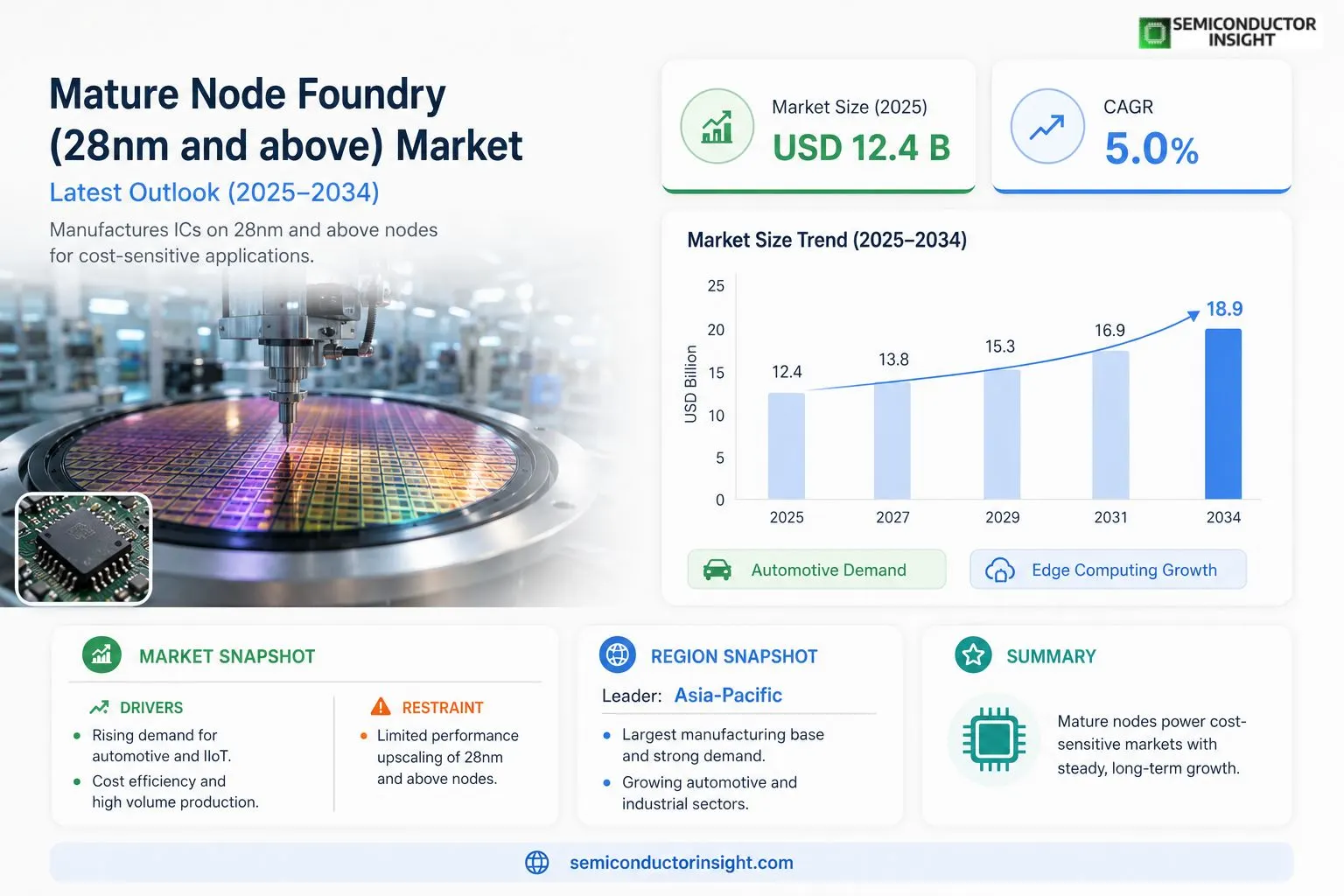
Global Mature Node Foundry (28nm and above) Market size was valued at USD 12.4 billion in 2025. The market is projected to grow from USD 13.1 billion in 2026 to USD 18.9 billion by 2034, exhibiting a CAGR of 5.0% during the forecast period.
Mature node foundries operate semiconductor fabrication facilities that produce integrated circuits using process technologies of 28 nm and larger. These nodes are preferred for cost‑sensitive applications such as analog/RF, power management, automotive electronics, and IoT devices because they deliver proven yields, lower mask costs, and adequate performance for many legacy designs.The market is expanding rapidly due to sustained demand for automotive electronics, the rise of edge‑computing devices, and continued investment in legacy‑compatible supply chains. Furthermore, manufacturers are extending the life of mature nodes through advanced packaging and EUV‑assisted lithography, which enhances performance without a full node shrink. Key players such as TSMC, GlobalFoundries, Samsung Electronics, and UMC are broadening capacity and offering specialized process options to capture this growth.
MARKET DRIVERS
Rising Demand for Automotive and Industrial IoT
Mature Node Foundry (28nm and above) Market is being propelled by the automotive sector’s shift toward advanced driver‑assist systems and electric‑vehicle power management. These applications require robust, low‑power silicon that balances performance with cost, making mature nodes the preferred choice for many OEMs.
Cost Efficiency and High Volume Production
Foundries operating at 28nm and larger nodes benefit from mature process optimization, yielding higher yields and lower per‑chip costs. This cost advantage enables manufacturers to price‑competitive products for consumer electronics, networking gear, and smart‑home devices.
➤ Analysts estimate that over 60% of all silicon shipments in 2024 still originate from mature nodes, underscoring their enduring relevance.
These cost and volume advantages reinforce the strategic importance of Mature Node Foundry (28nm and above) Market as companies prioritize rapid time‑to‑market and predictable pricing.
MARKET CHALLENGES
Technology Migration Barriers
While newer nodes offer higher performance, many customers face design‑tool compatibility issues and higher NRE (non‑recurring engineering) costs when transitioning from mature processes. This slows adoption and creates a knowledge gap in the ecosystem.
Other Challenges
Supply Chain Constraints
Global logistics disruptions and limited wafer capacity at key mature‑node fabs can lead to longer lead times, affecting manufacturers that rely on just‑in‑time production models.
MARKET RESTRAINTS
Limited Performance Upscaling
As application workloads become more compute‑intensive, the inherent performance ceiling of 28nm and larger nodes imposes a restraint. Designers seeking higher transistor density must look to advanced nodes, which can limit the long‑term growth potential of Mature Node Foundry (28nm and above) Market.
MARKET OPPORTUNITIES
Emerging Edge Computing Applications
Edge AI accelerators and low‑latency inference chips are increasingly being built on mature nodes to balance power budgets with cost. This creates a sizable opportunity for foundries to capture market share in the expanding edge‑computing landscapeAdditionally, the rise of 5G infrastructure hardware,such as base‑station transceivers and RF front‑end modules,continues to favor mature processes, where robustness and heat dissipation are critical.Strategic partnerships between fabless designers and mature‑node foundries can further unlock customized platforms, driving incremental revenue streams within Mature Node Foundry (28nm and above) Market.
Mature Node Foundry (28nm and above) Market Trends
Growth Driven by Automotive and Edge Computing
Mature Node Foundry (28nm and above) Market is benefitting from sustained demand in automotive electronics, where power‑management and safety‑critical ICs remain anchored to proven 28 nm and larger processes. Edge‑computing devices, which require cost‑effective silicon with reliable yields, also reinforce the market’s upward trajectory. Global revenue was valued at USD 12.4 billion in 2025 and is projected to reach USD 18.9 billion by 2034, reflecting a steady expansion as manufacturers align capacity with these application segments.
Other Trends
Cost Efficiency and Yield Advantages
Mature nodes continue to be favored for cost‑sensitive designs because mask sets are significantly cheaper than those for sub‑10 nm technologies. The proven yield characteristics of 28 nm and larger processes translate into lower per‑die costs, making them attractive for analog/RF, power‑management, and legacy IoT products. This economic advantage supports a stable demand base that offsets pressure on newer, higher‑cost nodes.
Advanced Packaging Extends Node Viability
Foundries are augmenting mature process platforms with advanced packaging solutions such as chip‑on‑wafer, fan‑out wafer‑level packaging, and EUV‑assisted lithography. These techniques boost performance and density without requiring a full node shrink, thereby preserving the relevance of 28 nm and larger technologies. Leading players,including TSMC, GlobalFoundries, Samsung Electronics, and UMC,are expanding capacity and offering specialized process options that integrate high‑bandwidth interconnects and heterogeneous integration, further cementing the market’s growth path.
COMPETITIVE LANDSCAPEKey Industry Players
Mature Node Foundry (28nm and above) Market Overview
The mature node segment is anchored by a handful of global foundries that command the bulk of capacity above 28 nm. Taiwan Semiconductor Manufacturing Co. (TSMC) leads with its 12‑inch fabs that deliver high‑volume analog/RF and automotive‑grade processes, leveraging extensive mask‑shop infrastructure and advanced packaging integration. Samsung Electronics follows closely, offering a diversified portfolio that includes 28 nm high‑performance mixed‑signal (HPMS) and power‑management libraries. GlobalFoundries distinguishes itself through its “28F+” line, targeting automotive and edge‑computing customers that demand proven yields and cost‑effective mask sets. These three giants collectively control over 60 % of the mature‑node wafer output, setting pricing benchmarks and driving technology extensions such as EUV‑assisted lithography for performance lifts without full node shrinks.Beyond the dominant trio, a robust set of niche players enriches the competitive landscape. United Microelectronics Corp. (UMC) specializes in mixed‑signal and RF IP for IoT devices, while Semiconductor Manufacturing International Corp. (SMIC) focuses on regional supply‑chain resilience for Chinese automotive OEMs. Tower Semiconductor and Powerchip Technology Corp. deliver customized analog and power‑management process options for automotive and industrial markets. Hua Hong Semiconductor and Vanguard International Semiconductor (VIS) provide cost‑efficient 40 nm‑65 nm platforms for legacy designs. Intel’s Foundry Services is entering the mature node arena with its 22 nm and 28 nm platforms to serve data‑center and automotive workloads. Silterra of Malaysia adds a strategic foothold in Southeast Asia, targeting automotive and sensor applications with its 45 nm and 55 nm lines. Collectively, these players sustain a diversified ecosystem that meets the price‑sensitivity and reliability requirements of mature‑node customers.
List of Key Mature Node Foundry Companies Profiled
- Taiwan Semiconductor Manufacturing Co. (TSMC)
- GlobalFoundries
- Samsung Electronics
- United Microelectronics Corp. (UMC)
- Semiconductor Manufacturing International Corp. (SMIC)
- Tower Semiconductor Ltd.
- Powerchip Technology Corp.
- Hua Hong Semiconductor
- Vanguard International Semiconductor (VIS)
- Intel Corporation (Intel Foundry Services)
- Silterra
Segment Analysis:
| Segment Category | Sub-Segments | Key Insights |
| By Type |
|
Standard CMOS is the dominant sub‑segment because it offers a versatile platform for a wide range of legacy designs.
|
| By Application |
|
Automotive electronics leads the application space as manufacturers require robust, cost‑effective silicon for power management, ADAS sensors and body‑control modules.
|
| By End User |
|
Automotive OEMs dominate the end‑user landscape because they integrate mature‑node ICs across power, safety and connectivity modules.
|
| By Packaging |
|
Advanced packaging is the leading sub‑segment as it extends the performance envelope of mature nodes without requiring a full node shrink.
|
| By Market Drivers |
|
Cost‑sensitivity drives the overall market because mature nodes deliver lower mask and fab expenses while still meeting performance thresholds.
|
Regional Analysis: North America
United States
The growth of automotive electronics, the increasing demand for industrial IoT devices, and the need for reliable and cost-effective solutions in legacy systems are key drivers for the Mature Node Foundry market in the United States.
Ongoing advancements in process technology, such as improved lithography and etching techniques, are crucial for optimizing performance and power efficiency in mature node devices, supporting a wider range of applications.
Collaboration between foundry providers, equipment manufacturers, and fabless companies is fostering innovation and accelerating the adoption of mature node technologies across various sectors.
Ensuring a stable and resilient supply chain for mature node components remains a critical focus for the United States semiconductor industry.
Europe
Europe represents a significant and established market for Mature Node Foundry (28nm and above) technologies. With a strong tradition of innovation in the automotive and industrial sectors, the region boasts a well-developed ecosystem of semiconductor design and manufacturing companies. Government initiatives and collaborative research projects are actively supporting the continued relevance of mature node technologies in key applications. The focus in Europe is on optimizing existing manufacturing capabilities and leveraging mature nodes for cost-effective solutions in specific market segments.
Asia-Pacific
Asia-Pacific is the largest and fastest-growing market for Mature Node Foundry (28nm and above) Market globally. Driven by the robust growth of the consumer electronics, automotive, and industrial sectors in countries like China, Japan, and South Korea, the region presents substantial opportunities for foundry providers. The emphasis is on expanding manufacturing capacity, enhancing technological capabilities, and catering to the increasing demand for cost-optimized solutions across a broad spectrum of applications.
South America
South America is an emerging market for Mature Node Foundry technologies, with growing demand driven by the expanding consumer electronics and industrial sectors. While the market size is currently smaller compared to other regions, it offers significant long-term potential. The focus is on establishing a reliable supply of mature node components for local manufacturers and leveraging cost-effective solutions for various applications.
Middle East & Africa
The Middle East & Africa region represents a relatively nascent market for Mature Node Foundry (28nm and above) technologies. However, with increasing investments in infrastructure development, telecommunications, and industrialization, the region is expected to witness gradual growth in demand. The focus is on establishing localized manufacturing capabilities and leveraging mature node solutions for cost-effective deployments in various sectors.
Report Scope
This market research report provides a comprehensive analysis of the Mature Node Foundry (28nm and above) Market , covering the forecast period 2026–2034. It offers detailed insights into market dynamics, technological advancements, competitive landscape, and key trends shaping the industry.
Key focus areas of the report include:
- Market Overview: The report begins with an overview outlining its current market scenario, key growth indicators, and industry transformation drivers. It discusses macroeconomic factors, demand–supply balance, regulatory landscape, and the strategic role of semiconductors in powering advancements across industries such as automotive, telecommunications, consumer electronics, and industrial automation.
- Market Size & Forecast: Historical data and future projections for revenue, unit shipments, and market value across major regions and segments.
- Segmentation Analysis: Detailed breakdown by product type, technology, application, and end-user industry to identify high-growth segments and investment opportunities.
- Regional Insights: Insights into market performance across North America, Europe, Asia-Pacific, Latin America, and the Middle East & Africa, including country-level analysis where relevant.
- Competitive Landscape: Profiles of leading market participants, including their product offerings, R&D focus, manufacturing capacity, pricing strategies, and recent developments such as mergers, acquisitions, and partnerships.
- Technology Trends & Innovation: Assessment of emerging technologies, integration of AI/IoT, semiconductor design trends, fabrication techniques, and evolving industry standards.
- Market Drivers & Restraints: Evaluation of factors driving market growth along with challenges, supply chain constraints, regulatory issues, and market-entry barriers.
- Stakeholder Insights: Insights for component suppliers, OEMs, system integrators, investors, and policymakers regarding the evolving ecosystem and strategic opportunities.
Primary and secondary research methods are employed, including interviews with industry experts, data from verified sources, and real-time market intelligence to ensure the accuracy and reliability of the insights presented.
FREQUENTLY ASKED QUESTIONS:
What is the current market size of Mature Node Foundry (28nm and above) Market?
-> Mature Node Foundry (28nm and above) Market was valued at USD 12.4 billion in 2025 and is expected to reach USD 18.9 billion by 2034.
Which key companies operate in Mature Node Foundry (28nm and above) Market?
-> Key players include TSMC, GlobalFoundries, Samsung Electronics, and UMC, among others.
What are the key growth drivers?
-> Key growth drivers include sustained demand for automotive electronics, the rise of edge‑computing devices, investment in legacy‑compatible supply chains, advanced packaging, and EUV‑assisted lithography.
Which region dominates the market?
-> The reference does not single out a dominant region; growth is observed across multiple geographies worldwide.
What are the emerging trends?
-> Emerging trends include advanced packaging techniques, EUV‑assisted lithography extensions for mature nodes, and the integration of mature‑node processes into heterogeneous integration strategies.

Get Sample Report PDF for Exclusive Insights
Report Sample Includes
- Table of Contents
- List of Tables & Figures
- Charts, Research Methodology, and more...
 Download Sample Report PDF