Key Statistics
Key Takeaways
- Market outlook: The market is valued at USD 5,300 million in 2026 and projected to reach USD 16,582 million in 2036, representing 12.1% growth across the 2027–2036 forecast period. The scope includes automotive-qualified LPDDR packages and excludes vehicle electronics system revenue.
- Memory generation: LPDDR4X leads the Type axis with an estimated ~32% of 2026 revenue, while LPDDR5X is the fastest-growing generation at about ~17.0% CAGR, as safety features, data bandwidth and on-board AI workloads raise qualification requirements.
- Vehicle applications: ADAS leads the application mix at an estimated ~31%, followed by infotainment at ~25% and digital cockpit at ~21%. These are modeled memory package revenue allocations, not measured system-on-chip or vehicle sales.
- Regional structure: Asia-Pacific holds an estimated ~48% of 2026 revenue, reflecting supplier production concentration and the scale of Asian vehicle electronics assembly; North America and Europe each contribute an estimated ~22%.
- Qualification and substitution: Samsung automotive LPDDR4X qualification and Micron and SK hynix LPDDR5X functional-safety programs illustrate coexistence of mature and higher-speed parts. Emerging LPDDR6 can displace the most demanding LPDDR5X sockets over time.
Automotive-Grade DRAM (LPDDR4, LPDDR5) Market Overview
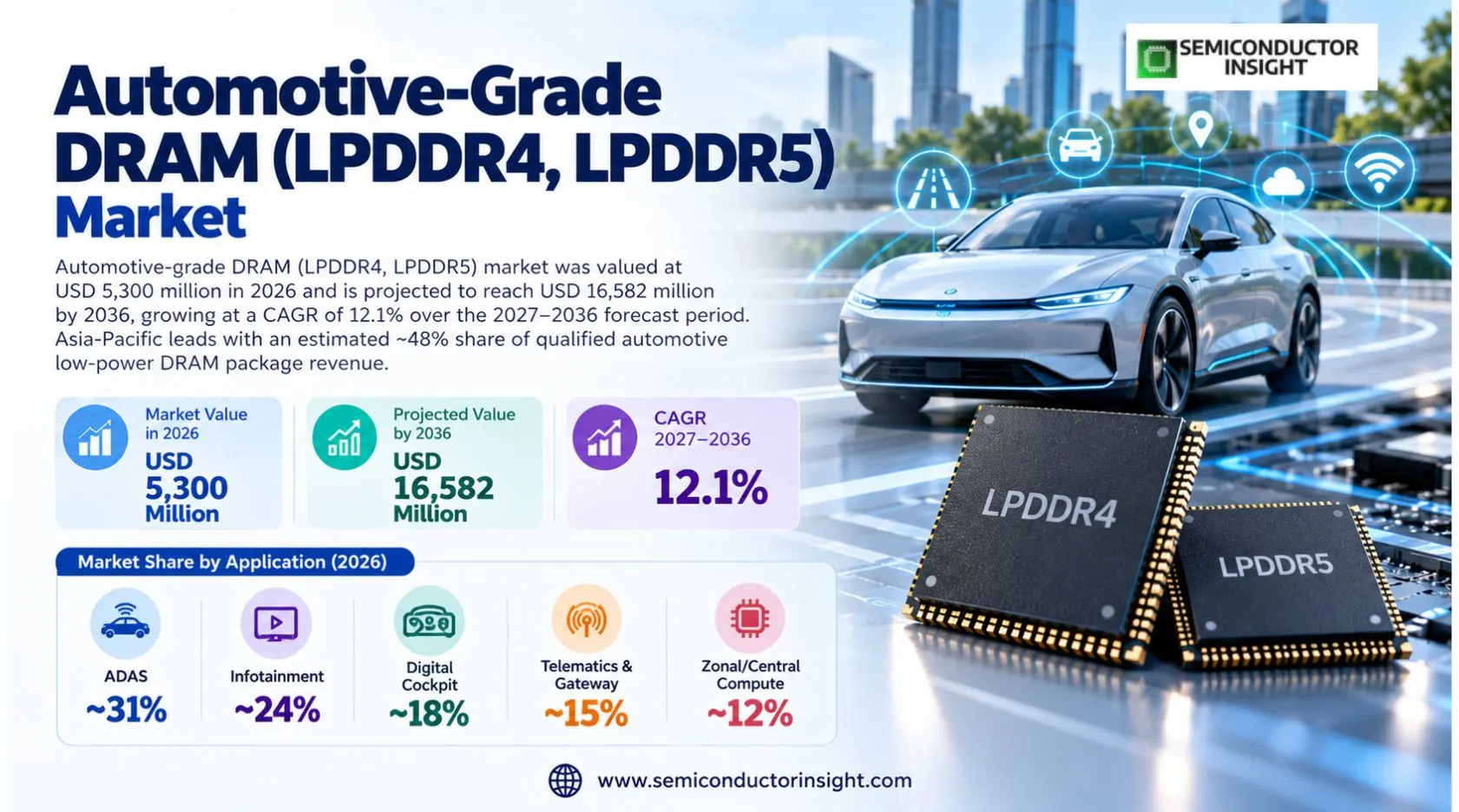
Automotive-grade DRAM (LPDDR4, LPDDR5) market was valued at USD 5,300 million in 2026 and is projected to reach USD 16,582 million by 2036, growing at a CAGR of 12.1% over the 2027–2036 forecast period. Asia-Pacific leads with an estimated ~48% share of qualified automotive low-power DRAM package revenue.
Automotive-grade low-power double data rate memory is volatile working memory attached to processors inside vehicles. It stores camera frames, maps, user-interface data, sensor-fusion buffers and executable workloads while a vehicle is operating. LPDDR4 and LPDDR4X remain established in infotainment and instrument clusters, whereas LPDDR5 and LPDDR5X offer higher bandwidth and power efficiency for advanced driver assistance and centralized compute. The memory package is sold as a semiconductor component, not as a complete electronic control unit.
The revenue boundary includes factory-gate automotive-qualified LPDDR4, LPDDR4X, LPDDR5 and LPDDR5X DRAM packages for passenger and commercial vehicle electronics. It excludes general-purpose mobile DRAM, NAND and NOR flash, graphics memory, processors, electronic control units, finished vehicles and memory sold for data centers. The distinction is important because supplier financial disclosures rarely isolate automotive LPDDR revenue, and broad semiconductor revenue cannot be substituted for this product-specific market.
Samsung began mass production of a 16Gb automotive LPDDR4X device in April 2018, describing operation to 125°C and a data rate of 4,266 megabits per second. In August 2024 the company reported Qualcomm Snapdragon Digital Chassis qualification for automotive LPDDR4X and described its development of automotive LPDDR5. These events demonstrate why established generations remain commercially relevant even as newer standards reach higher peak transfer rates.
Micron has described automotive LPDDR5X with a direct-link error-correction protocol that reduces system-level bandwidth penalties, while SK hynix reported an ISO 26262 ASIL-D assessment for its LPDDR5X automotive DRAM in January 2026. These advances respond to the need for predictable memory behavior in safety-related vehicle computing. A supplier certification is not a universal guarantee that every part number, board design or end application satisfies the same integrity requirements.
IEA Global EV Outlook 2026 reports more than 20 million electric cars sold in 2025 and nearly 22 million produced globally, with China accounting for close to three-quarters of production. These volumes are relevant to vehicle electronics demand but cannot be converted directly into DRAM revenue because memory capacity and price differ widely across trims, safety functions and platforms. The regional and segment percentages presented here are explicitly modeled estimates, not audited supplier disclosures.
Segment Analysis: By Type
By type, automotive-grade low-power DRAM is segmented into LPDDR4, LPDDR4X, LPDDR5 and LPDDR5X. LPDDR4X is the modeled leader at ~32% of 2026 revenue, while LPDDR5X expands fastest at about ~17.0% CAGR. Generations coexist because vehicle programs require part-specific reliability, long-term availability and system-level requalification before a memory interface can change.
| Type | Technical role and deployment | Market position and commercial implications |
|---|---|---|
| LPDDR4 | A mature low-power DRAM generation used in established infotainment, telematics and entry-level cockpit controllers, where proven controller support and long availability can outweigh peak throughput. Vehicle programs evaluate the memory interface alongside the processor controller, package temperature limits and expected supply duration; LPDDR4 therefore remains a distinct procurement choice. | Legacy vehicle programs retain approved memory designs to avoid new safety validation, but power efficiency and bandwidth requirements limit adoption in newly designed high-compute ADAS platforms. The revenue allocation includes finished automotive-qualified LPDDR4 DRAM packages only, excluding processor and module integration value. |
| LPDDR4X | An improved LPDDR4 interface with reduced I/O voltage, proven automotive temperature variants and a broad installed base in vehicle infotainment and digital cockpit platforms. Vehicle programs evaluate the memory interface alongside the processor controller, package temperature limits and expected supply duration; LPDDR4X therefore remains a distinct procurement choice. | Samsung documented automotive mass production in 2018 and Snapdragon Digital Chassis qualification in 2024, supporting an estimated leading revenue share while LPDDR5X grows from a smaller base. The revenue allocation includes finished automotive-qualified LPDDR4X DRAM packages only, excluding processor and module integration value. |
| LPDDR5 | Higher-speed low-power DRAM used for image processing, high-resolution displays and sensor fusion, with additional design requirements for reliability and functional safety. Vehicle programs evaluate the memory interface alongside the processor controller, package temperature limits and expected supply duration; LPDDR5 therefore remains a distinct procurement choice. | Micron described ASIL-D-oriented automotive LPDDR5 product certification, illustrating the importance of device diagnostics, documented safety processes and controlled supplier qualification. The revenue allocation includes finished automotive-qualified LPDDR5 DRAM packages only, excluding processor and module integration value. |
| LPDDR5X | An enhanced LPDDR5 interface for bandwidth-intensive centralized compute, driver assistance and multi-display applications with evolving ECC and system integrity requirements. Vehicle programs evaluate the memory interface alongside the processor controller, package temperature limits and expected supply duration; LPDDR5X therefore remains a distinct procurement choice. | SK hynix reported automotive LPDDR5X ASIL-D certification in January 2026 and Micron disclosed DLEP-enhanced LPDDR5X, indicating technical momentum despite long automotive adoption cycles. The revenue allocation includes finished automotive-qualified LPDDR5X DRAM packages only, excluding processor and module integration value. |
LPDDR4 automotive memory
In LPDDR4 automotive applications, a mature low-power DRAM generation used in established infotainment, telematics and entry-level cockpit controllers, where proven controller support and long availability can outweigh peak throughput. For LPDDR4, purchasing teams also review error detection, thermal behavior, board routing and the qualification status of exact ordering codes before approving a vehicle platform. LPDDR4 memory must also remain compatible with software updates and environmental test requirements throughout production.
For the LPDDR4 product family, legacy vehicle programs retain approved memory designs to avoid new safety validation, but power efficiency and bandwidth requirements limit adoption in newly designed high-compute ADAS platforms. Across a ten-year planning horizon, LPDDR4 demand depends on redesign cycles and the availability of compatible automotive processors rather than on consumer handset launches alone.
LPDDR4X automotive memory
In LPDDR4X automotive applications, an improved LPDDR4 interface with reduced I/O voltage, proven automotive temperature variants and a broad installed base in vehicle infotainment and digital cockpit platforms. For LPDDR4X, purchasing teams also review error detection, thermal behavior, board routing and the qualification status of exact ordering codes before approving a vehicle platform. LPDDR4X memory must also remain compatible with software updates and environmental test requirements throughout production.
For the LPDDR4X product family, samsung documented automotive mass production in 2018 and Snapdragon Digital Chassis qualification in 2024, supporting an estimated leading revenue share while LPDDR5X grows from a smaller base. Across a ten-year planning horizon, LPDDR4X demand depends on redesign cycles and the availability of compatible automotive processors rather than on consumer handset launches alone.
LPDDR5 automotive memory
In LPDDR5 automotive applications, higher-speed low-power DRAM used for image processing, high-resolution displays and sensor fusion, with additional design requirements for reliability and functional safety. For LPDDR5, purchasing teams also review error detection, thermal behavior, board routing and the qualification status of exact ordering codes before approving a vehicle platform. LPDDR5 memory must also remain compatible with software updates and environmental test requirements throughout production.
For the LPDDR5 product family, micron described ASIL-D-oriented automotive LPDDR5 product certification, illustrating the importance of device diagnostics, documented safety processes and controlled supplier qualification. Across a ten-year planning horizon, LPDDR5 demand depends on redesign cycles and the availability of compatible automotive processors rather than on consumer handset launches alone.
LPDDR5X automotive memory
In LPDDR5X automotive applications, an enhanced LPDDR5 interface for bandwidth-intensive centralized compute, driver assistance and multi-display applications with evolving ECC and system integrity requirements. For LPDDR5X, purchasing teams also review error detection, thermal behavior, board routing and the qualification status of exact ordering codes before approving a vehicle platform. LPDDR5X memory must also remain compatible with software updates and environmental test requirements throughout production.
For the LPDDR5X product family, sK hynix reported automotive LPDDR5X ASIL-D certification in January 2026 and Micron disclosed DLEP-enhanced LPDDR5X, indicating technical momentum despite long automotive adoption cycles. Across a ten-year planning horizon, LPDDR5X demand depends on redesign cycles and the availability of compatible automotive processors rather than on consumer handset launches alone.
Segment Analysis: By Application
By application, the market covers ADAS, Infotainment, Digital Cockpit, Telematics & Gateway, and Zonal/Central Compute. ADAS leads with an estimated ~31% of 2026 automotive LPDDR package revenue; zonal and central computing expands fastest as software-defined vehicle architectures consolidate controllers and increase shared-memory bandwidth requirements. Each allocation is an estimate for qualified DRAM component revenue rather than the value of the entire electronic controller.
| Application | Demand characteristics |
|---|---|
| ADAS | Advanced driver assistance uses memory to buffer camera images, radar processing data and inference workloads while maintaining predictable response under temperature and vibration stress. The segment has the highest modeled revenue share because high-resolution sensors and safety-oriented processors demand larger qualified memory capacities. The estimated ~31% share applies only to qualified DRAM package value in this function, not to the complete electronics system; product selection remains vehicle-model specific. |
| Infotainment | In-vehicle infotainment uses low-power memory for application execution, navigation, streaming interfaces and connectivity services across a growing number of displays. Mature LPDDR4X continues to support cost-sensitive systems, while premium designs adopt LPDDR5 as display resolution and multitasking increase. The estimated ~25% share applies only to qualified DRAM package value in this function, not to the complete electronics system; product selection remains vehicle-model specific. |
| Digital Cockpit | Digital cockpit electronics coordinate instrument clusters, heads-up displays and cabin user interfaces, frequently combining multiple software domains on one computing platform. Long qualification cycles and mixed-criticality functions encourage a combination of proven LPDDR4X and higher-bandwidth LPDDR5 family devices. The estimated ~21% share applies only to qualified DRAM package value in this function, not to the complete electronics system; product selection remains vehicle-model specific. |
| Telematics & Gateway | Telematics and gateway processors manage vehicle networking, over-the-air updates and communication between electronic domains, usually with lower memory bandwidth than advanced ADAS. A large installed base supports qualified mature memory while cybersecurity features and software updates can increase the minimum working-memory footprint. The estimated ~10% share applies only to qualified DRAM package value in this function, not to the complete electronics system; product selection remains vehicle-model specific. |
| Zonal/Central Compute | Zonal and central computing platforms consolidate formerly separate electronic controllers and create demanding memory interfaces for shared services and real-time workloads. The modeled fastest application growth reflects increasing use of centralized vehicle architectures rather than confirmed supplier-specific LPDDR sales. The estimated ~13% share applies only to qualified DRAM package value in this function, not to the complete electronics system; product selection remains vehicle-model specific. |
The distinction between application categories follows the primary computing function of the memory socket rather than the marketing label on a vehicle. A central computer can run both cockpit and driver-assistance software, but its DRAM revenue should be allocated once to the predominant design purpose. The modeled mix therefore avoids adding overlapping processor platform values or counting a single memory package in two application rows.
Qualcomm and BMW described a production-oriented automated-driving system in September 2025, and Qualcomm highlighted further integrated cockpit and ADAS programs in January and May 2026. These platform announcements establish a credible direction toward more memory-intensive vehicle electronics. They do not identify a specific automotive LPDDR manufacturer for every design or independently validate the estimated application shares shown in the table.
Regional Analysis
Asia-Pacific leads the modeled automotive LPDDR market with an estimated ~48% of 2026 revenue, followed by North America and Europe at ~22% each, South America at ~5%, and Middle East & Africa at ~3%. Growth depends on vehicle electronics complexity, local assembly, supplier qualification and the mix of established LPDDR4X versus newer LPDDR5X programs.
How do regional automotive LPDDR markets differ in 2026 and through 2036?
The geographical model assigns component revenue to the regional vehicle electronics demand associated with a qualified memory package, not simply the location of the semiconductor fabrication plant. This matters because South Korean and American suppliers can serve automakers headquartered in Europe or assembly operations in Mexico, while the package itself may have crossed several borders. The modeled region shares sum to 100% without claiming audited country-by-country supplier invoices.
Asia-Pacific benefits from automotive electronics assembly scale and established memory manufacturing expertise. North America is influential in vehicle compute processor platforms and software-defined architecture, while Europe emphasizes safety-oriented engineering and premium cockpit systems. South America and Middle East & Africa have smaller modeled shares because much demand arrives through imported vehicles and preassembled electronics rather than independent DRAM procurement.
| Region | Position | Growth outlook | Demand profile | What decides supplier selection |
|---|---|---|---|---|
| Asia-Pacific | Estimated ~48% share | ~13.1% CAGR | Asia-Pacific vehicle electronics and qualified memory demand | Automotive temperature grade, approved part number, platform processor compatibility and multi-year component availability |
| North America | Estimated ~22% share | ~11.5% CAGR | North America vehicle electronics and qualified memory demand | Automotive temperature grade, approved part number, platform processor compatibility and multi-year component availability |
| Europe | Estimated ~22% share | ~10.5% CAGR | Europe vehicle electronics and qualified memory demand | Automotive temperature grade, approved part number, platform processor compatibility and multi-year component availability |
| South America | Estimated ~5% share | ~11.7% CAGR | South America vehicle electronics and qualified memory demand | Automotive temperature grade, approved part number, platform processor compatibility and multi-year component availability |
| Middle East & Africa | Estimated ~3% share | ~10.8% CAGR | Middle East & Africa vehicle electronics and qualified memory demand | Automotive temperature grade, approved part number, platform processor compatibility and multi-year component availability |
Key Automotive-Grade LPDDR Manufacturers and Competitive Landscape
Automotive LPDDR competition combines memory fabrication capability with extended product availability, package-level reliability and vehicle system qualification. Samsung, SK hynix and Micron have public automotive LPDDR technical and qualification records, while other profiled memory suppliers participate across conventional DRAM, embedded memory and regional supply networks with varying automotive LPDDR product evidence.
Samsung provides direct evidence of commercial automotive LPDDR4X manufacturing and Qualcomm platform qualification. Its 2018 automotive device was described as operating at up to 125°C, and the 2024 qualification announcement linked the memory to premium infotainment and advanced driver assistance applications. These records demonstrate automotive product readiness but do not establish Samsung’s exact share of this narrowly defined market.
SK hynix reported an automotive LPDDR5X ASIL-D assessment in January 2026 and showed automotive LPDDR5/5X alongside LPDDR6 at MWC in March. Micron has described both ASIL-D-certified LPDDR5 and a DLEP-enhanced LPDDR5X design with improved system-level bandwidth efficiency. Competition therefore increasingly includes functional safety documentation, error detection, platform validation and predictable thermal behavior, not simply nominal gigabits per second.
Nanya Technology, Winbond, ISSI and CXMT appear in the broader automotive or DRAM supplier landscape, but their participation must be assessed against the exact LPDDR generation and automotive ordering code. A company selling conventional DDR, specialty DRAM or memory modules cannot automatically be classified as a qualified merchant supplier of LPDDR5X for safety-related vehicle controllers. This distinction matters when interpreting competitive tiers and long-term revenue opportunities.
Automotive memory sourcing is often locked to a specific vehicle electronics design for several years, and changing supplier can require hardware redesign, thermal testing and new functional safety assessment. Premium automotive programs may pay for supply continuity and diagnostic features, while entry-level infotainment procurement is more sensitive to unit cost. No public company disclosure in the inspected evidence independently audits the market-share allocations used here.
Tier structure
| Tier | Companies | Basis of competition |
|---|---|---|
| Tier 1 | Samsung Electronics; SK hynix; Micron Technology | Direct automotive LPDDR4X or LPDDR5/5X technical and qualification evidence, large DRAM production scale, and platform-level engineering support for safety-relevant vehicle programs. |
| Tier 2 | Nanya Technology; Winbond; ISSI | Memory suppliers with automotive or specialty DRAM participation whose exact LPDDR4X/LPDDR5X design wins and package qualification require part-level confirmation before assignment to a leading automotive LPDDR tier. |
| Emerging and adjacent | CXMT; automotive module integrators | Potential regional sourcing and module ecosystem participants; product-specific automotive LPDDR qualification and audited sales are not established by the reviewed public documents. |
Key companies profiled
- Samsung Electronics
- SK hynix
- Micron Technology
- Nanya Technology
- Winbond Electronics
- Integrated Silicon Solution, Inc. (ISSI)
- ChangXin Memory Technologies (CXMT)
Automotive LPDDR Production Capacity and Qualification Analysis
Production capability for automotive LPDDR is concentrated among global DRAM manufacturers, but automotive capacity cannot be inferred directly from total mobile memory wafer starts. Vehicle products require part-specific temperature screening, qualification documentation, long lifecycle support and platform validation. Package assembly and test may take place in different countries from wafer fabrication or final vehicle assembly.
Automotive LPDDR4X is a mature product family with documented commercial production dating to Samsung’s 2018 announcement. A qualified component may remain available over several vehicle model cycles, especially in infotainment and gateway applications that do not require the highest bandwidth. As a result, wafer technology migration can occur while automotive product programs retain approved ordering codes, producing a different mix from the rapidly changing smartphone DRAM market.
LPDDR5 and LPDDR5X require faster interfaces and increasingly sophisticated safety mechanisms, making test coverage and controller interoperability important capacity constraints. Micron describes its DLEP-enhanced automotive LPDDR5X as improving effective bandwidth by 15% to 25% against typical inline ECC arrangements, while SK hynix reports automotive LPDDR5X safety process assessment. These are technical specifications and qualification records, not public figures for automotive-only production capacity.
Production planning also has to account for successor technologies. SK hynix demonstrated automotive LPDDR6 at MWC 2026, creating a longer-term path beyond LPDDR5X for high-end compute, while existing LPDDR4X design wins may persist in cost-sensitive controllers. The relative availability of each generation is shaped by foundry process migration, packaging test resources, OEM forecasts and semiconductor inventory cycles rather than by a single uniform capacity utilization rate.
Automotive-Grade LPDDR Market Dynamics: Drivers, Restraints and Opportunities
Automotive low-power DRAM demand rises as vehicle computers process more sensor data, support richer displays and consolidate software functions. Qualification and lifecycle requirements can support value per package, while platform redesign costs, supply concentration, thermal requirements and migration to LPDDR6 restrain growth. The impact rankings below are analytical estimates linked to the 2027–2036 outlook.
MARKET DRIVERS
Drivers Impact Analysis*
| Market Drivers | Impact Rank | CAGR Contribution (%) | 2027–2029 | 2030–2032 | 2033–2036 |
|---|---|---|---|---|---|
| ADAS camera and sensor-fusion memory growth | High | +5.00% | High | High | Medium |
| Software-defined vehicle central computing | High | +4.10% | Medium | High | High |
| LPDDR5 and LPDDR5X qualification migration | Medium-High | +3.20% | High | High | Medium |
| Multi-display cockpit and infotainment expansion | Medium | +2.50% | High | Medium | Medium |
| Electric vehicle and commercial platform electrification | Low-Medium | +1.90% | Medium | High | High |
| Others (telematics, gateways and connected fleet functions) | Low | +1.20% | Medium | Medium | Low |
Sensor-fusion computing increases working-memory needs
Advanced driver assistance systems process camera, radar and other sensor data under tight latency and reliability requirements. The 2025 Qualcomm and BMW automated-driving collaboration demonstrates growing platform sophistication, while Micron describes enhanced ECC mechanisms for automotive LPDDR5X. The modeled ~31% ADAS application share reflects the high memory-content intensity of these systems, although actual package capacity depends on each controller and vehicle trim.
Centralized architectures increase bandwidth per computing domain
Vehicle manufacturers are combining functions that once ran on separate controllers into more centralized software-defined architectures. Qualcomm announced a broader Stellantis relationship in May 2026 and additional automotive platform design wins in January, indicating a market direction toward consolidated cockpit and assistance workloads. Such processors can need larger qualified memory pools and higher interface throughput, but design wins do not disclose supplier-specific DRAM shipment revenue.
Automotive LPDDR5X qualification supports generation migration
Samsung documented automotive LPDDR4X qualification in 2024, while SK hynix reported LPDDR5X ASIL-D assessment in January 2026 and Micron described automotive LPDDR5X direct-link ECC. These disclosures support a gradual transition from established LPDDR4X to higher-bandwidth memory in safety-oriented programs. Vehicle qualification can slow adoption relative to consumer devices, so the model retains meaningful revenue for both generations over the forecast horizon.
Connected cockpits and electrified vehicles broaden deployment
The IEA reported more than 20 million electric cars sold worldwide in 2025 and continued growth in connected and software-defined vehicle functions. Additional displays, digital instruments, voice interfaces and over-the-air updates increase the workload carried by vehicle processors. The resulting DRAM demand depends on the number of qualified memory sockets and package density per design, not simply on the headline number of electric vehicles sold.
MARKET RESTRAINTS
Restraints Impact Analysis*
| Market Restraints | Impact Rank | CAGR Contribution (%) | 2027–2029 | 2030–2032 | 2033–2036 |
|---|---|---|---|---|---|
| Automotive qualification and redesign costs | High | -2.20% | High | High | Medium |
| Supply concentration and component price cycles | Medium-High | -1.60% | High | Medium | Medium |
| LPDDR6 displacement and platform substitution | Medium | -1.20% | Low | Medium | High |
| Others (regional EV volatility and thermal testing burden) | Low | -0.80% | Medium | Medium | Low |
Qualification costs slow switching between memory generations
A memory supplier change can trigger thermal retesting, interface verification, documentation updates and functional safety reassessment across a vehicle electronics program. Samsung’s 2018 Grade 1 automotive LPDDR4X specifications and later Qualcomm qualification illustrate the work required for long-lived product support. These requirements help maintain approved mature parts but can delay deployment of a technically superior LPDDR5X replacement when the existing controller already meets vehicle performance needs.
Supply concentration raises resilience and price-cycle exposure
Automotive LPDDR supply depends on a small group of global DRAM producers whose fabs and packaging networks also serve other memory markets. Changes in consumer and AI memory demand can affect investment priorities and pricing even when automotive volumes are comparatively stable. The 2026 modeled regional split reflects demand geography, not a guarantee of geographically diversified wafer supply or a measured manufacturer concentration ratio.
Successor interfaces can erode the long-run LPDDR5X scope
SK hynix displayed automotive LPDDR6 at MWC 2026 and separately described its new-generation interface development, indicating a future technology route beyond LPDDR5X. In the most demanding central compute programs, qualification of LPDDR6 may gradually displace LPDDR5X sockets after controller redesign. This is a restraint for a market defined only around LPDDR4 through LPDDR5X, even if overall automotive low-power DRAM demand continues growing.
Regional demand and thermal requirements constrain adoption
IEA Global EV Outlook 2026 shows regional divergence, including changing United States incentives and strong electric vehicle growth in several emerging markets. Automotive DRAM also requires qualification across temperature and lifecycle conditions that differ from consumer devices. These factors can reduce short-term procurement predictability and make platform-by-platform forecasts more reliable than a single vehicle-unit multiplier applied to every geography.
MARKET OPPORTUNITIES
Safety-certified LPDDR5X for centralized ADAS
Micron and SK hynix have disclosed automotive LPDDR5X approaches addressing fault detection and ISO 26262 requirements. Suppliers that combine higher bandwidth with part-specific safety artifacts can compete for demanding ADAS processors where controller architects seek lower latency and dependable error handling. The opportunity depends on verified platform qualification, not merely on publishing a high nominal transfer rate.
Long-life LPDDR4X for cost-sensitive vehicle programs
Samsung’s automotive LPDDR4X production and Qualcomm qualification records show that established interfaces retain relevance in infotainment and cockpit systems. Manufacturers able to guarantee compatible packages, temperature grades and long-term supply can defend mature automotive sockets while consumer electronics migrate to newer memory. This opportunity is strongest where vehicle redesign costs exceed the value of incremental memory bandwidth.
Higher-density packages for multi-display cockpits
The increasing number of in-vehicle displays, camera streams and local AI features creates opportunities for 8GB, 16GB and larger qualified LPDDR packages. Micron’s ECC work highlights that usable system bandwidth and memory efficiency matter alongside nominal density. Suppliers can differentiate through tested package combinations and controller reference designs, although density adoption remains sensitive to vehicle price tier and software architecture.
Regional vehicle platform localization
IEA production data show growing electric vehicle assembly in Asia-Pacific and a rebound in European output during 2025. Automotive memory suppliers can serve localized vehicle platforms through regional engineering, distribution and approved Tier-1 relationships while keeping wafer production in existing semiconductor clusters. Commercial success depends on automotive component traceability and support throughout each vehicle program’s lifecycle.
Automotive LPDDR Supply Chain Analysis
The automotive LPDDR value chain spans DRAM design and wafer fabrication, advanced packaging and testing, automotive qualification, Tier-1 electronics integration and final vehicle assembly. Procurement often flows through an automotive processor or electronics platform rather than a direct contract between a carmaker and the memory wafer supplier, so each commercial stage has a different revenue boundary.
Upstream. Memory wafer production requires advanced lithography, deposition, etching and process control, with a concentrated group of manufacturers supporting multiple end markets. Automotive packages use the same broad semiconductor infrastructure as consumer DRAM but face different qualification and lifecycle expectations. Supply risk can therefore arise from capacity allocation decisions in other memory segments even when vehicle electronics demand remains stable.
Manufacturing. Finished automotive LPDDR packages require device characterization, thermal testing and reliable traceability before approval for a vehicle platform. Samsung described Grade 1 LPDDR4X operating to 125°C, while Micron and SK hynix describe safety-oriented LPDDR5 family processes. The manufacturing revenue object used in this study ends at the qualified DRAM package, excluding the value of the processor, printed circuit board and completed vehicle controller.
Distribution. Automotive Tier-1 electronics suppliers and system-on-chip vendors influence which memory parts are qualified for specific designs. Samsung’s 2024 Qualcomm Digital Chassis qualification demonstrates this platform-level approval process, while other suppliers work through distributors and direct long-term agreements. A design win may persist for years, but changes in vehicle launch schedules can shift delivery timing without changing the approved memory architecture.
Downstream. ADAS, digital cockpit, infotainment and telematics controllers consume LPDDR as working memory and often require predictable standby power and environmental performance. IEA electric car data and Qualcomm automotive platform announcements establish broad demand context but do not disclose LPDDR package revenue by vehicle. Consequently, market modeling separates component sales from vehicle production totals and avoids double counting electronics module value.
Recent Developments in the Automotive-Grade LPDDR Market
- 29 July 2026 Announced
Qualcomm disclosed an expanded long-term BMW compute relationship spanning digital cockpit and automated-driving silicon for next-decade vehicle programs. The announcement points to sustained requirements for qualified working memory around central vehicle processors, but does not name a DRAM supplier or establish a component shipment total. It is therefore relevant to the demand architecture rather than to a confirmed LPDDR revenue allocation. Source - 21 May 2026 Announced
Stellantis and Qualcomm expanded their collaboration to deploy Snapdragon Digital Chassis compute across cockpit, connectivity and driver assistance programs. The platform integration is relevant to LPDDR memory because shared processing workloads require predictable data access and thermal behavior. The release did not disclose automotive LPDDR4X or LPDDR5X part numbers, so any memory revenue attribution remains a separate modeling decision. Source - 10 March 2026 Developed
SK hynix reported development of a 16Gb LPDDR6 product based on its sixth-generation 10nm-class process, with a planned supply ramp later in 2026. Although LPDDR6 lies outside the LPDDR4/LPDDR5 revenue boundary, it is a credible future substitute in bandwidth-intensive automotive computing. The development may change the long-run mix of high-end memory sockets rather than immediately displacing approved vehicle LPDDR5X designs. Source - 5 March 2026 Showcased
At MWC 2026 SK hynix displayed automotive LPDDR6 and Auto/Robotics LPDDR5/5X memory, describing its response to autonomous driving and connected-car requirements. The automotive-specific display supports a technology transition narrative and highlights supplier investment in vehicle memory. Exhibition products should not be treated as audited 2026 shipment shares or evidence that every displayed memory generation is installed in production vehicles. Source - 19 January 2026 Certified
SK hynix announced ISO 26262 ASIL-D assessment for its automotive LPDDR5X DRAM, covering development, verification and quality processes as well as product safety architecture. The certification matters because ADAS and autonomous-driving controllers demand fault detection and predictable system behavior. It applies to the evaluated product and process scope, not automatically to all memory packages sold under the supplier’s brand. Source - 5 January 2026 Reported
Qualcomm outlined further Snapdragon Ride and Cockpit platform adoption and stated that its cockpit processors powered more than 75 million vehicles as of June 2025. The installed-base statistic indicates the commercial scale of vehicle compute architectures that require working memory. It does not measure annual LPDDR chip sales, nor does it identify the automotive memory manufacturer in each vehicle program. Source - 5 September 2025 Launched
Qualcomm and BMW introduced Snapdragon Ride Pilot for the new BMW iX3, combining an automated-driving software stack with vehicle compute silicon. The program demonstrates how camera processing and assistance functions increase pressure on memory bandwidth, latency and safety qualification. The announcement provides system-level evidence, not an audited DRAM bill of materials or a disclosed automotive LPDDR supplier allocation. Source - 27 August 2024 Qualified
Samsung announced that its automotive LPDDR4X memory passed qualification with Qualcomm Snapdragon Digital Chassis for infotainment and ADAS applications. The same announcement described plans for automotive LPDDR5 samples, illustrating a transition in which mature and next-generation interfaces coexist. The qualification is a concrete product milestone but should not be converted into a market share without shipment and pricing evidence. Source
REPORT SCOPE & SEGMENTATION
| Attribute | Details |
|---|---|
| Study Period | 2021–2036 |
| Base Year | 2026 |
| Estimated Year | 2027 |
| Forecast Period | 2027–2036 |
| Historical Period | 2021–2025 |
| Market Size 2026 | USD 5,300 million |
| Market Size 2027 | USD 5,940 million |
| Market Size 2036 | USD 16,582 million |
| Growth Rate | CAGR of 12.1% from 2027–2036 |
| Unit | Revenue (USD million), finished automotive-qualified DRAM packages |
| Segmentation | By Type, By Application, By Vehicle Class & Powertrain, By Memory Density, By Automotive Temperature Grade, and By Region |
| By Type | LPDDR4 · LPDDR4X · LPDDR5 · LPDDR5X |
| By Application | ADAS · Infotainment · Digital Cockpit · Telematics & Gateway · Zonal/Central Compute |
| By Vehicle Class and Powertrain | Passenger ICE and Hybrid · Passenger Electric · Commercial ICE and Hybrid · Commercial Electric |
| By Memory Density | Up to 4GB · 4GB–8GB · 8GB–16GB · Above 16GB |
| By Automotive Temperature Grade | Grade 1 (−40°C to +125°C) · Grade 2 (−40°C to +105°C) · Grade 0 (−40°C to +150°C) |
| By Region | Regional shares and growth rates are modeled 2026 estimates; countries represent end-use vehicle electronics demand, not necessarily DRAM wafer origin. North AmericaUnited States, Canada, Mexico EuropeGermany, France, Italy, United Kingdom, Nordics, Rest of Europe Asia-PacificChina, South Korea, Japan, India, Southeast Asia, Rest of Asia-Pacific South AmericaBrazil, Argentina, Chile, Colombia, Rest of South America Middle East & AfricaUnited Arab Emirates, Saudi Arabia, South Africa, Rest of Middle East & Africa |
| Key Companies Profiled | Samsung Electronics; SK hynix; Micron Technology; Nanya Technology; Winbond Electronics; Integrated Silicon Solution (ISSI); ChangXin Memory Technologies (CXMT) |
| Customization Scope | Additional country, platform, memory density, qualification grade and supplier design-win detail can be tailored to specific vehicle electronics applications, subject to supporting primary evidence. |
Frequently Asked Questions
How large is the automotive-grade LPDDR market?
The market is valued at USD 5,300 million in 2026 and projected to reach USD 16,582 million by 2036, with 12.1% annualized growth across the 2027–2036 window. The revenue boundary covers finished automotive-qualified LPDDR4, LPDDR4X, LPDDR5 and LPDDR5X packages. Processor, vehicle, flash-memory and electronic-control-unit revenue is excluded, so this measure should not be compared directly with complete automotive semiconductor or vehicle electronics totals.
Which companies supply automotive LPDDR memory?
Samsung Electronics, SK hynix and Micron have public automotive LPDDR product or qualification records. Other profiled memory vendors include Nanya, Winbond, ISSI and CXMT, but their exact participation in specific automotive LPDDR generations should be checked against ordering codes and qualification disclosures. Broad DRAM or automotive memory activity does not establish that every vendor ships qualified LPDDR5X to safety-critical vehicle controllers.
What is the difference between LPDDR4X and LPDDR5X in vehicles?
LPDDR4X is a mature low-power interface with established automotive qualification and broad controller support, while LPDDR5X targets higher bandwidth and efficiency for demanding ADAS and centralized compute systems. Samsung documented LPDDR4X qualification with Qualcomm in 2024, and Micron and SK hynix describe LPDDR5X safety features. Real-world selection also depends on package temperature rating, fault handling, processor compatibility and expected vehicle production lifetime.
Which automotive LPDDR type has the largest estimated share?
LPDDR4X leads the modeled 2026 Type axis at ~32% of automotive-qualified LPDDR package revenue, followed by LPDDR5 at ~29%, LPDDR5X at ~22% and LPDDR4 at ~17%. These are analyst allocations informed by product maturity, qualification records and vehicle computing trends, not audited manufacturer revenue shares. The faster growth of LPDDR5X does not mean every new vehicle program immediately changes its approved memory generation.
Which application uses the most automotive LPDDR revenue?
ADAS is the largest modeled application at ~31% of 2026 revenue because safety-related sensor processing often requires high memory bandwidth and qualified package density. Infotainment contributes ~25%, digital cockpit ~21%, zonal and central compute ~13%, and telematics and gateways ~10%. The allocation follows the primary memory socket function so that a package used in an integrated processor is not counted twice.
Which region leads automotive LPDDR demand?
Asia-Pacific leads with an estimated ~48% of 2026 component revenue, reflecting the scale of vehicle electronics manufacturing and regional memory supplier capabilities. North America and Europe each contribute an estimated ~22%, while South America and Middle East & Africa have smaller shares. Geographic allocation follows vehicle electronics demand rather than solely wafer fabrication origin; the regional percentages are modeled, not independently audited country shipment data.
Why does automotive LPDDR require different qualification?
Automotive components must operate reliably across specified temperatures and vehicle lifecycles while meeting application-specific quality and safety requirements. Samsung described automotive Grade 1 LPDDR4X operation up to 125°C, and Micron and SK hynix have documented functional-safety-oriented LPDDR5 family processes. Exact qualification depends on the product code and system design, so an ASIL-D-related supplier announcement is not a blanket certification for every DRAM package.
How do electric vehicles affect the automotive LPDDR market?
Electric vehicles often incorporate rich digital cockpit, connectivity and advanced assistance functions, raising the potential number and density of memory packages per vehicle. IEA data show more than 20 million electric car sales in 2025, but those sales cannot be converted into DRAM revenue without platform-specific content and price assumptions. The model treats passenger and commercial vehicles across electric and non-electric powertrains as mutually exclusive classes.
What risks could slow the LPDDR5X transition?
Vehicle memory migration requires controller redesign, thermal testing, software verification and supplier qualification that can take longer than consumer device cycles. Automotive LPDDR production is concentrated among global DRAM suppliers, and memory pricing may be influenced by other end markets. Newer LPDDR6 products may also substitute for LPDDR5X in high-end central computing, while established LPDDR4X continues to serve approved lower-cost vehicle platforms.
What does the report include and exclude?
The study covers qualified LPDDR4, LPDDR4X, LPDDR5 and LPDDR5X DRAM packages used in ADAS, cockpit, infotainment, telematics and centralized vehicle electronics across five world regions. It examines memory density, automotive temperature grade and mutually exclusive vehicle class and powertrain categories. It excludes processors, NAND and NOR flash, complete controllers, vehicles, consumer memory and LPDDR6 revenue, while separately discussing LPDDR6 as a substitution risk.
Research Sources & Evidence Base

Get Sample Report PDF for Exclusive Insights
Report Sample Includes
- Table of Contents
- List of Tables & Figures
- Charts, Research Methodology, and more...
 Download Sample Report PDF