Key Statistics
Key Takeaways
- The 1.00–2.00 mm pitch band holds the largest revenue share in 2025, because it is the range where float tolerance, current-carrying capability and contact reliability balance best for the automotive and industrial control assemblies that consume most of these connectors.
- Sub-1.00 mm pitch is the fastest-growing type, driven by board-stacking in compact ADAS modules, camera assemblies and communications hardware where the connector must deliver more contacts in less linear space without giving up misalignment tolerance.
- Transportation is the largest application and the segment that defines the product. JAE’s connector business drew 55% of sales from automotive in its most recent reported year, with automotive connectors up 7% on ADAS harness demand even as EV growth slowed.
- Asia-Pacific is the largest and fastest-growing region, because floating connectors are consumed where boards are assembled. The region produced 59.2 million motor vehicles in 2025 – 61% of the world’s 96.4 million units – and hosts most of the supplier base.
- Growth is modest for a structural reason. This is a mature mechanical-tolerance component in a connector industry whose growth is currently concentrated elsewhere: Amphenol’s Communications Solutions segment grew 71% organically to USD 12.1 billion in 2025 on AI infrastructure, while TE Connectivity’s Transportation Solutions declined 1% organically.
- Supplier consolidation has reshaped the named competitive set. Several companies still listed as independent floating connector suppliers now sit inside larger groups – ERNI within TE Connectivity and the former Delphi connector operations within Amphenol – which concentrates the category further than a supplier count suggests.
Floating Board-to-Board Connector Market Overview
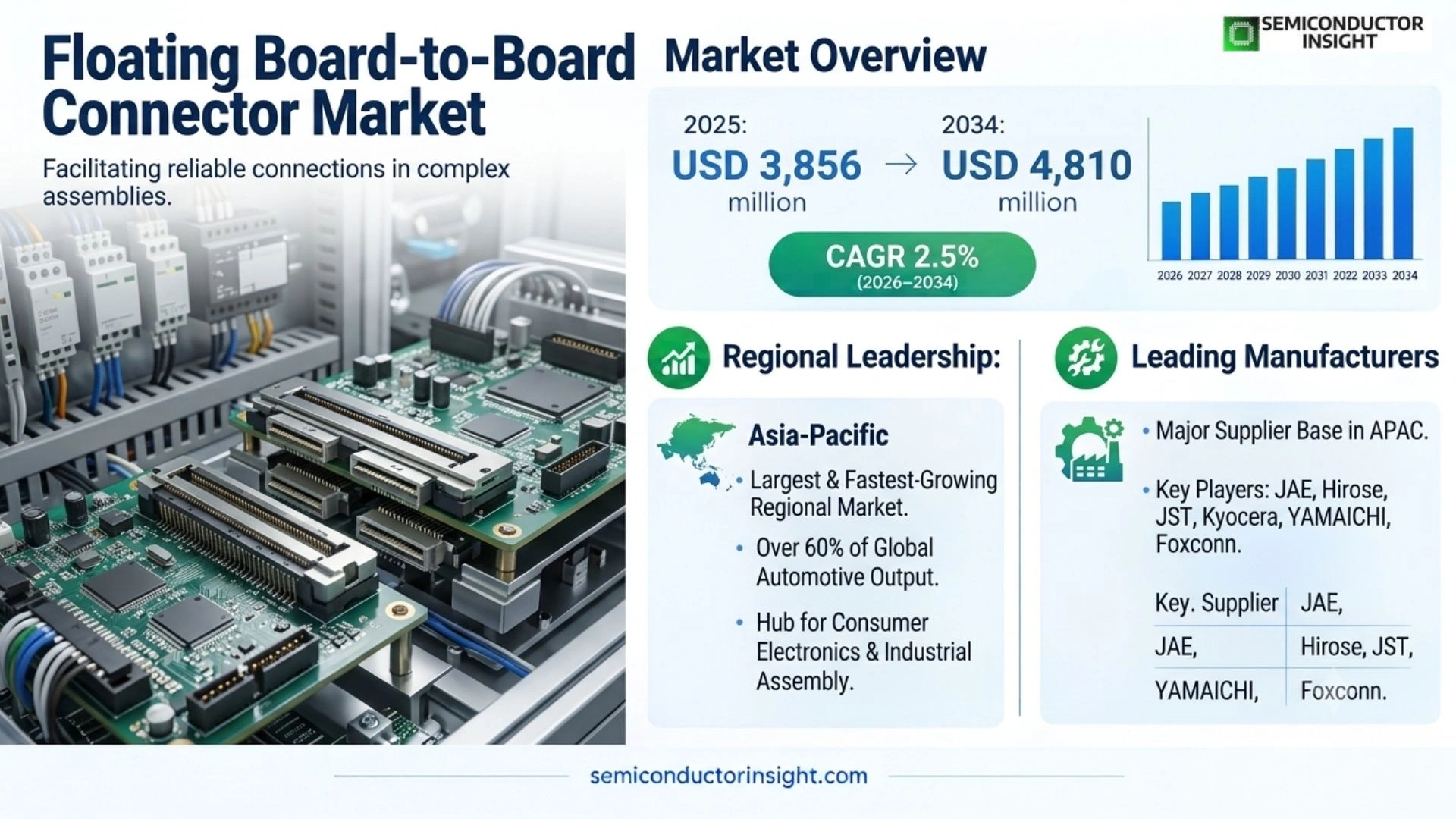
Floating board-to-board Connector Market was valued at USD 3,856 million in 2025 and is projected to reach USD 4,810 million by 2034, expanding at a CAGR of 2.5% across the 2026–2034 forecast period. Asia-Pacific held the largest regional share in 2025 and is also the fastest-growing region, reflecting the concentration of automotive, industrial and consumer electronics board assembly across China, Japan, South Korea and Southeast Asia.
A floating board-to-board connector joins two printed circuit boards while permitting controlled lateral and, in some designs, vertical misalignment between them. The contact assembly is mounted in a housing that moves relative to the solder terminations, typically allowing between ±0.5 mm and ±1.5 mm of float. Mating occurs successfully even when the two boards are not perfectly aligned, and the accumulated stress that misalignment would otherwise apply to the solder joints is absorbed by the connector instead.
That capability answers a specific and unglamorous manufacturing problem. When two boards are each fixed to a chassis at separate mounting points, the tolerances of the boards, the mounting holes, the fasteners and the enclosure accumulate, and the resulting misalignment at the connector can easily exceed what a rigid header will tolerate. A rigid connector in that situation either fails to mate, mates under stress, or transfers that stress into solder joints that crack under thermal cycling and vibration over the product’s life.
Scope covers floating-design board-to-board connector systems – headers, receptacles and mated pairs offering controlled X, Y or Z compliance – across pitch ranges, contact counts and mechanical configurations, together with the high-density, low-profile and ruggedised design variants serving different assembly environments. Rigid board-to-board connectors, mezzanine connectors without float capability, wire-to-board connectors, backplane systems and flexible circuit interconnects sit outside the definition.
Demand is therefore tied to how equipment is built rather than to what the electronics do. A floating connector is specified when a product architecture places two rigidly mounted boards in a mechanically demanding environment, and the count per unit depends on assembly design rather than on processing power or data rate. This is the fundamental reason the category grows at a mechanical-industry pace rather than at a semiconductor one.
The contrast within the connector industry itself makes the point sharply. Amphenol reported 2025 sales of USD 23.1 billion, up 52% in US dollars and 38% organically, with its Communications Solutions segment growing 71% organically to USD 12.1 billion on AI infrastructure demand. Floating board-to-board connectors participate in none of that: high-speed data centre interconnect is a different product family serving a different requirement.
Where the category is anchored instead is automotive and industrial equipment, and those markets grew modestly in 2025. World motor vehicle production reached 96.4 million units, up 3.9% from 92.7 million, while North American robot orders rose 6.6% to 36,766 units worth USD 2.25 billion. Those mid-single-digit unit growth rates, combined with steady price competition, are what a 2.5% value CAGR actually describes.
Segment Analysis: By Type
By contact pitch, the market is segmented into below 1.00 mm, 1.00–2.00 mm and above 2.00 mm connectors. The 1.00–2.00 mm band holds the largest revenue share in 2025 as the workhorse range for automotive and industrial control assemblies, while sub-1.00 mm pitch is the fastest-growing type on the strength of board-stacking in compact ADAS, camera and communications modules.
| Pitch range | Characteristics | Market position |
|---|---|---|
| Below 1.00 mm | Fine-pitch contacts delivering high contact density in minimal linear space, with float typically at the lower end of the available range and reduced current capacity per contact | Fastest-growing type. Demand comes from stacked-board architectures in ADAS controllers, camera and sensor modules, compact communications hardware and consumer devices, where contact count rises while available board edge does not. The engineering difficulty is real: maintaining reliable contact force and float tolerance simultaneously becomes harder as pitch shrinks, which is why this band carries the highest technical differentiation and resists commoditisation better than the coarser ranges. |
| 1.00–2.00 mm | The mainstream range, balancing contact density, current-carrying capability, mechanical robustness and achievable float in a single design | Largest revenue share in 2025. This is the default specification for automotive electronic control units, battery management assemblies, industrial controllers and building systems – applications where the connector must survive years of thermal cycling and vibration rather than merely fit. It also carries the broadest supplier coverage and therefore the most direct price competition, which caps value growth even where unit volumes rise steadily. |
| Above 2.00 mm | Coarse-pitch designs prioritising current-carrying capability, mechanical strength and the widest available float tolerance over contact density | A smaller segment defined by requirement rather than by cost. It serves power distribution within assemblies, heavy-duty industrial equipment, defence hardware and applications where mechanical tolerances are widest and vibration most severe. Average selling prices are the highest in the category, qualification cycles are longest, and design-in positions are correspondingly the most durable, since replacing a qualified connector in a ruggedised assembly requires revalidating the whole mechanical interface. |
Design configuration as a second segmentation axis
Pitch describes the electrical interface; design configuration describes what the connector is built to survive. The same pitch is offered in high-density, low-profile and ruggedised variants that differ in housing construction, retention design, float range and qualification level. Buyers frequently select on this axis first – deciding whether the application needs maximum contacts, minimum stack height or maximum mechanical survivability – and only then narrow to a pitch and contact count.
| Design | Characteristics | Position and application |
|---|---|---|
| High-Density | Maximum contact count per unit of board edge, frequently in dual-row or multi-row arrangements at fine pitch | The fastest-growing design configuration, tracking the sub-1.00 mm pitch trend. Adopted where a compact module must carry many signals between stacked boards – ADAS controllers, sensor fusion modules and communications hardware. The design tension is inherent: adding contacts reduces the space available for the float mechanism, so suppliers compete on how much compliance they preserve at a given density. |
| Low-Profile | Minimised mated stack height between boards, reducing the overall thickness of the assembled module | Specified where enclosure depth is the binding constraint rather than board area – thin consumer devices, space-constrained automotive modules and compact industrial controllers. Reducing stack height also reduces the mechanical leverage available for float, making this the configuration where compliance range is most tightly traded against dimension, and where supplier differentiation is most visible to a mechanical designer. |
| Ruggedised | Reinforced housings, enhanced retention and locking features, extended temperature range and qualification against shock and vibration standards | The design configuration serving transportation, defence and heavy industrial equipment, where the connector must maintain contact integrity through years of vibration and thermal cycling. Qualification requirements – including automotive electrical component standards and defence environmental specifications – create the highest barrier to entry in the category and make these positions the least contested once won. |
Pricing across the category
Delivered prices span roughly an order of magnitude across pitch and design configuration, and the direction of pricing differs sharply between segments. Mainstream 1.00–2.00 mm parts face persistent erosion because supplier coverage is broad and the designs are well understood. Fine-pitch high-density and qualified ruggedised variants have held pricing considerably better, because the engineering required to preserve float at density, or to pass environmental qualification, is not easily replicated by a value-segment entrant.
Segment Analysis: By Application
By application, the market is segmented into transportation, consumer electronics, communications, industries, defence and other end uses, and by end user across automotive, industrial machinery and consumer devices. Transportation is the largest application and the one that defines the product’s requirements, while communications and compact sensing modules drive the fastest growth in fine-pitch variants.
| Application | Demand characteristics |
|---|---|
| Transportation | The largest application. Electronic control units, ADAS controllers, camera and radar modules, battery management systems, infotainment and body electronics. This is the requirement that created the product category: vehicle assemblies combine wide mechanical tolerances, sustained vibration and temperature cycling across a fifteen-year service life, conditions under which a rigid connector transfers stress into solder joints until they crack. JAE’s connector business drew 55% of sales from automotive, with automotive connectors rising 7% on ADAS harness demand even as EV growth slowed – evidence that content per vehicle, not vehicle count, drives this segment. |
| Industries | Factory automation controllers, motor drives, robotics, instrumentation, building systems and power conversion equipment. Demand tracks capital equipment investment: North American robot orders reached 36,766 units worth USD 2.25 billion in 2025, up 6.6% in units and 10.1% in value, with general industries outpacing automotive. Industrial buyers value extended temperature range, long-term availability and mechanical robustness over unit price, and design-in positions frequently persist for a decade or more once a controller platform is qualified. |
| Communications | Base station and network hardware, routers, optical modules and radio units, where multiple boards are stacked within a sealed enclosure. Requirements emphasise contact density and signal integrity alongside float, since the connector must carry high-speed signals while still absorbing mechanical tolerance. Growth is driven by infrastructure build cycles rather than by any steady replacement flow, which makes this the most cyclical of the major applications. |
| Consumer Electronics | Compact devices with stacked internal boards – wearables, portable equipment, connected home hardware and gaming devices. The most price-sensitive and shortest-cycle segment, where low-profile fine-pitch designs dominate and purchasing turns almost entirely on landed cost and supply continuity. Design-in positions are far less durable here than in regulated or industrial applications, since product generations turn over annually. |
| Defence and Others | Defence electronics, aerospace ground equipment, medical devices, energy infrastructure and rail systems. Individually modest but collectively meaningful, and characterised by extended qualification cycles, low volumes, long production lifetimes and strict requirements for documented component provenance and lifetime availability – conditions that favour established suppliers able to evidence long-term supply over those competing on price. |
Why content per unit matters more than unit growth
The commercially decisive variable in this market is not how many vehicles or machines are built but how many separately mounted boards each contains. Electrification and driver assistance both increase that count: battery management, power conversion, sensor fusion and domain controllers each add modules that must interconnect. JAE’s disclosure that automotive connectors grew 7% on ADAS demand while EV growth slowed illustrates the point precisely – architecture change drives demand more reliably than end-market volume.
Regional Analysis
Asia-Pacific is the largest regional market for floating board-to-board connectors in 2025 and also the fastest-growing, because these components are consumed where boards are physically assembled. The region produced 59.2 million motor vehicles in 2025, up 7.6% and equal to 61% of global output, and hosts most of the supplier base including JAE, Hirose, JST, Kyocera, YAMAICHI and Foxconn.
How does regional demand differ across the floating board-to-board connector market?
The regions divide between where equipment is designed and where it is built, and for a component consumed at board assembly the second matters more. Asia-Pacific dominates consumption because that is where vehicles, machinery and consumer devices are physically produced. Europe and North America consume fewer units but at higher average value, concentrated in automotive, industrial and defence applications where ruggedised qualification and long-term availability outrank unit price.
| Region | Position | Growth outlook | Demand profile | What decides supplier selection |
|---|---|---|---|---|
| Asia-Pacific | Largest | Highest in market | Volume assembly led | Landed cost, supply continuity, local technical support, second-source availability |
| Europe | Second largest | Moderate | Automotive and industrial led | Automotive qualification, documented traceability, long-term availability commitments |
| North America | Third largest | Moderate | Industrial and defence led | Ruggedised qualification, supply-chain provenance, distributor stock depth |
| South America | Fourth | Emerging | Assembly and import led | Landed cost, local content rules, distributor stocking decisions |
| Middle East & Africa | Smallest base | Emerging | Manufacturing and project led | Supply reliability, distribution presence, delivery timelines |
Key Floating Board-to-Board Connector Manufacturers and Competitive Landscape
The market is led by large diversified interconnect manufacturers – TE Connectivity, Amphenol, Molex and Foxconn – alongside a concentrated group of Japanese specialists including JAE, Hirose, JST, Kyocera and YAMAICHI that hold much of the category’s design authority. Samtec, HARTING and Advanced Interconnect compete in defined segments where specification depth or regional presence outweighs scale.
Competition operates on three axes that rarely favour the same supplier. The first is mechanical design capability: preserving reliable contact force across a wide float range, at fine pitch, over thousands of thermal cycles is a genuinely difficult engineering problem, and it is where the Japanese specialists have historically differentiated. The second is qualification depth, particularly automotive and defence environmental validation, which takes years to accumulate and cannot be bought.
The third is scale and portfolio breadth. An automotive tier-one or industrial OEM prefers to source connectors from a supplier that also provides the wire-to-board, sealed and signal interconnects populating the same assembly, which structurally advantages the large diversified manufacturers. That preference is why the category has consolidated steadily rather than fragmenting, despite the specialist engineering it requires.
Consolidation has in fact gone further than the commonly cited company list reflects, and it is worth stating plainly. ERNI Electronics, long an independent specialist in this product family, now operates within TE Connectivity, and the former Delphi connector operations were absorbed into Amphenol well before Delphi Technologies itself was acquired by BorgWarner. The qualified supplier base available to a buyer is therefore narrower than a fourteen-company list implies.
The financial context in 2025 shows why this category receives measured rather than intensive development attention. Amphenol reported sales of USD 23.1 billion, up 52%, but with Communications Solutions growing 71% organically to USD 12.1 billion on AI infrastructure while Harsh Environment Solutions grew 17% and Interconnect and Sensor Systems 13%. TE Connectivity grew total sales 9% to USD 17.3 billion, yet Transportation Solutions declined 1% organically to USD 9.388 billion while Industrial Solutions rose 17.6% to USD 7.874 billion.
Tier structure
| Tier | Companies | Basis of competition |
|---|---|---|
| Tier 1 – Diversified interconnect scale | TE Connectivity (including ERNI Electronics), Amphenol, Molex, Foxconn | Portfolio breadth across the full interconnect content of an assembly, global manufacturing and distribution, and qualification depth with automotive tier-ones and industrial OEMs |
| Tier 2 – Japanese design specialists | JAE, Hirose, JST, Kyocera Corporation, YAMAICHI | Mechanical design authority in float mechanisms and fine-pitch contacts, deep automotive and consumer device qualification, and long-standing design-in relationships with Asian OEMs |
| Tier 3 – Segment and regional specialists | Samtec, HARTING, Advanced Interconnect | Specification depth in defined niches – high-density and rugged industrial applications, European industrial supply, and responsive support for lower-volume or custom configurations |
Key companies profiled
- TE Connectivity
- Amphenol
- Molex
- Foxconn
- JAE
- Delphi Technologies
- Samtec
- JST
- Hirose
- HARTING
- ERNI Electronics
- Kyocera Corporation
- Advanced Interconnect
- YAMAICHI
Floating Board-to-Board Connector Production Capacity Analysis
Production is concentrated in China, Japan, Taiwan and Southeast Asia, with smaller European and North American capacity serving qualified automotive, industrial and defence demand. Manufacturing is precision stamping, plating and moulding at high volume – tooling-intensive rather than capital-intensive – so capacity has not constrained the market. Tooling lead time and plating capability are the practical limits.
A floating connector is produced by stamping contacts from copper alloy strip, plating them selectively with nickel and gold, moulding the housings, and assembling the two into a mechanism that must move freely while maintaining contact force. The float mechanism is precisely what makes manufacture harder than a rigid equivalent: tolerances must be tight enough to guarantee contact reliability and loose enough to permit designed movement, across millions of units.
Tooling is the real investment and the real constraint. Progressive stamping dies and multi-cavity moulds for a given connector family cost substantially and take months to produce and validate, and they are specific to that part number. This is why suppliers rationalise ranges rather than proliferating them, and why a new pitch or contact count represents a genuine commercial commitment rather than a catalogue addition.
Selective plating capability is the second differentiator and the input most exposed to cost movement. Gold is applied only where contact occurs, and how efficiently a supplier does that directly affects both cost and contact reliability over the connector’s mating life. Copper alloy and gold pricing feed through to material cost as the principal input variable, in a category where material is a large share of delivered cost.
Geographic concentration is becoming a procurement topic for automotive and defence programmes. With most capacity in Asia, buyers on regulated programmes increasingly request documented second sources, qualified alternate manufacturing locations, or regional production for programmes carrying supply-chain provenance requirements – requests that raise cost in a category where price competition is already persistent at the mainstream pitch ranges.
Floating Board-to-Board Connector Market Dynamics: Drivers, Restraints and Opportunities
Growth is driven by rising module counts in electrified and driver-assisted vehicles, by industrial automation investment, and by miniaturisation pushing designs toward fine-pitch high-density variants. The principal restraints are persistent price erosion in mainstream pitch ranges, substitution by flexible circuits and integrated architectures, and the category’s exposure to automotive and industrial cycles rather than to AI-driven growth.
MARKET DRIVERS
Drivers Impact Analysis*
| Driver | (~) % impact on CAGR forecast | Geographic relevance | Impact timeline |
|---|---|---|---|
| Rising separately mounted module counts in electrified and ADAS-equipped vehicles | +1.3% | China, Europe, North America, Japan | Medium term (2–4 years) |
| Industrial automation and robotics investment | +0.8% | North America, Asia-Pacific, Europe | Medium term (2–4 years) |
| Miniaturisation driving fine-pitch high-density adoption | +0.6% | Global, consumer and communications first | Medium term (2–4 years) |
| Ruggedised qualification demand in defence and heavy industry | +0.4% | North America, Europe, Israel | Long term (≥ 4 years) |
| Manufacturing relocation reopening component sourcing decisions | +0.3% | India, Vietnam, Thailand, Mexico | Long term (≥ 4 years) |
| Communications infrastructure build cycles | +0.3% | Asia-Pacific, North America | Short term (≤ 2 years) |
Vehicle architecture drives demand more reliably than vehicle count
World vehicle production reached 96.4 million units in 2025, up 3.9%, but the more important number for this category is how many separately mounted boards each vehicle contains. Electrification adds battery management, power conversion and thermal control modules; driver assistance adds sensor, camera and domain controllers. JAE reported automotive connectors up 7% on ADAS harness demand even as EV growth slowed, which is exactly the architecture effect operating independently of end-market volume.
Industrial automation adds interconnect per machine
A3 reported North American robot orders of 36,766 units worth USD 2.25 billion in 2025, up 6.6% in units and 10.1% in value, with general industries outpacing automotive and collaborative robots reaching 7,212 units worth USD 241 million. Modern automation cells contain more separately mounted control, drive and sensing boards than earlier generations, and those boards must interconnect within enclosures subject to continuous vibration.
Miniaturisation raises technical differentiation
As modules shrink while contact counts rise, designs migrate toward sub-1.00 mm pitch and high-density configurations. This matters commercially beyond the volume it represents: preserving float tolerance and contact force at fine pitch is genuinely difficult, which means the growing segment is also the one least exposed to commodity price competition. Mix shift toward fine pitch therefore supports blended value even where mainstream pricing erodes.
MARKET RESTRAINTS
Restraints Impact Analysis*
| Restraint | (~) % impact on CAGR forecast | Geographic relevance | Impact timeline |
|---|---|---|---|
| Price erosion in mainstream 1.00–2.00 mm pitch ranges | -1.4% | Asia-Pacific, consumer and volume applications | Short term (≤ 2 years) |
| Exposure to automotive and industrial cycles rather than AI-driven growth | -0.9% | Global | Short term (≤ 2 years) |
| Substitution by flexible printed circuits and integrated board architectures | -0.7% | Consumer electronics, compact modules | Medium term (2–4 years) |
| Tooling investment discouraging range proliferation and new entry | -0.5% | Global | Long term (≥ 4 years) |
| Copper alloy and gold input cost volatility | -0.4% | Global | Short term (≤ 2 years) |
Mainstream pitch ranges are commoditised
The 1.00–2.00 mm band is well understood, broadly supplied and specified into applications where several suppliers can meet the requirement. Unit volumes grow with automotive and industrial production while prices erode under competition, and the net of those two forces is what produces a low-single-digit value CAGR from a category whose unit shipments continue to rise. This is a pricing outcome rather than a demand problem.
The connector industry’s growth is happening elsewhere
Amphenol’s Communications Solutions segment grew 71% organically to USD 12.1 billion in 2025 on AI infrastructure demand, lifting total company sales 52% to USD 23.1 billion. Meanwhile TE Connectivity’s Transportation Solutions declined 1% organically. Floating board-to-board connectors serve the second of those worlds, not the first, which is why a booming connector industry coexists with a 2.5% CAGR in this specific category.
Substitution pressure at the compact end
Flexible printed circuits and rigid-flex construction eliminate the board-to-board interface entirely in some compact designs, removing both the connector and its tolerance problem. Board-level integration has a similar effect where two functions can be combined onto one board. Neither displaces floating connectors in mechanically demanding assemblies, where thermal expansion and vibration make a compliant interface necessary, but both cap penetration in consumer and compact applications.
MARKET OPPORTUNITIES
Fine-pitch high-density float designs
Preserving useful float tolerance while increasing contact density is the category’s central engineering challenge, and the suppliers who solve it best command the segment least exposed to price competition. Because the difficulty compounds as pitch shrinks, capability here is genuinely differentiating rather than replicable, and design-in positions won in compact ADAS and communications modules persist for the platform’s production life.
Electrified vehicle power and thermal architecture
China alone produced 16.626 million new-energy vehicles in 2025, up 29%. Battery management, power conversion and thermal control assemblies each add separately mounted boards operating under vibration and wide temperature swings – the exact conditions floating connectors exist to serve. Suppliers with qualified higher-current and wide-temperature variants are positioned on the fastest-changing part of the automotive bill of materials.
Ruggedised qualification for defence and heavy industry
Programmes requiring validation against environmental and vibration standards, documented component provenance and lifetime availability generate demand that is largely insulated from price competition. Qualification takes years to accumulate and cannot be shortcut, which makes it the most defensible position in the category – and the one where established suppliers hold a barrier that no cost advantage can overcome.
Design-in support for relocating manufacturing
Production lines moving into India, Vietnam, Thailand and Mexico re-specify their bills of materials against local supply and support. In a category where design-in positions normally persist for years, relocation is one of the few reliable mechanisms for displacing an incumbent, and suppliers with local application engineering in those markets are positioned to capture designs that would otherwise be inaccessible.
Floating Board-to-Board Connector Supply Chain Analysis
The value chain runs from copper alloy strip, plating metals and engineering thermoplastics through precision stamping, moulding and assembly to a channel mixing direct OEM supply with broadline distribution. Value concentrates in mechanical design and qualification at one end and in design-in position at the other, while high-volume assembly in the middle is the most cost-exposed stage.
Upstream. Copper alloy strip and engineering thermoplastics are commoditised and multiply sourced, but metal pricing is the principal input-cost variable and passes through to delivered cost in a category where material is a large share of the total. Gold used in selective plating is the most price-volatile input, and how efficiently a supplier applies it affects both cost and long-term contact reliability.
Manufacturing. Production is tooling-intensive precision work: progressive stamping dies and multi-cavity moulds cost substantially, take months to validate and are specific to a part number. That economics discourages range proliferation and raises the commitment required to enter a new pitch or contact count, which is a genuine barrier to entry even though the underlying processes are widely available.
Channel. High-volume automotive tier-ones and industrial OEMs buy direct under annual agreements negotiated on price and supply continuity, while broadline distributors serve mid-volume, prototype and maintenance demand where availability and technical support matter more than unit cost. Contract manufacturers form a third layer, and where they control procurement the specification can be reopened at each production transfer.
Downstream. The connector is selected during mechanical and electrical design of the assembly and then repeats for the production life of that design – commonly a decade or more in automotive and industrial applications. Because the float range and mounting footprint are designed into the boards and the enclosure, switching supplier later means changing the mechanical design, which makes design-in position considerably more valuable than any individual order.
Recent Developments in the Floating Board-to-Board Connector Market
- 23 April 2026 Market data
OICA reported world motor vehicle production of 96.4 million units in 2025, up 3.9% from 92.7 million. Asia-Pacific produced 59.2 million units, up 7.6% and equal to 61% of global output, while Europe declined 0.8% to 17.2 million and the Americas fell 2.1% to 18.74 million. China built 34.53 million vehicles including 16.626 million new-energy vehicles, up 29%, and India 6.49 million. Electrified platforms carry more separately mounted modules, raising connector content per vehicle independently of unit growth.
Source - 6 February 2026 Market data
A3 reported North American robot orders of 36,766 units valued at USD 2.25 billion in 2025, up 6.6% in units and 10.1% in value. Collaborative robots accounted for 7,212 units worth USD 241 million, or 19.6% of unit volume, and general industries – food and consumer goods, semiconductors and electronics, life sciences – outpaced automotive. Modern automation cells contain more separately mounted control, drive and sensing boards than earlier generations.
Source - 28 January 2026 Market data
Amphenol reported record 2025 sales of USD 23.1 billion, up 52% in US dollars and 38% organically, at a 26.2% adjusted operating margin. Communications Solutions grew 71% organically to USD 12.1 billion on AI infrastructure demand, while Harsh Environment Solutions rose 17% organically to USD 5.9 billion and Interconnect and Sensor Systems 13% to USD 5.2 billion. The divergence identifies precisely where connector industry growth is concentrated – and where floating board-to-board connectors are not.
Source - 29 October 2025 Market data
TE Connectivity reported fiscal 2025 net sales of USD 17.3 billion, up 9% reported and 6% organically, with fourth-quarter orders of USD 4.7 billion, up 22%. Industrial Solutions grew 17.6% organically to USD 7.874 billion while Transportation Solutions declined 1% organically to USD 9.388 billion. Because floating connectors are weighted toward transportation and industrial applications, this split describes the demand conditions the category actually faced.
Source - 2025 Market data
JAE reported connector business net sales of ¥192.8 billion with segment profit of ¥17.65 billion, up ¥2.3 billion year on year. Automotive accounted for 55% of segment sales, mobile devices 35% and industrial and infrastructure 8%, with 69% of sales overseas. Automotive connectors grew 7% on ADAS harness demand despite an EV market slowdown, and the company identified high-current connectors and EV charging plugs as its next growth driver – evidence that vehicle architecture change, not vehicle volume, drives this category.
Source - 6 February 2026 Market data
SIA reported global semiconductor sales of USD 791.7 billion in 2025, up 25.6%, with Asia-Pacific growing 45.0%, the Americas 30.5%, China 17.3% and Europe 6.3%, while Japan declined 4.7%. Growth was concentrated in AI-driven logic and memory rather than in the automotive and industrial semiconductors that populate the assemblies floating connectors serve, which is the same divergence visible in the connector suppliers’ own segment results.
Source
REPORT SCOPE & SEGMENTATION
| Attribute | Details |
|---|---|
| Study Period | 2021–2034 |
| Base Year | 2025 |
| Estimated Year | 2026 |
| Forecast Period | 2026–2034 |
| Historical Period | 2021–2025 |
| Market Size 2025 | USD 3,856 Million |
| Market Size 2034 | USD 4,810 Million |
| Growth Rate | CAGR of 2.5% from 2026–2034 |
| Unit | Value (USD Million) and Volume (Million Units) |
| Segmentation | By Type, By Application, By End User, By Design, and By Region |
| By Type | Below 1.00 mm · 1.00–2.00 mm · Above 2.00 mm |
| By Application | Transportation · Consumer Electronics · Communications · Industries · Defense · Others |
| By End User | Automotive · Industrial Machinery · Consumer Devices |
| By Design | High-Density · Low-Profile · Ruggedized |
| By Region | Each region analysed by Type, Application and Country Asia-PacificChina, Japan, South Korea, Taiwan, India, Southeast Asia EuropeGermany, France, Italy, Switzerland, Austria, Eastern Europe, Rest of Europe North AmericaU.S., Canada, Mexico South AmericaBrazil, Argentina, Colombia, Chile, Rest of South America Middle East & AfricaTürkiye, Israel, Saudi Arabia, UAE, South Africa, North Africa, Rest of MEA |
| Key Companies Profiled | TE Connectivity, Amphenol, Molex, Foxconn, JAE, Delphi Technologies, Samtec, JST, Hirose, HARTING, ERNI Electronics, Kyocera Corporation, Advanced Interconnect, YAMAICHI |
| Customization Scope | Free report customization (equivalent to up to 4 analyst working days) with purchase. Addition or alteration to country, regional and segment scope. |
Frequently Asked Questions
What is the current size of the floating board-to-board connector market?
Floating board-to-board connector market is projected to reach USD 4,810 million by 2034, expanding at a CAGR of 2.5% across the 2026–2034 forecast period. The base year is 2025, the historical period runs from 2021, and values are reported in US dollars with volumes in million units. Growth is modest because this is a mature component facing steady price erosion in its mainstream pitch ranges.
What is a floating board-to-board connector?
A floating board-to-board connector joins two printed circuit boards while permitting controlled lateral and sometimes vertical misalignment between them, typically allowing between ±0.5 mm and ±1.5 mm of float. The contact assembly moves relative to the solder terminations, so the boards mate successfully even when imperfectly aligned and the connector absorbs stress that would otherwise crack solder joints under thermal cycling and vibration.
Why are floating connectors used instead of rigid board-to-board connectors?
Because tolerances accumulate. When two boards are each fixed to a chassis at separate mounting points, the tolerances of the boards, mounting holes, fasteners and enclosure add up, and the resulting misalignment can exceed what a rigid header tolerates. A rigid connector then either fails to mate, mates under stress, or transfers that stress into solder joints that fail over the product’s service life.
Which region leads the floating board-to-board connector market?
Asia-Pacific is the largest and fastest-growing region, because these connectors are consumed where boards are physically assembled. The region produced 59.2 million motor vehicles in 2025, up 7.6% and equal to 61% of global output, and hosts most of the supplier base including JAE, Hirose, JST, Kyocera, YAMAICHI and Foxconn. Europe and North America follow at higher average value per unit.
What are the main types of floating board-to-board connector?
By contact pitch the market covers connectors below 1.00 mm, between 1.00 and 2.00 mm, and above 2.00 mm. The 1.00–2.00 mm band holds the largest revenue share as the workhorse range for automotive and industrial assemblies, while sub-1.00 mm is fastest-growing. A second axis divides high-density, low-profile and ruggedised design configurations serving different assembly environments.
Which applications drive floating board-to-board connector demand?
Transportation is the largest application, covering electronic control units, ADAS controllers, camera and radar modules and battery management systems, where vibration and thermal cycling across a long service life make a compliant interface necessary. Industrial equipment, communications hardware, consumer devices and defence electronics make up the remainder, with industrial demand tracking automation investment and defence demand insulated from price competition by qualification requirements.
Who are the key companies in the floating board-to-board connector market?
TE Connectivity, Amphenol, Molex and Foxconn lead on scale and portfolio breadth, while Japanese specialists JAE, Hirose, JST, Kyocera and YAMAICHI hold much of the category’s mechanical design authority. Samtec, HARTING and Advanced Interconnect compete in defined niches. Consolidation has narrowed the field further – ERNI Electronics now operates within TE Connectivity and the former Delphi connector operations within Amphenol.
What are the key growth drivers for the floating board-to-board connector market?
The principal drivers are rising counts of separately mounted modules in electrified and ADAS-equipped vehicles, industrial automation investment with North American robot orders reaching 36,766 units worth USD 2.25 billion in 2025, miniaturisation pushing designs toward fine-pitch high-density variants, and ruggedised qualification demand from defence and heavy industry. Manufacturing relocation into India, Vietnam and Mexico adds a further stream by reopening component sourcing decisions settled years earlier.
Why is this market growing more slowly than the connector industry overall?
Because connector industry growth is currently concentrated in AI infrastructure, which this category does not serve. Amphenol’s Communications Solutions segment grew 71% organically to USD 12.1 billion in 2025, lifting total sales 52%, while TE Connectivity’s Transportation Solutions declined 1% organically. Floating board-to-board connectors are anchored in automotive and industrial equipment, where unit growth is mid-single-digit and mainstream pricing erodes steadily.
What is the outlook for the floating board-to-board connector market through 2034?
The market is projected to grow from USD 3,856 million in 2025 to USD 4,810 million by 2034 at a 2.5% CAGR. Growth will concentrate in fine-pitch high-density designs, in electrified vehicle power and thermal architectures that add separately mounted modules, and in ruggedised qualified variants for defence and heavy industry, while mainstream 1.00–2.00 mm pitch ranges continue to face price erosion.

Get Sample Report PDF for Exclusive Insights
Report Sample Includes
- Table of Contents
- List of Tables & Figures
- Charts, Research Methodology, and more...
 Download Sample Report PDF