Key Statistics
Key Takeaways
- Class D architectures lead new-design activity because switching amplifiers deliver materially higher power efficiency and lower heat dissipation than conventional linear classes. This allows smaller heat sinks, higher channel density and better battery or vehicle energy management, making Class D the fastest-growing technology across automotive, mobile, smart-home and installed-audio applications.
- Mobile devices remain the largest unit-volume application, supported by smartphones, tablets and compact connected devices that require efficient speaker amplification in very small footprints. Automotive is the fastest-growing value application because multi-speaker immersive audio, active noise control, diagnostics and software-defined cockpits increase amplifier channels and semiconductor value per vehicle.
- Asia Pacific is the largest regional market because China, South Korea, Japan and Taiwan concentrate smartphone, consumer-electronics, automotive and semiconductor production. The region also has fast-growing domestic analog and mixed-signal suppliers such as Awinic, increasing competitive intensity in high-volume audio amplifier designs.
- Integration is replacing discrete system complexity. Digital input, DSP, current and voltage sensing, speaker protection, diagnostics, boost conversion and intelligent power management are increasingly integrated into the amplifier IC. This reduces board area and bill-of-material cost while making software tuning and real-time speaker monitoring part of the value proposition.
- Automotive amplifier design is moving toward higher channel density and more efficient power conversion. Texas Instruments introduced 1L modulation to reduce the number of output inductors, while Awinic launched an automotive-grade 4×80 W digital amplifier with low-latency and load-diagnostic features for intelligent cockpits.
- Manufacturing economics favor suppliers with analog process scale and packaging depth. Audio power amplifiers rely on BCD, CMOS, SOI and other mixed-signal processes, and competitive supply requires not only wafer capacity but also power packaging, thermal performance, automotive qualification, test capability and software tools.
Commercial Audio Power Amplifiers Market Overview
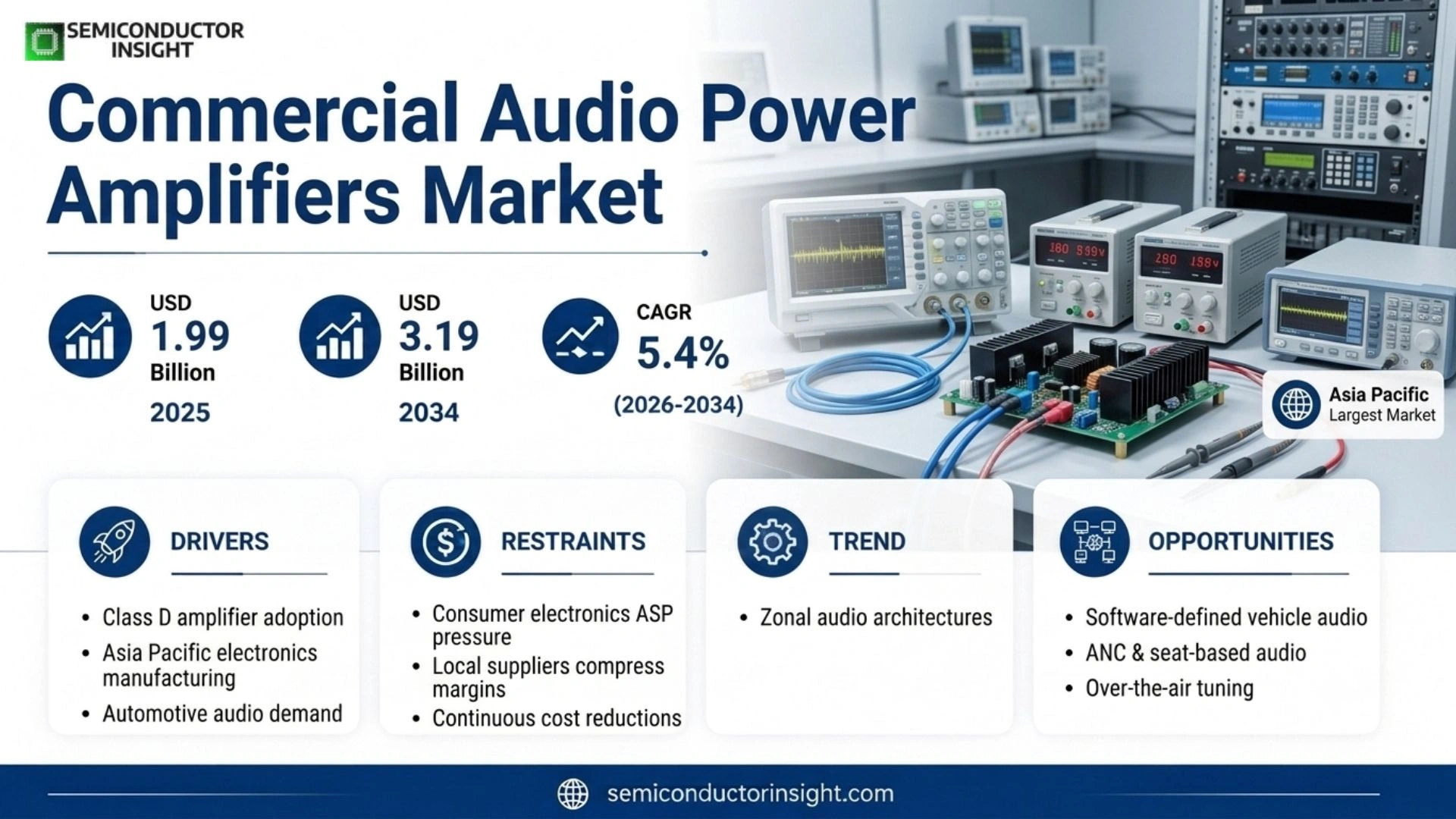
Commercial audio power amplifiers market was valued at approximately USD 1.99 billion in 2025 and is projected to reach approximately USD 3.19 billion by 2034, representing a 5.4% CAGR during 2026–2034. Asia Pacific is the largest regional market because the region concentrates smartphone, smart-device, automotive and consumer-electronics manufacturing, while Class D amplifier architectures are capturing most new-design momentum because of their high efficiency and compact thermal footprint.
Commercial audio power amplifiers are semiconductor devices or amplifier stages that increase low-level audio signals to the voltage and current required to drive loudspeakers. The market scope spans Class A, Class B, Class AB, Class D and other architectures used in automobiles, computers, wearables, mobile devices, smart-home and audio-visual equipment, and other electronics. Although the title uses the commercial-audio label, the competitive universe is primarily analog and mixed-signal semiconductor suppliers whose products are designed into mass-produced electronic systems.
The commercial value of an amplifier IC depends on more than output wattage. Designers evaluate total harmonic distortion and noise, efficiency, quiescent power, EMI behavior, channel count, package size, supply-voltage range, load diagnostics, digital input support and the ability to protect the speaker. High-volume mobile and wearable designs prioritize tiny packages and low battery drain, while automotive and smart-audio systems accept higher ASPs for diagnostics, multichannel output, DSP integration, current sensing and operation across difficult supply conditions.
Class D is reshaping the market because switching amplification converts a much larger share of input power into acoustic output rather than heat. Texas Instruments and STMicroelectronics both market Class D automotive portfolios built around higher efficiency and reduced thermal management, while Awinic is pushing digital smart amplifiers into mobile, PC and automotive designs. The result is a shift in design economics: customers can reduce heat sinks, inductors and board area while adding software-controlled audio functions and real-time diagnostics.
The market is also becoming more software-defined. Modern smart amplifiers monitor speaker voltage and current, estimate temperature or excursion, adjust gain dynamically and expose controls through I²C, I²S or TDM interfaces. That turns the audio amplifier from a largely analog output component into an intelligent subsystem. Semiconductor suppliers therefore increasingly compete with tuning software, reference designs, DSP algorithms and speaker-protection frameworks that help OEMs deliver louder output from smaller speakers without compromising reliability.
Segment Analysis: By Type
By type, the market is segmented into Class A, Class B, Class AB, Class D and Others. Class AB retains a large installed base in applications that value linearity and straightforward analog implementation, but Class D leads new-design momentum because it provides much higher power efficiency and lower heat dissipation. Class A and Class B remain niche architectures where their specific transfer characteristics justify efficiency trade-offs.
| Type | Operating characteristics | Market position |
|---|---|---|
| Class A | The output device conducts for the full signal cycle, providing simple linear behavior and potentially excellent low-level fidelity but poor electrical efficiency. Continuous bias current creates substantial heat even when the output signal is small, making the architecture difficult to use in battery-powered and thermally constrained modern electronics. | A specialized segment concentrated in premium audio, instrumentation and designs where linearity or sonic preference outweighs size and power consumption. Commercial growth is limited because energy use, heat-sink requirements and package size conflict with the dominant trend toward compact, efficient electronics. |
| Class B | Complementary output devices each conduct for roughly half of the signal cycle, improving efficiency over Class A but introducing crossover distortion around the zero crossing unless carefully controlled. Pure Class B is less common in high-fidelity integrated products than Class AB or modern switching amplifiers. | A small and mature segment. Its historical efficiency advantage over Class A is no longer sufficient to offset distortion challenges and the superior efficiency of Class D. New product development is generally limited to specialized or cost-driven implementations. |
| Class AB | Combines Class A and Class B biasing so both output devices conduct slightly around the crossover region, reducing distortion while retaining better efficiency than pure Class A. The architecture remains widely understood, easy to integrate and capable of high sound quality without switching-output filtering. | Large installed base. Class AB remains important in automotive, consumer and specialty audio, especially where output power is moderate and electromagnetic behavior is easier to manage than Class D. Its relative share is pressured by thermal and energy-efficiency requirements. |
| Class D | Uses high-frequency switching output stages whose duty cycle represents the audio waveform. Modern feedback, BCD processes and digital control allow high fidelity with power efficiency that can exceed traditional linear architectures by a wide margin, reducing heat-sink size and enabling compact multi-channel systems. | Fastest-growing and leading new-design architecture. Automotive, mobile, smart-home, PC and installed-audio designers increasingly choose Class D because efficiency improves battery life, thermal performance and channel density. Integration of DSP, boost conversion, current sensing and diagnostics further expands value per device. |
| Others | Includes hybrid approaches such as Class G, Class H and proprietary architectures that dynamically manage supply rails or combine switching and linear techniques. These designs target specific trade-offs among fidelity, efficiency, peak power and electromagnetic emissions. | A smaller but strategically important segment where suppliers use proprietary architectures to differentiate power management. STMicroelectronics, for example, offers Class G and high-efficiency Class AB variants for automotive systems as alternatives or complements to Class D. |
Technology migration and pricing
Technology migration is changing the average value of an amplifier design. A low-power mono amplifier for a mobile device may sell at a relatively low unit price, while a four-channel automotive device with diagnostics, current sensing, DSP interfaces and high-voltage capability can command a materially higher ASP. Class D devices also create system-level savings through smaller heat sinks, reduced power consumption and higher channel density, allowing suppliers to defend pricing when the amplifier replaces several external components or simplifies the customer’s thermal design.
Segment Analysis: By Application
By application, the report covers Automobile, Computer, Wearable Device, Mobile Device, Smart Home and Audio-Visual Equipment, and Others. Mobile devices represent the largest unit-volume pool because every smartphone and many tablets require compact speaker amplification. Automotive is the fastest-growing value segment as premium multi-channel sound, active noise cancellation, external warning systems and diagnostic functions raise amplifier content per vehicle.
| Application | Demand characteristics |
|---|---|
| Automobile | Fastest-growing value application. Automotive audio systems are moving from four-channel head-unit amplification toward distributed, multichannel architectures supporting premium sound, Dolby Atmos, active noise cancellation, road-noise cancellation and seat-based audio. Automotive-grade amplifiers require AEC-Q qualification, wide supply tolerance, load diagnostics, EMI control and long lifecycle support, raising value per device relative to many consumer applications. |
| Computer | Laptops, monitors, all-in-one PCs, gaming devices and conference equipment use compact Class D amplifiers to deliver higher speaker output within tight thermal and power budgets. AI PCs and premium gaming systems are increasing emphasis on spatial sound, stronger low-frequency output and efficient speaker protection, creating opportunities for digitally controlled amplifiers with DSP and smart tuning. |
| Wearable Device | Smartwatches, AR/VR devices, hearing products and compact wearables need extremely low quiescent current and very small packages. Output power is lower than automotive or smart speakers, but integration density and battery efficiency are critical. Suppliers compete on millimeter-scale packaging, boost integration, speaker protection and the ability to maintain loudness as the battery voltage falls. |
| Mobile Device | Largest unit-volume application. Smartphones and tablets use smart amplifiers to drive tiny speakers near their mechanical limits. Voltage/current sensing and software protection allow louder output without damaging the speaker, while integrated boost conversion helps maintain acoustic performance as the battery discharges. Competitive pressure is intense because OEM volumes are high and board area is scarce. |
| Smart Home and Audio-Visual Equipment | Smart speakers, televisions, soundbars, conferencing systems and installed audio use multi-channel Class D amplification because efficiency and compactness simplify enclosure and thermal design. Digital input, DSP integration and networked control support multi-room and smart-home use cases. Higher-power devices can also serve powered speakers and commercial fixed-installation systems. |
| Others | Includes portable speakers, professional audio, public-address equipment, medical devices and specialized electronics. Requirements vary widely, from milliwatt-class hearing products to multi-hundred-watt powered speakers. Suppliers address this diversity with scalable amplifier families, reference designs and process technologies covering low-voltage battery devices through high-voltage audio power stages. |
Regional Analysis
Asia Pacific is the largest commercial audio power amplifier market because China, South Korea, Japan and Taiwan combine semiconductor supply with the world’s largest concentration of smartphones, televisions, smart speakers, computers and automotive electronics manufacturing. North America is strategically important for analog IC design and premium consumer platforms. Europe is strong in automotive audio and high-fidelity systems, while emerging regions expand primarily through electronics consumption and vehicle production.
How does regional demand differ across the commercial audio power amplifier market?
Regional demand follows both electronic-device production and amplifier semiconductor design activity. Asia Pacific captures the largest unit volumes because final devices are assembled there and Chinese analog suppliers are gaining design share. North America captures important IC design, smartphone, PC and automotive platform decisions through companies such as Texas Instruments, Cirrus Logic and Analog Devices. Europe has a high-value automotive and professional-audio mix, while other regions primarily consume amplifiers embedded inside imported vehicles and electronics.
| Region | Position | Growth outlook | Demand profile | What decides supplier selection |
|---|---|---|---|---|
| Asia Pacific | Largest | High | Mobile, consumer electronics and automotive manufacturing led | Cost, package size, power efficiency, local support, supply continuity and rapid design-in |
| North America | Major design/value market | Moderate to high | Smart devices, automotive platforms and pro audio led | Audio performance, software ecosystem, system integration, IP differentiation and OEM relationships |
| Europe | High-value automotive market | Moderate | Automotive and premium/pro audio led | Automotive qualification, EMI, diagnostics, efficiency and long lifecycle support |
| South America | Developing | Moderate from small base | Automotive and electronics consumption led | Cost, distributor availability, vehicle production and imported device demand |
| Middle East & Africa | Emerging | Moderate to high from small base | Smart devices, automotive and commercial AV led | Availability, thermal reliability, service support and high-temperature operation |
Key Commercial Audio Power Amplifier Manufacturers and Competitive Landscape
Competition is led by analog and mixed-signal semiconductor companies with audio power, signal-chain and power-management expertise. Cirrus Logic, Analog Devices, Texas Instruments, NXP, onsemi, Infineon, Realtek, STMicroelectronics, ROHM, Renesas, Nisshinbo Micro Devices and Awinic compete across different power ranges and end applications. The market is fragmented by design requirement: mobile smart amplifiers, automotive multichannel devices and higher-power consumer or installed-audio products need different process technologies, packages and software ecosystems.
Texas Instruments and STMicroelectronics have broad automotive amplifier portfolios and compete on efficiency, diagnostics and integration. Cirrus Logic is particularly strong in premium audio signal chains and smart-device audio. Awinic has expanded rapidly from mobile smart amplifiers into PC and automotive power levels, using highly integrated digital devices and speaker algorithms. Japanese suppliers such as ROHM, Renesas and Nisshinbo participate across analog, automotive and high-fidelity segments, while Infineon brings power-semiconductor expertise that can support higher-efficiency architectures.
Design wins can be sticky because the amplifier is tuned with the customer’s speaker, enclosure, DSP and power system. Smart-amplifier software may contain speaker protection limits, equalization and thermal models that are specific to a device. Automotive designs add AEC-Q qualification, EMC validation and load diagnostics. Once these engineering steps are complete, switching suppliers can force substantial revalidation, creating durable revenue if the amplifier is selected across a product family.
Competitive differentiation is increasingly system-level. TI’s 1L modulation reduces output-filter component count in automotive audio; Awinic integrates IV sensing and proprietary DSP algorithms; ST combines digital input, high switching frequency and diagnostics. The common strategy is to remove external components or engineering effort around the amplifier, allowing the supplier to defend ASP through lower total system cost rather than by competing only on dollars per watt.
Tier structure
| Tier | Companies | Basis of competition |
|---|---|---|
| Global analog and audio platform leaders | Cirrus Logic; Analog Devices; Texas Instruments; NXP Semiconductors; STMicroelectronics | Audio fidelity, broad amplifier portfolios, automotive and consumer design relationships, software tools, diagnostics and mixed-signal integration |
| Broad semiconductor and automotive suppliers | onsemi; Infineon Technologies; Renesas Electronics; ROHM Semiconductor | Power and analog process capability, automotive qualification, supply scale, thermal performance and integration with broader vehicle or power portfolios |
| Asia-focused audio and mixed-signal specialists | Realtek; Nisshinbo Micro Devices; Awinic Electronics; Dialog Semiconductor legacy portfolio | Cost-performance, compact packages, high-volume mobile and consumer design support, smart-amplifier integration and rapid product cycles |
Key Industry Players
- Cirrus Logic
- Analog Devices (ADI)
- Texas Instruments
- Dialog Semiconductor
- NXP Semiconductors
- onsemi
- Infineon Technologies
- Realtek
- STMicroelectronics
- ROHM Semiconductor
- Renesas Electronics
- Nisshinbo Micro Devices
- Awinic Electronics
Commercial Audio Power Amplifier Production Capacity Analysis
Production capacity is determined by mixed-signal wafer fabrication, power-device process capability, packaging and final test rather than by a dedicated audio-amplifier factory. Class D and automotive devices often use BCD, SOI or specialized CMOS processes that integrate power transistors, analog control, digital logic and protection circuitry. Asia Pacific carries much of the global foundry, packaging and electronics manufacturing base, while North American, European and Japanese suppliers retain substantial design and specialty-process capacity.
Audio power devices place unusual demands on package and test capability because the IC must deliver current into low-impedance loads while surviving short circuits, load dump, high temperature and electromagnetic stress. Automotive devices may need large exposed-pad packages, top-side cooling or specialized leadframes, while mobile amplifiers require wafer-level or compact QFN packages. Effective capacity therefore depends on thermal package availability and high-current test equipment in addition to wafer starts.
Class D migration can alter the manufacturing mix because switching amplifiers integrate more control logic, diagnostics and sometimes DSP or boost conversion. This increases die complexity but can reduce system-level components. Suppliers with proprietary BCD processes and strong analog design libraries can integrate more functionality on one die, while fabless or fab-lite companies rely on foundry partners and outsourced packaging. Foundry diversification and package second-sourcing are important because a single qualified process may support a customer platform for many years.
Automotive amplifier capacity is more constrained than nominal semiconductor output suggests because every process, package and test flow must remain stable over long vehicle programs. Moving a design to another fab or package can require extensive AEC-Q and OEM requalification. Suppliers therefore carry the cost of controlled product change, long-term manufacturing agreements and inventory planning, but these same requirements protect qualified incumbents from rapid price-only substitution.
Commercial Audio Power Amplifiers Market Dynamics: Drivers, Restraints and Opportunities
The market is growing because consumer and automotive products demand more speaker channels, higher output and smarter audio processing within tighter energy and thermal budgets. Class D efficiency, digital input, DSP integration and speaker sensing increase semiconductor value per design. Growth is restrained by intense price competition in mobile electronics, EMI challenges, mature end-device volumes and long automotive qualification cycles. The largest opportunities lie in software-defined automotive audio, AI PCs, smart speakers and intelligent amplifier algorithms.
MARKET DRIVERS
Drivers Impact Analysis*
| Market Factor | Directional Impact on CAGR Forecast* | Commercial Mechanism |
|---|---|---|
| Class D efficiency and thermal advantages | +1.1 to +1.6 percentage points | Higher efficiency reduces heat-sink size and power losses, enabling more channels and higher output in constrained mobile, automotive and smart-audio systems. |
| Automotive multi-channel and active-noise audio | +0.9 to +1.4 percentage points | More speakers, ANC/RNC, spatial sound and diagnostics increase amplifier channels and ASP per vehicle. |
| Smart amplifier integration and speaker protection | +0.7 to +1.1 percentage points | IV sensing, DSP, boost conversion and algorithms allow smaller speakers to play louder and reduce OEM engineering effort. |
Class D efficiency enables higher power inside smaller products
Power efficiency has become a system-design parameter because smartphones, laptops, smart speakers and vehicles cannot simply add larger heat sinks. Class D architectures switch output transistors rather than dissipating large amounts of power linearly, allowing much higher channel density. TI explicitly positions 1L modulation around smaller and lighter automotive systems, while ST emphasizes reduced thermal management. The commercial effect is broader use of amplified speakers without proportional increases in enclosure size or energy consumption.
Automotive audio content rises with premium sound and noise management
Electric vehicles have quieter powertrains but expose road and wind noise more clearly, increasing interest in active noise cancellation and premium sound. Modern cars can use many speakers distributed throughout the cabin, each requiring amplification and diagnostics. Automotive amplifiers therefore move toward more channels, current sensing, digital interfaces and low-latency paths. Awinic’s 4×80 W AW85601QPR-Q1 and TI’s TAS67xx-Q1 family illustrate how suppliers are adding output power and system intelligence together.
Smart amplifiers protect smaller speakers at higher acoustic output
Mobile and wearable products use physically small speakers that can be damaged by excessive excursion or temperature. Smart amplifier architectures monitor voltage and current, estimate speaker conditions and adjust power dynamically. This allows OEMs to extract more loudness from a compact transducer without sacrificing reliability. The function creates software and algorithmic differentiation, making the amplifier a higher-value subsystem rather than a simple analog gain stage.
Digital audio integration reduces board area and design complexity
I²S and TDM inputs allow an amplifier to connect directly to digital processors without extra DAC stages, while integrated DSP, load diagnostics and boost conversion remove additional ICs. The customer can reduce BOM count and route fewer sensitive analog signals. This is especially valuable in vehicles and compact smart devices, where board space, EMI and assembly complexity have direct cost implications. Vendors that integrate these functions can win even at a higher amplifier ASP.
MARKET RESTRAINTS
Restraints Impact Analysis*
| Market Factor | Directional Impact on CAGR Forecast* | Commercial Mechanism |
|---|---|---|
| Price pressure in mobile and consumer electronics | −0.8 to −1.2 percentage points | Very high volumes attract multiple suppliers and aggressive cost-down, limiting revenue growth even when unit shipments are large. |
| EMI and switching-noise design complexity | −0.5 to −0.9 percentage points | Class D efficiency comes with switching edges that require careful PCB, filtering and modulation design to meet emissions and audio-performance requirements. |
| Automotive qualification and long design cycles | −0.4 to −0.8 percentage points | AEC-Q, EMC, thermal and OEM validation can delay new products and make capacity changes expensive. |
Consumer-electronics ASP pressure limits value growth
Smartphones, tablets and mainstream consumer devices ship in large quantities, but OEM purchasing teams demand continuous cost reductions. Amplifier suppliers therefore face a trade-off: add DSP, boost and sensing to increase value while keeping die size and package cost low enough for high-volume platforms. Domestic Chinese analog suppliers intensify competition by offering highly integrated devices close to local manufacturing customers, which can compress margins for global vendors.
Class D switching creates EMI and output-filter challenges
The same high-frequency switching that improves efficiency can generate electromagnetic interference and complicate speaker-cable emissions, especially in vehicles. Designers may need output inductors, spread-spectrum modulation, careful PCB layout and switching-frequency management. TI’s 1L architecture explicitly targets output-filter component reduction, showing that external passive count remains a competitive issue. Products that fail EMC testing can delay a full vehicle or electronics platform, making proven reference designs valuable.
Automotive validation slows technology replacement
Automotive amplifiers operate across wide supply voltages, severe temperatures and fault conditions while supporting diagnostic requirements. A new device must pass semiconductor qualification and then extensive Tier-1 and OEM system tests. This raises development cost and slows market entry, particularly for new suppliers. Once qualified, however, the same barrier supports long design lifetimes and reduces the risk that a competitor can displace the incumbent with a slightly lower price.
MARKET OPPORTUNITIES
Software-defined vehicle audio architectures
As vehicles consolidate compute and networking, audio becomes a distributed software-controlled function rather than a fixed head-unit circuit. Amplifiers can receive digital streams over zonal architectures, report speaker health and support over-the-air tuning. Suppliers that combine efficient power stages with diagnostics and software control can participate in premium sound, warning functions, ANC and seat-based audio using one scalable platform.
AI PCs and premium portable computing
Notebook computers are adding richer conferencing, spatial audio and entertainment features while becoming thinner. Medium-power smart amplifiers with DSP and speaker sensing can increase perceived loudness from compact speakers without large thermal penalties. Awinic’s 2026 AW85180FCR launch specifically targets tablets, Bluetooth speakers and PCs, illustrating how suppliers are widening beyond smartphones into higher-output intelligent audio.
Smart-home and installed audio integration
Smart speakers, soundbars, televisions and fixed-installation systems need efficient multi-channel amplification that can be controlled digitally. Integration of DSP, diagnostics and networked management reduces separate hardware and simplifies remote service. The opportunity is particularly attractive for suppliers that can scale the same Class D platform from compact home devices to powered speakers and commercial AV systems.
Higher-voltage and high-channel-density automotive devices
Premium electric vehicles are moving toward more speakers and higher supply voltages, creating an opportunity for amplifiers that operate efficiently at 24 V, 48 V or boosted rails. Higher-voltage devices can deliver more power with lower current, while multichannel integration reduces the number of packages. Suppliers with advanced BCD processes, top-side cooling and real-time load sensing can capture higher ASPs in these designs.
Commercial Audio Power Amplifiers Supply Chain Analysis
The supply chain has four principal stages: mixed-signal semiconductor design and wafer fabrication, packaging and high-current test, OEM audio-system integration, and final device or vehicle deployment. Value capture is highest where the supplier reduces system complexity through DSP, speaker protection, power management and software tools. Bottlenecks can occur at specialty analog wafer processes, automotive-grade packages or qualification rather than at generic logic capacity, making supply planning application-specific.
Stage 1 – Mixed-signal design and specialty wafer processes
Audio power amplifiers combine low-noise analog circuitry with power transistors and digital control. BCD and SOI technologies are valuable because they integrate power devices and signal processing on the same die. Process selection affects output resistance, efficiency, breakdown voltage and die size. Suppliers with internal specialty fabs can optimize process and design together, while fabless companies depend on foundries that can provide stable mixed-signal nodes for many years.
Stage 2 – Thermal packaging and high-current test
A small amplifier die may dissipate significant heat and drive several amperes into low-impedance loads. Package thermal resistance, exposed-pad design, leadframe current capability and solder reliability therefore influence final system performance. Automotive products require additional temperature and reliability screening. Testing must verify output power, distortion, protection thresholds and fault behavior, so back-end capacity can become a bottleneck even when wafer supply is available.
Stage 3 – Speaker, DSP and power-system integration
The amplifier is tuned as part of an acoustic system. OEM engineers select speakers, enclosure volume, filters, DSP algorithms and supply rails, then validate loudness, distortion, EMI and thermal performance. Smart amplifiers add current and voltage sensing that must be calibrated to the transducer. This integration creates significant application-engineering work and gives vendors with strong software and reference designs an advantage in winning and retaining designs.
Stage 4 – Device and vehicle platform lifecycle
Once the amplifier enters a smartphone, PC, television or vehicle platform, volume can scale rapidly. Consumer products may refresh annually, while vehicle programs can run for many years. Suppliers must therefore support both fast ramp capability and long lifecycle continuity. Automotive customers also require controlled process changes and traceability, creating a supply relationship that is harder to replace than a purely commodity consumer component.
Recent Developments in the Commercial Audio Power Amplifiers Market
Awinic introduced the AW85180FCR for tablets, Bluetooth speakers and PCs, combining a 25 W output stage with IV sensing, DSP processing and speaker-protection algorithms. The device shows how smart-amplifier functions are moving into medium-power consumer systems, where OEMs want louder sound and lower power consumption without increasing speaker size or external component count.
Texas Instruments outlined how modern audio ICs support active road-noise cancellation, lighter vehicle systems and more accessible professional audio. The company’s broader audio strategy illustrates the commercial shift from discrete amplification toward integrated signal processing, diagnostics and efficient power stages that allow OEMs to improve acoustics while reducing system weight, heat and design complexity.
Awinic released the AW85601QPR-Q1 for intelligent cockpit audio systems. The device supports four channels up to 80 W each, low-latency operation, load diagnostics, current monitoring and AEC-Q100 Grade 2 requirements. The launch expands competition in high-value automotive amplifier ICs and demonstrates growing capability among Chinese analog semiconductor suppliers.
Awinic launched the AW88271CSR digital smart audio power amplifier with I²S/TDM interfaces, speaker monitoring and support for low-voltage silicon-anode battery applications. The product addresses a central mobile-audio requirement: maintaining acoustic output while reducing quiescent power and package area, which increases the value of integrated smart amplifier functions in portable electronics.
Texas Instruments announced the TAS6754-Q1 Class D automotive audio amplifier as part of a new in-cabin semiconductor portfolio. TI said its proprietary 1L modulation can deliver Class D performance using half the number of inductors compared with existing approaches, targeting lower component cost, smaller board area and improved power efficiency in multi-channel vehicle audio systems.
REPORT SCOPE & SEGMENTATION
| Study Period | 2020–2034 |
| Base Year | 2025 |
| Estimated Year | 2026 |
| Forecast Period | 2026–2034 |
| Historical Period | 2020–2025 |
| Market Size 2025 | USD 1.99 Billion |
| Market Size 2034 | USD 3.19 Billion |
| Growth Rate | CAGR of 5.4% from 2026–2034 |
| Unit | Value (USD Million/Billion) and shipments |
| Segmentation | By Type, By Application and By Region |
| By Type | Class A · Class B · Class AB · Class D · Others |
| By Application | Automobile · Computer · Wearable Device · Mobile Device · Smart Home and Audio-Visual Equipment · Others |
| By Region | North America · Europe · Asia Pacific · South America · Middle East & Africa |
| Companies Profiled | Cirrus Logic · Analog Devices (ADI) · Texas Instruments · Dialog Semiconductor · NXP Semiconductors · onsemi · Infineon Technologies · Realtek · STMicroelectronics · ROHM Semiconductor · Renesas Electronics · Nisshinbo Micro Devices · Awinic Electronics |
| Customization Scope | Country, regional, amplifier-class, application and company-level customization can be added to align the study with customer-specific device platforms, audio architectures and sourcing requirements. |
Frequently Asked Questions
What is the size of the commercial audio power amplifiers market in 2025?
Commercial audio power amplifiers market was valued at approximately USD 1.99 billion in 2025. The scope covers Class A, Class B, Class AB, Class D and other amplifier architectures used across automobiles, computers, wearables, mobile devices, smart-home and audio-visual equipment, and other electronics.
What is the projected market size by 2034?
The market is projected to reach approximately USD 3.19 billion by 2034, representing a 5.4% CAGR during 2026–2034. Growth reflects higher amplifier content per system, Class D migration, smart-speaker protection and rising automotive channel counts rather than only unit growth in end devices.
Which region leads the commercial audio power amplifiers market?
Asia Pacific is the largest regional market because China, South Korea, Japan and Taiwan concentrate smartphone, PC, television, smart-device and automotive electronics production. The region also has a growing domestic analog semiconductor supplier base that competes directly in high-volume smart amplifier designs.
Which amplifier class is growing fastest?
Class D is the fastest-growing architecture and leads new-design activity because switching operation delivers high efficiency and low heat dissipation. This allows smaller heat sinks, compact packages and more channels, while digital input, diagnostics and DSP integration further improve system-level economics.
Which application has the largest volume?
Mobile devices represent the largest unit-volume application because smartphones and tablets use compact speaker amplifier ICs in very high quantities. Smart amplifier sensing and boost integration allow OEMs to extract more loudness from tiny speakers while protecting them against excessive temperature or excursion.
Why is automotive audio a high-growth opportunity?
Automotive systems are adding more speakers, premium spatial audio, active noise cancellation, road-noise cancellation and diagnostic functions. These features increase amplifier channels and semiconductor value per vehicle. Automotive devices also carry higher technical requirements for voltage tolerance, EMI, load diagnostics, qualification and long lifecycle support.
What are the main restraints on market growth?
The principal restraints are aggressive ASP pressure in mobile and consumer electronics, Class D EMI and filter-design complexity, mature end-device unit growth and long automotive qualification cycles. Suppliers must therefore use integration and software to create additional value rather than rely solely on higher output power.
Which companies are profiled in the report?
The report profiles Cirrus Logic, Analog Devices, Texas Instruments, Dialog Semiconductor, NXP Semiconductors, onsemi, Infineon Technologies, Realtek, STMicroelectronics, ROHM Semiconductor, Renesas Electronics, Nisshinbo Micro Devices and Awinic Electronics. These companies span global analog leaders and Asia-focused mixed-signal specialists.
How are smart amplifiers different from conventional power amplifiers?
Smart amplifiers combine the power stage with digital control, speaker voltage/current sensing, protection algorithms and often DSP or boost conversion. The device can monitor speaker behavior in real time and adjust output to maintain loudness without causing thermal or mechanical damage, reducing OEM tuning effort and external component count.
What is the strongest technology opportunity through 2034?
The strongest opportunities are software-defined automotive audio, high-efficiency Class D architectures, AI-PC and premium portable audio, smart speakers and higher-voltage multichannel automotive devices. Suppliers that combine efficient power stages with diagnostics, sensing, DSP algorithms and compact thermal packages can capture more value per design.
Get Sample Report PDF for Exclusive Insights
Report Sample Includes
- Table of Contents
- List of Tables & Figures
- Charts, Research Methodology, and more...
 Download Sample Report PDF