Analog Sensor Market Insights
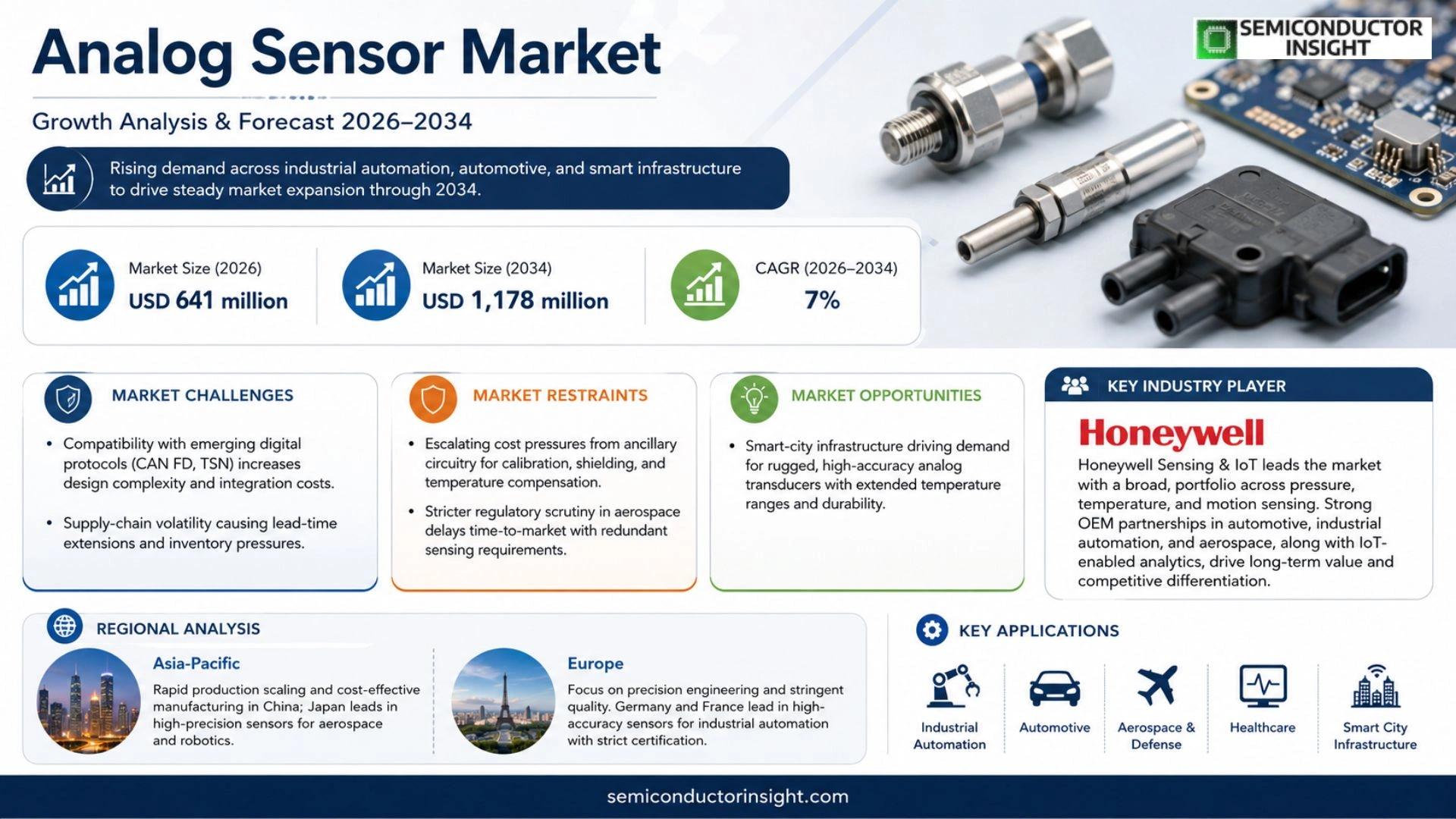
Global Analog Sensor market size was valued at USD 641 million in 2025. The market is forecasted to increase from USD 641 million in 2026 to USD 1,178 million by 2034, exhibiting a CAGR of 7 % during the forecast period.
Analog sensors generate a continuous voltage signal that corresponds directly to the measured physical quantity. Typical output ranges from 0 V to 5 V, where a voltage between 3.5 V and 5 V represents a logical “1” and voltages below 3.5 V represent a logical “0”. These devices monitor variables such as light intensity, wind speed or solar radiation.
The expansion of the sector reflects several influences: ongoing advances in sensor miniaturization and sensitivity; growing adoption of analog sensors in industrial automation for temperature, pressure and motion monitoring; increasing integration of sensors into automotive systems supporting electric‑vehicle power‑train management; broader use within consumer electronics for touch‑screen and motion detection; rising demand from healthcare wearables that require reliable physiological data capture; and heightened environmental monitoring efforts driven by climate‑change concerns.
MARKET DRIVERS
Increasing Adoption in Automotive Electronics
Automakers are reconfiguring vehicle architectures to accommodate higher levels of electrification and driver‑assist features. Analog sensors remain indispensable for real‑time monitoring of temperature, pressure, and position because they deliver low latency and cost‑effective signal conversion. This shift is prompting OEMs to source larger volumes of analog devices, thereby lifting the overall demand curve.
Industrial Automation and IoT Integration
Manufacturing plants are upgrading legacy PLCs with smart edge modules that rely on analog inputs to capture nuanced process variables. The convergence of legacy equipment with modern IoT gateways creates a niche where analog sensors offer the most reliable bridge, reinforcing their relevance despite the digital‑sensor surge.
➤ “Analog front‑ends continue to dominate sensor‑to‑controller pathways in sectors where precision and endurance outweigh the allure of digital convenience.”
Beyond automotive and factory floors, medical‑device manufacturers are standardising on analog transducers for patient‑monitoring circuits because of their proven track record in high‑frequency environments. This cross‑industry endorsement sustains a steady upward trajectory for Analog Sensor Market.
MARKET CHALLENGES
Compatibility with Emerging Digital Protocols
As manufacturers embed more digital communication stacks (e.g., CAN FD, TSN) into hardware, integrating analog front‑ends without inducing latency or conversion error becomes more intricate. System integrators must allocate additional design effort to ensure seamless hand‑off, which can raise bill‑of‑materials costs.
Other Challenges
Supply‑Chain Volatility
Recent geopolitical tensions have disrupted semiconductor foundries that also produce mixed‑signal ASICs used alongside analog sensors. Lead‑time extensions force OEMs to hold larger safety stocks, compressing margins and complicating production planning.
MARKET RESTRAINTS
Escalating Cost Pressures
While analog components are generally inexpensive, the ancillary circuitry required for calibration, shielding, and temperature compensation adds hidden expense. Companies that attempt to slash component costs without accounting for these peripherals often encounter lower yield rates, tempering overall market enthusiasm.
Regulatory scrutiny is intensifying in sectors such as aerospace, where failure‑mode analysis now mandates redundant sensing pathways. The need to certify multiple analog channels can delay time‑to‑market for new platforms.
MARKET OPPORTUNITIES
Smart‑City Infrastructure
Urban deployments of environmental monitoring stations (air quality, noise levels) rely on rugged analog transducers that survive harsh outdoor conditions. Municipal contracts increasingly specify sensor modules with extended temperature ranges, opening a niche for manufacturers that can promise durability alongside accuracy.
Advancements in low‑power analog front‑end design are enabling battery‑operated sensors for remote installations. By pairing these with edge‑analytics platforms, vendors can offer end‑to‑end solutions that reduce maintenance cycles, presenting a lucrative avenue for growth.
Analog Sensor Market Trends
Miniaturization and Accuracy Enhancements
Analog Sensor Market is witnessing a wave of size reduction that allows manufacturers to embed sensing capability directly onto printed circuit boards. Recent process improvements shrink device footprints to under 1 mm² while preserving linearity, which in turn shortens assembly cycles for factory automation lines. Higher resolution transducers now deliver sub‑millivolt granularity, enabling tighter control loops in temperature‑regulated processes. Cost per unit has fallen by roughly 15 % over the past three years, encouraging smaller‑volume OEMs to adopt analog solutions that were once confined to high‑volume segments. The cumulative effect is a more diversified supplier base and a broader set of applications that can benefit from precise analog read‑outs without resorting to expensive digital converters.
Other Trends
Synergy with IoT and Edge Analytics
By marrying analog front‑ends with low‑power connectivity modules, Analog Sensor Market is supplying the raw signals required for real‑time edge analytics. Sensors that report voltage swings in the 0‑5 V range are now capable of streaming data directly to cloud gateways, where AI algorithms flag deviations before equipment fails. This capability is reshaping maintenance contracts, shifting the emphasis from scheduled inspections to condition‑based services. Enterprises that embed this loop within their production ecosystems report a reduction of unplanned downtime by up to 20 %, a margin that directly improves bottom‑line performance. The trend also nudges manufacturers toward offering calibrated sensor packages that include firmware for seamless integration, thereby creating a new revenue tier beyond pure hardware sales.
Automotive Electrification and Safety Systems
Electrified powertrains and advanced driver‑assistance systems (ADAS) are amplifying demand for analog components that monitor battery temperature, motor current, and brake pressure with minimal latency. Unlike digital counterparts, analog outputs deliver continuous voltage curves that can be processed instantly by vehicle control units, a necessity for safety‑critical functions such as regenerative braking modulation. As OEMs push for higher energy density in battery packs, the tolerance for thermal drift tightens, prompting the adoption of analog temperature sensors with ±0.1 °C accuracy. This shift is compelling traditional automotive suppliers to broaden their portfolios, while pure‑play sensor firms accelerate R&D pipelines to meet stringent automotive qualification standards.
COMPETITIVE LANDSCAPE
Key Industry Players
Analog Sensor Market: Competitive Overview and Player Dynamics
Honeywell Sensing & IoT dominates Analog Sensor arena through a combination of scale, diversified end‑market exposure, and a robust portfolio that spans pressure, temperature, and motion sensing. The company leverages its deep OEM relationships in automotive, industrial automation, and aerospace to secure long‑term contracts, while its investment in IoT‑enabled analytics creates value‑added services that differentiate its offerings from pure hardware competitors. Recent acquisitions in the precision‑measurement space have expanded Honeywell’s footprint in high‑growth segments such as robotics and smart‑factory deployments, reinforcing a market structure where a few large integrators command the majority of revenue and set performance benchmarks for the rest of the ecosystem.
Beyond Honeywell, the market hosts a cluster of niche players that excel through specialization or regional dominance. Pepperl+Fuchs and IFM Electronic, both headquartered in Germany, focus heavily on rugged industrial sensors tailored for harsh environments, a strategy that secures them a loyal customer base in heavy‑manufacturing corridors across Europe and Asia. Balluff and Baumer complement this segment with high‑precision, miniaturized solutions catering to the medical‑device and consumer‑electronics sectors. Meanwhile, Panasonic Electric Works Europe, Servoflo Corporation, and Kaman Precision Measuring Systems capitalize on proprietary packaging technologies and customized OEM services, enabling them to carve out profitable niches despite the presence of larger, diversified rivals.
List of Key Analog Sensor Companies Profiled
- Honeywell Sensing & IoT
- Pepperl+Fuchs GmbH
- IFM Electronic GmbH
- Balluff GmbH
- Baumer Ltd
- Panasonic Electric Works Europe
- Servoflo Corporation
- Kaman Precision Measuring Systems
- Allied Electronics, Inc.
- Locon Sensor Systems, Inc.
- Fargo Controls, Inc.
- Hach
- Lion Precision
Segment Analysis:
| Segment Category | Sub-Segments | Key Insights |
| By Type |
|
Accelerometers
|
| By Application |
|
Industrial Fabrications
|
| By End User |
|
Manufacturing
|
| By Technology Integration |
|
IoT Integration
|
| By Market Driver |
|
Technological Advancement
|
Regional Analysis: Analog Sensor Market
North America
The concentration of wafer‑fab facilities in the Midwest and West Coast supplies a steady stream of high‑performance analog chips, while precision‑casting firms in the Northeast deliver bespoke sensor housings. This integrated ecosystem shortens lead times and encourages collaborative engineering.
Automotive electrification, smart‑factory equipment, and wearable health devices dominate demand. Each segment stresses low noise, high linearity, and compact footprints, pushing suppliers toward mixed‑signal solutions.
Investment targets include ultra‑low‑power consumption, temperature‑independent calibration, and seamless integration with digital signal processors. Academic partnerships proliferate around leading universities.
Large incumbents leverage scale to lock in supply agreements, while niche startups differentiate through specialty materials and rapid prototyping platforms, creating a layered competitive environment.
Europe
European activity revolves around precision engineering and stringent quality standards. German and French manufacturers excel in high‑accuracy pressure and temperature sensors for industrial automation, where traceability and certification are non‑negotiable. The United Kingdom’s focus on medical analog devices adds a layer of regulatory expertise that benefits cross‑border collaborations. Sustainability initiatives encourage the adoption of energy‑efficient analog front‑ends, prompting suppliers to revisit circuit topologies and component selections. The market’s character is therefore defined by a blend of technical rigor and an increasing appetite for eco‑conscious design.
Asia‑Pacific
The Asia‑Pacific region stands out for its rapid scaling of production capacity and cost‑effective manufacturing. China’s expansive electronics ecosystem provides an inexpensive platform for high‑volume sensor modules, while Japan continues to lead in high‑precision instrumentation for aerospace and robotics. South Korea’s semiconductor giants are integrating analog sensor blocks directly onto system‑on‑chip platforms, reducing board space and power draw. Regional growth is fueled by expanding smart‑city projects and a burgeoning demand for consumer electronics, which together push vendors to balance price competitiveness with performance reliability.
South America
In South America, emerging industrial initiatives and infrastructure upgrades generate modest but steady demand for analog sensing solutions. Brazil’s agritech sector adopts moisture and pH sensors to improve crop yields, while Argentina’s energy reforms stimulate interest in pressure and flow monitoring devices for pipelines. Market participants often rely on partnerships with North American distributors to access advanced technologies, leading to a gradual transfer of expertise and a cautious optimism about future growth.
Middle East & Africa
The Middle East & Africa region is distinguished by its focus on oil‑and‑gas extraction, water‑management, and renewable‑energy projects. Sensors that can withstand extreme temperatures and corrosive environments are prized, prompting local OEMs to seek robust analog front‑ends. Investment in smart‑grid infrastructure across the Gulf states further elevates the need for precise voltage and current monitoring equipment. Although market size remains limited compared with other regions, the strategic importance of reliability and durability drives a niche but sophisticated demand profile.
Report Scope
This market research report provides a comprehensive analysis of the Analog Sensor Market , covering the forecast period 2026–2034. It offers detailed insights into market dynamics, technological advancements, competitive landscape, and key trends shaping the industry.
Key focus areas of the report include:
- Market Overview: The report begins with an overview outlining its current market scenario, key growth indicators, and industry transformation drivers. It discusses macroeconomic factors, demand–supply balance, regulatory landscape, and the strategic role of semiconductors in powering advancements across industries such as automotive, telecommunications, consumer electronics, and industrial automation.
- Market Size & Forecast: Historical data and future projections for revenue, unit shipments, and market value across major regions and segments.
- Segmentation Analysis: Detailed breakdown by product type, technology, application, and end-user industry to identify high-growth segments and investment opportunities.
- Regional Insights: Insights into market performance across North America, Europe, Asia-Pacific, Latin America, and the Middle East & Africa, including country-level analysis where relevant.
- Competitive Landscape: Profiles of leading market participants, including their product offerings, R&D focus, manufacturing capacity, pricing strategies, and recent developments such as mergers, acquisitions, and partnerships.
- Technology Trends & Innovation: Assessment of emerging technologies, integration of AI/IoT, semiconductor design trends, fabrication techniques, and evolving industry standards.
- Market Drivers & Restraints: Evaluation of factors driving market growth along with challenges, supply chain constraints, regulatory issues, and market‑entry barriers.
- Stakeholder Insights: Insights for component suppliers, OEMs, system integrators, investors, and policymakers regarding the evolving ecosystem and strategic opportunities.
Primary and secondary research methods are employed, including interviews with industry experts, data from verified sources, and real‑time market intelligence to ensure the accuracy and reliability of the insights presented.
FREQUENTLY ASKED QUESTIONS:
What is the current market size of Analog Sensor Market?
-> Analog Sensor market size is forecasted to increase from USD 641 million in 2026 to USD 1,178 million by 2034, exhibiting a CAGR of 7 %
Which key companies operate in Analog Sensor Market?
-> Key players include Pepperl+Fuchs GmbH, Allied Electronics, Inc., Locon Sensor Systems, Inc., Fargo Controls, Inc., Hach, IFM Electronic GmbH, Lion Precision, B&Plus USA, Inc., Baumer Ltd, Honeywell Sensing & IoT, Kaman Precision Measuring Systems, Servoflo Corporation, Panasonic Electric Works Europe, Balluff GmbH.
What are the key growth drivers?
-> Key growth drivers include technological advancements (miniaturization, AI/IoT integration), expanding industrial automation, rising automotive electrification, growing consumer electronics demand, and increased healthcare monitoring solutions.
Which region dominates the market?
-> Asia‑Pacific is the largest and fastest‑growing region, driven by strong automotive, electronics, and industrial automation adoption, while Europe and North America also hold significant shares.
What are the emerging trends?
-> Emerging trends include integration of analog sensors with IoT and AI platforms, development of multi‑parameter smart sensors, focus on low‑power and miniaturized designs, and expanding applications in environmental monitoring and wearable health devices.
Get Sample Report PDF for Exclusive Insights
Report Sample Includes
- Table of Contents
- List of Tables & Figures
- Charts, Research Methodology, and more...
 Download Sample Report PDF